
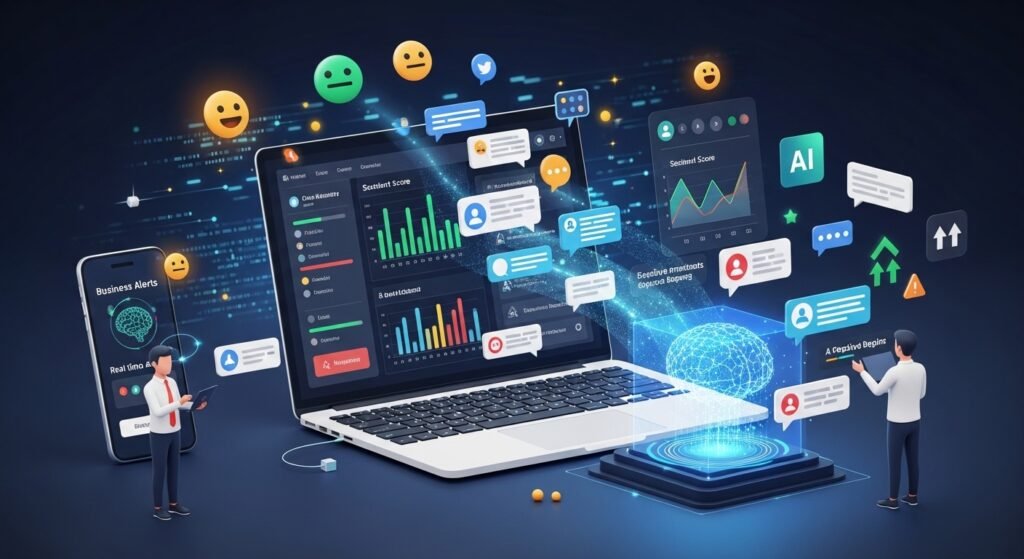
Introduction to AI-Powered Sentiment Analysis
As a digital marketing strategist and SEO consultant, I have witnessed the profound impact of artificial intelligence (AI) on the way businesses interact with their customers. One of the most significant applications of AI in this realm is sentiment analysis, which enables companies to gauge customer emotions and opinions in real-time. In this section, we will delve into the world of AI-powered sentiment analysis, exploring its definition, importance, and applications in the digital landscape.
Sentiment analysis, also known as opinion mining, is a natural language processing (NLP) technique that uses AI algorithms to analyze text data and determine the emotional tone or sentiment behind it. This can include social media posts, customer reviews, feedback forms, and other online interactions. By leveraging machine learning and deep learning techniques, AI-powered sentiment analysis can accurately identify and categorize emotions such as happiness, sadness, anger, and frustration, providing businesses with valuable insights into customer preferences and pain points.
The importance of sentiment analysis cannot be overstated. In today’s digitally connected world, customers are more empowered than ever to share their opinions and experiences with others. A single negative review or social media post can have a significant impact on a company’s reputation and bottom line. On the other hand, positive sentiment can drive loyalty, retention, and advocacy. By monitoring and analyzing customer sentiment in real-time, businesses can respond promptly to concerns, capitalize on opportunities, and foster a more positive and engaging brand experience.
So, how does AI-powered sentiment analysis work? The process typically involves the following steps:
- Data collection: Gathering text data from various sources, such as social media, review sites, and feedback forms.
- Data preprocessing: Cleaning and normalizing the data to remove noise, punctuation, and other irrelevant information.
- Tokenization: Breaking down the text into individual words or tokens to analyze their meaning and context.
- Sentiment analysis: Applying AI algorithms to identify the sentiment behind each token or phrase, using techniques such as machine learning, deep learning, or rule-based approaches.
- Visualization: Presenting the results in a user-friendly format, such as dashboards, charts, or graphs, to facilitate insights and decision-making.
For instance, a company like Netflix can use AI-powered sentiment analysis to monitor customer opinions about its shows and movies. By analyzing social media posts, reviews, and ratings, Netflix can identify areas of improvement, such as content quality, user interface, or customer support. This information can then be used to inform product development, marketing strategies, and customer engagement initiatives, ultimately enhancing the overall user experience and driving business growth.
Another example is Amazon, which uses AI-powered sentiment analysis to analyze customer reviews and feedback about its products and services. By identifying patterns and trends in customer sentiment, Amazon can optimize its product offerings, improve customer support, and refine its marketing messaging to better resonate with its target audience. This not only enhances customer satisfaction but also drives revenue and competitiveness in the marketplace.
In addition to these examples, AI-powered sentiment analysis has numerous applications across various industries, including:
- Customer service: Identifying and responding to customer complaints and concerns in real-time.
- Marketing: Analyzing customer opinions and preferences to inform marketing strategies and messaging.
- Product development: Gathering feedback and insights to improve product design, features, and functionality.
- Competitor analysis: Monitoring competitor sentiment to identify gaps and opportunities in the market.
In conclusion, AI-powered sentiment analysis is a powerful tool for businesses to understand customer emotions and opinions in real-time. By leveraging AI algorithms and NLP techniques, companies can gain valuable insights into customer preferences, pain points, and behaviors, enabling them to respond promptly, capitalize on opportunities, and foster a more positive and engaging brand experience. As a digital marketing strategist and SEO consultant, I strongly believe that AI-powered sentiment analysis is an essential component of any modern marketing strategy, and I look forward to exploring its applications and implications in more detail in the following sections.
Understanding the Technology Behind AI-Powered Sentiment Analysis
As a digital marketing strategist, I have witnessed firsthand the impact of sentiment analysis on a brand’s online presence and reputation. With the advent of artificial intelligence (AI), sentiment analysis has become more sophisticated, enabling businesses to gauge customer emotions in real-time. In this section, we will delve into the technology behind AI-powered sentiment analysis, exploring its components, functionality, and applications.
At its core, AI-powered sentiment analysis relies on natural language processing (NLP) and machine learning algorithms to analyze text-based data from various sources, including social media, customer reviews, and feedback forms. The primary goal of sentiment analysis is to determine the emotional tone or sentiment behind customer interactions, which can be categorized as positive, negative, or neutral. By leveraging AI, businesses can automate the sentiment analysis process, analyzing vast amounts of data in a fraction of the time it would take manual methods.
The technology behind AI-powered sentiment analysis involves several key components, including text preprocessing, tokenization, and machine learning models. Text preprocessing involves cleaning and normalizing the text data, removing punctuation, special characters, and irrelevant information. Tokenization is the process of breaking down text into individual words or phrases, known as tokens, which are then analyzed for sentiment. Machine learning models, such as support vector machines and random forests, are trained on large datasets to recognize patterns and relationships between words, phrases, and emotions.
One of the most significant advantages of AI-powered sentiment analysis is its ability to analyze unstructured data, which accounts for a significant portion of customer interactions. Unstructured data includes social media posts, customer reviews, and feedback forms, which can be difficult to analyze using traditional methods. By leveraging AI, businesses can tap into this wealth of information, gaining valuable insights into customer emotions, preferences, and pain points. For example, a company like Amazon can use AI-powered sentiment analysis to analyze customer reviews and feedback, identifying areas for improvement and optimizing its product offerings and customer service.
To illustrate the functionality of AI-powered sentiment analysis, let’s consider a hypothetical example. Suppose a company like Coca-Cola wants to analyze customer sentiment around its new product launch. Using AI-powered sentiment analysis, the company can analyze social media posts, customer reviews, and feedback forms to determine the overall sentiment around the product. The analysis may reveal that customers are positive about the product’s taste but negative about its packaging. This information can be used to inform product development, marketing strategies, and customer service initiatives, enabling the company to make data-driven decisions and improve customer satisfaction.
The applications of AI-powered sentiment analysis are vast and varied, extending beyond customer service and product development to market research, brand monitoring, and competitor analysis. By analyzing customer sentiment, businesses can gain a deeper understanding of their target audience, identifying trends, preferences, and pain points. This information can be used to inform marketing strategies, optimize product offerings, and improve customer engagement. For instance, a company like Apple can use AI-powered sentiment analysis to analyze customer sentiment around its competitors, identifying areas for differentiation and improving its market position.
In addition to its many applications, AI-powered sentiment analysis also offers several benefits, including improved accuracy, increased efficiency, and enhanced customer insights. By automating the sentiment analysis process, businesses can reduce the risk of human error, increasing the accuracy of their analysis. AI-powered sentiment analysis can also analyze vast amounts of data in a fraction of the time it would take manual methods, enabling businesses to respond quickly to customer feedback and concerns. Furthermore, AI-powered sentiment analysis can provide businesses with a deeper understanding of customer emotions, preferences, and pain points, enabling them to develop more effective marketing strategies and improve customer satisfaction.
Some of the key benefits of AI-powered sentiment analysis include:
- Improved accuracy: AI-powered sentiment analysis can reduce the risk of human error, increasing the accuracy of sentiment analysis.
- Increased efficiency: AI-powered sentiment analysis can analyze vast amounts of data in a fraction of the time it would take manual methods.
- Enhanced customer insights: AI-powered sentiment analysis can provide businesses with a deeper understanding of customer emotions, preferences, and pain points.
- Real-time analysis: AI-powered sentiment analysis can analyze customer sentiment in real-time, enabling businesses to respond quickly to customer feedback and concerns.
- Competitor analysis: AI-powered sentiment analysis can be used to analyze customer sentiment around competitors, identifying areas for differentiation and improving market position.
In conclusion, AI-powered sentiment analysis is a powerful tool for businesses, enabling them to gauge customer emotions in real-time and make data-driven decisions. By understanding the technology behind AI-powered sentiment analysis, businesses can unlock its full potential, improving customer satisfaction, optimizing product offerings, and gaining a competitive edge in the market. As a digital marketing strategist, I highly recommend that businesses invest in AI-powered sentiment analysis, leveraging its many benefits to drive growth, revenue, and customer engagement.
Applications of AI-Powered Sentiment Analysis in Customer Emotion Understanding
As a digital marketing strategist and SEO consultant, I have witnessed the evolution of customer sentiment analysis from manual, time-consuming processes to advanced, AI-powered solutions. The integration of Artificial Intelligence (AI) in sentiment analysis has revolutionized the way businesses understand and respond to customer emotions, enabling them to make data-driven decisions and drive revenue growth. In this section, we will delve into the applications of AI-powered sentiment analysis in customer emotion understanding, exploring its benefits, examples, and real-world use cases.
AI-powered sentiment analysis refers to the use of machine learning algorithms and natural language processing (NLP) techniques to analyze and interpret customer feedback, opinions, and emotions expressed through various channels, including social media, reviews, forums, and customer support interactions. By leveraging AI, businesses can gain a deeper understanding of customer sentiments, preferences, and pain points, allowing them to tailor their marketing strategies, product development, and customer service to meet the evolving needs of their target audience.
The applications of AI-powered sentiment analysis are diverse and far-reaching, with numerous benefits for businesses seeking to enhance customer experience, improve brand reputation, and drive growth. Some of the key applications of AI-powered sentiment analysis include:
- Social Media Monitoring: AI-powered sentiment analysis can be used to monitor social media conversations, track brand mentions, and analyze customer sentiments expressed through tweets, posts, and comments. This enables businesses to respond promptly to customer concerns, capitalize on positive feedback, and mitigate the impact of negative reviews.
- Customer Feedback Analysis: AI-powered sentiment analysis can be applied to customer feedback collected through surveys, reviews, and support tickets. By analyzing this feedback, businesses can identify areas of improvement, prioritize product development, and optimize customer service to enhance overall customer satisfaction.
- Competitor Analysis: AI-powered sentiment analysis can be used to analyze customer sentiments expressed about competitors, providing valuable insights into their strengths, weaknesses, and market positioning. This enables businesses to refine their competitive strategies, identify market gaps, and develop targeted marketing campaigns.
- Market Research: AI-powered sentiment analysis can be applied to large datasets of customer feedback, social media conversations, and online reviews to identify trends, patterns, and preferences. This enables businesses to conduct market research, identify emerging opportunities, and develop data-driven marketing strategies.
For instance, a leading e-commerce company used AI-powered sentiment analysis to analyze customer feedback and improve their product offerings. By integrating AI-powered sentiment analysis into their customer feedback system, the company was able to identify areas of improvement, prioritize product development, and optimize their customer service. As a result, the company experienced a significant increase in customer satisfaction, leading to improved customer retention and revenue growth.
Another example is a popular restaurant chain that used AI-powered sentiment analysis to monitor social media conversations and respond to customer concerns. By leveraging AI-powered sentiment analysis, the restaurant chain was able to identify and address customer complaints promptly, reducing the negative impact of bad reviews and improving their overall brand reputation.
The benefits of AI-powered sentiment analysis are numerous, including improved customer experience, enhanced brand reputation, and increased revenue growth. By leveraging AI-powered sentiment analysis, businesses can gain a deeper understanding of customer emotions, preferences, and pain points, enabling them to develop targeted marketing strategies, improve product development, and optimize customer service.
Furthermore, AI-powered sentiment analysis can be used to identify emerging trends and patterns in customer behavior, enabling businesses to stay ahead of the competition and capitalize on new opportunities. By analyzing large datasets of customer feedback, social media conversations, and online reviews, businesses can identify areas of improvement, prioritize product development, and develop data-driven marketing strategies.
In addition to its numerous benefits, AI-powered sentiment analysis also offers several technical advantages, including speed, accuracy, and scalability. AI-powered sentiment analysis can process large volumes of customer feedback and social media conversations in real-time, providing businesses with instant insights into customer emotions and preferences. This enables businesses to respond promptly to customer concerns, capitalize on positive feedback, and mitigate the impact of negative reviews.
In conclusion, AI-powered sentiment analysis is a powerful tool for businesses seeking to understand customer emotions, improve brand reputation, and drive revenue growth. By leveraging AI-powered sentiment analysis, businesses can gain a deeper understanding of customer sentiments, preferences, and pain points, enabling them to develop targeted marketing strategies, improve product development, and optimize customer service. As the use of AI-powered sentiment analysis continues to evolve, businesses that adopt this technology will be well-positioned to stay ahead of the competition, capitalize on emerging trends and patterns, and drive long-term growth and success.
Implementing AI-Powered Sentiment Analysis for Business Growth
As a digital marketing strategist, I have seen firsthand the impact that artificial intelligence (AI) can have on a business’s ability to understand and connect with its customers. One of the most powerful tools in this regard is AI-powered sentiment analysis, which enables companies to analyze customer emotions and opinions in real-time. In this section, we will explore the ways in which AI-powered sentiment analysis can be implemented to drive business growth, and provide examples of how this technology is being used in various industries.
Sentiment analysis is the process of using natural language processing (NLP) and machine learning algorithms to analyze text-based data, such as customer reviews, social media posts, and feedback forms, to determine the emotional tone or sentiment behind the text. This can be used to gain insights into customer opinions and emotions, and to identify trends and patterns in customer behavior. By using AI-powered sentiment analysis, businesses can gain a deeper understanding of their customers’ needs and preferences, and make data-driven decisions to improve customer experience and drive business growth.
One of the key benefits of AI-powered sentiment analysis is its ability to analyze large volumes of data in real-time. This enables businesses to respond quickly to changes in customer sentiment, and to identify potential issues before they become major problems. For example, a company that uses AI-powered sentiment analysis to monitor social media conversations about its brand may be able to identify a growing trend of negative sentiment around a particular product or service. By responding quickly to this trend, the company can address customer concerns and prevent a potential crisis from developing.
Another benefit of AI-powered sentiment analysis is its ability to provide granular insights into customer emotions and opinions. By analyzing the language and tone used by customers, businesses can gain a deeper understanding of the underlying reasons for customer sentiment, and identify areas for improvement. For example, a company that uses AI-powered sentiment analysis to analyze customer reviews may be able to identify that customers are consistently praising the company’s customer service team, but are criticizing the company’s return policy. By using this information, the company can make targeted improvements to its return policy, and enhance the overall customer experience.
There are several ways in which AI-powered sentiment analysis can be implemented in a business setting. Some common approaches include:
- Using machine learning algorithms to analyze customer feedback forms and identify areas for improvement
- Monitoring social media conversations about the company’s brand, products, and services to identify trends and patterns in customer sentiment
- Analyzing customer reviews and ratings to identify strengths and weaknesses in the company’s products and services
- Using natural language processing (NLP) to analyze customer communications, such as emails and chat logs, to identify emotional tone and sentiment
- Integrating AI-powered sentiment analysis with customer relationship management (CRM) systems to gain a more complete understanding of customer interactions and sentiment
For example, a company like Amazon uses AI-powered sentiment analysis to analyze customer reviews and ratings, and to identify areas for improvement in its products and services. By using this information, Amazon can make targeted improvements to its products and services, and enhance the overall customer experience. Similarly, a company like United Airlines uses AI-powered sentiment analysis to monitor social media conversations about its brand, and to identify trends and patterns in customer sentiment. By responding quickly to changes in customer sentiment, United Airlines can address customer concerns and prevent a potential crisis from developing.
In addition to these examples, there are many other ways in which AI-powered sentiment analysis can be used to drive business growth. Some other potential applications include:
- Using AI-powered sentiment analysis to analyze customer feedback and identify areas for improvement in the company’s products and services
- Using AI-powered sentiment analysis to monitor competitor activity and identify trends and patterns in customer sentiment towards competing brands
- Using AI-powered sentiment analysis to analyze customer communications, such as emails and chat logs, to identify emotional tone and sentiment
- Using AI-powered sentiment analysis to integrate with marketing automation systems, to personalize marketing campaigns and improve customer engagement
- Using AI-powered sentiment analysis to analyze customer behavior, such as purchase history and browsing behavior, to identify trends and patterns in customer sentiment
Overall, AI-powered sentiment analysis is a powerful tool for businesses looking to gain a deeper understanding of their customers’ needs and preferences. By analyzing customer emotions and opinions in real-time, businesses can make data-driven decisions to improve customer experience, drive business growth, and stay ahead of the competition. As a digital marketing strategist, I have seen firsthand the impact that AI-powered sentiment analysis can have on a business’s ability to connect with its customers, and I believe that this technology will continue to play an increasingly important role in the years to come.
By implementing AI-powered sentiment analysis, businesses can gain a competitive advantage in the market, and stay ahead of the curve in terms of customer experience and engagement. Whether it’s used to analyze customer feedback, monitor social media conversations, or personalize marketing campaigns, AI-powered sentiment analysis is a powerful tool that can help businesses drive growth, improve customer satisfaction, and achieve long-term success. As the technology continues to evolve and improve, I expect to see even more innovative applications of AI-powered sentiment analysis in the years to come, and I believe that businesses that adopt this technology will be well-positioned for success in an increasingly competitive and rapidly changing market.
In conclusion, AI-powered sentiment analysis is a game-changer for businesses looking to understand and connect with their customers. By providing real-time insights into customer emotions and opinions, this technology enables businesses to make data-driven decisions, improve customer experience, and drive business growth. As a digital marketing strategist, I highly recommend that businesses consider implementing AI-powered sentiment analysis as part of their overall marketing strategy, and I believe that this technology will continue to play an increasingly important role in the years to come.
Future of AI-Powered Sentiment Analysis and Emerging Trends
As a digital marketing strategist and SEO consultant, I, Amit Tyagi, have witnessed the rapid evolution of AI-powered sentiment analysis in recent years. This technology has revolutionized the way businesses understand customer emotions and opinions, enabling them to make informed decisions and improve their overall customer experience. In this section, we will delve into the future of AI-powered sentiment analysis and explore the emerging trends that are shaping the industry.
One of the key emerging trends in AI-powered sentiment analysis is the integration of natural language processing (NLP) and machine learning (ML) algorithms. These advanced technologies enable businesses to analyze vast amounts of customer feedback data, including social media posts, reviews, and ratings, in real-time. By leveraging NLP and ML, companies can gain a deeper understanding of customer emotions, preferences, and pain points, allowing them to develop more effective marketing strategies and improve their customer engagement.
Another significant trend in AI-powered sentiment analysis is the use of deep learning techniques, such as convolutional neural networks (CNNs) and recurrent neural networks (RNNs). These techniques enable businesses to analyze complex customer feedback data, including images, videos, and audio recordings, and extract valuable insights that can inform their marketing decisions. For example, a company can use deep learning algorithms to analyze customer reviews and ratings on social media platforms, such as Facebook and Twitter, and identify patterns and trends that can help them improve their customer service.
The increasing use of cloud-based sentiment analysis platforms is also an emerging trend in the industry. These platforms provide businesses with access to advanced AI-powered sentiment analysis tools and technologies, enabling them to analyze customer feedback data in real-time and gain valuable insights into customer emotions and preferences. Cloud-based platforms also offer scalability, flexibility, and cost-effectiveness, making them an attractive option for businesses of all sizes.
Furthermore, the integration of sentiment analysis with other AI-powered technologies, such as chatbots and virtual assistants, is becoming increasingly popular. This integration enables businesses to provide customers with personalized and empathetic support, while also analyzing customer feedback data in real-time. For example, a company can use a chatbot to interact with customers and provide them with support, while also using sentiment analysis algorithms to analyze customer feedback and improve the chatbot’s responses.
Some of the key benefits of AI-powered sentiment analysis include:
- Improved customer experience: By analyzing customer feedback data in real-time, businesses can identify areas for improvement and develop strategies to enhance the customer experience.
- Enhanced customer engagement: AI-powered sentiment analysis enables businesses to engage with customers in a more personalized and empathetic way, leading to increased customer loyalty and retention.
- Increased revenue: By gaining a deeper understanding of customer emotions and preferences, businesses can develop more effective marketing strategies and improve their revenue growth.
- Competitive advantage: Companies that leverage AI-powered sentiment analysis can gain a competitive advantage over their rivals, by providing customers with a more personalized and responsive experience.
To illustrate the power of AI-powered sentiment analysis, let’s consider a few examples. For instance, a company like Netflix can use sentiment analysis algorithms to analyze customer feedback data on social media platforms and identify patterns and trends that can inform their content development decisions. Similarly, a company like Amazon can use sentiment analysis to analyze customer reviews and ratings on their e-commerce platform and improve their customer service and support.
Another example is the use of sentiment analysis in the healthcare industry. Hospitals and healthcare providers can use sentiment analysis algorithms to analyze patient feedback data and identify areas for improvement in their patient care services. This can help them develop more effective patient engagement strategies and improve patient outcomes.
In addition, the use of sentiment analysis in the financial services industry is also becoming increasingly popular. Banks and financial institutions can use sentiment analysis algorithms to analyze customer feedback data and identify patterns and trends that can inform their marketing and customer service decisions. This can help them develop more effective customer engagement strategies and improve their customer retention rates.
In conclusion, the future of AI-powered sentiment analysis is exciting and rapidly evolving. As businesses continue to leverage advanced AI-powered technologies, such as NLP, ML, and deep learning, they will be able to gain a deeper understanding of customer emotions and preferences, and develop more effective marketing strategies and customer engagement tactics. By staying ahead of the curve and embracing emerging trends in AI-powered sentiment analysis, businesses can gain a competitive advantage and improve their revenue growth and customer satisfaction.
As a digital marketing strategist and SEO consultant, I believe that AI-powered sentiment analysis is a game-changer for businesses of all sizes. By leveraging this technology, companies can develop a more customer-centric approach, improve their customer experience, and drive revenue growth. Whether you’re a small startup or a large enterprise, AI-powered sentiment analysis is an essential tool that can help you stay ahead of the competition and achieve your business goals.

Amit Tyagi is a seasoned Digital Marketing and SEO Consultant with extensive experience helping businesses improve online visibility through SEO, AI Search Optimization (AIO/GEO), content strategy, and performance marketing. He regularly shares practical insights, industry updates, and data-driven strategies, empowering brands and marketers to achieve sustainable digital growth in an evolving search landsca