
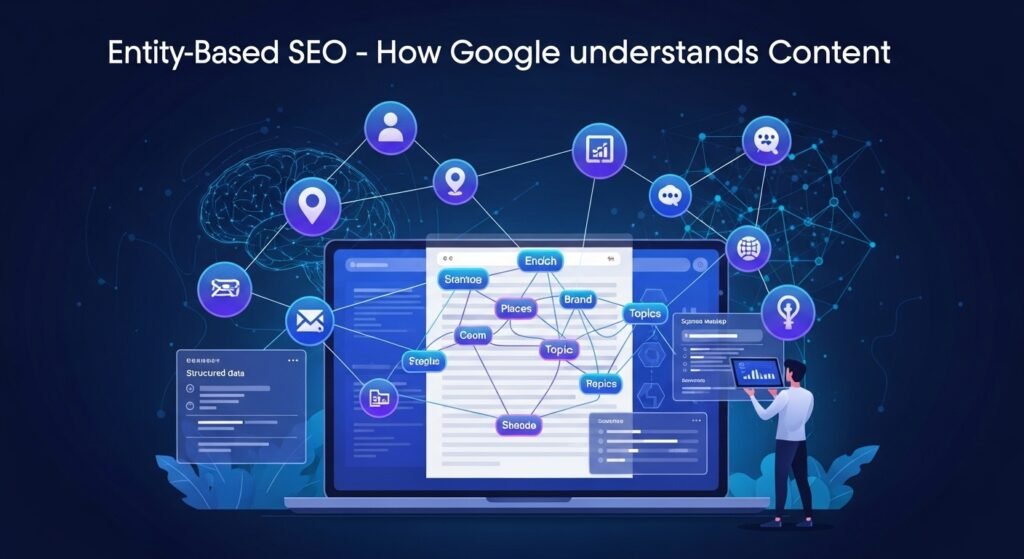
Introduction to Entity-Based SEO
As a digital marketing strategist and SEO consultant, I have witnessed the evolution of search engine optimization over the years. With the rapid advancements in artificial intelligence and machine learning, search engines like Google have become more sophisticated in understanding the context and intent behind user queries. One of the key concepts that have gained significant attention in recent times is Entity-Based SEO. In this section, we will delve into the world of Entity-Based SEO, exploring how Google understands content and the importance of entities in search visibility.
Entity-Based SEO is a paradigm shift from traditional keyword-based optimization. It focuses on creating content that is centered around entities, which are essentially people, places, things, and concepts that have distinct identities. By understanding entities and their relationships, Google can provide more accurate and relevant search results, enhancing the user experience. As a result, Entity-Based SEO has become a crucial aspect of modern search engine optimization, allowing businesses to establish themselves as authorities in their respective domains.
The concept of entities is not new to Google. In fact, the search engine giant has been working on entity recognition and disambiguation for several years. With the introduction of the Knowledge Graph in 2012, Google began to focus on understanding the relationships between entities and providing users with more informative and relevant search results. The Knowledge Graph is a massive database that contains information about various entities, including people, places, and things, and how they are connected. By tapping into this database, Google can provide users with more accurate and up-to-date information, making search results more useful and engaging.
So, how does Google understand entities? The search engine uses a combination of natural language processing (NLP) and machine learning algorithms to identify and disambiguate entities. When a user searches for a query, Google’s algorithms analyze the context and intent behind the query, identifying the entities involved. For example, if a user searches for “apple,” Google’s algorithms can determine whether the user is looking for information about the fruit, the technology company, or something else entirely. This process is called entity recognition, and it is a critical component of Entity-Based SEO.
Entity recognition is not just limited to identifying entities; it also involves understanding the relationships between them. Google’s algorithms can analyze the context and intent behind a query, identifying the entities involved and how they are connected. For instance, if a user searches for “best coffee shops in New York,” Google’s algorithms can identify the entities involved, including coffee shops, New York, and the concept of “best.” By understanding these relationships, Google can provide users with more relevant and accurate search results, such as a list of top-rated coffee shops in New York City.
To illustrate the importance of Entity-Based SEO, let’s consider an example. Suppose we have two websites, both offering information about coffee shops in New York City. Website A is optimized for keywords like “coffee shops in New York” and “best coffee in NYC,” but it does not provide any meaningful information about the entities involved. Website B, on the other hand, is optimized for entities like “coffee shops,” “New York City,” and “specialty coffee.” It provides detailed information about the coffee shops, including their locations, menus, and reviews. By focusing on entities, Website B is more likely to rank higher in search results, as it provides more relevant and useful information to users.
The benefits of Entity-Based SEO are numerous. By focusing on entities, businesses can:
- Establish themselves as authorities in their respective domains, increasing their credibility and trust with users
- Improve their search visibility, driving more traffic and revenue to their websites
- Enhance the user experience, providing more relevant and accurate information to users
- Future-proof their SEO strategies, as Entity-Based SEO is less susceptible to algorithmic changes and updates
- Gain a competitive edge, as Entity-Based SEO is still a relatively new and emerging concept in the world of search engine optimization
In conclusion, Entity-Based SEO is a powerful approach to search engine optimization that focuses on creating content centered around entities. By understanding entities and their relationships, Google can provide more accurate and relevant search results, enhancing the user experience. As a digital marketing strategist and SEO consultant, I strongly believe that Entity-Based SEO is the future of search engine optimization, and businesses that adopt this approach will be better positioned to succeed in the ever-evolving landscape of search.
As we move forward, it is essential to recognize the importance of entities in search visibility and to develop strategies that focus on creating high-quality, entity-centric content. By doing so, businesses can establish themselves as authorities in their respective domains, drive more traffic and revenue to their websites, and enhance the user experience. In the next section, we will delve deeper into the world of Entity-Based SEO, exploring the key concepts and strategies that businesses can use to succeed in this emerging field.
Understanding Entities and Their Role in SEO
As a digital marketing strategist and SEO consultant, I have witnessed the evolution of search engine optimization (SEO) over the years. With the increasing importance of artificial intelligence (AI) and machine learning (ML) in search algorithms, it’s essential to understand how Google comprehends content. One crucial aspect of this understanding is the concept of entities and their role in SEO. In this section, we will delve into the world of entities, exploring what they are, how they are identified, and their significance in the context of search engine optimization.
Entities, in the context of SEO, refer to objects, concepts, or things that have a distinct existence and identity. They can be people, places, organizations, events, or even abstract ideas. Google’s algorithm is designed to understand these entities and their relationships, allowing it to provide more accurate and relevant search results. The concept of entities is not new, but its importance has grown significantly with the introduction of Google’s Knowledge Graph in 2012. The Knowledge Graph is a massive database that stores information about various entities and their connections, enabling Google to provide more informed and context-specific search results.
So, how does Google identify entities? The process involves natural language processing (NLP) and machine learning algorithms that analyze the content of web pages, identifying mentions of specific entities. This can include names, keywords, phrases, and other linguistic patterns that indicate the presence of an entity. For example, if a web page mentions “Apple,” Google’s algorithm will identify this as a reference to the technology company, rather than the fruit. This is achieved through a process called entity disambiguation, which involves resolving ambiguities and uncertainties in the meaning of words and phrases.
Entity-based SEO is a strategic approach that focuses on optimizing content around specific entities, rather than just targeting keywords. This involves creating high-quality, informative, and engaging content that provides value to users and helps to establish a brand’s authority and expertise. By optimizing for entities, businesses can improve their online visibility, increase their search engine rankings, and drive more traffic to their websites. For instance, a company that sells outdoor gear and equipment could create content around entities like “hiking,” “camping,” or “rock climbing,” providing tips, guides, and product recommendations that cater to the needs of outdoor enthusiasts.
One of the key benefits of entity-based SEO is that it allows businesses to target specific topics and themes, rather than just keywords. This enables them to create more nuanced and sophisticated content that resonates with their target audience. By focusing on entities, businesses can also improve their chances of appearing in Google’s Knowledge Panel, which is a prominent feature that provides users with a snapshot of information about a particular entity. For example, if a user searches for “Tesla,” they may see a Knowledge Panel that includes information about the company’s history, products, and leadership, as well as links to relevant articles and reviews.
The importance of entity-based SEO can be illustrated through several examples. Let’s consider the case of a company that specializes in financial planning and wealth management. By creating content around entities like “retirement planning,” “investment strategies,” or “tax optimization,” the company can establish its authority and expertise in the financial services sector. This can involve producing high-quality blog posts, videos, or podcasts that provide valuable insights and advice to individuals and businesses. By optimizing for these entities, the company can increase its online visibility, attract more leads, and drive revenue growth.
Another example is a company that operates in the e-commerce sector, selling products like electronics, fashion, or home goods. By creating content around entities like “product reviews,” “customer testimonials,” or “buying guides,” the company can improve its search engine rankings and drive more traffic to its website. This can involve producing detailed product descriptions, customer reviews, and ratings, as well as guides and tutorials that help customers make informed purchasing decisions. By optimizing for these entities, the company can increase its online sales, improve customer satisfaction, and build a strong brand reputation.
In addition to these examples, entity-based SEO can be applied to various industries and sectors, including healthcare, education, and travel. By understanding the entities that are relevant to their business and creating high-quality content around them, companies can improve their online visibility, establish their authority and expertise, and drive revenue growth. The following are some of the key entities that businesses can target in these industries:
- Healthcare: medical conditions, treatments, medications, healthcare providers, hospitals, and medical research
- Education: educational institutions, courses, programs, degrees, scholarships, and educational resources
- Travel: destinations, hotels, restaurants, tourist attractions, travel guides, and cultural events
By targeting these entities and creating high-quality content around them, businesses can improve their online visibility, attract more leads, and drive revenue growth. However, it’s essential to note that entity-based SEO requires a deep understanding of the target audience, their needs, and their search behavior. It also requires a strategic approach to content creation, involving the production of high-quality, informative, and engaging content that provides value to users.
In conclusion, entity-based SEO is a powerful approach that can help businesses improve their online visibility, establish their authority and expertise, and drive revenue growth. By understanding the entities that are relevant to their business and creating high-quality content around them, companies can increase their search engine rankings, attract more leads, and build a strong brand reputation. As a digital marketing strategist and SEO consultant, I have seen the benefits of entity-based SEO firsthand, and I believe that it will continue to play a critical role in the evolution of search engine optimization.
Entity-Based SEO Strategies for Content Creation
As a digital marketing strategist and SEO consultant, I have witnessed the evolution of search engine optimization (SEO) over the years. With the increasing importance of artificial intelligence (AI) in search algorithms, entity-based SEO has become a crucial aspect of content creation. In this section, we will delve into the world of entity-based SEO and explore how Google understands content, providing you with actionable strategies to enhance your online presence.
Entity-based SEO is a concept that focuses on creating content around specific entities, such as people, places, organizations, and things. This approach helps search engines like Google to better understand the context and relevance of your content, ultimately improving your website’s visibility and authority. To grasp the concept of entity-based SEO, it’s essential to understand how Google perceives and interprets content.
Google’s algorithm is designed to mimic human-like understanding, using natural language processing (NLP) and machine learning to analyze and comprehend the content on your website. When you create content around a specific entity, you are providing Google with a clear understanding of what your content is about, who it’s for, and what topics it covers. This, in turn, enables Google to provide more accurate and relevant search results to users, which is the primary goal of entity-based SEO.
For instance, let’s say you’re a fashion brand, and you want to create content around the entity “sustainable fashion.” You can create a series of blog posts, articles, and social media content that discuss the importance of sustainable fashion, the benefits of eco-friendly clothing, and the latest trends in the industry. By doing so, you’re providing Google with a clear understanding of your brand’s expertise and authority in the sustainable fashion space, which can lead to improved search engine rankings and increased online visibility.
To implement entity-based SEO strategies for content creation, you need to follow a structured approach. Here are some key steps to get you started:
- Identify your target entity: Determine the entity you want to create content around, such as a person, place, organization, or thing. Make sure it’s relevant to your brand and aligns with your business goals.
- Conduct entity research: Research your target entity to gain a deeper understanding of its context, relevance, and relationships with other entities. This will help you create more accurate and informative content.
- Develop an entity-based content strategy: Create a content strategy that revolves around your target entity. This can include blog posts, articles, social media content, videos, and more. Ensure that your content is high-quality, engaging, and provides value to your target audience.
- Optimize your content for entity-based SEO: Optimize your content with relevant keywords, meta tags, and structured data to help Google understand the context and relevance of your content. Use schema markup to provide additional information about your entity and its relationships with other entities.
- Build high-quality backlinks: Build high-quality backlinks from authoritative sources to increase your website’s authority and credibility. This can be achieved through guest blogging, broken link building, and other link building strategies.
By following these steps and creating content around specific entities, you can improve your website’s visibility, authority, and online presence. Entity-based SEO is a powerful strategy that can help you stay ahead of the competition and achieve your business goals.
Another important aspect of entity-based SEO is the concept of entity salience. Entity salience refers to the degree to which an entity is prominent or relevant in a given context. When creating content, it’s essential to ensure that your target entity is salient and clearly defined. This can be achieved by using relevant keywords, providing accurate and informative content, and optimizing your content with structured data.
For example, let’s say you’re creating content around the entity “coffee shop.” To make this entity salient, you can use relevant keywords such as “coffee,” “cafe,” and “specialty coffee.” You can also provide accurate and informative content about coffee shops, such as their history, benefits, and cultural significance. By doing so, you’re making the entity “coffee shop” more prominent and relevant in the context of your content, which can improve your website’s visibility and authority.
In conclusion, entity-based SEO is a powerful strategy that can help you improve your website’s visibility, authority, and online presence. By creating content around specific entities and following a structured approach, you can provide Google with a clear understanding of your content and its relevance to your target audience. Remember to identify your target entity, conduct entity research, develop an entity-based content strategy, optimize your content for entity-based SEO, build high-quality backlinks, and ensure entity salience to achieve success in entity-based SEO.
As a digital marketing strategist and SEO consultant, I have seen firsthand the impact of entity-based SEO on businesses and organizations. By implementing these strategies and staying up-to-date with the latest developments in AI-driven search visibility, you can stay ahead of the competition and achieve your business goals. Whether you’re a small business or a large corporation, entity-based SEO is an essential aspect of your digital marketing strategy that can help you succeed in today’s online landscape.
Technical Optimization for Entity-Based SEO
As a digital marketing strategist and SEO consultant, I have witnessed the evolution of search engine optimization (SEO) over the years. With the increasing importance of entity-based SEO, it has become essential to understand how Google comprehends content and optimize it accordingly. In this section, we will delve into the technical aspects of entity-based SEO and explore the strategies that can help improve your website’s search visibility.
Technical optimization is a critical component of entity-based SEO, as it enables search engines like Google to crawl, index, and understand the content on your website. By implementing the right technical optimization strategies, you can ensure that your website is entity-friendly and provides a solid foundation for your SEO efforts. In this article, we will discuss the key technical optimization strategies for entity-based SEO, including entity markup, schema, structured data, and content hierarchy.
Entity markup is a crucial aspect of technical optimization for entity-based SEO. It involves using specific HTML tags to identify and describe the entities on your website, such as people, places, organizations, and things. By using entity markup, you can help search engines like Google understand the context and relevance of your content, which can improve your website’s search visibility and ranking. For example, if you have a website about a specific person, you can use the schema.org/Person markup to provide additional information about that person, such as their name, birthdate, and occupation.
Another important aspect of technical optimization for entity-based SEO is schema. Schema is a vocabulary of HTML tags that you can use to provide search engines with additional information about the content on your website. By using schema, you can help search engines like Google understand the structure and context of your content, which can improve your website’s search visibility and ranking. For instance, if you have a website about a specific event, you can use the schema.org/Event schema to provide additional information about that event, such as the date, time, location, and description.
Structured data is also a critical component of technical optimization for entity-based SEO. Structured data refers to the use of specific formats and protocols to provide search engines with additional information about the content on your website. By using structured data, you can help search engines like Google understand the context and relevance of your content, which can improve your website’s search visibility and ranking. For example, if you have a website about a specific product, you can use the schema.org/Product structured data to provide additional information about that product, such as the price, description, and reviews.
Content hierarchy is another important aspect of technical optimization for entity-based SEO. Content hierarchy refers to the way you organize and structure the content on your website. By using a clear and logical content hierarchy, you can help search engines like Google understand the relationships between different pieces of content on your website, which can improve your website’s search visibility and ranking. For instance, if you have a website about a specific topic, you can use a hierarchical structure to organize the content, with the most general information at the top and the most specific information at the bottom.
In addition to these strategies, there are several other technical optimization techniques that you can use to improve your website’s entity-based SEO. These include:
- Entity-based keyword research: This involves conducting keyword research to identify the most relevant and high-traffic keywords related to your entities.
- Entity-based content creation: This involves creating high-quality, engaging, and informative content that is optimized for your target entities.
- Entity-based link building: This involves building high-quality backlinks from other websites that are relevant to your target entities.
- Entity-based technical audit: This involves conducting a technical audit of your website to identify and fix any technical issues that may be impacting your entity-based SEO.
By implementing these technical optimization strategies, you can improve your website’s entity-based SEO and increase your online visibility. However, it is essential to remember that entity-based SEO is a complex and ongoing process that requires continuous monitoring and optimization. As a digital marketing strategist and SEO consultant, I recommend that you stay up-to-date with the latest best practices and trends in entity-based SEO to ensure that your website remains competitive and visible in the search engine results pages (SERPs).
In conclusion, technical optimization is a critical component of entity-based SEO, and it requires a deep understanding of how Google comprehends content. By using entity markup, schema, structured data, and content hierarchy, you can help search engines like Google understand the context and relevance of your content, which can improve your website’s search visibility and ranking. Additionally, by implementing other technical optimization techniques, such as entity-based keyword research, content creation, link building, and technical audit, you can further improve your website’s entity-based SEO and increase your online visibility.
As we move forward in the world of digital marketing, it is essential to stay ahead of the curve and adapt to the latest trends and best practices in entity-based SEO. By doing so, you can ensure that your website remains competitive and visible in the search engine results pages (SERPs), and that you are able to reach and engage with your target audience effectively. Whether you are a seasoned digital marketer or just starting out, I hope that this article has provided you with a deeper understanding of the technical optimization strategies that can help improve your website’s entity-based SEO.
Measuring Success and Future of Entity-Based SEO
As we delve into the realm of entity-based SEO, it’s essential to understand how to measure the success of this approach and what the future holds for this rapidly evolving field. As a digital marketing strategist and SEO consultant, I, Amit Tyagi, have had the privilege of working with numerous brands, helping them scale globally through advanced SEO frameworks, Generative Engine Optimization (GEO), and performance-driven digital strategies. In this section, we’ll explore the key performance indicators (KPIs) that matter most in entity-based SEO and the emerging trends that will shape the future of search engine optimization.
To measure the success of entity-based SEO, it’s crucial to track a range of metrics that go beyond traditional SEO KPIs such as keyword rankings and organic traffic. Some of the key metrics to focus on include:
- Entity mentions: The number of times your brand, product, or service is mentioned across the web, including social media, news articles, and blogs.
- Entity-based search volume: The number of searches for your brand, product, or service, including long-tail keywords and phrases.
- Knowledge panel presence: The presence of your brand, product, or service in Google’s knowledge panel, which is a significant indicator of entity-based authority.
- Reviews and ratings: The number and quality of reviews and ratings for your brand, product, or service, which can significantly impact entity-based reputation and trust.
- Social media engagement: The level of engagement with your brand, product, or service on social media platforms, including likes, shares, and comments.
By tracking these metrics, you can gain a deeper understanding of how your entity-based SEO efforts are impacting your online presence and reputation. For instance, if you notice a significant increase in entity mentions and entity-based search volume, it may indicate that your brand is becoming more prominent and authoritative in your industry. On the other hand, a decline in knowledge panel presence or reviews and ratings may suggest that your entity-based reputation is being negatively impacted.
Now, let’s look at some examples of how entity-based SEO can be applied in real-world scenarios. For instance, a fashion brand like Gucci can focus on building entity-based authority by creating high-quality content that showcases its brand history, products, and values. By doing so, Gucci can increase its entity mentions, entity-based search volume, and knowledge panel presence, ultimately driving more traffic and sales to its website. Similarly, a healthcare provider like Mayo Clinic can leverage entity-based SEO to establish itself as a trusted authority in the medical field by creating informative content, engaging with patients on social media, and encouraging online reviews and ratings.
The future of entity-based SEO is exciting and rapidly evolving. As Google continues to improve its natural language processing (NLP) and machine learning algorithms, we can expect to see even more emphasis on entity-based search results. Some of the emerging trends that will shape the future of entity-based SEO include:
- Increased use of AI-powered tools: The use of AI-powered tools, such as entity recognition and disambiguation software, will become more prevalent in entity-based SEO.
- Greater emphasis on entity-based reputation management: As entity-based search results become more prominent, brands will need to focus on managing their online reputation and building trust with their target audience.
- More focus on knowledge graph optimization: The knowledge graph will play an increasingly important role in entity-based SEO, and brands will need to optimize their online presence to ensure they are accurately represented in the knowledge graph.
- Improved entity-based search results: Google will continue to refine its entity-based search results, providing users with more accurate and relevant information about entities, including brands, products, and services.
- Growing importance of entity-based content creation: The creation of high-quality, entity-based content will become even more critical, as brands seek to establish themselves as authorities in their industry and build trust with their target audience.
In conclusion, measuring the success of entity-based SEO requires a deep understanding of the key metrics that matter most, including entity mentions, entity-based search volume, knowledge panel presence, reviews and ratings, and social media engagement. As the field of entity-based SEO continues to evolve, it’s essential to stay ahead of the curve by leveraging emerging trends, such as the use of AI-powered tools, entity-based reputation management, knowledge graph optimization, and entity-based content creation. By doing so, brands can establish themselves as trusted authorities in their industry, drive more traffic and sales, and ultimately achieve long-term success in the ever-changing landscape of search engine optimization.
As a digital marketing strategist and SEO consultant, I, Amit Tyagi, am committed to helping brands navigate the complex world of entity-based SEO and achieve their online goals. With over 15 years of experience in the field, I have developed a range of advanced SEO frameworks and strategies that can help brands scale globally and drive long-term success. Whether you’re looking to establish your brand as a trusted authority in your industry or simply want to improve your online presence, I can help you achieve your goals through entity-based SEO and other digital marketing strategies.

Amit Tyagi is a seasoned Digital Marketing and SEO Consultant with extensive experience helping businesses improve online visibility through SEO, AI Search Optimization (AIO/GEO), content strategy, and performance marketing. He regularly shares practical insights, industry updates, and data-driven strategies, empowering brands and marketers to achieve sustainable digital growth in an evolving search landsca