
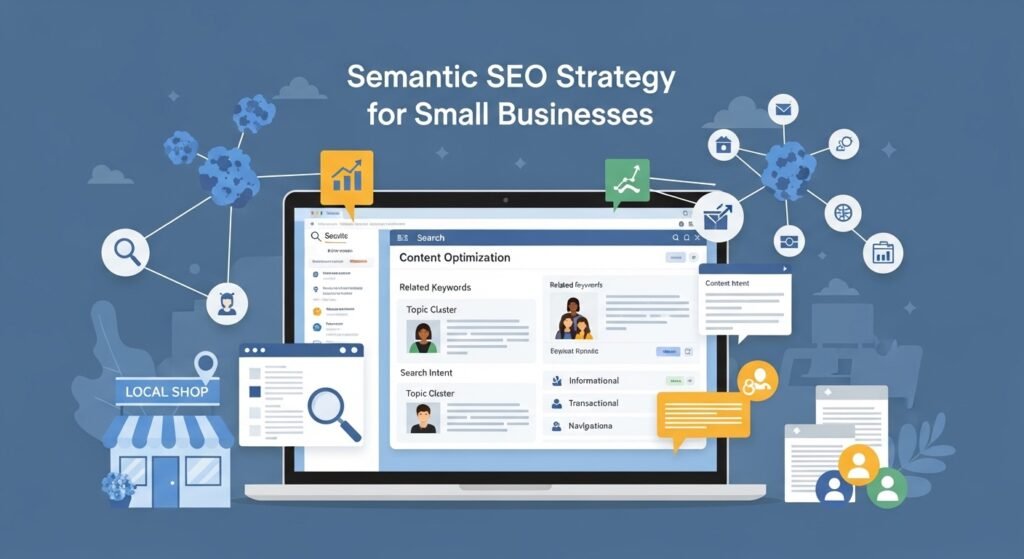
Introduction to Semantic SEO for Small Businesses
As a digital marketing strategist and SEO consultant, I have witnessed the evolution of search engine optimization (SEO) over the years. With the increasing complexity of search algorithms and the rise of artificial intelligence (AI), it has become essential for small businesses to adopt a semantic SEO strategy to stay ahead in the game. In this section, we will delve into the world of semantic SEO and explore its significance for small businesses.
Semantic SEO is an approach that focuses on understanding the context and intent behind a user’s search query. It goes beyond traditional keyword-based optimization and aims to provide search engines with a deeper understanding of the content’s meaning and relevance. By adopting a semantic SEO strategy, small businesses can improve their online visibility, drive more targeted traffic, and increase their chances of ranking higher in search engine results pages (SERPs).
The concept of semantic SEO is rooted in the idea that search engines are becoming increasingly sophisticated in their ability to understand natural language. With the help of AI and machine learning algorithms, search engines can now analyze the context and intent behind a search query and provide more accurate and relevant results. For small businesses, this means that they need to optimize their content to match the user’s intent and provide value to their target audience.
For instance, let’s consider a small business that sells outdoor gear and equipment. Instead of optimizing their content around generic keywords like “hiking boots,” they could focus on long-tail keywords like “best hiking boots for trail running” or “waterproof hiking boots for wet conditions.” By doing so, they can attract more targeted traffic and increase their chances of ranking higher in SERPs for relevant search queries.
Another key aspect of semantic SEO is the use of entity-based optimization. This involves creating content that is centered around specific entities, such as people, places, or things. By doing so, small businesses can provide search engines with a clearer understanding of their content’s context and relevance. For example, a small business that sells coffee could create content around the entity “coffee beans” and provide information on the different types of coffee beans, their origin, and their flavor profiles.
To implement a semantic SEO strategy, small businesses need to conduct thorough keyword research and analyze their competition. They should identify the keywords and phrases that their target audience is using to search for products or services like theirs and create content that provides value and relevance to those search queries. They should also use tools like Google’s Natural Language API and Entity Disambiguation API to gain a deeper understanding of the context and intent behind their target keywords.
In addition to keyword research and entity-based optimization, small businesses should also focus on creating high-quality, engaging content that provides value to their target audience. This could include blog posts, videos, infographics, and other types of content that are optimized for user experience and search engine crawlability. By creating content that is both informative and engaging, small businesses can increase their online visibility, drive more targeted traffic, and establish themselves as authorities in their industry.
Some of the key benefits of implementing a semantic SEO strategy for small businesses include:
- Improved online visibility and increased chances of ranking higher in SERPs
- More targeted traffic and higher conversion rates
- Increased brand authority and credibility
- Better user experience and engagement
- Increased ROI and revenue growth
However, implementing a semantic SEO strategy can be challenging, especially for small businesses with limited resources and expertise. It requires a deep understanding of search engine algorithms, keyword research, and content creation. It also requires ongoing monitoring and optimization to ensure that the strategy is working effectively and providing the desired results.
Despite the challenges, the benefits of implementing a semantic SEO strategy far outweigh the costs. By adopting a semantic SEO approach, small businesses can stay ahead of the competition, drive more targeted traffic, and increase their online visibility. As a digital marketing strategist and SEO consultant, I have seen firsthand the impact that a well-implemented semantic SEO strategy can have on a small business’s online presence and revenue growth.
In the next section, we will explore the key elements of a semantic SEO strategy and provide tips and best practices for small businesses to implement this approach effectively. We will also discuss the role of AI and machine learning in semantic SEO and how small businesses can leverage these technologies to improve their online visibility and drive more targeted traffic.
Some of the key elements of a semantic SEO strategy include:
- Keyword research and analysis
- Entity-based optimization
- Content creation and optimization
- Technical SEO and website optimization
- Link building and authority building
- Tracking and analysis
By understanding these key elements and implementing them effectively, small businesses can create a robust semantic SEO strategy that drives real results and helps them achieve their online marketing goals. Whether you are a small business owner, a digital marketing professional, or an SEO specialist, this guide will provide you with the insights and expertise you need to succeed in the world of semantic SEO.
In conclusion, semantic SEO is a powerful approach that can help small businesses improve their online visibility, drive more targeted traffic, and increase their revenue growth. By adopting a semantic SEO strategy, small businesses can stay ahead of the competition, establish themselves as authorities in their industry, and achieve their online marketing goals. As a digital marketing strategist and SEO consultant, I highly recommend that small businesses consider implementing a semantic SEO strategy as part of their overall digital marketing plan.
With the right approach and expertise, small businesses can unlock the full potential of semantic SEO and achieve real results that drive business growth and success. In the next section, we will delve deeper into the key elements of a semantic SEO strategy and provide tips and best practices for small businesses to implement this approach effectively.
Understanding the Fundamentals of Semantic Search
As a digital marketing strategist and SEO consultant, I have witnessed the evolution of search engine optimization (SEO) over the years. With the advent of artificial intelligence (AI) and machine learning (ML) algorithms, search engines have become more sophisticated, and the way we approach SEO has undergone a significant transformation. One of the key concepts that have emerged in recent years is semantic search, which has revolutionized the way search engines understand and retrieve information. In this section, we will delve into the fundamentals of semantic search and explore its implications for small businesses.
Semantic search refers to the ability of search engines to understand the context, intent, and meaning behind a search query. It goes beyond the traditional keyword-based approach, where search engines simply matched keywords with relevant content. With semantic search, search engines use natural language processing (NLP) and entity-based indexing to provide more accurate and relevant results. This means that search engines can now understand the nuances of language, including synonyms, antonyms, and related concepts, to deliver more precise results.
For example, if a user searches for “best Italian restaurants in New York City,” a traditional keyword-based approach would simply look for web pages containing the exact keywords. However, a semantic search engine would understand the intent behind the query, which is to find high-quality Italian restaurants in New York City. The search engine would then use its knowledge graph to retrieve relevant information, including reviews, ratings, and menus, to provide a more comprehensive and accurate result.
The key components of semantic search include entity recognition, intent identification, and contextual understanding. Entity recognition involves identifying and extracting specific entities, such as names, locations, and organizations, from a search query. Intent identification involves understanding the purpose or goal behind a search query, such as making a purchase or seeking information. Contextual understanding involves analyzing the context in which a search query is made, including the user’s location, device, and search history.
To illustrate this concept, let’s consider an example. Suppose a user searches for “flu symptoms” on a search engine. A traditional keyword-based approach would simply retrieve web pages containing the exact keywords. However, a semantic search engine would use entity recognition to identify the entity “flu” and intent identification to understand that the user is seeking information about the symptoms of the flu. The search engine would then use contextual understanding to analyze the user’s location and provide more relevant results, such as information about flu outbreaks in their area or nearby healthcare providers.
The implications of semantic search for small businesses are significant. With semantic search, small businesses can no longer rely on keyword stuffing and other outdated SEO tactics. Instead, they must focus on creating high-quality, relevant, and informative content that addresses the needs and intent of their target audience. This requires a deep understanding of their customers, including their pain points, interests, and behaviors.
Some of the key strategies for optimizing for semantic search include:
- Creating entity-rich content that includes specific entities, such as names, locations, and organizations, to help search engines understand the context and intent of the content.
- Using natural language in content to make it more conversational and engaging, and to help search engines understand the nuances of language.
- Optimizing for intent by creating content that addresses the specific needs and goals of the target audience.
- Building a knowledge graph to provide search engines with a comprehensive understanding of the business, including its products, services, and expertise.
- Using schema markup to provide search engines with additional context and information about the content, such as reviews, ratings, and events.
By understanding the fundamentals of semantic search and implementing these strategies, small businesses can improve their online visibility, drive more targeted traffic to their website, and increase their revenue and growth. In the next section, we will explore the importance of entity-based optimization and how small businesses can leverage it to improve their semantic search rankings.
Developing a Semantic SEO Strategy for Small Businesses
As a digital marketing strategist and SEO consultant, I have worked with numerous small businesses, helping them scale their online presence and drive revenue through advanced SEO frameworks. In today’s competitive digital landscape, it’s essential for small businesses to adopt a semantic SEO strategy that goes beyond traditional keyword targeting. In this section, we will delve into the world of semantic SEO and explore how small businesses can leverage this approach to improve their search visibility, authority, and bottom line.
Semantic SEO is an approach that focuses on understanding the context, intent, and meaning behind a search query, rather than just targeting specific keywords. This approach requires a deep understanding of your target audience, their pain points, and the topics they care about. By creating content that resonates with your audience and addresses their needs, you can establish your brand as an authority in your niche and drive more qualified leads to your website.
So, how can small businesses develop a semantic SEO strategy that drives real results? The first step is to conduct thorough keyword research that goes beyond just identifying relevant keywords. You need to understand the topics, entities, and concepts that are related to your business and industry. This can be done using tools like Google Keyword Planner, Ahrefs, or SEMrush. For example, if you’re a small business that offers SEO services, you may want to target topics like “digital marketing,” “search engine optimization,” and “online visibility.”
Once you have a list of relevant topics and keywords, you need to create content that addresses the needs and pain points of your target audience. This can include blog posts, articles, videos, podcasts, and other types of content that provide value to your audience. For instance, if you’re a small business that offers SEO services, you may want to create content that provides tips and best practices for improving website rankings, such as “10 Ways to Optimize Your Website for Search Engines” or “The Ultimate Guide to Keyword Research.”
In addition to creating high-quality content, you also need to optimize your website’s structure and architecture to support your semantic SEO strategy. This includes using header tags, meta descriptions, and internal linking to help search engines understand the context and relationships between different pages on your website. For example, if you have a page on your website that provides information on “SEO services,” you may want to link to other relevant pages, such as “keyword research” or “link building,” to help search engines understand the relationships between these topics.
Another important aspect of semantic SEO is entity-based optimization. This involves creating content that is centered around specific entities, such as people, places, or organizations, and using schema markup to help search engines understand the context and relationships between these entities. For instance, if you’re a small business that offers SEO services, you may want to create content that is centered around specific entities, such as “Google” or “Bing,” and use schema markup to help search engines understand the relationships between these entities and your business.
To illustrate the power of semantic SEO, let’s consider an example. Suppose you’re a small business that offers yoga classes in a specific city. You may want to create content that targets topics like “yoga classes,” “yoga studios,” and “wellness programs.” However, you may also want to create content that addresses the specific needs and pain points of your target audience, such as “yoga for beginners” or “yoga for stress relief.” By creating content that resonates with your audience and addresses their needs, you can establish your brand as an authority in your niche and drive more qualified leads to your website.
Here are some key takeaways for small businesses that want to develop a semantic SEO strategy:
- Conduct thorough keyword research that goes beyond just identifying relevant keywords
- Create content that addresses the needs and pain points of your target audience
- Optimize your website’s structure and architecture to support your semantic SEO strategy
- Use entity-based optimization to create content that is centered around specific entities
- Use schema markup to help search engines understand the context and relationships between different entities
By following these best practices and staying up-to-date with the latest developments in semantic SEO, small businesses can improve their search visibility, authority, and bottom line. Remember, semantic SEO is a long-term strategy that requires ongoing effort and optimization. However, the rewards are well worth it, as you can drive more qualified leads to your website, establish your brand as an authority in your niche, and stay ahead of the competition in the ever-evolving digital landscape.
In conclusion, developing a semantic SEO strategy is a crucial step for small businesses that want to succeed in the digital age. By understanding the context, intent, and meaning behind search queries, small businesses can create content that resonates with their audience, establishes their brand as an authority, and drives more qualified leads to their website. Whether you’re just starting out or looking to take your online presence to the next level, a well-crafted semantic SEO strategy can help you achieve your goals and stay ahead of the competition.
As a digital marketing strategist and SEO consultant, I have seen firsthand the impact that a well-crafted semantic SEO strategy can have on a small business. By leveraging the power of semantic SEO, small businesses can drive more traffic to their website, increase their online visibility, and establish their brand as a trusted authority in their niche. If you’re looking to take your online presence to the next level, I encourage you to explore the world of semantic SEO and discover the benefits it can bring to your business.
Technical Optimization for Semantic SEO
As a digital marketing strategist and SEO consultant, I have worked with numerous small businesses to improve their online presence and drive revenue through search engine optimization. One crucial aspect of SEO that is often overlooked is technical optimization, which plays a vital role in semantic SEO. In this section, we will delve into the importance of technical optimization for semantic SEO and provide actionable tips for small businesses to improve their website’s technical foundation.
Semantic SEO is all about creating a website that is easily understood by search engines, and technical optimization is the first step towards achieving this goal. Technical optimization involves ensuring that your website is crawlable, indexable, and accessible to search engines, which is essential for improving your website’s visibility and search engine rankings. A well-optimized website is like a well-built house – it provides a solid foundation for your online presence and helps you to attract and engage with your target audience.
So, what does technical optimization entail? At its core, technical optimization involves ensuring that your website is technically sound and meets the requirements of search engines. This includes optimizing your website’s structure, content, and coding to make it easy for search engines to crawl, index, and understand your website. Some key aspects of technical optimization include page speed optimization, mobile-friendliness, SSL encryption, XML sitemap optimization, and schema markup. Let’s take a closer look at each of these aspects and explore how they contribute to technical optimization for semantic SEO.
Page speed optimization is critical for technical optimization, as it directly impacts the user experience and search engine rankings. A slow-loading website can lead to high bounce rates, low engagement, and poor search engine rankings. To optimize your website’s page speed, you can use tools like Google PageSpeed Insights, which provides recommendations for improving your website’s speed and performance. Some simple ways to improve your website’s page speed include compressing images, minifying CSS and JavaScript files, leveraging browser caching, and using a content delivery network (CDN).
Another important aspect of technical optimization is mobile-friendliness. With the majority of online searches now taking place on mobile devices, it’s essential to ensure that your website is optimized for mobile users. A mobile-friendly website is one that is responsive, easy to navigate, and provides a seamless user experience across all devices. To ensure that your website is mobile-friendly, you can use tools like Google’s Mobile-Friendly Test, which provides a simple and easy-to-use interface for testing your website’s mobile-friendliness.
In addition to page speed optimization and mobile-friendliness, SSL encryption is also critical for technical optimization. SSL encryption, also known as HTTPS, is a security protocol that encrypts data between your website and users’ browsers, providing a secure and trustworthy online environment. Google has announced that HTTPS is a ranking signal, which means that websites with SSL encryption are more likely to rank higher in search engine results pages (SERPs). To implement SSL encryption on your website, you can purchase an SSL certificate from a reputable provider and install it on your website’s server.
Other important aspects of technical optimization include XML sitemap optimization and schema markup. An XML sitemap is a file that helps search engines understand your website’s structure and content, making it easier for them to crawl and index your website. To optimize your XML sitemap, you can use tools like Google Search Console, which provides a simple and easy-to-use interface for submitting and managing your XML sitemap. Schema markup, on the other hand, is a type of microdata that helps search engines understand your website’s content and context, providing users with more informative and accurate search results. To implement schema markup on your website, you can use tools like Google’s Structured Data Markup Helper, which provides a simple and easy-to-use interface for creating and managing schema markup.
Now that we’ve explored the key aspects of technical optimization for semantic SEO, let’s take a look at some examples of how small businesses can implement these strategies. For instance, a small e-commerce business can improve its page speed by compressing images and minifying CSS and JavaScript files. A mobile-friendly website can be achieved by using a responsive design and testing the website on multiple devices. SSL encryption can be implemented by purchasing an SSL certificate and installing it on the website’s server. XML sitemap optimization can be achieved by submitting the XML sitemap to Google Search Console and regularly updating it to reflect changes to the website’s structure and content. Schema markup can be implemented by using tools like Google’s Structured Data Markup Helper and testing the markup to ensure it’s working correctly.
In conclusion, technical optimization is a critical aspect of semantic SEO that cannot be overlooked. By optimizing your website’s page speed, mobile-friendliness, SSL encryption, XML sitemap, and schema markup, you can improve your website’s visibility, search engine rankings, and overall online presence. As a small business owner, it’s essential to prioritize technical optimization and invest in the right tools and resources to ensure your website is technically sound and meets the requirements of search engines. By doing so, you can drive more traffic, generate more leads, and increase revenue through search engine optimization.
Here are some key takeaways for small businesses looking to improve their technical optimization for semantic SEO:
- Optimize your website’s page speed by compressing images, minifying CSS and JavaScript files, leveraging browser caching, and using a content delivery network (CDN)
- Ensure your website is mobile-friendly by using a responsive design and testing it on multiple devices
- Implement SSL encryption by purchasing an SSL certificate and installing it on your website’s server
- Optimize your XML sitemap by submitting it to Google Search Console and regularly updating it to reflect changes to your website’s structure and content
- Implement schema markup by using tools like Google’s Structured Data Markup Helper and testing the markup to ensure it’s working correctly
By following these tips and prioritizing technical optimization, small businesses can improve their website’s technical foundation, drive more traffic, and increase revenue through search engine optimization. Remember, technical optimization is an ongoing process that requires regular monitoring and maintenance to ensure your website remains technically sound and meets the evolving requirements of search engines.
Measuring and Refining Semantic SEO Performance
As a small business owner, it’s essential to track the performance of your semantic SEO strategy to understand what’s working and what areas need improvement. Measuring and refining your approach will help you optimize your content, improve user experience, and increase your online visibility. In this section, we’ll delve into the key performance indicators (KPIs) to measure, tools to use, and strategies to refine your semantic SEO performance.
When it comes to measuring semantic SEO performance, there are several KPIs to focus on. These include organic traffic, keyword rankings, click-through rates (CTRs), conversion rates, and user engagement metrics such as time on page, bounce rate, and pages per session. By tracking these KPIs, you can gain insights into how your target audience is interacting with your content and identify areas for improvement.
To measure these KPIs, you can use various tools such as Google Analytics, Google Search Console, Ahrefs, and SEMrush. These tools provide valuable data on your website’s traffic, keyword rankings, and user behavior, which can help you refine your semantic SEO strategy. For example, Google Analytics can help you track your website’s organic traffic, while Google Search Console can provide insights into your keyword rankings and CTRs.
In addition to tracking KPIs, it’s essential to conduct regular keyword research to identify new opportunities and refine your existing keyword strategy. You can use tools like Ahrefs or Moz Keyword Explorer to conduct keyword research and identify relevant keywords and phrases to target. By conducting regular keyword research, you can stay ahead of the competition and ensure your content remains relevant and optimized for your target audience.
To refine your semantic SEO performance, consider the following strategies:
- Optimize your content for user intent: Understand what your target audience is searching for and create content that meets their needs. Use long-tail keywords and phrase-based keywords to target specific user intents and increase your chances of ranking higher in search engine results pages (SERPs).
- Use entity-based optimization: Entity-based optimization involves optimizing your content for specific entities such as people, places, and things. By using entity-based keywords and structured data, you can help search engines understand the context and relevance of your content.
- Improve your website’s technical SEO: Technical SEO is critical to ensuring your website is crawlable, indexable, and accessible to search engines. Make sure to optimize your website’s speed, mobile responsiveness, and SSL encryption to improve your website’s technical SEO.
- Build high-quality backlinks: High-quality backlinks from authoritative sources can help increase your website’s authority and ranking in SERPs. Focus on building relevant and contextual backlinks from sources that are relevant to your industry or niche.
By implementing these strategies and tracking your KPIs, you can refine your semantic SEO performance and improve your online visibility. Remember to stay up-to-date with the latest trends and best practices in semantic SEO to ensure your strategy remains effective and competitive.
For example, let’s say you’re a small business owner in the healthcare industry, and you’ve created a blog post on the benefits of meditation for mental health. To refine your semantic SEO performance, you could conduct keyword research to identify relevant keywords and phrases such as “meditation for anxiety” or “mindfulness for depression.” You could then optimize your blog post for these keywords by using them in your title, meta description, and headings. Additionally, you could use entity-based optimization by including structured data on your website that highlights your expertise in the healthcare industry.
By taking a data-driven approach to semantic SEO and refining your strategy based on your KPIs, you can increase your online visibility, drive more traffic to your website, and ultimately, boost your revenue. As a digital marketing strategist and SEO consultant, I’ve seen firsthand the impact that a well-executed semantic SEO strategy can have on a small business’s online presence and bottom line. By following the strategies outlined in this section, you can set your business up for success and achieve your online marketing goals.
In conclusion, measuring and refining semantic SEO performance is critical to the success of your online marketing strategy. By tracking your KPIs, conducting regular keyword research, and implementing entity-based optimization and technical SEO strategies, you can improve your online visibility, drive more traffic to your website, and increase your revenue. Remember to stay up-to-date with the latest trends and best practices in semantic SEO to ensure your strategy remains effective and competitive.

Amit Tyagi is a seasoned Digital Marketing and SEO Consultant with extensive experience helping businesses improve online visibility through SEO, AI Search Optimization (AIO/GEO), content strategy, and performance marketing. He regularly shares practical insights, industry updates, and data-driven strategies, empowering brands and marketers to achieve sustainable digital growth in an evolving search landsca