
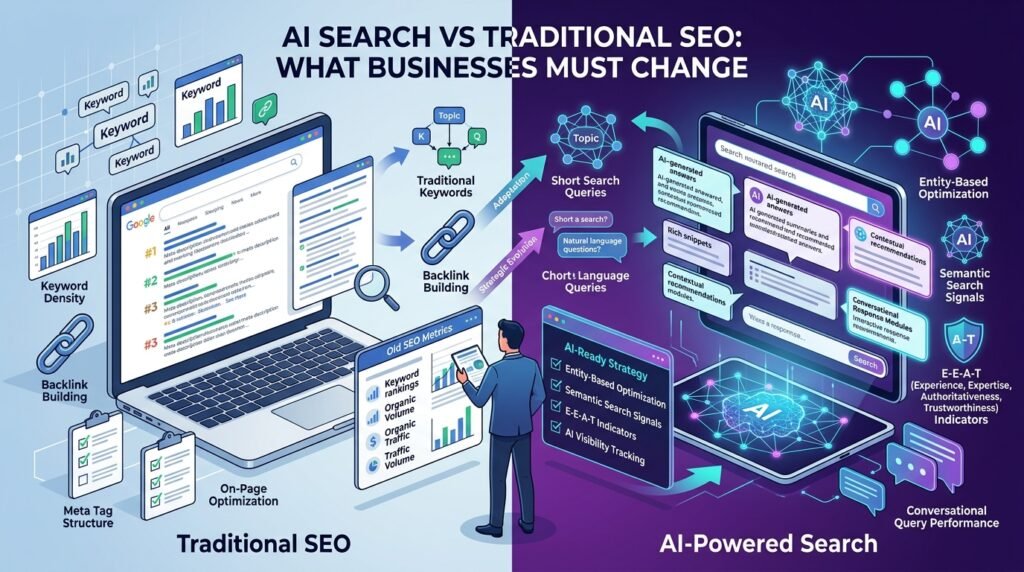
Introduction to AI Search and Traditional SEO
As the digital landscape continues to evolve, businesses are faced with a new challenge: adapting to the shift from traditional Search Engine Optimization (SEO) to AI-driven search. The rise of artificial intelligence (AI) has transformed the way search engines operate, making it essential for companies to reassess their SEO strategies. In this article, we will delve into the world of AI search and traditional SEO, exploring the key differences between the two and what businesses must change to remain competitive in the ever-changing digital landscape.
Traditional SEO has been the cornerstone of digital marketing for years, focusing on optimizing website content, structure, and coding to improve search engine rankings. However, with the advent of AI-powered search engines, the rules of the game have changed. AI search uses machine learning algorithms to understand user intent, context, and behavior, providing more accurate and personalized search results. This shift has significant implications for businesses, as they must now adapt their SEO strategies to accommodate the capabilities and limitations of AI-driven search.
According to Amit Tyagi, a seasoned digital marketing strategist and SEO consultant, “The integration of AI in search engines has revolutionized the way we approach SEO. Businesses can no longer rely on traditional SEO tactics alone; they must now incorporate AI-driven strategies to remain visible and competitive in the digital landscape.” With over 15 years of experience in the field, Tyagi has helped numerous brands scale globally through advanced SEO frameworks, Generative Engine Optimization (GEO), and performance-driven digital strategies.
To understand the differences between AI search and traditional SEO, let’s examine the key characteristics of each. Traditional SEO focuses on:
- Keyword research and optimization
- On-page optimization (meta tags, titles, descriptions)
- Link building and off-page optimization
- Technical optimization (site speed, mobile responsiveness)
- Content creation and marketing
In contrast, AI search emphasizes:
- Entity-based optimization (focus on entities, not just keywords)
- Contextual understanding (user intent, behavior, and preferences)
- Personalization (tailored search results based on user data)
- Natural Language Processing (NLP) and conversational search
- Machine learning and algorithmic updates
As we can see, AI search introduces new dimensions to the traditional SEO paradigm. While traditional SEO focuses on optimizing for specific keywords and technical aspects, AI search prioritizes understanding user context, intent, and behavior. This shift requires businesses to rethink their SEO strategies, incorporating AI-driven approaches to remain competitive.
For instance, a business that previously optimized its website for the keyword “best Italian restaurant” might now need to focus on entity-based optimization, highlighting the unique aspects of their restaurant, such as “family-owned,” “traditional recipes,” or “cozy atmosphere.” By doing so, they can improve their chances of appearing in search results for users looking for a specific type of Italian dining experience.
Another example is the use of Natural Language Processing (NLP) in AI search. With the rise of voice assistants like Siri, Google Assistant, and Alexa, users are increasingly using conversational language to search for information. Businesses must now optimize their content to match this shift, using long-tail keywords and phrases that mimic natural speech patterns. For example, instead of optimizing for the keyword “Italian restaurant,” a business might optimize for phrases like “What are the best Italian restaurants near me?” or “I’m looking for a family-friendly Italian place to eat.”
In conclusion, the introduction of AI search has revolutionized the world of SEO, requiring businesses to adapt and evolve their strategies to remain competitive. By understanding the key differences between traditional SEO and AI search, companies can begin to develop new approaches that prioritize entity-based optimization, contextual understanding, and personalization. In the next section, we will explore the implications of AI search on businesses and what they must change to thrive in this new landscape.
Key Differences Between AI Search and Traditional SEO
As a digital marketing strategist and SEO consultant, I have witnessed the evolution of search engine optimization (SEO) over the years. With the advent of artificial intelligence (AI) in search, the landscape has changed dramatically, and businesses must adapt to stay ahead. In this section, we will delve into the key differences between AI search and traditional SEO, and what businesses must change to thrive in this new era.
Traditional SEO has long been focused on keyword optimization, link building, and content creation. However, with the rise of AI-powered search engines, the rules of the game have changed. AI search is no longer just about matching keywords, but about understanding the context, intent, and nuances of search queries. This shift requires businesses to rethink their SEO strategies and adapt to the new AI-driven landscape.
One of the primary differences between AI search and traditional SEO is the way search queries are processed. Traditional SEO relies on keyword matching, where the search engine looks for exact keyword matches in the content. In contrast, AI search uses natural language processing (NLP) and machine learning algorithms to understand the context and intent behind the search query. This means that businesses must focus on creating content that is more conversational, contextual, and relevant to the user’s needs.
For example, if a user searches for “best Italian restaurants in New York,” a traditional SEO approach would focus on optimizing the content for the exact keywords “best Italian restaurants” and “New York.” However, an AI search approach would consider the context and intent behind the search query, such as the user’s location, preferences, and previous search history. This would require businesses to create content that is more personalized, relevant, and engaging, such as “Top 5 Italian Restaurants in New York City for Foodies” or “Best Italian Restaurants in Manhattan for a Romantic Dinner.”
Another key difference between AI search and traditional SEO is the role of links and authority. In traditional SEO, links from high-authority sites were a key ranking factor, as they signaled to the search engine that the content was trustworthy and relevant. However, with AI search, the focus has shifted from link equity to content relevance and user experience. This means that businesses must focus on creating high-quality, engaging, and relevant content that resonates with their target audience, rather than just accumulating links from high-authority sites.
For instance, a business that creates a comprehensive guide to “The Ultimate Guide to Italian Cuisine” would likely rank higher in AI search results than a business that has a large number of low-quality links pointing to their site. This is because the guide provides value to the user, is well-researched, and demonstrates expertise in the field, which are all key factors in AI search rankings.
To adapt to the new AI-driven landscape, businesses must change their approach to SEO in several ways. Firstly, they must focus on creating high-quality, engaging, and relevant content that resonates with their target audience. This includes using conversational language, providing personalized recommendations, and creating content that is optimized for voice search.
Secondly, businesses must prioritize user experience and ensure that their website is optimized for speed, mobile-friendliness, and accessibility. This includes using responsive design, optimizing images, and ensuring that the site is easy to navigate and use.
Thirdly, businesses must leverage AI-powered tools and technologies to analyze and optimize their SEO strategies. This includes using tools such as Google Analytics, Ahrefs, and SEMrush to track keyword rankings, analyze competitor strategies, and identify areas for improvement.
The key takeaways for businesses are:
- Focus on creating high-quality, engaging, and relevant content that resonates with your target audience
- Prioritize user experience and ensure that your website is optimized for speed, mobile-friendliness, and accessibility
- Leverage AI-powered tools and technologies to analyze and optimize your SEO strategies
- Use conversational language and provide personalized recommendations to users
- Optimize content for voice search and other emerging search trends
In conclusion, the differences between AI search and traditional SEO are significant, and businesses must adapt to stay ahead. By focusing on high-quality content, user experience, and AI-powered tools, businesses can thrive in the new AI-driven landscape and drive more traffic, engagement, and revenue to their site. As a digital marketing strategist and SEO consultant, I have seen firsthand the impact that AI search can have on a business’s online presence, and I am excited to help businesses navigate this new era of search engine optimization.
By understanding the key differences between AI search and traditional SEO, businesses can make informed decisions about their SEO strategies and stay ahead of the competition. Whether you are a small business or a large enterprise, adapting to the new AI-driven landscape is crucial for success in the digital age. As AI search continues to evolve and improve, businesses must be prepared to adapt and innovate to stay ahead of the curve.
Ultimately, the future of SEO is AI-driven, and businesses that fail to adapt will be left behind. By prioritizing high-quality content, user experience, and AI-powered tools, businesses can drive more traffic, engagement, and revenue to their site, and establish themselves as leaders in their industry. As a digital marketing strategist and SEO consultant, I am committed to helping businesses navigate the complex and ever-changing landscape of AI search, and achieve success in the digital age.
With the rise of AI search, the opportunities for businesses to connect with their target audience and drive revenue are vast. By leveraging the power of AI and machine learning, businesses can create personalized, relevant, and engaging content that resonates with their target audience, and drives real results. Whether you are looking to increase brand awareness, drive website traffic, or boost conversions, AI search offers a wealth of opportunities for businesses to achieve their goals and succeed in the digital age.
In the next section, we will explore the importance of Generative Engine Optimization (GEO) in AI search, and how businesses can leverage this powerful strategy to drive more traffic, engagement, and revenue to their site. By understanding the principles of GEO and how to apply them to your SEO strategy, businesses can stay ahead of the competition and achieve success in the AI-driven landscape.
Strategies for Businesses to Adapt to AI Search
As a digital marketing strategist and SEO consultant, I have witnessed the evolution of search engine optimization (SEO) over the years. With the advent of Artificial Intelligence (AI) in search, businesses must adapt their strategies to stay ahead of the curve. In this section, we will delve into the world of AI search and explore the strategies that businesses can employ to thrive in this new landscape.
The traditional SEO approach focused on keyword optimization, link building, and content creation. However, with AI search, the rules of the game have changed. AI-powered search engines can understand the context, intent, and nuances of search queries, making it essential for businesses to shift their focus from keyword-centric to user-centric strategies. Understanding the user’s intent and providing relevant, high-quality content is crucial to succeed in AI search.
One of the primary strategies for businesses to adapt to AI search is to focus on entity-based optimization. This involves creating content that is centered around entities, such as people, places, and things, rather than just keywords. By doing so, businesses can help search engines understand the context and relevance of their content, increasing their visibility in search results. For instance, a business that sells outdoor gear can create content around the entity “hiking” and include relevant sub-entities such as “hiking trails,” “hiking boots,” and “hiking tips.” This approach helps search engines understand the business’s expertise and authority in the niche, leading to improved search rankings.
Another strategy is to leverage the power of natural language processing (NLP). NLP enables businesses to analyze and understand the language patterns and preferences of their target audience. By incorporating NLP into their content creation process, businesses can develop content that resonates with their audience and addresses their specific needs and pain points. For example, a business that offers financial services can use NLP to analyze the language patterns of their target audience and create content that uses similar terminology and tone. This approach helps build trust and credibility with the audience, increasing the chances of conversion.
In addition to entity-based optimization and NLP, businesses must also focus on creating high-quality, engaging content. AI search engines can detect the quality and relevance of content, and reward businesses that provide value to their audience. This means creating content that is well-researched, informative, and engaging, and that addresses the specific needs and pain points of the target audience. Businesses can use various formats, such as blog posts, videos, podcasts, and infographics, to create a diverse range of content that caters to different learning styles and preferences.
Furthermore, businesses must optimize their content for voice search. With the rise of voice assistants like Siri, Google Assistant, and Alexa, voice search has become an essential aspect of AI search. Businesses can optimize their content for voice search by using natural language patterns, including long-tail keywords, and creating content that answers specific questions. For instance, a business that offers pizza delivery services can create content that answers questions like “What are the best pizza places near me?” or “How can I order pizza online?” By doing so, businesses can increase their visibility in voice search results and attract more customers.
Another crucial strategy for businesses is to build a strong brand identity. AI search engines can understand the reputation and credibility of a brand, and reward businesses that have a strong online presence. This means creating a consistent brand voice, visual identity, and messaging across all online channels, including social media, website, and content. Businesses can also use customer reviews, testimonials, and ratings to build trust and credibility with their audience.
To implement these strategies, businesses can follow these steps:
- Conduct a thorough analysis of their target audience, including their language patterns, preferences, and pain points.
- Develop a content creation strategy that focuses on entity-based optimization, NLP, and high-quality content.
- Optimize their content for voice search by using natural language patterns and including long-tail keywords.
- Build a strong brand identity by creating a consistent brand voice, visual identity, and messaging across all online channels.
- Monitor and adjust their strategy regularly to stay ahead of the competition and adapt to the evolving AI search landscape.
In conclusion, the rise of AI search has transformed the way businesses approach SEO. By focusing on entity-based optimization, NLP, high-quality content, voice search optimization, and building a strong brand identity, businesses can adapt to the new landscape and thrive in the world of AI search. As a digital marketing strategist and SEO consultant, I have seen firsthand the impact that these strategies can have on a business’s online visibility and revenue. By staying ahead of the curve and embracing the latest trends and technologies, businesses can future-proof their online presence and achieve long-term success.
Measuring Success in AI Search: New Metrics and KPIs
As businesses navigate the evolving landscape of search engine optimization (SEO), it has become increasingly important to reassess the metrics and key performance indicators (KPIs) used to measure success. Traditional SEO has long relied on metrics such as keyword rankings, organic traffic, and conversion rates to gauge the effectiveness of a campaign. However, with the rise of AI search, these metrics are no longer sufficient. In this section, we will explore the new metrics and KPIs that businesses must adopt to measure success in AI search.
The integration of artificial intelligence (AI) into search engines has significantly altered the way search results are generated and ranked. AI search algorithms can understand the context and intent behind a search query, allowing for more accurate and personalized results. As a result, businesses must adapt their approach to measuring success in AI search. Relevance and context have become crucial factors in determining search engine rankings, making it essential to track metrics that reflect these changes.
One of the primary challenges in measuring success in AI search is the lack of transparency in AI algorithms. Unlike traditional SEO, where keyword rankings and backlinks were clear indicators of success, AI search algorithms are more complex and nuanced. To overcome this challenge, businesses must focus on metrics that provide insight into the user experience and the relevance of their content. Some of the new metrics and KPIs that businesses must consider include:
- Entity-based metrics: With AI search, entities such as people, places, and organizations have become essential in determining search engine rankings. Businesses must track metrics such as entity mentions, entity-based keyword rankings, and entity-driven traffic to understand their online presence.
- Intent-based metrics: AI search algorithms can understand the intent behind a search query, making it crucial to track metrics such as intent-based keyword rankings, intent-driven traffic, and intent-based conversion rates.
- Contextual metrics: Context has become a critical factor in AI search, and businesses must track metrics such as contextual keyword rankings, contextual traffic, and contextual conversion rates to understand how their content is performing in different contexts.
- User experience metrics: AI search prioritizes user experience, making it essential to track metrics such as time on site, bounce rate, and user engagement to understand how users are interacting with your content.
For example, a business that sells outdoor gear may have traditionally tracked keyword rankings for terms like “hiking boots” or “camping equipment.” However, in AI search, this business may need to track entity-based metrics such as mentions of their brand or products in outdoor enthusiast communities, intent-based metrics such as search queries related to hiking or camping, and contextual metrics such as search queries related to specific outdoor activities or locations. By tracking these new metrics and KPIs, the business can gain a deeper understanding of how their content is performing in AI search and make data-driven decisions to improve their online presence.
Another critical aspect of measuring success in AI search is the use of machine learning algorithms to analyze data and identify patterns. Machine learning can help businesses uncover insights that may not be immediately apparent, such as changes in user behavior or shifts in search engine algorithms. By leveraging machine learning algorithms, businesses can stay ahead of the curve and adapt their SEO strategies to the evolving landscape of AI search.
In addition to tracking new metrics and KPIs, businesses must also reassess their SEO strategies to ensure they are aligned with the principles of AI search. This may involve creating content that is more contextual and entity-based, as well as optimizing for user experience and intent. By adopting a more holistic approach to SEO, businesses can improve their online presence and drive more revenue through AI search.
In conclusion, measuring success in AI search requires a new set of metrics and KPIs that reflect the changing landscape of search engine optimization. By tracking entity-based metrics, intent-based metrics, contextual metrics, and user experience metrics, businesses can gain a deeper understanding of how their content is performing in AI search. Additionally, by leveraging machine learning algorithms and reassessing their SEO strategies, businesses can stay ahead of the curve and drive more revenue through AI search. As a digital marketing strategist and SEO consultant, I have seen firsthand the impact that AI search can have on a business’s online presence, and I believe that by adopting these new metrics and KPIs, businesses can thrive in the evolving landscape of search engine optimization.
Future-Proofing Your Business with AI-Driven SEO
As a digital marketing strategist and SEO consultant, I have witnessed the evolution of search engine optimization (SEO) over the past 15 years. The rise of artificial intelligence (AI) has revolutionized the way search engines operate, making traditional SEO strategies less effective. To stay ahead of the curve, businesses must adapt to AI-driven SEO, focusing on advanced techniques that prioritize user experience, relevance, and authority. In this section, we will delve into the world of AI search vs traditional SEO, exploring the key differences and highlighting the essential changes businesses must make to future-proof their online presence.
The traditional SEO approach has long relied on keyword optimization, link building, and technical SEO. While these elements are still important, they are no longer sufficient to guarantee top rankings in search engine results pages (SERPs). The introduction of AI-driven search algorithms, such as Google’s BERT and MUM, has shifted the focus towards more nuanced and context-aware search results. These algorithms can understand natural language, intent, and user behavior, making them more adept at identifying high-quality, relevant content.
One of the primary differences between AI-driven SEO and traditional SEO is the emphasis on content quality and relevance. AI algorithms can analyze content at a deeper level, assessing factors such as readability, comprehensiveness, and expertise. This means that businesses must focus on creating high-quality, engaging content that resonates with their target audience. For instance, a company like HubSpot has successfully implemented AI-driven SEO by producing in-depth, well-researched content that addresses the needs of its users, resulting in improved search rankings and increased organic traffic.
Another critical aspect of AI-driven SEO is entity-based optimization. This involves creating content that is optimized for specific entities, such as people, places, and organizations, rather than just keywords. By doing so, businesses can establish themselves as authorities in their niche, increasing their visibility in search results. For example, a company like Wikipedia has become an entity in its own right, with its content being referenced and cited by other websites, further solidifying its online authority.
To illustrate the importance of AI-driven SEO, let’s consider the following examples:
- Improved search rankings: By incorporating AI-driven SEO strategies, businesses can improve their search rankings, increasing their online visibility and driving more organic traffic to their website.
- Enhanced user experience: AI-driven SEO prioritizes user experience, ensuring that search results are relevant, informative, and engaging, which can lead to higher conversion rates and increased customer satisfaction.
- Increased authority and trust: By establishing themselves as authorities in their niche, businesses can build trust with their target audience, leading to increased brand loyalty and advocacy.
In addition to these benefits, AI-driven SEO also requires businesses to adopt a more data-driven approach. This involves leveraging tools and technologies, such as machine learning and natural language processing, to analyze user behavior, track keyword trends, and optimize content in real-time. By doing so, businesses can stay ahead of the competition, identifying opportunities and challenges before they become major issues.
So, what changes must businesses make to future-proof their online presence in the age of AI-driven SEO? Firstly, they must invest in high-quality content creation, focusing on relevance, expertise, and user experience. Secondly, they must adopt an entity-based optimization approach, establishing themselves as authorities in their niche. Finally, they must leverage data and analytics to inform their SEO strategies, staying ahead of the competition and adapting to the ever-changing search landscape.
In conclusion, the rise of AI-driven SEO has revolutionized the way businesses approach online marketing. By prioritizing content quality, relevance, and entity-based optimization, businesses can future-proof their online presence, driving more organic traffic, increasing authority and trust, and staying ahead of the competition. As a digital marketing strategist and SEO consultant, I have seen firsthand the impact that AI-driven SEO can have on businesses, and I firmly believe that it is essential for companies to adapt to this new reality in order to succeed in the ever-changing world of search engine optimization.

Amit Tyagi is a seasoned Digital Marketing and SEO Consultant with extensive experience helping businesses improve online visibility through SEO, AI Search Optimization (AIO/GEO), content strategy, and performance marketing. He regularly shares practical insights, industry updates, and data-driven strategies, empowering brands and marketers to achieve sustainable digital growth in an evolving search landsca