
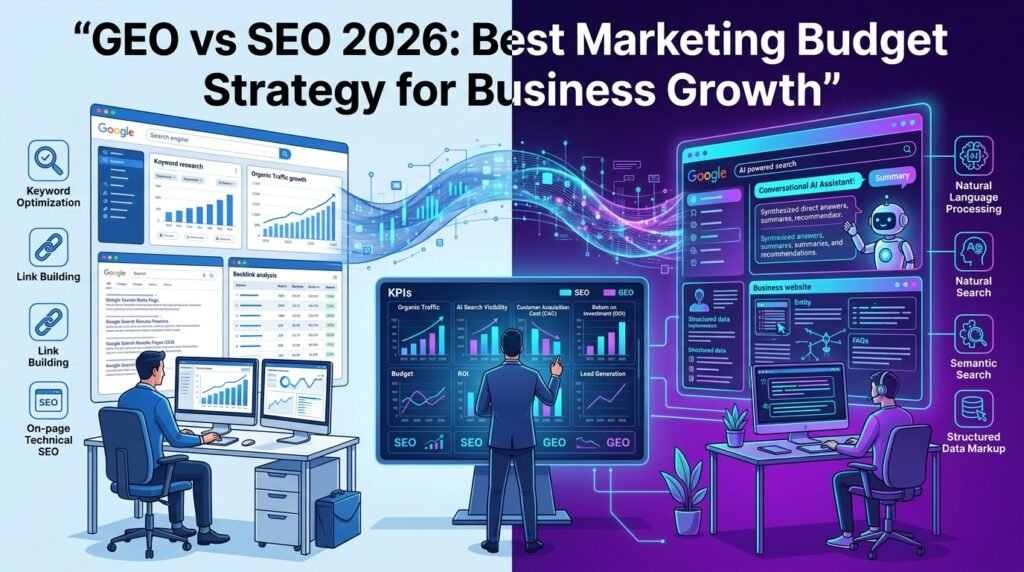
Introduction to GEO and SEO: Understanding the Basics
As a digital marketing strategist and SEO consultant, I have witnessed the evolution of search engine optimization (SEO) over the years. With the rapid advancement of technology, a new player has entered the scene: Generative Engine Optimization (GEO). In this article, we will delve into the world of GEO and SEO, exploring their differences, benefits, and applications. By the end of this discussion, you will have a clear understanding of how to allocate your marketing budget effectively between these two strategies to drive business growth.
Let’s start with the basics. SEO is a well-established practice that focuses on optimizing your website’s content, structure, and overall online presence to rank higher in search engine results pages (SERPs). The primary goal of SEO is to increase your website’s visibility, drive organic traffic, and generate leads or sales. With the help of SEO, you can improve your website’s technical performance, create high-quality and relevant content, and build authoritative backlinks from other reputable websites.
On the other hand, GEO is a relatively new concept that has emerged with the advent of artificial intelligence (AI) and machine learning (ML) technologies. GEO involves using AI-powered tools to generate high-quality, optimized content at scale, while also analyzing and improving your website’s technical performance in real-time. The primary objective of GEO is to enhance your website’s search engine rankings by leveraging the power of AI-driven content creation, optimization, and distribution.
To illustrate the difference between SEO and GEO, consider a simple example. Suppose you have an e-commerce website that sells outdoor gear and equipment. With SEO, you would focus on creating high-quality, keyword-optimized product descriptions, meta tags, and titles to improve your website’s visibility in search engines. You would also build backlinks from other relevant websites, such as outdoor blogs or magazines, to increase your website’s authority and trustworthiness.
In contrast, with GEO, you would use AI-powered tools to generate optimized product descriptions, meta tags, and titles at scale, while also analyzing and improving your website’s technical performance in real-time. For instance, a GEO tool could analyze your website’s content and identify areas for improvement, such as optimizing images, compressing files, or improving mobile responsiveness. The tool could then generate optimized content and implement the necessary technical improvements to enhance your website’s search engine rankings.
Now, let’s explore the benefits of both SEO and GEO. SEO offers several advantages, including:
- Improved website visibility and organic traffic
- Increased brand awareness and credibility
- Targeted and relevant content that resonates with your audience
- Long-term sustainability and cost-effectiveness
On the other hand, GEO provides its own set of benefits, including:
- AI-driven content creation and optimization at scale
- Real-time technical performance analysis and improvement
- Enhanced search engine rankings and visibility
- Faster and more efficient content distribution and marketing
In conclusion, both SEO and GEO offer unique benefits and applications in the world of digital marketing. While SEO provides a solid foundation for improving your website’s visibility and credibility, GEO offers a more advanced and AI-driven approach to content creation, optimization, and distribution. As we move forward in this discussion, we will explore how to allocate your marketing budget effectively between these two strategies to drive business growth and achieve your online goals.
As a digital marketing strategist, I have worked with numerous clients who have struggled to decide between SEO and GEO. Some have opted for a traditional SEO approach, focusing on creating high-quality content and building backlinks. Others have embraced the power of GEO, using AI-powered tools to generate optimized content and improve their website’s technical performance. The key to success, however, lies in understanding the strengths and weaknesses of both strategies and allocating your marketing budget accordingly.
In the next section, we will delve deeper into the applications and benefits of SEO and GEO, exploring how to create a winning marketing strategy that drives business growth and achieves your online goals. We will also examine case studies and examples of companies that have successfully implemented SEO and GEO strategies, highlighting the challenges they faced and the results they achieved.
GEO vs SEO: A Comparative Analysis for Business Growth
As a digital marketing strategist and SEO consultant, I have witnessed the evolution of search engine optimization (SEO) and the emergence of Generative Engine Optimization (GEO) as a new paradigm in the digital marketing landscape. With over 15 years of experience in helping brands scale globally, I have had the opportunity to work with various businesses, analyzing their marketing strategies and identifying areas for improvement. In this article, we will delve into the world of GEO vs SEO, exploring the differences, benefits, and challenges of each approach, and providing insights into the best marketing budget strategy for business growth in 2026.
First, let’s define what SEO and GEO entail. SEO is the process of optimizing website content, structure, and coding to rank higher in search engine results pages (SERPs) for specific keywords and phrases. The primary goal of SEO is to increase visibility, drive organic traffic, and generate leads and sales. On the other hand, GEO is an AI-driven approach that focuses on creating high-quality, engaging, and personalized content that resonates with the target audience. GEO involves using machine learning algorithms to analyze user behavior, preferences, and intent, and then generating content that meets their needs and expectations.
One of the key differences between SEO and GEO is the approach to content creation. SEO typically involves creating content around specific keywords and phrases, with the primary goal of ranking higher in search engines. In contrast, GEO involves creating content that is personalized, engaging, and relevant to the target audience. For example, a business that sells outdoor gear may use SEO to create content around keywords like “hiking boots” or “camping equipment.” However, with GEO, the same business may use machine learning algorithms to analyze user behavior and create content that is personalized to individual users, such as “top 5 hiking trails for beginners” or “how to choose the right camping gear for your next adventure.”
Another significant difference between SEO and GEO is the role of AI and machine learning. SEO typically involves manual optimization techniques, such as keyword research, on-page optimization, and link building. In contrast, GEO relies heavily on AI and machine learning algorithms to analyze user behavior, generate content, and optimize website performance. For instance, a business that uses GEO may use machine learning algorithms to analyze user search queries, click-through rates, and conversion rates, and then use that data to generate personalized content and optimize website design and layout.
Now, let’s explore the benefits and challenges of each approach. The benefits of SEO include increased visibility, organic traffic, and lead generation. However, SEO can be time-consuming and requires ongoing optimization efforts to maintain rankings. Additionally, SEO is highly competitive, and businesses must continually adapt to changing search engine algorithms and user behavior. On the other hand, the benefits of GEO include personalized content, increased engagement, and improved conversion rates. However, GEO requires significant investment in AI and machine learning technology, and businesses must have a deep understanding of user behavior and preferences.
Here are some key benefits and challenges of SEO and GEO:
- SEO Benefits: increased visibility, organic traffic, and lead generation
- SEO Challenges: time-consuming, requires ongoing optimization efforts, highly competitive
- GEO Benefits: personalized content, increased engagement, improved conversion rates
- GEO Challenges: requires significant investment in AI and machine learning technology, requires deep understanding of user behavior and preferences
In conclusion, both SEO and GEO have their strengths and weaknesses, and the best marketing budget strategy for business growth in 2026 will depend on the specific needs and goals of each business. While SEO is still an effective way to increase visibility and drive organic traffic, GEO offers a more personalized and engaging approach to content creation and user experience. As a digital marketing strategist and SEO consultant, I recommend that businesses consider a hybrid approach that combines the benefits of SEO and GEO. By investing in AI and machine learning technology, and using data and analytics to inform content creation and optimization efforts, businesses can create a powerful marketing strategy that drives growth, engagement, and revenue.
For example, a business that sells e-commerce products may use SEO to drive organic traffic to their website, and then use GEO to create personalized product recommendations and content that resonates with individual users. Similarly, a business that offers services may use SEO to increase visibility and drive leads, and then use GEO to create personalized content and user experiences that improve conversion rates and customer satisfaction.
Ultimately, the key to success in digital marketing is to stay ahead of the curve and continually adapt to changing user behavior and search engine algorithms. By leveraging the latest advancements in AI and machine learning, and using data and analytics to inform marketing efforts, businesses can create a powerful marketing strategy that drives growth, engagement, and revenue in 2026 and beyond.
Marketing Budget Allocation: Strategies for GEO and SEO
As a digital marketing strategist and SEO consultant, I have had the privilege of working with numerous businesses, helping them navigate the complex landscape of online marketing. One of the most critical decisions that businesses face is allocating their marketing budget effectively between Generative Engine Optimization (GEO) and Search Engine Optimization (SEO). In this section, we will delve into the strategies for marketing budget allocation, exploring the best approaches for businesses to achieve growth and maximize their return on investment (ROI).
The marketing landscape has undergone significant transformations in recent years, with the rise of AI-driven technologies and the increasing importance of online visibility. As a result, businesses must adapt their marketing strategies to stay ahead of the competition. GEO and SEO are two essential components of a comprehensive digital marketing strategy, each with its unique strengths and weaknesses. By understanding the differences between these two approaches, businesses can make informed decisions about their marketing budget allocation.
GEO, or Generative Engine Optimization, refers to the process of optimizing a website or online content to rank higher in search engine results pages (SERPs) using AI-driven techniques. This approach focuses on creating high-quality, engaging content that resonates with users and provides value to them. GEO involves the use of machine learning algorithms and natural language processing (NLP) to analyze user behavior, preferences, and search patterns, enabling businesses to create targeted content that meets the needs of their audience.
On the other hand, SEO, or Search Engine Optimization, is the process of optimizing a website or online content to rank higher in SERPs using traditional techniques such as keyword research, link building, and technical optimization. SEO focuses on improving the visibility, credibility, and authority of a website, making it more appealing to search engines and users alike. While SEO is still an essential component of digital marketing, the rise of GEO has changed the way businesses approach online marketing, and it is crucial to understand the differences between these two approaches to allocate marketing budget effectively.
To allocate marketing budget effectively between GEO and SEO, businesses must consider their goals, target audience, and marketing objectives. Here are some strategies to consider:
- Define clear goals and objectives: Before allocating marketing budget, businesses must define clear goals and objectives. What do they want to achieve through their online marketing efforts? Are they looking to increase brand awareness, drive website traffic, generate leads, or boost sales? By setting clear goals, businesses can determine the most effective allocation of their marketing budget.
- Understand the target audience: Understanding the target audience is critical to allocating marketing budget effectively. Businesses must analyze their audience’s demographics, preferences, behavior, and search patterns to determine the most effective approach. For example, if the target audience is tech-savvy and actively uses voice search, a GEO-focused approach may be more effective.
- Assess the competitive landscape: Assessing the competitive landscape is essential to allocating marketing budget effectively. Businesses must analyze their competitors’ online marketing strategies, identifying gaps and opportunities to outperform them. By understanding the competitive landscape, businesses can determine the most effective allocation of their marketing budget.
- Allocate budget based on ROI: Businesses must allocate their marketing budget based on the expected return on investment (ROI). By analyzing the ROI of different marketing channels and strategies, businesses can determine the most effective allocation of their budget. For example, if a business finds that GEO-driven content is generating a higher ROI than traditional SEO efforts, they may allocate a larger portion of their budget to GEO.
Another critical aspect of marketing budget allocation is the use of data and analytics. Businesses must track their online marketing efforts, analyzing the performance of different channels and strategies to determine the most effective allocation of their budget. By using data and analytics, businesses can identify areas of improvement, optimize their marketing efforts, and maximize their ROI.
For instance, a business may use tools like Google Analytics to track website traffic, engagement, and conversion rates. By analyzing this data, they can determine which marketing channels are driving the most traffic, engagement, and conversions, and allocate their budget accordingly. Similarly, businesses can use tools like Ahrefs or SEMrush to track their keyword rankings, backlinks, and technical SEO performance, making data-driven decisions to optimize their SEO efforts.
In conclusion, allocating marketing budget effectively between GEO and SEO is crucial for businesses to achieve growth and maximize their ROI. By defining clear goals and objectives, understanding the target audience, assessing the competitive landscape, allocating budget based on ROI, and using data and analytics, businesses can make informed decisions about their marketing budget allocation. As a digital marketing strategist and SEO consultant, I have seen firsthand the impact of effective marketing budget allocation on business growth, and I strongly recommend that businesses prioritize this aspect of their online marketing strategy.
Moreover, the rise of GEO has changed the way businesses approach online marketing, and it is essential to stay ahead of the curve. By incorporating GEO-driven techniques into their marketing strategy, businesses can create high-quality, engaging content that resonates with users and provides value to them. As the marketing landscape continues to evolve, businesses must adapt their strategies to stay ahead of the competition, and effective marketing budget allocation is critical to achieving this goal.
Ultimately, the key to successful marketing budget allocation is to strike a balance between GEO and SEO. By allocating budget effectively between these two approaches, businesses can create a comprehensive digital marketing strategy that drives growth, engagement, and revenue. As a digital marketing strategist and SEO consultant, I recommend that businesses prioritize this aspect of their online marketing strategy, staying ahead of the curve and achieving long-term success in the ever-evolving marketing landscape.
Implementing GEO and SEO: Tools, Techniques, and Technologies
As a digital marketing strategist and SEO consultant, I have worked with numerous businesses to help them scale globally through advanced SEO frameworks and performance-driven digital strategies. In recent years, I have noticed a significant shift in the way businesses approach search engine optimization, with many now considering Generative Engine Optimization (GEO) as a viable alternative to traditional SEO. In this section, we will delve into the tools, techniques, and technologies used to implement GEO and SEO, and explore the benefits and drawbacks of each approach.
When it comes to implementing GEO and SEO, there are several tools and techniques that businesses can use to improve their online visibility and drive more traffic to their website. For SEO, some of the most commonly used tools include keyword research software, such as Ahrefs and SEMrush, which help businesses identify relevant keywords and phrases to target in their content. Other important tools for SEO include backlink analysis software, such as Moz and Majestic, which help businesses build high-quality backlinks to their website and improve their domain authority.
In addition to these tools, there are also several techniques that businesses can use to improve their SEO. Some of the most effective techniques include content marketing, which involves creating high-quality, engaging content that attracts links and shares, and technical optimization, which involves optimizing a website’s technical infrastructure to improve its crawlability and indexability. Other important techniques for SEO include local SEO, which involves optimizing a website for local search terms and phrases, and mobile optimization, which involves optimizing a website for mobile devices and users.
For GEO, the tools and techniques used are slightly different. Some of the most commonly used tools for GEO include generative models, such as language models and image models, which can be used to generate high-quality content and images that attract links and shares. Other important tools for GEO include AI-powered analytics software, such as Google Analytics and Adobe Analytics, which help businesses track their online performance and make data-driven decisions.
When it comes to techniques, GEO involves using machine learning algorithms to analyze and optimize online performance. This can involve using algorithms to identify patterns and trends in online data, and to predict future performance based on historical data. Other important techniques for GEO include natural language processing, which involves using machine learning algorithms to analyze and optimize language-based content, and computer vision, which involves using machine learning algorithms to analyze and optimize image-based content.
Some examples of businesses that have successfully implemented GEO and SEO include:
- eCommerce companies, such as Amazon and Walmart, which use GEO and SEO to drive more traffic to their website and improve their online sales.
- Financial institutions, such as banks and credit unions, which use GEO and SEO to improve their online visibility and drive more leads to their website.
- Healthcare organizations, such as hospitals and medical groups, which use GEO and SEO to improve their online reputation and drive more patients to their website.
In terms of technologies, there are several that are used to implement GEO and SEO. Some of the most important technologies include cloud computing, which provides businesses with the scalability and flexibility they need to manage large amounts of online data, and big data analytics, which provides businesses with the insights and intelligence they need to make data-driven decisions. Other important technologies for GEO and SEO include artificial intelligence, which provides businesses with the ability to automate and optimize their online marketing efforts, and Internet of Things (IoT), which provides businesses with the ability to collect and analyze data from a wide range of online devices and sources.
Overall, the tools, techniques, and technologies used to implement GEO and SEO are constantly evolving, and businesses must stay up-to-date with the latest developments in order to remain competitive. By using the right tools and techniques, and by leveraging the latest technologies, businesses can improve their online visibility, drive more traffic to their website, and achieve their marketing goals.
To illustrate the difference between GEO and SEO, let’s consider an example. Suppose we have an eCommerce company that sells outdoor gear and equipment. Using SEO, the company might focus on optimizing its website for keywords such as “hiking boots” and “camping tents”, and building high-quality backlinks to its website from other outdoor gear and equipment websites. Using GEO, on the other hand, the company might focus on using generative models to create high-quality product descriptions and images, and AI-powered analytics software to track its online performance and make data-driven decisions.
In terms of benefits, both GEO and SEO have their advantages. SEO is a well-established discipline that has been proven to drive more traffic to websites and improve online sales. GEO, on the other hand, is a newer discipline that has the potential to revolutionize the way businesses approach online marketing. By using machine learning algorithms and generative models, businesses can automate and optimize their online marketing efforts, and achieve better results with less effort and resources.
However, there are also some drawbacks to consider. SEO can be a time-consuming and labor-intensive process, requiring businesses to constantly monitor and adjust their online marketing efforts. GEO, on the other hand, requires businesses to have a high level of technical expertise and resources, as well as access to large amounts of online data and computing power.
Ultimately, the choice between GEO and SEO will depend on the specific needs and goals of the business. By understanding the tools, techniques, and technologies used to implement GEO and SEO, businesses can make informed decisions about which approach is best for them, and achieve their marketing goals in a more effective and efficient way.
Conclusion and Future Outlook: Maximizing Business Growth with GEO and SEO
As we navigate the ever-evolving landscape of digital marketing in 2026, it’s clear that both Generative Engine Optimization (GEO) and Search Engine Optimization (SEO) play crucial roles in driving business growth. As a digital marketing strategist and SEO consultant, I’ve had the privilege of working with numerous brands, helping them scale globally through advanced SEO frameworks, GEO, and performance-driven digital strategies. In this conclusion, we’ll delve into the future outlook of GEO and SEO, exploring how businesses can maximize their marketing budget to achieve unparalleled growth.
In the realm of digital marketing, it’s essential to understand that GEO and SEO are not mutually exclusive. In fact, they complement each other, and a well-crafted strategy that incorporates both can yield remarkable results. GEO focuses on optimizing content for generative models, such as AI-powered chatbots and virtual assistants, whereas SEO concentrates on improving search engine rankings through keyword research, on-page optimization, and link building. By allocating a marketing budget that balances both GEO and SEO, businesses can tap into the vast potential of the digital landscape.
One of the primary advantages of incorporating GEO into a marketing strategy is its ability to enhance brand visibility and authority. By optimizing content for generative models, businesses can increase their chances of being featured in AI-powered search results, voice assistants, and other emerging technologies. For instance, a company that specializes in e-commerce can leverage GEO to optimize its product descriptions, ensuring that they are easily discoverable by AI-powered shopping assistants. This not only drives sales but also establishes the brand as a thought leader in its industry.
On the other hand, SEO remains a cornerstone of digital marketing, providing a solid foundation for businesses to build upon. By conducting thorough keyword research, optimizing on-page elements, and building high-quality backlinks, companies can improve their search engine rankings, driving organic traffic and revenue. For example, a health and wellness brand can use SEO to optimize its blog posts, targeting specific keywords and phrases that resonate with its target audience. This not only attracts relevant traffic but also positions the brand as a trusted authority in the health and wellness space.
To maximize business growth with GEO and SEO, it’s essential to allocate a marketing budget that balances both strategies. Here are some key considerations to keep in mind:
- Conduct thorough keyword research: Understand your target audience and the keywords they use to search for products or services like yours.
- Optimize content for generative models: Ensure that your content is easily discoverable by AI-powered search results, voice assistants, and other emerging technologies.
- Build high-quality backlinks: Establish your brand as a thought leader by building relationships with other reputable websites and earning high-quality backlinks.
- Monitor and adjust your strategy: Continuously monitor your GEO and SEO performance, making adjustments to your strategy as needed to optimize results.
- Invest in AI-powered tools: Leverage AI-powered tools to streamline your GEO and SEO efforts, improving efficiency and reducing costs.
As we look to the future, it’s clear that the intersection of GEO and SEO will continue to play a vital role in driving business growth. By understanding the strengths and weaknesses of each strategy and allocating a marketing budget that balances both, companies can position themselves for success in the ever-evolving digital landscape. Whether you’re a seasoned marketer or just starting out, it’s essential to stay ahead of the curve, embracing the latest trends and technologies to drive unparalleled growth and revenue.
In conclusion, the future of digital marketing is exciting and full of possibilities. By embracing both GEO and SEO, businesses can unlock new opportunities for growth, establishing themselves as thought leaders in their industries. As a digital marketing strategist and SEO consultant, I’m committed to helping brands navigate the complex world of GEO and SEO, providing expert guidance and support every step of the way. Whether you’re looking to enhance your brand visibility, drive organic traffic, or simply stay ahead of the competition, I’m here to help you achieve your goals and maximize your marketing budget.
As we move forward into 2026 and beyond, it’s essential to remember that the digital landscape is constantly evolving. New technologies and trends will emerge, and it’s crucial to stay adaptable and agile in response. By prioritizing GEO and SEO, businesses can establish a solid foundation for growth, driving revenue and establishing themselves as leaders in their industries. So why wait? Start exploring the possibilities of GEO and SEO today, and discover how these powerful strategies can help you achieve unparalleled business growth and success.

Amit Tyagi is a seasoned Digital Marketing and SEO Consultant with extensive experience helping businesses improve online visibility through SEO, AI Search Optimization (AIO/GEO), content strategy, and performance marketing. He regularly shares practical insights, industry updates, and data-driven strategies, empowering brands and marketers to achieve sustainable digital growth in an evolving search landsca