
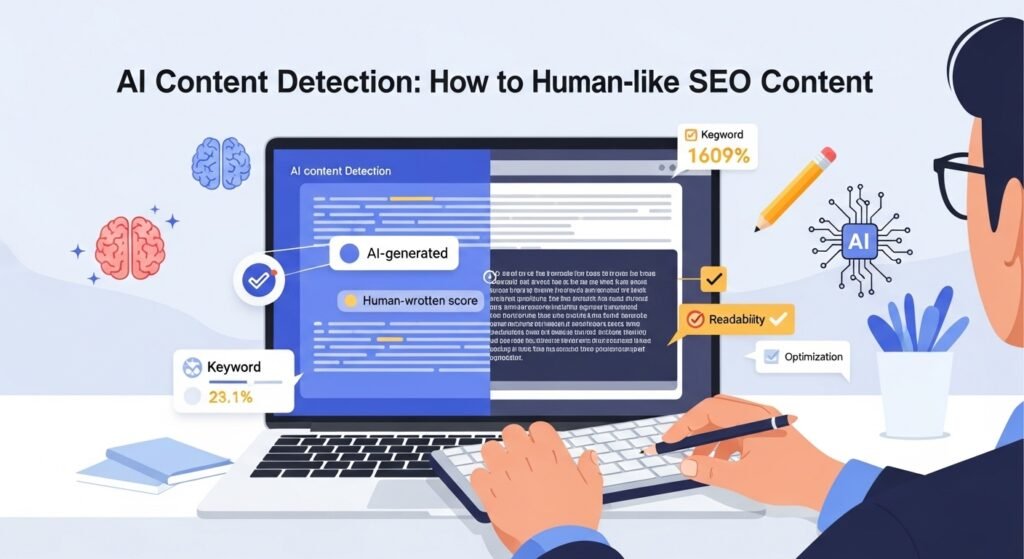
Introduction to AI Content Detection
As a digital marketing strategist and SEO consultant, I have witnessed the rapid evolution of search engine algorithms and their ability to detect and differentiate between human-generated and AI-produced content. The rise of artificial intelligence (AI) has transformed the way we create, consume, and interact with online content. With the increasing use of AI-powered tools to generate content, it has become essential to understand the concept of AI content detection and its implications on search engine optimization (SEO). In this section, we will delve into the world of AI content detection, exploring its significance, challenges, and strategies for writing human-like SEO content that resonates with both search engines and human audiences.
The primary goal of AI content detection is to identify and distinguish between content created by humans and that generated by machines. Search engines like Google, Bing, and Yahoo use sophisticated algorithms to analyze and evaluate the quality, relevance, and authenticity of online content. These algorithms are designed to detect patterns, anomalies, and red flags that may indicate the use of AI-generated content. As a result, it is crucial for content creators, marketers, and SEO professionals to understand the nuances of AI content detection and develop strategies to produce high-quality, human-like content that meets the evolving standards of search engines.
One of the significant challenges in AI content detection is the ability of AI tools to mimic human language patterns, tone, and style. Advanced language generation models, such as transformer-based architectures, can produce content that is often indistinguishable from human-generated content. This has led to a cat-and-mouse game between search engines and AI content generators, with search engines continually updating their algorithms to stay ahead of the curve. For instance, Google’s recent updates to its algorithm have focused on detecting and penalizing content that exhibits patterns of AI-generated content, such as over-optimization, keyword stuffing, and lack of coherence.
To illustrate the complexity of AI content detection, let’s consider an example. Suppose we have two articles on the same topic, one written by a human and the other generated by an AI tool. Both articles may appear to be well-researched, informative, and engaging, but upon closer inspection, the AI-generated article may exhibit subtle patterns, such as:
- Overuse of transitional phrases and sentences
- Lack of personal anecdotes, emotions, and tone
- Inconsistent language patterns, such as verb tense and sentence structure
- Excessive use of buzzwords, jargon, and technical terms
These patterns can serve as red flags for search engines, indicating that the content may be AI-generated. However, it is essential to note that AI content detection is not a straightforward process, and search engines use a combination of signals and factors to evaluate the authenticity and quality of online content. As a digital marketing strategist, I have worked with numerous clients who have struggled to create human-like content that resonates with their target audience and meets the standards of search engines.
So, what does it take to write human-like SEO content that passes the AI content detection test? The answer lies in creating content that is authentic, engaging, and relevant to the target audience. This requires a deep understanding of the topic, industry, and audience, as well as the ability to craft compelling narratives, use persuasive language, and incorporate personal anecdotes and emotions. By focusing on these elements, content creators can produce high-quality content that resonates with human readers and meets the evolving standards of search engines. In the next section, we will explore the strategies and techniques for writing human-like SEO content that drives engagement, conversions, and revenue growth.
As we navigate the complex landscape of AI content detection, it is essential to remember that the primary goal of search engines is to provide users with relevant, accurate, and high-quality content. By prioritizing the needs and preferences of human readers, content creators can stay ahead of the curve and produce content that meets the standards of search engines. As Amit Tyagi, a digital marketing strategist and SEO consultant, I have helped numerous brands and businesses develop effective content strategies that drive engagement, conversions, and revenue growth. In the following sections, we will delve deeper into the world of AI content detection, exploring the strategies, techniques, and best practices for writing human-like SEO content that resonates with both search engines and human audiences.
In conclusion, AI content detection is a critical aspect of search engine optimization, and understanding its significance, challenges, and strategies is essential for content creators, marketers, and SEO professionals. By recognizing the patterns, anomalies, and red flags that may indicate AI-generated content, search engines can provide users with high-quality, relevant, and authentic content. As we move forward in this rapidly evolving landscape, it is crucial to prioritize the needs and preferences of human readers, focusing on creating content that is engaging, informative, and relevant to the target audience. By doing so, we can stay ahead of the curve and produce content that meets the standards of search engines, drives engagement, conversions, and revenue growth, and ultimately achieves our digital marketing goals.
Understanding AI-powered Content Analysis Tools
As a digital marketing strategist and SEO consultant, I have witnessed the rapid evolution of search engine optimization (SEO) over the years. With the increasing use of artificial intelligence (AI) in content creation, it has become essential to understand how AI-powered content analysis tools work and how they impact the way we write SEO content. In this section, we will delve into the world of AI-powered content analysis tools and explore their capabilities, limitations, and implications for content creators.
Ai-powered content analysis tools are designed to analyze and evaluate the quality, relevance, and authenticity of online content. These tools use machine learning algorithms and natural language processing (NLP) to assess various aspects of content, including syntax, semantics, tone, style, and structure. By analyzing these factors, AI-powered content analysis tools can determine whether a piece of content is written by a human or generated by a machine.
One of the primary functions of AI-powered content analysis tools is to detect AI-generated content. With the rise of AI-powered content generation tools, it has become increasingly difficult to distinguish between human-written and machine-generated content. AI-powered content analysis tools help to bridge this gap by identifying patterns and anomalies in content that are characteristic of AI-generated text. For instance, AI-generated content may lack the nuances and subtleties of human language, such as idioms, colloquialisms, and figurative language.
Ai-powered content analysis tools can also evaluate the readability, coherence, and overall quality of content. These tools can assess factors such as sentence structure, word choice, and tone to determine whether the content is engaging, informative, and easy to understand. By analyzing these factors, AI-powered content analysis tools can provide content creators with valuable insights and suggestions for improving the quality and effectiveness of their content.
Some examples of AI-powered content analysis tools include language processing tools like Grammarly, ProWritingAid, and Language Tool. These tools use AI algorithms to analyze and evaluate the grammar, syntax, and style of content, providing suggestions for improvement and identifying potential errors. Other examples include content optimization tools like Ahrefs, SEMrush, and Moz, which use AI-powered algorithms to analyze and evaluate the SEO potential of content, providing recommendations for improvement and identifying opportunities for optimization.
When using AI-powered content analysis tools, it is essential to understand their limitations and potential biases. AI algorithms are only as good as the data they are trained on, and if the training data is biased or incomplete, the results may be skewed or inaccurate. Additionally, AI-powered content analysis tools may not always be able to detect the nuances and complexities of human language, which can lead to false positives or false negatives.
To get the most out of AI-powered content analysis tools, it is crucial to use them in conjunction with human judgment and expertise. Content creators should use these tools as a guide, rather than a substitute, for human evaluation and editing. By combining the capabilities of AI-powered content analysis tools with human insight and expertise, content creators can produce high-quality, engaging, and effective content that resonates with their target audience.
Here are some key benefits of using AI-powered content analysis tools:
- Improved content quality: AI-powered content analysis tools can help content creators identify and address issues with grammar, syntax, and style, leading to improved content quality and readability.
- Enhanced SEO potential: By analyzing and evaluating the SEO potential of content, AI-powered content analysis tools can provide recommendations for improvement and identify opportunities for optimization.
- Increased efficiency: AI-powered content analysis tools can automate many of the tasks involved in content evaluation and editing, freeing up time and resources for content creators to focus on higher-level tasks.
- Better detection of AI-generated content: AI-powered content analysis tools can help detect AI-generated content, which can be useful for identifying and addressing potential issues with content authenticity and originality.
In conclusion, AI-powered content analysis tools are powerful tools that can help content creators produce high-quality, engaging, and effective content. By understanding how these tools work and their limitations, content creators can use them to improve the quality and SEO potential of their content, while also detecting and addressing potential issues with AI-generated content. As a digital marketing strategist and SEO consultant, I recommend using AI-powered content analysis tools as part of a comprehensive content creation and optimization strategy, one that combines the capabilities of AI with human insight and expertise.
As we move forward in the world of SEO and content creation, it is essential to stay up-to-date with the latest developments and advancements in AI-powered content analysis tools. By doing so, content creators can stay ahead of the curve and produce content that resonates with their target audience, drives engagement and conversions, and ultimately contributes to the success and growth of their brand.
In the next section, we will explore the art of writing human-like SEO content, including the importance of tone, style, and language, as well as the role of AI-powered content generation tools in creating high-quality, engaging, and effective content.
Strategies for Writing Human-like SEO Content
As a digital marketing strategist and SEO consultant, I have seen the rise of AI content detection and its impact on search engine optimization. With the increasing use of artificial intelligence in content creation, it has become essential to write human-like SEO content that resonates with both search engines and human readers. In this section, we will explore the strategies for writing human-like SEO content that can help you outrank your competitors and increase your online visibility.
The key to writing human-like SEO content is to understand the nuances of human language and behavior. Human language is complex, and it involves a range of emotions, tone, and context. To create content that resonates with human readers, you need to incorporate these elements into your writing. For instance, using a conversational tone, adding personal anecdotes, and including emotional appeals can make your content more relatable and engaging. Additionally, using storytelling techniques can help you connect with your audience on a deeper level and make your content more memorable.
Another important aspect of human-like SEO content is to use natural language patterns. This involves using everyday language, avoiding jargon, and incorporating idioms and colloquialisms. Natural language patterns can help you create content that sounds more human and less like a machine. For example, instead of using a formal tone, you can use a more casual tone that mirrors how people speak in everyday conversations. Moreover, using contractions and slang can add a touch of informality to your content and make it more approachable.
To write human-like SEO content, you need to have a deep understanding of your target audience. This involves creating buyer personas that outline their needs, preferences, and behaviors. By understanding your audience, you can create content that resonates with them and addresses their pain points. For instance, if your target audience is young adults, you can use a more informal tone and incorporate pop culture references to make your content more relatable. On the other hand, if your target audience is professionals, you can use a more formal tone and incorporate industry-specific terminology to establish your authority.
Here are some strategies for writing human-like SEO content:
- Use conversational language: Use everyday language and avoid jargon to make your content more relatable and engaging.
- Incorporate emotional appeals: Use storytelling techniques and emotional appeals to connect with your audience on a deeper level.
- Use natural language patterns: Use everyday language, avoid jargon, and incorporate idioms and colloquialisms to create content that sounds more human.
- Create buyer personas: Understand your target audience and create content that resonates with them and addresses their pain points.
- Use contractions and slang: Use contractions and slang to add a touch of informality to your content and make it more approachable.
- Use humor and wit: Use humor and wit to make your content more engaging and memorable.
- Use anecdotes and personal experiences: Use anecdotes and personal experiences to make your content more relatable and authentic.
By incorporating these strategies into your content creation process, you can create human-like SEO content that resonates with both search engines and human readers. Remember, the key to writing human-like SEO content is to understand the nuances of human language and behavior and to incorporate these elements into your writing. With practice and patience, you can develop a writing style that is both engaging and optimized for search engines.
For example, let’s say you are writing a blog post about the benefits of meditation. A human-like SEO content approach would involve using a conversational tone, incorporating emotional appeals, and using natural language patterns. You could start your blog post with a personal anecdote about how meditation has helped you, and then use storytelling techniques to illustrate the benefits of meditation. You could also use contractions and slang to add a touch of informality to your content and make it more approachable. By using these techniques, you can create a blog post that is both engaging and optimized for search engines.
In conclusion, writing human-like SEO content is essential for outranking your competitors and increasing your online visibility. By incorporating conversational language, emotional appeals, natural language patterns, and other strategies into your content creation process, you can create content that resonates with both search engines and human readers. Remember to always keep your target audience in mind and to use a range of techniques to make your content more relatable, engaging, and memorable. With practice and patience, you can develop a writing style that is both optimized for search engines and engaging for human readers.
Optimizing Content for AI-driven Search Algorithms
As a digital marketing strategist and SEO consultant, I have witnessed the evolution of search algorithms and their impact on content creation. With the advent of Artificial Intelligence (AI) in search engines, the way we approach content writing has undergone a significant transformation. Today, it is crucial to optimize content for AI-driven search algorithms to ensure higher search engine rankings and increased online visibility. In this section, we will delve into the world of AI content detection and explore the strategies for writing human-like SEO content that resonates with both search engines and human readers.
The primary goal of AI-driven search algorithms is to provide users with the most relevant and accurate results for their search queries. To achieve this, search engines employ complex algorithms that analyze various factors, including the content’s relevance, authority, and user experience. As a content creator, it is essential to understand these factors and optimize your content accordingly. One of the key aspects of AI-driven search algorithms is their ability to detect and differentiate between human-written and AI-generated content. While AI-generated content may seem like a convenient option, it often lacks the nuance and depth that human writers can provide.
To write human-like SEO content, it is vital to focus on creating high-quality, engaging, and informative content that addresses the needs and concerns of your target audience. This can be achieved by using a conversational tone, incorporating personal anecdotes, and providing unique insights and perspectives. For instance, instead of using generic phrases like “buy our product,” you can use more descriptive language like “discover how our product can help you achieve your goals.” By doing so, you can create content that resonates with human readers and sets your brand apart from the competition.
Another critical aspect of optimizing content for AI-driven search algorithms is to ensure that it is well-structured and easy to navigate. This can be achieved by using clear headings, subheadings, and bullet points to break up the content and make it more scannable. Additionally, using internal and external linking can help search engines understand the context and relevance of your content, thereby improving its visibility in search results. For example, if you are writing about the benefits of meditation, you can link to other relevant articles on your website, such as “10 tips for starting a meditation practice” or “the science behind meditation and mindfulness.”
Furthermore, AI-driven search algorithms place a significant emphasis on content freshness and relevance. This means that regularly updating your content and ensuring that it remains relevant to your target audience is crucial for maintaining high search engine rankings. One way to achieve this is by using a content calendar to plan and schedule your content in advance. This can help you stay organized and ensure that your content remains consistent and engaging. For instance, if you are a fashion brand, you can create a content calendar that highlights the latest trends and styles for each season, ensuring that your content remains relevant and fresh throughout the year.
In terms of specific strategies for writing human-like SEO content, there are several techniques that you can employ. These include:
- Using a conversational tone and incorporating personal anecdotes to create a sense of connection with your readers
- Providing unique insights and perspectives to differentiate your content from others in your industry
- Using storytelling techniques to make your content more engaging and memorable
- Incorporating humor and emotion to create a more human-like tone
- Using active voice and contractions to create a sense of immediacy and intimacy
Another important aspect of writing human-like SEO content is to ensure that it is optimized for user experience. This includes factors such as page speed, mobile responsiveness, and accessibility. By ensuring that your content is easy to read and navigate, you can improve the overall user experience and increase the chances of your content being shared and linked to by others. For example, if you are a food blogger, you can optimize your recipes by using clear headings, concise instructions, and high-quality images, making it easy for users to follow and share your content.
In conclusion, optimizing content for AI-driven search algorithms requires a deep understanding of the factors that influence search engine rankings and user experience. By focusing on creating high-quality, engaging, and informative content that addresses the needs and concerns of your target audience, you can improve your search engine rankings and increase your online visibility. Additionally, by using techniques such as conversational tone, storytelling, and humor, you can create human-like SEO content that resonates with both search engines and human readers. As a digital marketing strategist and SEO consultant, I have seen firsthand the impact that well-optimized content can have on a brand’s online presence, and I am excited to help you achieve similar results.
As we move forward in the world of AI-driven search algorithms, it is essential to stay ahead of the curve and adapt to the changing landscape of content creation. By prioritizing quality, relevance, and user experience, you can ensure that your content remains competitive and continues to drive results for your brand. Whether you are a seasoned content creator or just starting out, I encourage you to explore the strategies and techniques outlined in this section and discover the power of human-like SEO content for yourself.
By leveraging the power of AI-driven search algorithms and creating content that resonates with both search engines and human readers, you can take your brand to the next level and achieve unprecedented success in the digital landscape. As a digital marketing strategist and SEO consultant, I am committed to helping you navigate the ever-changing world of search engine optimization and content creation, and I look forward to helping you achieve your online goals.
Future of Content Creation: Balancing Human Touch with AI Efficiency
As a digital marketing strategist and SEO consultant, I have witnessed the evolution of content creation over the years. With the advent of artificial intelligence (AI), the landscape of content creation has undergone a significant transformation. Today, AI-powered tools are capable of generating high-quality content at an unprecedented scale and speed. However, the question remains: can AI-generated content replace human-created content entirely? In my opinion, the future of content creation lies in striking a balance between human touch and AI efficiency.
On one hand, AI-generated content offers numerous benefits, including increased efficiency and scalability. AI algorithms can analyze vast amounts of data, identify patterns, and generate content that is optimized for search engines. This can be particularly useful for businesses that require large volumes of content, such as product descriptions, blog posts, and social media updates. For instance, a company like Amazon can use AI to generate product descriptions for thousands of products, saving time and resources.
On the other hand, human-created content has a unique emotional resonance that AI-generated content often lacks. Human writers can infuse their content with personality, empathy, and creativity, making it more relatable and engaging for readers. Moreover, human writers can understand the nuances of language and cultural context, which is essential for creating content that resonates with diverse audiences. For example, a human writer can craft a compelling story that evokes emotions and inspires readers to take action, whereas AI-generated content may struggle to replicate this level of emotional depth.
To illustrate the difference, consider the following example. Suppose we ask an AI tool to write a blog post on the topic of “sustainable fashion.” The AI algorithm may generate a well-structured and informative post, but it may lack the passion and conviction that a human writer would bring to the topic. A human writer, on the other hand, can share personal anecdotes, highlight the emotional impact of fast fashion, and inspire readers to make conscious choices. This is where the human touch makes all the difference, and AI-generated content may fall short.
So, how can we balance human touch with AI efficiency in content creation? Here are some strategies that I recommend:
- Use AI as a tool, not a replacement: AI can be used to generate ideas, outline content, and even draft initial versions. However, human writers should review, edit, and refine the content to ensure it meets the required standards.
- Focus on high-level creative tasks: Human writers should focus on high-level creative tasks such as developing content strategies, crafting compelling narratives, and infusing content with personality. AI can handle more mundane tasks such as data analysis and content optimization.
- Collaborate with AI tools: Human writers can collaborate with AI tools to generate content that is both informative and engaging. For instance, AI can provide data-driven insights, while human writers can use these insights to craft compelling stories.
- Develop AI-generated content with a human touch: AI algorithms can be trained to generate content that mimics human writing styles. However, this requires a deep understanding of human language and behavior, as well as a large dataset of high-quality human-generated content.
In conclusion, the future of content creation lies in striking a balance between human touch and AI efficiency. While AI-generated content offers numerous benefits, human-created content has a unique emotional resonance that is essential for building connections with readers. By using AI as a tool, focusing on high-level creative tasks, collaborating with AI tools, and developing AI-generated content with a human touch, we can create content that is both informative and engaging. As a digital marketing strategist and SEO consultant, I believe that this balanced approach will be essential for businesses that want to succeed in the ever-evolving landscape of content creation.
As we move forward, it is essential to recognize the limitations and potential biases of AI-generated content. AI algorithms can perpetuate existing biases and stereotypes if they are trained on biased data. Moreover, AI-generated content may lack the nuance and context that human writers can provide. Therefore, it is crucial to have human writers review and edit AI-generated content to ensure that it meets the required standards.
Ultimately, the key to success lies in combining the best of both worlds. By leveraging the efficiency and scalability of AI-generated content, while also infusing it with the emotional resonance and creativity of human writers, we can create content that resonates with readers and drives business results. As a digital marketing strategist and SEO consultant, I am excited to explore the possibilities of AI-driven content creation and help businesses navigate the ever-evolving landscape of content creation.