
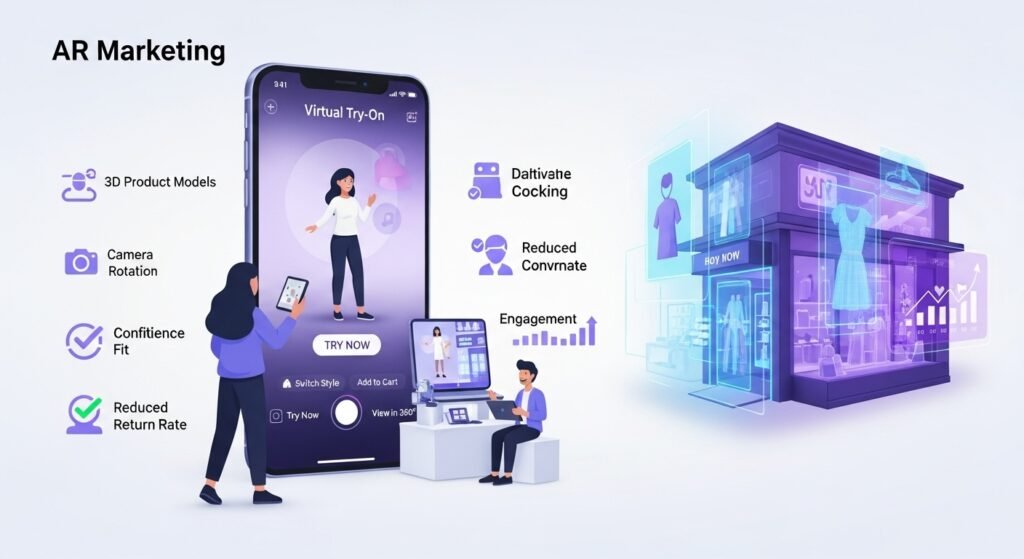
Augmented Reality (AR) marketing is rapidly transforming how small retailers attract, engage, and convert customers in 2026. What was once considered a high-cost technology limited to global brands is now accessible, affordable, and highly effective for local and small retail businesses. AR marketing allows customers to visualize products in real time using their smartphones—whether it’s trying on glasses, seeing how a sofa fits in their living room, previewing makeup shades, or checking how apparel looks before buying. This immersive experience removes uncertainty from online shopping and bridges the gap between digital and physical retail.
For small retailers, one of the biggest challenges is building buyer confidence online. Customers hesitate to purchase because they can’t touch, try, or test products. Virtual try-ons powered by AR solve this problem by offering interactive previews that closely mimic real-life experiences. In 2026, AR tools are easier to integrate into websites, eCommerce platforms, social media apps, and even WhatsApp catalogs. Customers don’t need special devices—just a smartphone camera.
AR marketing also delivers measurable business results. Retailers using virtual try-ons report higher engagement, longer time spent on product pages, fewer returns, and increased conversion rates. Instead of relying solely on product images or videos, AR adds a layer of personalization and realism that modern consumers expect. For fashion, eyewear, cosmetics, furniture, home décor, and accessories, AR has become a competitive advantage.
In this article, you’ll learn what ARs marketing is, how virtual try-ons work, why they matter for small retailers, step-by-step implementation strategies, real case studies, success stories, video content ideas, a practical AR framework, and frequently asked questions—all designed to help small retailers boost sales and customer trust using AR technology.
What Is AR Marketing?
AR marketing uses augmented reality technology to overlay digital elements—such as products, colors, or effects—onto a real-world environment through a smartphone or camera.
For retailers, this means customers can:
- Try products virtually
- Visualize size, color, and fit
- Interact with products before buying
Why Virtual Try-Ons Matter for Small Retailers
Virtual try-ons solve key retail challenges:
- Reduce hesitation before purchase
- Increase buyer confidence
- Lower return rates
- Improve customer engagement
AR helps small retailers compete with large brands by offering premium experiences.
Types of AR Virtual Try-Ons for Retail Businesses
Fashion & Apparel Try-Ons
Customers can preview clothing styles and fits digitally.
Eyewear & Accessories
Virtual glasses, watches, and jewelry try-ons improve accuracy.
Beauty & Cosmetics
Makeup, skincare, and hair color previews boost conversion.
Furniture & Home Décor
AR shows how items fit into real spaces before purchase.
How Small Retailers Can Implement AR Step by Step
Step 1: Choose the Right AR Platform
Select tools compatible with your website, eCommerce platform, or social media.
Step 2: Prepare Product Assets
High-quality 3D models or images are essential for accurate AR experiences.
Step 3: Integrate AR with Sales Channels
Use AR on:
- Product pages
- Instagram and Facebook filters
- Google AR results
Step 4: Educate Customers
Use tutorials and prompts to encourage users to try ARs features.
Step 5: Track Performance
Measure engagement, conversions, and return rates.
Case Study: Increasing Online Sales with ARs Try-Ons
A small fashion retailer introduced AR try-ons on product pages.
Results in 60 days:
- 45% increase in product engagement
- 30% higher conversion rate
- Significant reduction in returns
Customers felt more confident purchasing online.
Success Story: Competing with Big Brands Using ARs
A local eyewear store added virtual try-ons to their online catalog.
Outcome:
- Increased online orders
- Higher customer satisfaction
- Stronger brand perception
AR helped the store compete with national brands digitally.
Video Content Ideas for ARs Marketing
A strong video idea is “How ARs Try-Ons Are Changing Online Shopping for Small Retailers”, featuring:
- Live AR demos
- Before-and-after results
- Customer reactions
This content performs well on YouTube, Instagram Reels, and Facebook.
ARs Marketing Framework for Small Retailers
A simple AR framework:
- Select products suitable for ARs
- Create immersive try-ons
- Integrate with eCommerce
- Promote ARs features
- Optimize based on data
Best Practices
- Start with best-selling products
- Keep AR experiences simple
- Ensure mobile optimization
- Combine AR with social proof
FAQs: AR Marketing for Small Retailers
Is AR marketing expensive for small businesses?
Many AR tools are now affordable and scalable.
Do customers need special devices?
No, smartphones with cameras are enough.
Does AR actually increase conversions?
Yes, AR improves confidence and reduces uncertainty.
Which retail businesses benefit most from AR?
Fashion, beauty, furniture, eyewear, and home décor.
How long does AR implementation take?
Basic setups can be launched within weeks.
Final Thoughts
Augmented Reality marketing is no longer a future trend—it’s a present-day advantage for small retailers in 2026. Virtual try-ons create trust, reduce returns, and deliver immersive experiences that modern customers expect.
Retailers that succeed with AR:
- Focus on customer experience
- Use AR where it adds real value
- Promote AR features actively
- Measure and improve continuously
At Kanity Solutions, we help small retailers implement AR-powered marketing strategies that drive engagement and sales.
🌐 www.kanity.in
📞 9454784602