
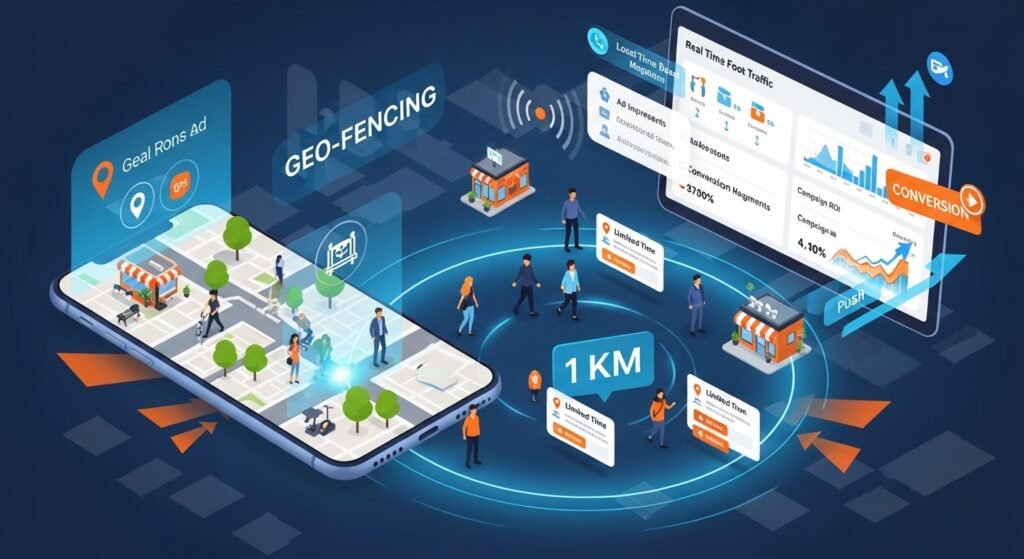
Introduction to Geo-Fencing Ads
As a digital marketing strategist, I have witnessed the evolution of location-based advertising, and one of the most effective strategies that have gained significant attention in recent years is geo-fencing ads. Geo-fencing is a technology that allows businesses to target customers within a specific geographic radius, typically within a 1 km radius, using mobile devices. This location-based advertising strategy has revolutionized the way businesses approach local marketing, enabling them to reach customers who are in close proximity to their physical stores or locations.
The concept of geo-fencing ads is simple yet powerful. It involves creating a virtual boundary around a specific location, such as a store, restaurant, or event, and targeting customers who enter or exit that boundary with relevant ads. This approach allows businesses to reach customers who are most likely to be interested in their products or services, increasing the chances of conversion and driving foot traffic to their physical locations. In this section, we will delve deeper into the world of geo-fencing ads, exploring their benefits, how they work, and examples of successful campaigns.
Geo-fencing ads are particularly useful for businesses that have a physical presence, such as retail stores, restaurants, and hotels. By targeting customers who are in close proximity to their locations, these businesses can increase brand awareness, drive sales, and enhance customer engagement. For instance, a retail store can create a geo-fence around its location and target customers who enter the fence with ads promoting special offers, discounts, or new products. This approach enables the store to reach customers who are most likely to visit the store and make a purchase, increasing the chances of conversion.
Another significant advantage of geo-fencing ads is their ability to provide businesses with valuable insights into customer behavior. By analyzing data on customer interactions with geo-fencing ads, businesses can gain a deeper understanding of their target audience, including their demographics, interests, and preferences. This information can be used to refine marketing strategies, optimize ad targeting, and improve overall customer experience. For example, a restaurant can use geo-fencing ads to target customers who are in close proximity to its location and analyze data on customer interactions to identify peak hours, popular menu items, and customer preferences.
The technology behind geo-fencing ads is based on a combination of GPS, Wi-Fi, and cellular data. When a customer enters a geo-fence, their mobile device sends a signal to the geo-fencing platform, which then triggers the delivery of targeted ads. The platform uses advanced algorithms to determine the customer’s location, taking into account factors such as latitude, longitude, and altitude. This ensures that customers receive relevant ads that are tailored to their specific location and interests.
There are several types of geo-fencing ads, including:
- Location-based ads: These ads are triggered when a customer enters or exits a specific location, such as a store or restaurant.
- Proximity ads: These ads are triggered when a customer is within a certain distance from a specific location, such as a 1 km radius.
- Geotargeting ads: These ads are triggered when a customer is in a specific geographic region, such as a city or zip code.
Geo-fencing ads can be delivered through various channels, including mobile apps, social media, and search engines. For example, a business can use Facebook’s geo-fencing feature to target customers who are within a 1 km radius of its location. Similarly, a business can use Google Ads to target customers who are searching for keywords related to its products or services within a specific geographic region.
In conclusion, geo-fencing ads offer a powerful way for businesses to target customers within a specific geographic radius, increasing the chances of conversion and driving foot traffic to physical locations. By understanding how geo-fencing ads work and the benefits they offer, businesses can develop effective location-based marketing strategies that drive real results. In the next section, we will explore the benefits of geo-fencing ads in more detail, including their ability to increase brand awareness, drive sales, and enhance customer engagement.
As a digital marketing strategist, I have seen firsthand the impact that geo-fencing ads can have on a business’s bottom line. By targeting customers who are in close proximity to their physical locations, businesses can increase sales, drive foot traffic, and enhance customer engagement. For example, a retail store can use geo-fencing ads to target customers who are within a 1 km radius of its location, promoting special offers and discounts to drive sales and increase customer loyalty.
Geo-fencing ads also offer a range of benefits for businesses, including:
- Increased brand awareness: Geo-fencing ads enable businesses to reach customers who are in close proximity to their physical locations, increasing brand awareness and recognition.
- Improved customer engagement: Geo-fencing ads allow businesses to engage with customers in real-time, providing them with relevant and personalized offers and promotions.
- Enhanced customer experience: Geo-fencing ads enable businesses to provide customers with a seamless and personalized experience, both online and offline.
Overall, geo-fencing ads offer a powerful way for businesses to target customers within a specific geographic radius, driving real results and enhancing customer engagement. By understanding the benefits and technology behind geo-fencing ads, businesses can develop effective location-based marketing strategies that drive sales, increase brand awareness, and enhance customer loyalty.
How Geo-Fencing Ads Work
As a digital marketing strategist, I have witnessed the evolution of location-based advertising, and one of the most effective techniques that have emerged in recent years is geo-fencing ads. This innovative approach allows businesses to target customers within a specific geographic radius, typically within 1 kilometer, with personalized messages and offers. In this section, we will delve into the inner workings of geo-fencing ads and explore how they can be leveraged to drive foot traffic, increase sales, and enhance customer engagement.
Geo-fencing ads rely on a combination of GPS, cellular, and Wi-Fi data to identify the location of potential customers. By creating a virtual fence around a specific area, businesses can target users who enter or exit that zone with tailored ads, promotions, and messages. This location-based targeting is made possible by the widespread use of smartphones, which are equipped with GPS and other location-sensing technologies. As a result, businesses can now reach customers who are in close proximity to their physical locations, increasing the likelihood of converting them into paying customers.
The process of creating a geo-fence involves defining a specific geographic area, which can be as small as 1 kilometer in radius. This area is then used to target users who enter or exit the zone, triggering the delivery of ads, notifications, or other forms of communication. For example, a retail store could create a geo-fence around its physical location, targeting customers who are within a 1-kilometer radius with exclusive offers, discounts, or promotions. By doing so, the store can increase foot traffic, drive sales, and build brand awareness among local customers.
One of the key benefits of geo-fencing ads is their ability to target customers in real-time, as they move in and out of the defined geographic area. This allows businesses to respond quickly to changing customer behaviors and preferences, delivering personalized messages and offers that are relevant to their current location and context. For instance, a restaurant could create a geo-fence around its location, targeting customers who are within a 1-kilometer radius with special deals, discounts, or promotions during lunch or dinner hours. By doing so, the restaurant can increase foot traffic, drive sales, and enhance customer engagement during peak hours.
Geo-fencing ads can be delivered through a variety of channels, including mobile apps, social media platforms, and websites. By leveraging these channels, businesses can reach customers who are most likely to be interested in their products or services, increasing the effectiveness of their advertising efforts. For example, a coffee shop could create a geo-fence around its location, targeting customers who are within a 1-kilometer radius with ads, promotions, or offers on social media platforms like Facebook or Instagram. By doing so, the coffee shop can increase brand awareness, drive foot traffic, and enhance customer engagement among local customers.
The use of geo-fencing ads is not limited to retail or food service industries. Any business that has a physical location can benefit from this location-based targeting technique. For instance, a car dealership could create a geo-fence around its location, targeting customers who are within a 1-kilometer radius with ads, promotions, or offers on new or used vehicles. By doing so, the dealership can increase foot traffic, drive sales, and enhance customer engagement among local car buyers.
There are several benefits to using geo-fencing ads, including:
- Increased foot traffic: By targeting customers who are within a specific geographic radius, businesses can drive more foot traffic to their physical locations.
- Improved customer engagement: Geo-fencing ads allow businesses to deliver personalized messages and offers to customers who are most likely to be interested in their products or services.
- Enhanced targeting: Geo-fencing ads enable businesses to target customers based on their location, increasing the effectiveness of their advertising efforts.
- Real-time targeting: Geo-fencing ads can be delivered in real-time, as customers move in and out of the defined geographic area.
- Measurable results: The effectiveness of geo-fencing ads can be measured and tracked, allowing businesses to refine their targeting and optimization strategies.
However, geo-fencing ads also require careful planning and execution to be effective. Businesses must define their target audience, create compelling ad copy, and optimize their ad delivery to ensure maximum impact. Additionally, businesses must ensure that their geo-fencing ads comply with relevant laws and regulations, such as those related to data privacy and consumer protection.
As a digital marketing strategist, I have worked with numerous businesses to develop and implement effective geo-fencing ad campaigns. One example that comes to mind is a retail client that created a geo-fence around its physical location, targeting customers who were within a 1-kilometer radius with exclusive offers and promotions. The campaign resulted in a significant increase in foot traffic, with a 25% boost in sales during the promotional period. The client was able to track the effectiveness of the campaign in real-time, making adjustments to the ad targeting and optimization strategy to maximize results.
In conclusion, geo-fencing ads offer a powerful way for businesses to target customers within a specific geographic radius, driving foot traffic, increasing sales, and enhancing customer engagement. By leveraging location-based targeting, businesses can deliver personalized messages and offers to customers who are most likely to be interested in their products or services. As the use of smartphones and location-sensing technologies continues to grow, geo-fencing ads are likely to become an increasingly important part of any business’s marketing strategy. Whether you are a retail store, restaurant, or car dealership, geo-fencing ads can help you reach customers who are in close proximity to your physical location, increasing the likelihood of converting them into paying customers.
As we move forward in the digital marketing landscape, it is essential to stay ahead of the curve and leverage the latest technologies and techniques to drive business growth. Geo-fencing ads are just one example of the many innovative approaches that can be used to target customers and drive sales. By staying up-to-date with the latest trends and best practices, businesses can stay competitive and achieve their marketing goals. In my next section, I will explore the benefits and challenges of implementing geo-fencing ads, providing insights and examples to help businesses get started with this powerful location-based targeting technique.
Targeting Options and Strategies
As a digital marketing strategist, I have seen firsthand the impact that geo-fencing ads can have on a business’s bottom line. By targeting customers within a 1 KM radius, businesses can increase foot traffic, drive sales, and boost brand awareness. In this section, we will explore the various targeting options and strategies that are available to businesses looking to leverage geo-fencing ads.
One of the most effective ways to target customers with geo-fencing ads is to use location-based targeting. This involves creating a virtual fence around a specific location, such as a store or restaurant, and targeting customers who are within that fence. For example, a coffee shop could create a geo-fence around their location and target customers who are within a 1 KM radius, offering them a discount on their next purchase. This can be especially effective for businesses that have a physical location and want to drive foot traffic.
Another targeting option is to use demographic targeting. This involves targeting customers based on demographics such as age, gender, and income level. For example, a clothing store could target customers who are within a 1 KM radius of their location and are between the ages of 25-45, with a medium to high income level. This can be especially effective for businesses that have a specific target audience and want to reach them with targeted ads.
Behavioral targeting is another option that businesses can use to target customers with geo-fencing ads. This involves targeting customers based on their behavior, such as their purchase history or search history. For example, a restaurant could target customers who are within a 1 KM radius of their location and have searched for “food” or “dining” online in the past 30 days. This can be especially effective for businesses that want to reach customers who are already interested in their products or services.
In addition to these targeting options, businesses can also use contextual targeting to reach customers with geo-fencing ads. This involves targeting customers based on the context in which they are viewing the ad, such as the time of day or the device they are using. For example, a gym could target customers who are within a 1 KM radius of their location and are viewing the ad on a mobile device during peak hours (e.g. 5-7 pm). This can be especially effective for businesses that want to reach customers who are likely to be interested in their products or services at a specific time or place.
Some of the key strategies that businesses can use to target customers with geo-fencing ads include:
- Proximity targeting: targeting customers who are within a specific distance of a location, such as a store or restaurant.
- Time-based targeting: targeting customers at specific times of the day or week, such as during peak hours or on weekends.
- Device-based targeting: targeting customers based on the device they are using, such as a mobile device or desktop computer.
- Interest-based targeting: targeting customers based on their interests, such as hobbies or passions.
- Lookalike targeting: targeting customers who are similar to a business’s existing customers, such as in terms of demographics or behavior.
For example, a retail store could use proximity targeting to target customers who are within a 1 KM radius of their location, and offer them a discount on their next purchase. They could also use time-based targeting to target customers during peak hours (e.g. 12-2 pm) and offer them a special promotion. By using these strategies, businesses can increase the effectiveness of their geo-fencing ads and drive more sales and revenue.
It’s also important to note that businesses can use geo-fencing ads in combination with other digital marketing strategies, such as search engine optimization (SEO) and pay-per-click (PPC) advertising. For example, a business could use geo-fencing ads to target customers who are within a 1 KM radius of their location, and also use SEO to optimize their website for local search terms. This can help to increase the business’s online visibility and drive more foot traffic to their location.
In addition, businesses can use data and analytics to measure the effectiveness of their geo-fencing ads and make data-driven decisions about their marketing strategy. For example, a business could use data on customer behavior and demographics to identify the most effective targeting options and strategies, and adjust their ad creative and messaging accordingly. This can help to ensure that the business is getting the most out of their geo-fencing ad spend and driving the best possible return on investment (ROI).
Overall, geo-fencing ads offer a powerful way for businesses to target customers within a 1 KM radius and drive sales, revenue, and brand awareness. By using the targeting options and strategies outlined in this section, businesses can create effective geo-fencing ad campaigns that reach their target audience and achieve their marketing goals. Whether you’re a small business or a large enterprise, geo-fencing ads can be a valuable addition to your digital marketing strategy, and can help you to reach and engage with your customers in new and innovative ways.
Measuring Success and Optimizing Geo-Fencing Ads
As a digital marketing strategist, I have worked with numerous businesses to implement geo-fencing ads, and one of the most critical aspects of this strategy is measuring its success and optimizing it for better results. In this section, we will delve into the world of measuring success and optimizing geo-fencing ads to help you get the most out of your campaigns.
When it comes to measuring the success of geo-fencing ads, there are several key performance indicators (KPIs) that you need to track. These KPIs will help you understand how your ads are performing and whether they are meeting your marketing goals. Some of the most common KPIs for geo-fencing ads include click-through rates (CTR), conversion rates, and return on ad spend (ROAS). By tracking these KPIs, you can gain valuable insights into the effectiveness of your ads and make data-driven decisions to optimize them.
For example, let’s say you are a retail business that has implemented geo-fencing ads to target customers within a 1 km radius of your store. You have set up a campaign with a budget of $1,000 per month, and your goal is to drive foot traffic to your store. To measure the success of your campaign, you track the CTR, conversion rate, and ROAS. After a month, you find that your CTR is 2%, your conversion rate is 10%, and your ROAS is 300%. This means that for every dollar you spend on ads, you are getting three dollars back in revenue. Based on these results, you can optimize your campaign by increasing your budget, targeting a wider radius, or adjusting your ad creative to improve performance.
Another important aspect of measuring success is to track the customer journey. By using tools like Google Analytics, you can track how customers are interacting with your ads, from the initial click to the final conversion. This will help you identify any bottlenecks in the customer journey and make optimizations to improve the overall experience. For instance, if you find that customers are clicking on your ads but not converting, you may need to adjust your landing page or offer to better meet their needs.
In addition to tracking KPIs and the customer journey, it’s also essential to conduct regular A/B testing to optimize your geo-fencing ads. A/B testing involves creating two versions of an ad, with one version being the control group and the other version being the test group. By comparing the performance of the two groups, you can identify which ad creative, targeting option, or bidding strategy is performing better. This will help you refine your campaign and improve its overall performance.
Some examples of A/B testing for geo-fencing ads include:
- Testing different ad creatives, such as images or videos, to see which one performs better
- Testing different targeting options, such as demographics or interests, to see which one is more effective
- Testing different bidding strategies, such as cost-per-click (CPC) or cost-per-thousand impressions (CPM), to see which one provides the best return on investment
By conducting regular A/B testing, you can continually optimize your geo-fencing ads and improve their performance over time. This will help you achieve your marketing goals, whether it’s driving foot traffic to your store, generating leads, or increasing sales.
Furthermore, it’s also important to use geo-fencing ad platforms that provide advanced targeting options and real-time analytics. These platforms can help you target customers with precision, using factors such as location, behavior, and demographics. They can also provide you with real-time insights into your campaign’s performance, allowing you to make data-driven decisions and optimize your ads on the fly.
For instance, some geo-fencing ad platforms offer advanced features such as:
- Location-based targeting, which allows you to target customers based on their physical location
- Behavioral targeting, which allows you to target customers based on their online behavior and interests
- Demographic targeting, which allows you to target customers based on their age, gender, and other demographic factors
By using these advanced targeting options, you can create highly targeted campaigns that reach your ideal customer and drive real results for your business. Additionally, by using real-time analytics, you can monitor your campaign’s performance and make adjustments as needed to optimize its performance.
In conclusion, measuring success and optimizing geo-fencing ads is critical to achieving your marketing goals. By tracking KPIs, the customer journey, and conducting regular A/B testing, you can refine your campaign and improve its overall performance. Additionally, by using geo-fencing ad platforms with advanced targeting options and real-time analytics, you can create highly targeted campaigns that drive real results for your business. As a digital marketing strategist, I have seen firsthand the impact that geo-fencing ads can have on a business, and I highly recommend incorporating them into your marketing strategy.
As you continue to optimize and refine your geo-fencing ads, keep in mind that the key to success lies in continually testing and improving your campaigns. By staying up-to-date with the latest trends and best practices in geo-fencing ads, you can stay ahead of the competition and achieve your marketing goals. Whether you’re a retail business, restaurant, or service provider, geo-fencing ads can help you reach your target audience and drive real results for your business.
Best Practices and Future of Geo-Fencing Ads
As a digital marketing strategist and SEO consultant, I have witnessed the evolution of location-based advertising, and geo-fencing ads have emerged as a game-changer in targeting customers within a specific geographic radius. In this section, we will delve into the best practices and future of geo-fencing ads, exploring how businesses can leverage this technology to drive sales, increase brand awareness, and stay ahead of the competition.
Geo-fencing ads allow businesses to target customers within a specific geographic area, typically within a 1 KM radius, by creating a virtual fence around a specific location. This location-based advertising strategy enables businesses to reach customers who are in close proximity to their store, restaurant, or office, increasing the likelihood of conversion. To maximize the effectiveness of geo-fencing ads, businesses must adhere to best practices that ensure precision, relevance, and engagement.
One of the most critical best practices for geo-fencing ads is to define the target audience. Businesses must identify their ideal customer demographics, interests, and behaviors to create targeted ads that resonate with their audience. For instance, a retail store may target customers who have shown interest in fashion, have a medium to high disposable income, and are between the ages of 25 and 45. By defining the target audience, businesses can ensure that their ads are seen by the people who are most likely to convert.
Another essential best practice is to choose the right geo-fencing platform. With numerous platforms available, businesses must select a platform that offers precise location targeting, robust analytics, and seamless integration with their existing marketing stack. Some popular geo-fencing platforms include Google Ads, Facebook Ads, and GroundTruth. When choosing a platform, businesses must consider factors such as cost, ease of use, and customer support to ensure a smooth and effective campaign execution.
In addition to defining the target audience and choosing the right platform, businesses must also optimize their ad creatives. Geo-fencing ads must be visually appealing, engaging, and relevant to the target audience. Businesses can use high-quality images, videos, and copy that speaks to the customer’s needs and interests. For example, a restaurant may use an image of a delicious meal, along with a limited-time offer, to entice customers to visit their establishment. By optimizing ad creatives, businesses can increase click-through rates, conversions, and overall campaign ROI.
Furthermore, businesses must monitor and measure campaign performance to ensure that their geo-fencing ads are meeting their marketing objectives. Key performance indicators (KPIs) such as click-through rates, conversions, and return on ad spend (ROAS) must be tracked and analyzed to identify areas of improvement. Businesses can use analytics tools such as Google Analytics or platform-specific analytics to monitor campaign performance and make data-driven decisions to optimize their ads.
To illustrate the effectiveness of geo-fencing ads, let’s consider a few examples:
- A coffee shop uses geo-fencing ads to target customers within a 1 KM radius of their store. The ads offer a limited-time discount on coffee purchases, resulting in a 25% increase in foot traffic and a 15% increase in sales.
- A retail store uses geo-fencing ads to target customers who have visited their competitors’ stores. The ads offer exclusive promotions and discounts, resulting in a 30% increase in sales and a 20% increase in customer loyalty.
- A restaurant uses geo-fencing ads to target customers who have shown interest in food delivery services. The ads offer limited-time discounts and free delivery, resulting in a 40% increase in online orders and a 25% increase in customer retention.
As we look to the future of geo-fencing ads, we can expect to see even more advanced location-based advertising technologies emerge. With the increasing use of artificial intelligence (AI) and machine learning (ML), businesses will be able to create more personalized and targeted ads that speak to the individual needs and preferences of their customers. Additionally, the integration of Internet of Things (IoT) devices will enable businesses to target customers based on their physical presence and behavior, creating a more seamless and immersive advertising experience.
In conclusion, geo-fencing ads offer a powerful way for businesses to target customers within a specific geographic radius, driving sales, increasing brand awareness, and stay ahead of the competition. By following best practices such as defining the target audience, choosing the right platform, optimizing ad creatives, and monitoring campaign performance, businesses can maximize the effectiveness of their geo-fencing ads. As the technology continues to evolve, we can expect to see even more advanced location-based advertising strategies emerge, enabling businesses to create more personalized, targeted, and engaging ads that resonate with their customers.
As a digital marketing strategist and SEO consultant, I strongly believe that geo-fencing ads will play a critical role in the future of location-based advertising. With the increasing use of mobile devices, advancements in AI and ML, and the integration of IoT devices, businesses will have more opportunities to create targeted, engaging, and personalized ads that drive real results. Whether you’re a small business or a large enterprise, geo-fencing ads offer a powerful way to reach your target audience and achieve your marketing objectives.