
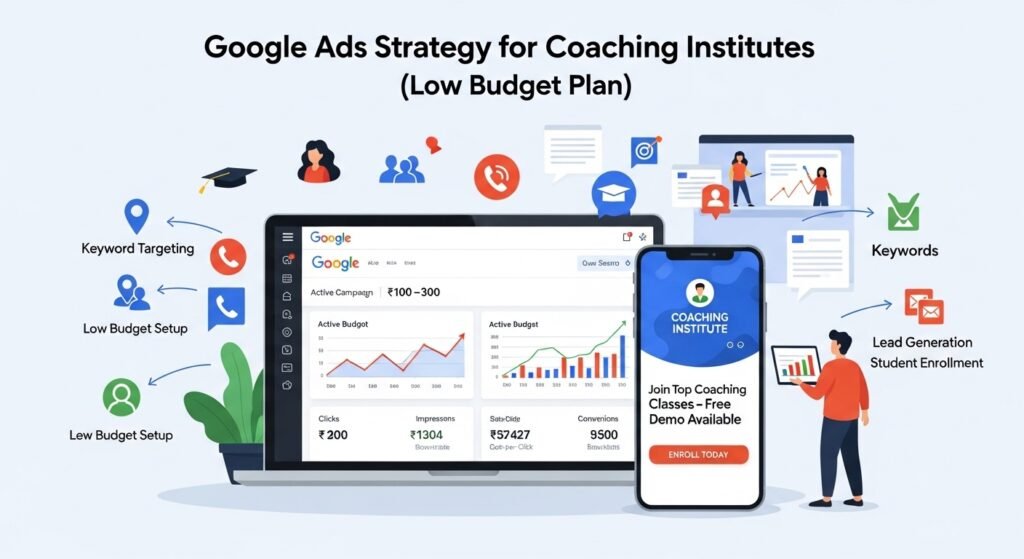
Introduction to Google Ads for Coaching Institutes
As a digital marketing strategist, I have worked with numerous coaching institutes to help them establish a strong online presence and attract potential students. In today’s competitive landscape, having a well-planned Google Ads strategy is crucial for coaching institutes to reach their target audience and drive conversions. Google Ads, formerly known as Google AdWords, is a powerful platform that enables businesses to create and display ads to users who are searching for specific keywords or browsing websites with relevant content. In this section, we will explore the importance of Google Ads for coaching institutes and how a low-budget plan can be effectively implemented to achieve desired results.
Coaching institutes often face challenges in terms of limited budget and resources, which can make it difficult to compete with larger institutions. However, with a strategic approach to Google Ads, even small coaching institutes can increase their visibility, generate leads, and drive enrollments. By targeting the right audience, creating compelling ad copy, and optimizing bids, coaching institutes can maximize their return on investment (ROI) and achieve their marketing goals. In this article, we will discuss the key components of a Google Ads strategy for coaching institutes, including keyword research, ad copy creation, bid optimization, and campaign tracking.
Before we dive into the details of creating a low-budget Google Ads plan, it’s essential to understand the benefits of using Google Ads for coaching institutes. Some of the advantages of Google Ads include increased brand visibility, targeted advertising, measurable results, and flexible budgeting. By leveraging these benefits, coaching institutes can create a competitive edge and establish themselves as a trusted provider of educational services. For instance, a coaching institute that offers preparation courses for competitive exams can use Google Ads to target students who are searching for relevant keywords, such as “exam preparation courses” or “coaching classes for exams”.
To create an effective Google Ads strategy, coaching institutes need to conduct thorough keyword research. This involves identifying relevant keywords and phrases that potential students are likely to use when searching for coaching services. Some examples of keywords that coaching institutes might target include:
- Coaching classes for exams
- Exam preparation courses
- Test preparation coaching
- Coaching institutes for competitive exams
- Online coaching classes
By targeting these keywords, coaching institutes can create ads that are relevant to their target audience and increase the likelihood of driving conversions. For example, a coaching institute that offers online coaching classes can create an ad with the headline “Online Coaching Classes for Competitive Exams” and the description “Get expert coaching and preparation for competitive exams with our online classes. Enroll now and achieve your goals!”.
In addition to keyword research, coaching institutes need to create compelling ad copy that resonates with their target audience. This includes crafting headlines, descriptions, and display URLs that are informative, engaging, and persuasive. Some best practices for creating effective ad copy include:
- Using attention-grabbing headlines that highlight the benefits of the coaching institute
- Writing descriptive text that provides valuable information about the coaching services
- Including calls-to-action (CTAs) that encourage users to take action
- Using display URLs that are easy to remember and relevant to the ad copy
By following these best practices, coaching institutes can create ad copy that drives conversions and establishes their brand as a trusted provider of educational services. For instance, a coaching institute that offers coaching classes for exams can create an ad with the headline “Get Expert Coaching for Competitive Exams” and the description “Our experienced faculty and proven teaching methods will help you achieve your goals. Enroll now and start preparing for your exams!”.
In the next section, we will discuss how to optimize bids and track campaign performance to maximize ROI and achieve marketing goals. We will also explore some tips and tricks for creating a low-budget Google Ads plan that drives results for coaching institutes.
Setting Up a Low Budget Google Ads Campaign
As a digital marketing strategist, I have worked with numerous coaching institutes that are looking to expand their reach and attract new students. One of the most effective ways to do this is through Google Ads, but many institutes are hesitant to try it due to concerns about budget. However, with a well-planned strategy, it is possible to set up a low budget Google Ads campaign that drives results. In this section, we will explore the key steps to setting up a low budget Google Ads campaign for coaching institutes.
The first step in setting up a low budget Google Ads campaign is to define your target audience. Who are the people that you want to reach with your ads? What are their interests, behaviors, and demographics? Understanding your target audience is crucial to creating ads that resonate with them and drive conversions. For example, if you are a coaching institute that specializes in preparing students for engineering exams, your target audience may be students who are interested in engineering and are actively searching for coaching services online.
Once you have defined your target audience, the next step is to conduct keyword research. What keywords are your target audience using to search for coaching services online? What are the most relevant and high-traffic keywords that you can use to target your ads? Using tools like Google Keyword Planner or Ahrefs, you can identify the most relevant keywords and phrases that your target audience is using to search for coaching services. For instance, if you are a coaching institute that offers coaching for engineering exams, some relevant keywords may include “engineering exam coaching,” “engineering entrance exam preparation,” or “best coaching for engineering exams.”
After conducting keyword research, the next step is to set up your ad groups. Ad groups are a way to organize your ads and keywords into specific categories, making it easier to manage and optimize your campaigns. For a low budget Google Ads campaign, it’s essential to keep your ad groups small and focused, with no more than 10-15 keywords per ad group. This will help you to target your ads more effectively and avoid wasting budget on irrelevant keywords. For example, if you are a coaching institute that offers coaching for engineering exams, you may set up ad groups for specific exams, such as “JEE Main,” “JEE Advanced,” or “GATE.”
Another crucial step in setting up a low budget Google Ads campaign is to create compelling ad copy. Your ad copy should be clear, concise, and compelling, with a clear call-to-action that encourages users to click on your ad. Your ad copy should also be relevant to your target audience and keywords, with a focus on the benefits and unique selling points of your coaching institute. For instance, if you are a coaching institute that offers coaching for engineering exams, your ad copy may include headlines such as “Crack JEE Main with Our Expert Coaching” or “Get Ahead in Engineering Exams with Our Proven Strategies.”
In addition to creating compelling ad copy, it’s also essential to set up conversion tracking. Conversion tracking allows you to track the actions that users take on your website after clicking on your ad, such as filling out a form, making a phone call, or signing up for a newsletter. By tracking conversions, you can measure the effectiveness of your ads and make data-driven decisions to optimize your campaign. For example, if you are a coaching institute that offers coaching for engineering exams, you may set up conversion tracking for actions such as “request a callback,” “download a brochure,” or “register for a free demo class.”
Finally, the last step in setting up a low budget Google Ads campaign is to set a budget and bid strategy. Your budget and bid strategy will depend on your goals and target audience, but for a low budget campaign, it’s essential to start with a small budget and gradually increase it as you gather more data and insights. You may also consider using automated bid strategies such as cost-per-conversion (CPA) or return on ad spend (ROAS) to optimize your bids and get the most out of your budget. For instance, if you are a coaching institute that offers coaching for engineering exams, you may set a budget of $500 per month and bid $5 per click, with a focus on targeting users who are actively searching for coaching services online.
Some other tips to keep in mind when setting up a low budget Google Ads campaign include:
- Using long-tail keywords to target specific search queries and reduce competition
- Targeting specific locations to reach users who are searching for coaching services in specific areas
- Using ad extensions such as site links, callouts, and call extensions to provide more information and encourage users to click on your ad
- Monitoring and optimizing your campaign regularly to ensure that you are getting the most out of your budget
- Using Google Ads scripts to automate tasks and streamline your campaign management
By following these steps and tips, you can set up a low budget Google Ads campaign that drives results for your coaching institute. Remember to always keep your target audience in mind, and to regularly monitor and optimize your campaign to ensure that you are getting the most out of your budget. With a well-planned strategy and a focus on targeting the right audience, you can use Google Ads to attract new students and grow your coaching institute, even on a limited budget.
Additionally, it’s essential to track your return on investment (ROI) to ensure that your Google Ads campaign is generating a positive return. You can use tools like Google Analytics to track your ROI and make data-driven decisions to optimize your campaign. For example, if you are spending $500 per month on Google Ads and generating $2,000 in revenue, your ROI would be 300%, indicating that your campaign is generating a positive return.
In conclusion, setting up a low budget Google Ads campaign requires careful planning, targeting, and optimization. By defining your target audience, conducting keyword research, setting up ad groups, creating compelling ad copy, setting up conversion tracking, and setting a budget and bid strategy, you can create a campaign that drives results for your coaching institute. Remember to always keep your target audience in mind, and to regularly monitor and optimize your campaign to ensure that you are getting the most out of your budget.
Optimizing Google Ads Campaigns for Coaching Institutes
As a digital marketing strategist, I have worked with numerous coaching institutes to help them scale their online presence and attract more students. One of the most effective ways to achieve this is by optimizing Google Ads campaigns. In this section, we will explore the strategies and techniques that coaching institutes can use to optimize their Google Ads campaigns, even with a low budget.
Google Ads is a powerful platform that allows coaching institutes to reach their target audience and drive conversions. However, with so many features and options available, it can be overwhelming to navigate, especially for those with limited experience. In this article, we will break down the key components of a successful Google Ads campaign for coaching institutes and provide actionable tips on how to optimize them for maximum ROI.
The first step in optimizing Google Ads campaigns for coaching institutes is to define the target audience. This involves identifying the demographics, interests, and behaviors of the ideal student. For example, if a coaching institute specializes in preparing students for engineering exams, their target audience may be students aged 18-25 who are interested in science and technology. By targeting the right audience, coaching institutes can increase the likelihood of converting ad clicks into leads and ultimately, into students.
Another crucial aspect of optimizing Google Ads campaigns is to choose the right keywords. Coaching institutes should conduct thorough keyword research to identify relevant and high-traffic keywords that their target audience is searching for. For instance, if a coaching institute offers courses in mathematics, they may target keywords such as “math tuition” or “math coaching classes.” By targeting the right keywords, coaching institutes can increase their ad visibility and drive more relevant traffic to their website.
In addition to targeting the right audience and keywords, coaching institutes should also optimize their ad copy. This involves crafting compelling and relevant ad copy that resonates with the target audience and encourages them to click on the ad. For example, a coaching institute may use ad copy such as “Get expert math tuition and achieve your academic goals” or “Join our coaching classes and become a math whiz.” By optimizing their ad copy, coaching institutes can increase their click-through rates and drive more conversions.
Coaching institutes should also set up conversion tracking to measure the effectiveness of their Google Ads campaigns. This involves setting up goals and conversions in Google Ads, such as form submissions or phone calls, to track the number of leads and conversions generated from the campaigns. By tracking conversions, coaching institutes can optimize their campaigns for maximum ROI and make data-driven decisions to improve their ad performance.
Furthermore, coaching institutes should utilize Google Ads extensions to enhance their ad visibility and drive more conversions. Google Ads extensions such as site links, callouts, and call extensions can provide additional information about the coaching institute and encourage users to click on the ad. For example, a coaching institute may use site links to promote their courses or callouts to highlight their unique selling points. By utilizing Google Ads extensions, coaching institutes can increase their ad visibility and drive more conversions.
In terms of budgeting, coaching institutes can use low-budget strategies to optimize their Google Ads campaigns. One strategy is to use cost-per-click (CPC) bidding, which allows coaching institutes to set a maximum bid for each ad click. This can help coaching institutes control their ad spend and ensure that they are getting the most out of their budget. Another strategy is to use ad scheduling, which allows coaching institutes to schedule their ads to run during specific times of the day or week. This can help coaching institutes target their audience when they are most likely to convert.
Some other low-budget strategies that coaching institutes can use to optimize their Google Ads campaigns include:
- Targeting specific locations: Coaching institutes can target specific locations to reach their local audience and reduce ad spend.
- Using negative keywords: Coaching institutes can use negative keywords to exclude irrelevant searches and reduce ad spend.
- Optimizing ad copy for mobile devices: Coaching institutes can optimize their ad copy for mobile devices to increase their click-through rates and drive more conversions.
- Using Google Ads remarketing: Coaching institutes can use Google Ads remarketing to target users who have visited their website and encourage them to convert.
By implementing these strategies and techniques, coaching institutes can optimize their Google Ads campaigns and drive more conversions, even with a low budget. It’s also important to note that ongoing optimization is key to achieving maximum ROI from Google Ads campaigns. Coaching institutes should regularly monitor their ad performance, track their conversions, and make data-driven decisions to improve their ad campaigns.
In conclusion, optimizing Google Ads campaigns for coaching institutes requires a deep understanding of the target audience, keywords, ad copy, and budgeting strategies. By following the strategies and techniques outlined in this article, coaching institutes can create effective Google Ads campaigns that drive conversions and help them achieve their business goals. As a digital marketing strategist, I have seen firsthand the impact that optimized Google Ads campaigns can have on coaching institutes, and I recommend that all coaching institutes consider using Google Ads as part of their digital marketing strategy.
Advanced Google Ads Strategies for Coaching Institutes
As a digital marketing strategist, I have worked with numerous coaching institutes to help them establish a strong online presence and attract potential students. One of the most effective ways to achieve this is by leveraging Google Ads. With a well-planned Google Ads strategy, coaching institutes can increase their visibility, drive more conversions, and ultimately boost their revenue. In this section, we will explore advanced Google Ads strategies that coaching institutes can use to achieve their marketing goals, even with a low budget.
Before we dive into the strategies, it’s essential to understand the importance of Google Ads for coaching institutes. Google Ads is a powerful platform that allows businesses to create and display ads to a targeted audience. By using relevant keywords, coaching institutes can reach potential students who are actively searching for courses or programs related to their offerings. This targeted approach ensures that coaching institutes can maximize their return on investment (ROI) and minimize waste on irrelevant advertising.
To create an effective Google Ads strategy, coaching institutes need to start by defining their target audience. This involves identifying the demographic characteristics, interests, and behaviors of potential students. For example, a coaching institute that offers preparation courses for engineering exams may target students who are between the ages of 18 and 25, have a strong interest in science and mathematics, and are actively searching for exam preparation resources online. By understanding their target audience, coaching institutes can create ads that resonate with them and increase the likelihood of conversion.
Another critical aspect of a Google Ads strategy is keyword research. Coaching institutes need to identify relevant keywords that potential students use when searching for courses or programs. This can be done using tools like Google Keyword Planner or Ahrefs. For instance, a coaching institute that offers language courses may target keywords like “English language courses,” “Spanish language classes,” or “French language tutorials.” By targeting the right keywords, coaching institutes can increase their ad visibility and attract more relevant traffic to their website.
In addition to keyword research, coaching institutes need to optimize their ad copy and landing pages to improve their conversion rates. This involves creating compelling ad headlines, descriptions, and display URLs that entice potential students to click on the ad. The landing page should also be optimized to provide a seamless user experience, with clear and concise information about the course or program, as well as a prominent call-to-action (CTA) to encourage conversions. For example, a coaching institute that offers online courses may use a headline like “Learn from the comfort of your home” and a description like “Get access to our expert instructors and interactive learning materials.”
Coaching institutes can also use Google Ads extensions to enhance their ad visibility and provide more value to potential students. Ad extensions like site links, callouts, and call extensions can be used to provide additional information about the course or program, such as tuition fees, course duration, or admission requirements. For instance, a coaching institute that offers a diploma program may use a site link extension to link to a page that provides more information about the program, such as the curriculum, faculty, and career prospects.
To maximize their ROI, coaching institutes need to monitor and optimize their Google Ads campaigns regularly. This involves tracking key metrics like click-through rates (CTRs), conversion rates, and cost per conversion (CPC). By analyzing these metrics, coaching institutes can identify areas for improvement and make data-driven decisions to optimize their campaigns. For example, if a coaching institute finds that their CTR is low, they may need to adjust their ad copy or targeting to better resonate with their target audience.
Some other advanced Google Ads strategies that coaching institutes can use include:
- Retargeting ads: Coaching institutes can use retargeting ads to target users who have visited their website but have not converted yet. This involves creating ads that are specifically designed to target users who have shown interest in the course or program but have not taken the desired action.
- Lookalike targeting: Coaching institutes can use lookalike targeting to target users who are similar to their existing students or website visitors. This involves creating ads that are designed to target users who share similar characteristics, interests, or behaviors with the target audience.
- Google Ads scripts: Coaching institutes can use Google Ads scripts to automate their campaigns and improve their efficiency. This involves using scripts to automate tasks like bid management, ad rotation, and reporting, which can help coaching institutes save time and resources.
Despite the many benefits of Google Ads, coaching institutes often face challenges when it comes to managing their campaigns, especially with a low budget. One of the biggest challenges is ensuring that the ad spend is optimized to maximize ROI. To overcome this challenge, coaching institutes can use a variety of strategies, such as:
- Setting a daily budget: Coaching institutes can set a daily budget to ensure that their ad spend is limited to a specific amount. This can help prevent overspending and ensure that the ad campaigns are optimized to maximize ROI.
- Using bid adjustments: Coaching institutes can use bid adjustments to adjust their bids based on the target audience, location, or device. This can help coaching institutes optimize their ad spend to target the most relevant audience and maximize their conversions.
- Utilizing ad extensions: Coaching institutes can use ad extensions like site links, callouts, and call extensions to provide more value to potential students and increase their ad visibility. This can help coaching institutes attract more relevant traffic to their website and improve their conversion rates.
In conclusion, Google Ads can be a powerful tool for coaching institutes to attract potential students and drive conversions. By using advanced Google Ads strategies like keyword research, ad copy optimization, and ad extensions, coaching institutes can maximize their ROI and achieve their marketing goals, even with a low budget. By monitoring and optimizing their campaigns regularly, coaching institutes can ensure that their ad spend is optimized to maximize ROI and drive business growth.
As a digital marketing strategist, I have seen many coaching institutes achieve success with Google Ads by using the strategies outlined above. For example, a coaching institute that offers preparation courses for medical exams was able to increase their conversions by 25% by using retargeting ads and lookalike targeting. Another coaching institute that offers language courses was able to reduce their cost per conversion by 30% by using bid adjustments and ad extensions. By leveraging the power of Google Ads and using advanced strategies, coaching institutes can achieve their marketing goals and drive business growth.
Measuring and Improving ROI for Coaching Institutes
As a digital marketing strategist, I have worked with numerous coaching institutes to help them scale their online presence and boost their return on investment (ROI). One of the most critical aspects of any Google Ads strategy is measuring and improving ROI. In this section, we will delve into the world of ROI measurement and explore strategies to enhance it for coaching institutes, particularly those operating on a low budget.
Measuring ROI is essential because it helps coaching institutes understand the effectiveness of their Google Ads campaigns. By tracking ROI, they can identify areas of improvement, optimize their campaigns, and allocate their budget more efficiently. In the context of coaching institutes, ROI is not just about generating leads or driving website traffic; it’s about converting those leads into paying students and ultimately, increasing revenue.
To measure ROI, coaching institutes need to set clear goals and key performance indicators (KPIs). These goals may include increasing website traffic, generating leads, boosting conversions, or driving sales. Once the goals are established, they can use Google Ads’ built-in metrics, such as cost per conversion, conversion rate, and return on ad spend (ROAS), to track their progress. For instance, if a coaching institute aims to increase its website traffic, it can use Google Ads’ metrics to monitor the number of clicks, impressions, and cost per click (CPC) for its campaigns.
Improving ROI for coaching institutes requires a combination of strategic planning, ongoing optimization, and data-driven decision-making. One approach is to focus on high-performing keywords and ad groups, which can help coaching institutes reach their target audience more effectively. For example, if a coaching institute offers test preparation courses, it can target keywords like “test prep,” “entrance exam coaching,” or “competitive exam preparation.” By targeting these keywords, the coaching institute can increase its visibility, drive more relevant traffic to its website, and ultimately, boost its conversions.
Another strategy to improve ROI is to use location targeting. Coaching institutes can target specific geographic locations, such as cities, states, or countries, to reach their target audience. This approach is particularly useful for coaching institutes with physical centers or those that offer online courses with a regional focus. For instance, a coaching institute with centers in India can target cities like Mumbai, Delhi, or Bangalore to reach students preparing for competitive exams.
In addition to keyword targeting and location targeting, coaching institutes can also use ad extensions to enhance their Google Ads campaigns. Ad extensions provide additional information about the coaching institute, such as its address, phone number, or reviews, which can help increase its credibility and appeal to potential students. For example, a coaching institute can use sitelink extensions to promote its courses, callout extensions to highlight its unique selling points, or review extensions to showcase its ratings and testimonials.
Coaching institutes can also leverage remarketing campaigns to target users who have previously interacted with their website or social media channels. Remarketing campaigns can help coaching institutes re-engage with potential students, increase their brand awareness, and ultimately, drive more conversions. For instance, a coaching institute can create a remarketing campaign to target users who have visited its website but haven’t converted yet, offering them special discounts or promotions to encourage them to take action.
To optimize their Google Ads campaigns and improve ROI, coaching institutes can use the following strategies:
- Conduct regular keyword research to identify high-performing keywords and ad groups
- Monitor and optimize their ad copy and landing pages to improve their conversion rates
- Use negative keywords to exclude irrelevant searches and reduce wasted spend
- Set up and track conversion actions to measure the effectiveness of their campaigns
- Use Google Ads’ automated bidding strategies to optimize their bids and improve their ROI
By implementing these strategies and continuously monitoring their Google Ads campaigns, coaching institutes can improve their ROI, increase their revenue, and achieve their business goals. As a digital marketing strategist, I have seen numerous coaching institutes achieve significant improvements in their ROI by following these strategies and leveraging the power of Google Ads.
In conclusion, measuring and improving ROI is crucial for coaching institutes to maximize their return on investment and achieve their business objectives. By setting clear goals, tracking key performance indicators, and using strategic planning, ongoing optimization, and data-driven decision-making, coaching institutes can improve their ROI and drive more conversions. As the digital marketing landscape continues to evolve, it’s essential for coaching institutes to stay up-to-date with the latest trends and best practices in Google Ads to remain competitive and achieve long-term success.

Amit Tyagi is a seasoned Digital Marketing and SEO Consultant with extensive experience helping businesses improve online visibility through SEO, AI Search Optimization (AIO/GEO), content strategy, and performance marketing. He regularly shares practical insights, industry updates, and data-driven strategies, empowering brands and marketers to achieve sustainable digital growth in an evolving search landsca