
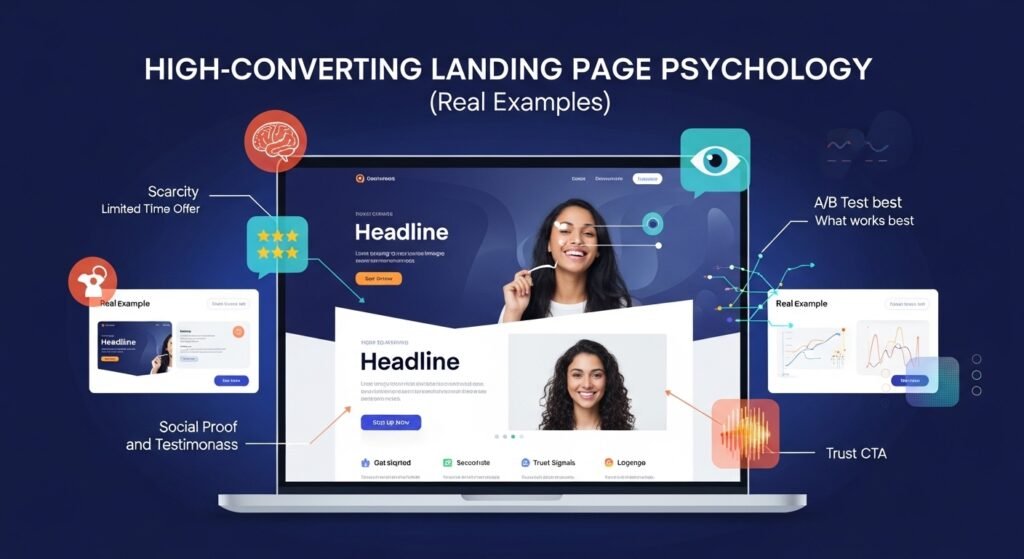
Introduction to High-Converting Landing Page Psychology
As a digital marketing strategist, I’ve seen firsthand the impact that a well-designed landing page can have on conversion rates. A landing page is often the first point of contact between a potential customer and a brand, and it’s essential to make a good impression. In this section, we’ll explore the importance of landing page optimization, the role of psychology in crafting effective landing pages, and provide an overview of key psychological principles for conversion.
Understanding the Importance of Landing Page Optimization
Landing page optimization is crucial for any business looking to drive conversions and revenue. A well-designed landing page can increase conversion rates, improve user experience, and ultimately drive more sales. However, a poorly designed landing page can have the opposite effect, leading to high bounce rates and low conversion rates. By understanding the importance of landing page optimization, businesses can take the first step towards creating a high-converting landing page.
Role of Psychology in Crafting Effective Landing Pages
Psychology plays a significant role in crafting effective landing pages. By understanding how users think, feel, and behave, businesses can design landing pages that resonate with their target audience. This includes using cognitive biases to influence user behavior, creating emotional connections with users, and streamlining the user experience to reduce friction and increase conversions. By incorporating psychological principles into landing page design, businesses can create pages that are more effective at driving conversions.
Overview of Key Psychological Principles for Conversion
There are several key psychological principles that can be used to drive conversions on landing pages. These include:
- Social proof: using customer testimonials, reviews, and ratings to build trust and credibility
- Scarcity: creating a sense of urgency by limiting availability or offering limited-time discounts
- Reciprocity: offering something of value in exchange for a user’s contact information or other desired action
- Anchoring: using a higher-priced option to make a lower-priced option seem more reasonable by comparison
By understanding these psychological principles, businesses can create landing pages that are more effective at driving conversions.
Principles of Landing Page Psychology
In this section, we’ll delve deeper into the principles of landing page psychology, including understanding user behavior and decision-making, applying cognitive biases to boost conversions, and utilizing emotional triggers for engagement.
Understanding User Behavior and Decision-Making
Understanding user behavior and decision-making is critical for creating effective landing pages. By understanding how users think and behave, businesses can design landing pages that meet their needs and resonate with their target audience. This includes understanding user motivations, pain points, and goals. By understanding these factors, businesses can create landing pages that are more effective at driving conversions.
Applying Cognitive Biases to Boost Conversions
Cognitive biases are systematic patterns of thought that influence user behavior. By applying cognitive biases to landing page design, businesses can boost conversions and drive more sales. For example, the principle of reciprocity can be used to offer a free trial or demo in exchange for a user’s contact information. The principle of scarcity can be used to create a sense of urgency by limiting availability or offering limited-time discounts. By understanding and applying cognitive biases, businesses can create landing pages that are more effective at driving conversions.
Utilizing Emotional Triggers for Engagement
Emotional triggers are powerful motivators that can be used to drive engagement and conversions on landing pages. By understanding and utilizing emotional triggers, businesses can create landing pages that resonate with their target audience and drive more sales. For example, images and videos can be used to create an emotional connection with users, while storytelling can be used to create a sense of narrative and engagement. By understanding and utilizing emotional triggers, businesses can create landing pages that are more effective at driving conversions.
Real-World Examples of High-Converting Landing Pages
In this section, we’ll explore real-world examples of high-converting landing pages, including case studies and analysis of successful landing pages.
Case Study: Analyzing Successful Landing Pages
Let’s take a look at a case study of a successful landing page. The landing page for Warby Parker, an online eyewear retailer, is a great example of a high-converting landing page. The page features a clear and concise headline, a prominent call-to-action, and a visually appealing design. The page also uses social proof in the form of customer testimonials and reviews to build trust and credibility. By analyzing this landing page, we can see how the principles of landing page psychology are applied in real-world scenarios.
Breaking Down the Psychology Behind Each Element
Let’s break down the psychology behind each element of the Warby Parker landing page. The headline is designed to grab the user’s attention and communicate the value proposition of the brand. The call-to-action is prominent and clear, making it easy for users to take the desired action. The social proof is used to build trust and credibility with users, while the visually appealing design creates an emotional connection with users. By understanding the psychology behind each element, businesses can create landing pages that are more effective at driving conversions.
Lessons Learned from Real-World Landing Page Examples
By analyzing real-world landing page examples, we can learn valuable lessons about what works and what doesn’t. For example, we can see the importance of clear and concise headlines, prominent calls-to-action, and visually appealing design. We can also see the value of social proof and emotional triggers in driving conversions. By applying these lessons to our own landing page design, we can create pages that are more effective at driving conversions and revenue.
Implementing Landing Page Psychology for Better Conversions
In this section, we’ll explore strategies for implementing landing page psychology for better conversions, including creating attention-grabbing headlines, building trust and credibility, and streamlining landing page design.
Strategies for Creating Attention-Grabbing Headlines
Creating attention-grabbing headlines is critical for driving conversions on landing pages. By using action-oriented language, emotional triggers, and clear and concise language, businesses can create headlines that grab the user’s attention and communicate the value proposition of the brand. For example, a headline that uses scarcity or urgency can create a sense of limited-time offer and drive more conversions.
Tactics for Building Trust and Credibility
Building trust and credibility is essential for driving conversions on landing pages. By using social proof, customer testimonials, and trust badges, businesses can create a sense of trust and credibility with users. For example, a landing page that features a customer testimonial or a trust badge can create a sense of trust and credibility with users.
Best Practices for Streamlining Landing Page Design
Streamlining landing page design is critical for driving conversions. By using clear and concise language, visually appealing design, and prominent calls-to-action, businesses can create landing pages that are easy to navigate and drive more conversions. For example, a landing page that uses a single-column design and a prominent call-to-action can create a sense of clarity and simplicity, making it easier for users to take the desired action.
Measuring and Optimizing Landing Page Performance
In this section, we’ll explore key metrics for evaluating landing page success, using A/B testing and user feedback for improvement, and advanced analytics for data-driven decision making.
Key Metrics for Evaluating Landing Page Success
There are several key metrics that can be used to evaluate landing page success, including conversion rate, bounce rate, and average order value. By tracking these metrics, businesses can understand how their landing pages are performing and identify areas for improvement.
Using A/B Testing and User Feedback for Improvement
A/B testing and user feedback are essential for optimizing landing page performance. By testing different elements of the landing page, such as headlines, calls-to-action, and images, businesses can identify which elements are driving the most conversions and make data-driven decisions to improve performance. User feedback can also provide valuable insights into user behavior and preferences, helping businesses to create landing pages that are more effective at driving conversions.
Advanced Analytics for Data-Driven Decision Making
Advanced analytics can provide businesses with a deeper understanding of user behavior and landing page performance. By using heat maps, click-through analysis, and funnel analysis, businesses can identify areas of the landing page that are driving the most conversions and make data-driven decisions to improve performance. For example, a heat map can show which areas of the landing page are receiving the most attention, while click-through analysis can show which elements are driving the most conversions. By using advanced analytics, businesses can create landing pages that are more effective at driving conversions and revenue.