
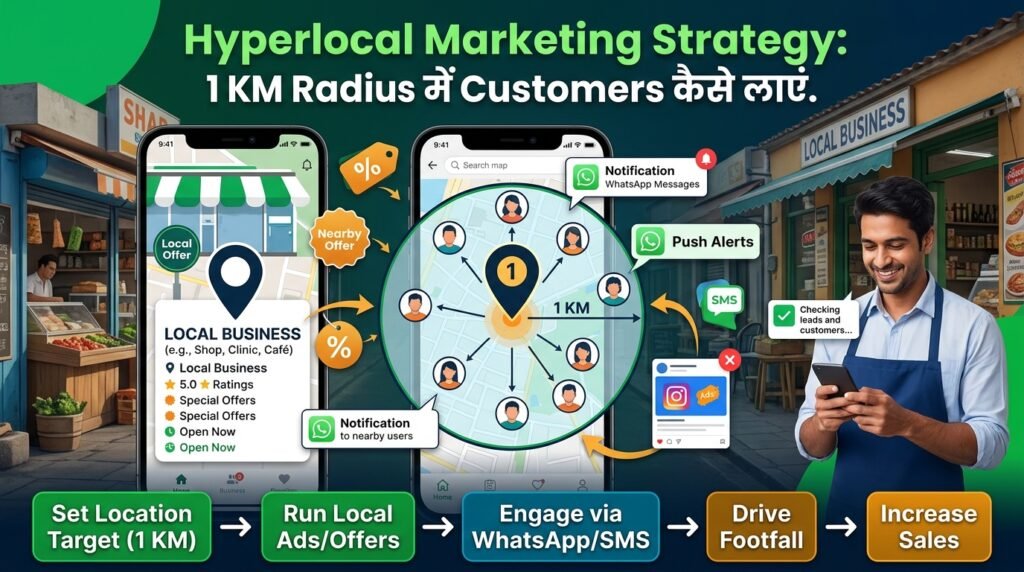
Introduction to Hyperlocal Marketing Strategy
As a digital marketing strategist and SEO consultant, I have worked with numerous businesses to help them scale globally through advanced SEO frameworks and performance-driven digital strategies. However, in today’s competitive market, it’s not just about reaching a global audience, but also about targeting the right customers in the right location. This is where hyperlocal marketing comes into play. In this section, we will delve into the concept of hyperlocal marketing strategy and how it can help businesses attract customers within a 1 KM radius.
Hyperlocal marketing refers to the process of targeting customers within a specific geographic location, usually within a few kilometers of a business’s physical location. This type of marketing strategy is particularly effective for small and medium-sized businesses that rely on local customers to drive sales and revenue. By focusing on a specific area, businesses can create highly targeted marketing campaigns that resonate with local customers and drive foot traffic to their stores.
The concept of hyperlocal marketing is not new, but it has gained significant attention in recent years with the rise of mobile devices and location-based services. With the majority of consumers using their smartphones to search for local businesses, hyperlocal marketing has become an essential component of any local SEO strategy. In this article, we will explore the benefits of hyperlocal marketing and provide tips and strategies for businesses to attract customers within a 1 KM radius.
One of the primary benefits of hyperlocal marketing is that it allows businesses to target customers who are most likely to visit their store. By creating highly targeted marketing campaigns, businesses can increase foot traffic, drive sales, and build brand awareness within their local community. Hyperlocal marketing also provides businesses with the opportunity to compete with larger corporations and online retailers, which often have a broader reach and more significant marketing budgets.
Another significant advantage of hyperlocal marketing is that it enables businesses to build strong relationships with their local customers. By engaging with customers through social media, email marketing, and other channels, businesses can create a loyal customer base that will drive repeat business and referrals. This, in turn, can help businesses to establish a strong reputation within their local community and increase their online visibility through positive reviews and testimonials.
To illustrate the effectiveness of hyperlocal marketing, let’s consider an example. Suppose we have a small coffee shop located in the heart of a busy city. The coffee shop wants to attract more customers within a 1 KM radius and increase foot traffic to their store. To achieve this, they create a hyperlocal marketing campaign that targets customers who are searching for coffee shops in their area. The campaign includes a combination of search engine optimization (SEO), pay-per-click (PPC) advertising, and social media marketing.
Through SEO, the coffee shop optimizes their website and online presence to rank higher in search engine results pages (SERPs) for keywords related to their business, such as “coffee shops near me” or “best coffee in [city name].” This helps the coffee shop to increase their online visibility and attract organic traffic to their website. The coffee shop also uses PPC advertising to target customers who are searching for coffee shops in their area, using keywords such as “coffee shops in [city name]” or “coffee near me.”
In addition to SEO and PPC advertising, the coffee shop uses social media marketing to engage with their local customers and build a loyal customer base. They create a business page on Facebook and Instagram, and post regular updates, promotions, and special offers to attract customers to their store. The coffee shop also uses social media to respond to customer inquiries, resolve complaints, and build strong relationships with their customers.
By using a combination of these hyperlocal marketing strategies, the coffee shop is able to attract more customers within a 1 KM radius and increase foot traffic to their store. The coffee shop’s online visibility increases, and they start to receive more positive reviews and testimonials from their customers. This, in turn, helps the coffee shop to establish a strong reputation within their local community and increase their sales and revenue.
In the next section, we will explore the key components of a successful hyperlocal marketing strategy and provide tips and strategies for businesses to attract customers within a 1 KM radius. We will also discuss the importance of location-based services, such as Google My Business, and how businesses can use these services to increase their online visibility and attract more customers to their store.
Some of the key components of a successful hyperlocal marketing strategy include:
- Search engine optimization (SEO) to increase online visibility and attract organic traffic to a business’s website
- Pay-per-click (PPC) advertising to target customers who are searching for businesses in their area
- Social media marketing to engage with local customers and build a loyal customer base
- Location-based services, such as Google My Business, to increase online visibility and attract more customers to a business’s store
- Email marketing to stay in touch with customers and promote special offers and promotions
- Content marketing to create valuable and relevant content that attracts and engages local customers
By using these components and creating a comprehensive hyperlocal marketing strategy, businesses can attract more customers within a 1 KM radius and increase their sales and revenue. In the next section, we will provide more detailed information on each of these components and offer tips and strategies for businesses to create a successful hyperlocal marketing campaign.
Understanding Your Hyperlocal Audience
As a digital marketing strategist, I have worked with numerous businesses to develop effective hyperlocal marketing strategies that drive real results. One of the most critical components of a successful hyperlocal marketing strategy is understanding your target audience within a specific geographic area, typically within a 1 KM radius. In this section, we will delve into the importance of understanding your hyperlocal audience and provide actionable tips on how to do so.
To effectively target customers within a 1 KM radius, it is essential to have a deep understanding of their needs, preferences, and behaviors. This requires gathering and analyzing data on demographics, interests, and pain points. By doing so, you can create targeted marketing campaigns that resonate with your audience and drive foot traffic to your business. For instance, if you own a coffee shop, understanding that your target audience is predominantly young professionals who value sustainability and quality coffee can help you tailor your marketing efforts to appeal to this demographic.
So, how can you gain a deeper understanding of your hyperlocal audience? One approach is to conduct market research through surveys, focus groups, or social media listening. This can provide valuable insights into your target audience’s demographics, interests, and pain points. Additionally, you can leverage tools like Google Analytics to analyze website traffic and identify trends and patterns in user behavior. By combining these data points, you can develop a comprehensive understanding of your hyperlocal audience and create targeted marketing campaigns that drive real results.
Another crucial aspect of understanding your hyperlocal audience is identifying their preferred communication channels. In today’s digital age, consumers are bombarded with marketing messages across various platforms, including social media, email, and search engines. To effectively reach your target audience, it is essential to understand which channels they prefer and tailor your marketing efforts accordingly. For example, if your target audience is predominantly active on Instagram, you may want to focus your marketing efforts on this platform, creating engaging content that resonates with your audience and drives foot traffic to your business.
Furthermore, understanding your hyperlocal audience’s behavior and preferences can help you identify opportunities to differentiate your business from competitors. By offering unique products or services that cater to the specific needs of your target audience, you can establish your business as a go-to destination within the local community. For instance, if you own a restaurant, offering a loyalty program or exclusive discounts to local residents can help drive customer loyalty and retention.
It is also important to note that understanding your hyperlocal audience is an ongoing process that requires continuous monitoring and analysis. Consumer behaviors and preferences can change rapidly, and it is essential to stay ahead of the curve to remain competitive. By regularly reviewing your marketing analytics and adjusting your strategies accordingly, you can ensure that your marketing efforts remain effective and drive real results for your business.
To illustrate the importance of understanding your hyperlocal audience, let’s consider a few examples. Suppose you own a fitness studio within a 1 KM radius of a busy commercial district. By understanding that your target audience is predominantly professionals who value convenience and flexibility, you can offer classes and workshops that cater to their schedules and preferences. This could include early morning or lunchtime classes, as well as online booking and payment systems to streamline the customer experience.
In another example, if you own a retail store within a 1 KM radius of a residential area, understanding that your target audience is predominantly families with young children can help you tailor your marketing efforts to appeal to this demographic. This could include offering kid-friendly products and services, such as childcare facilities or kid’s clubs, as well as hosting events and workshops that cater to families.
In conclusion, understanding your hyperlocal audience is a critical component of a successful hyperlocal marketing strategy. By gathering and analyzing data on demographics, interests, and pain points, you can create targeted marketing campaigns that resonate with your audience and drive foot traffic to your business. Additionally, identifying preferred communication channels and differentiating your business from competitors can help establish your business as a go-to destination within the local community.
Some key takeaways for understanding your hyperlocal audience include:
- Conduct market research to gather data on demographics, interests, and pain points
- Leverage tools like Google Analytics to analyze website traffic and identify trends and patterns in user behavior
- Identify preferred communication channels and tailor marketing efforts accordingly
- Differentiate your business from competitors by offering unique products or services that cater to the specific needs of your target audience
- Regularly review marketing analytics and adjust strategies to stay ahead of the curve
By following these tips and staying focused on the needs and preferences of your hyperlocal audience, you can develop a hyperlocal marketing strategy that drives real results for your business. In the next section, we will explore how to create targeted marketing campaigns that resonate with your hyperlocal audience and drive foot traffic to your business.
Hyperlocal Marketing Strategies for Businesses
As a digital marketing strategist and SEO consultant, I have worked with numerous businesses to help them scale globally through advanced SEO frameworks and performance-driven digital strategies. However, in today’s competitive market, it’s equally important for businesses to focus on hyperlocal marketing strategies to attract customers within a 1 KM radius. In this section, we will explore the importance of hyperlocal marketing and discuss strategies that businesses can use to attract customers within a specific geographic location.
Hyperlocal marketing refers to the practice of targeting customers within a specific geographic location, usually within a 1-5 KM radius. This type of marketing is particularly useful for small businesses, such as restaurants, retail stores, and service providers, that rely on local customers for their revenue. By using hyperlocal marketing strategies, businesses can increase their visibility, drive foot traffic, and ultimately, boost sales.
So, how can businesses attract customers within a 1 KM radius? Here are a few strategies that can be effective:
- Optimize Your Website for Local Search: One of the most important hyperlocal marketing strategies is to optimize your website for local search. This includes using location-specific keywords, creating content that is relevant to your local audience, and ensuring that your website is mobile-friendly. By doing so, you can increase your website’s visibility in local search results, making it more likely that customers will find you when searching for products or services in your area.
- Use Location-Based Social Media Advertising: Social media platforms, such as Facebook and Instagram, offer location-based advertising options that allow you to target customers within a specific geographic location. By using these options, you can create targeted ads that are more likely to reach customers who are near your business. For example, if you own a coffee shop, you can create an ad that targets customers who are within a 1 KM radius of your shop, offering them a discount on their next purchase.
- Claim and Optimize Your Google My Business Listing: Claiming and optimizing your Google My Business listing is another important hyperlocal marketing strategy. This includes providing accurate and up-to-date information about your business, such as your address, phone number, and hours of operation. You should also respond promptly to customer reviews and use the listing to promote your business and offer special deals. By doing so, you can increase your business’s visibility in local search results and attract more customers.
- Partner with Local Influencers: Partnering with local influencers can be an effective way to attract customers within a 1 KM radius. Local influencers are individuals who have a large following within your local community and can help promote your business to their followers. For example, if you own a fashion store, you can partner with a local fashion influencer to promote your store and products to their followers.
- Use Location-Based Email Marketing: Location-based email marketing involves sending targeted emails to customers who are near your business. For example, if you own a restaurant, you can send an email to customers who are within a 1 KM radius of your restaurant, offering them a discount on their next meal. By using location-based email marketing, you can increase the effectiveness of your email marketing campaigns and attract more customers to your business.
In addition to these strategies, businesses can also use other hyperlocal marketing tactics, such as hosting local events, offering loyalty programs, and using location-based messaging apps. By using these tactics, businesses can increase their visibility, drive foot traffic, and ultimately, boost sales.
For example, let’s say you own a retail store that sells clothing and accessories. To attract customers within a 1 KM radius, you can create a social media ad that targets customers who are near your store, offering them a discount on their next purchase. You can also partner with local influencers to promote your store and products to their followers. Additionally, you can use location-based email marketing to send targeted emails to customers who are near your store, offering them exclusive deals and promotions.
Another example is a restaurant that uses location-based marketing to attract customers within a 1 KM radius. The restaurant can create a Google My Business listing and optimize it with accurate and up-to-date information, such as its address, phone number, and hours of operation. The restaurant can also use location-based social media advertising to target customers who are near the restaurant, offering them discounts and promotions. Additionally, the restaurant can partner with local influencers to promote its menu and services to their followers.
In conclusion, hyperlocal marketing is an effective way for businesses to attract customers within a specific geographic location. By using hyperlocal marketing strategies, such as optimizing your website for local search, using location-based social media advertising, claiming and optimizing your Google My Business listing, partnering with local influencers, and using location-based email marketing, businesses can increase their visibility, drive foot traffic, and ultimately, boost sales. As a digital marketing strategist and SEO consultant, I have seen firsthand the effectiveness of hyperlocal marketing strategies in attracting customers and driving revenue for businesses.
Measuring and Optimizing Hyperlocal Marketing Performance
As a digital marketing strategist and SEO consultant, I have worked with numerous businesses to develop and implement effective hyperlocal marketing strategies. One of the key aspects of a successful hyperlocal marketing campaign is measuring and optimizing its performance. In this section, we will delve into the importance of tracking key performance indicators (KPIs) and adjusting your strategy to maximize your return on investment (ROI) within a 1 KM radius.
When it comes to hyperlocal marketing, it is crucial to understand that the metrics used to measure success may differ from those used in traditional digital marketing campaigns. For instance, instead of focusing solely on website traffic or social media engagement, hyperlocal marketing campaigns should prioritize metrics such as foot traffic, in-store sales, and customer retention. By tracking these KPIs, businesses can gain valuable insights into the effectiveness of their hyperlocal marketing efforts and make data-driven decisions to optimize their strategy.
So, how can you measure the performance of your hyperlocal marketing campaign? Here are some key metrics to track:
- Foot traffic: This refers to the number of customers who visit your physical store or location. You can track foot traffic using tools such as Google Analytics or by installing people counters in your store.
- In-store sales: This metric measures the revenue generated by customers who visit your physical store. You can track in-store sales by integrating your point-of-sale system with your hyperlocal marketing platform or by using sales tracking software.
- Customer retention: This refers to the percentage of customers who return to your store or location after their initial visit. You can track customer retention by using loyalty programs or by analyzing customer purchase history.
- Online-to-offline conversions: This metric measures the number of customers who visit your website or social media page and then visit your physical store. You can track online-to-offline conversions using tools such as Google Analytics or by using promo codes and discounts.
Once you have started tracking these KPIs, you can begin to optimize your hyperlocal marketing performance by adjusting your strategy to better target your audience and drive more sales. Here are some tips to help you optimize your hyperlocal marketing campaign:
- Use location-based targeting: Use tools such as geofencing or location-based ads to target customers who are within a specific radius of your physical store. For example, you can create a geofence around your store and send push notifications to customers who enter the fenced area.
- Personalize your messaging: Use customer data and behavior to personalize your messaging and offers. For instance, you can use customer purchase history to send personalized offers and discounts to customers who have shown interest in specific products.
- Utilize user-generated content: Encourage customers to share their experiences and photos of your store or products on social media. You can then use this user-generated content to create social media ads and promote your business to a wider audience.
- Run limited-time offers: Create a sense of urgency by running limited-time offers and promotions. For example, you can offer a discount to customers who visit your store within a specific time frame or make a purchase within a certain period.
Let’s consider an example of a successful hyperlocal marketing campaign. Suppose you are a coffee shop owner who wants to increase foot traffic and sales within a 1 KM radius of your store. You can create a hyperlocal marketing campaign that targets customers who are within a specific radius of your store, using location-based targeting and personalized messaging. For instance, you can send push notifications to customers who are near your store, offering them a discount on their next purchase. You can also use user-generated content to create social media ads and promote your coffee shop to a wider audience.
In addition to tracking KPIs and optimizing your hyperlocal marketing campaign, it’s also important to continually monitor and adjust your strategy to ensure that it remains effective. This can involve conducting regular analysis of your campaign’s performance, gathering feedback from customers, and making adjustments to your targeting, messaging, and offers as needed. By taking a data-driven approach to hyperlocal marketing and continually optimizing your campaign, you can increase your chances of success and drive more sales and revenue for your business.
Furthermore, it’s essential to leverage the power of artificial intelligence (AI) and machine learning (ML) to optimize your hyperlocal marketing campaign. AI and ML can help you analyze large amounts of data, identify patterns, and make predictions about customer behavior. For instance, you can use AI-powered tools to analyze customer purchase history and behavior, and then use this data to create personalized offers and messaging. You can also use ML algorithms to optimize your ad targeting and bidding, ensuring that your ads are seen by the most relevant audience.
In conclusion, measuring and optimizing hyperlocal marketing performance is crucial to the success of your campaign. By tracking key metrics such as foot traffic, in-store sales, and customer retention, and adjusting your strategy to better target your audience and drive more sales, you can increase your chances of success and drive more revenue for your business. Remember to continually monitor and adjust your strategy, leveraging the power of AI and ML to optimize your campaign and stay ahead of the competition.
Implementing AI-Driven Hyperlocal Marketing Solutions
As a digital marketing strategist and SEO consultant, I have worked with numerous businesses to help them scale their online presence and drive revenue through advanced SEO frameworks and performance-driven digital strategies. One of the most effective ways to reach local customers is through hyperlocal marketing, which focuses on targeting customers within a specific geographic area, typically within a 1 KM radius. In this section, we will explore the concept of hyperlocal marketing and how AI-driven solutions can be implemented to reach customers within a 1 KM radius.
Hyperlocal marketing is a highly targeted approach that allows businesses to reach customers who are most likely to visit their store or engage with their brand. By targeting customers within a specific geographic area, businesses can increase foot traffic, drive sales, and build brand awareness. However, implementing a successful hyperlocal marketing strategy can be challenging, especially for small businesses with limited resources.
This is where AI-driven hyperlocal marketing solutions come in. With the help of AI-driven tools and technologies, businesses can automate and optimize their hyperlocal marketing efforts, reaching customers within a 1 KM radius with precision and accuracy. For example, Google My Business is a powerful tool that allows businesses to manage their online presence and reach local customers through search and maps. By optimizing their Google My Business listing, businesses can increase their visibility in search results and attract more customers to their store.
Another example of AI-driven hyperlocal marketing solutions is location-based advertising. This type of advertising uses geolocation technology to target customers who are within a specific geographic area. For instance, a coffee shop can use location-based advertising to target customers who are within a 1 KM radius of their store, offering them special promotions and discounts to visit their shop. This type of advertising is highly effective, as it reaches customers who are most likely to visit the store and engage with the brand.
In addition to location-based advertising, social media marketing is another effective way to reach customers within a 1 KM radius. Social media platforms such as Facebook and Instagram offer a range of targeting options, including location-based targeting, which allows businesses to target customers who are within a specific geographic area. For example, a restaurant can use social media marketing to target customers who are within a 1 KM radius of their location, offering them special promotions and discounts to visit their restaurant.
To implement AI-driven hyperlocal marketing solutions, businesses need to follow a structured approach. Here are some steps to follow:
- Define your target audience: Identify your target audience and their location. This will help you to create targeted marketing campaigns that reach customers within a 1 KM radius of your store.
- Optimize your online presence: Optimize your website and social media profiles to ensure that they are visible in search results and attract local customers.
- Use location-based advertising: Use location-based advertising to target customers who are within a specific geographic area. This type of advertising is highly effective, as it reaches customers who are most likely to visit your store.
- Leverage social media marketing: Leverage social media marketing to target customers who are within a 1 KM radius of your store. Social media platforms such as Facebook and Instagram offer a range of targeting options, including location-based targeting.
- Monitor and analyze your results: Monitor and analyze your results to see which marketing campaigns are working and which ones need improvement. This will help you to optimize your marketing efforts and achieve better results.
By following these steps and implementing AI-driven hyperlocal marketing solutions, businesses can reach customers within a 1 KM radius and drive revenue through increased foot traffic and sales. For example, a retail store can use AI-driven hyperlocal marketing solutions to target customers who are within a 1 KM radius of their store, offering them special promotions and discounts to visit their store. Similarly, a restaurant can use AI-driven hyperlocal marketing solutions to target customers who are within a 1 KM radius of their location, offering them special promotions and discounts to visit their restaurant.
In conclusion, implementing AI-driven hyperlocal marketing solutions is a highly effective way to reach customers within a 1 KM radius and drive revenue through increased foot traffic and sales. By defining your target audience, optimizing your online presence, using location-based advertising, leveraging social media marketing, and monitoring and analyzing your results, businesses can achieve better results and scale their online presence. As a digital marketing strategist and SEO consultant, I have worked with numerous businesses to help them implement AI-driven hyperlocal marketing solutions and achieve success in their marketing efforts.
Furthermore, AI-driven hyperlocal marketing solutions can be used in a variety of industries, including healthcare, finance, and education. For example, a hospital can use AI-driven hyperlocal marketing solutions to target patients who are within a 1 KM radius of their location, offering them special promotions and discounts to visit their hospital. Similarly, a bank can use AI-driven hyperlocal marketing solutions to target customers who are within a 1 KM radius of their branch, offering them special promotions and discounts to visit their branch.
In addition to the benefits mentioned earlier, AI-driven hyperlocal marketing solutions can also help businesses to build brand awareness and establish themselves as thought leaders in their industry. By targeting customers within a specific geographic area, businesses can increase their visibility and reach a larger audience, which can help to build brand awareness and establish themselves as thought leaders in their industry.
Finally, AI-driven hyperlocal marketing solutions can be used to personalize the customer experience and increase customer engagement. By targeting customers who are within a 1 KM radius of their store, businesses can offer them personalized promotions and discounts, which can help to increase customer engagement and loyalty. For example, a coffee shop can use AI-driven hyperlocal marketing solutions to target customers who are within a 1 KM radius of their store, offering them personalized promotions and discounts based on their purchase history and preferences.

Amit Tyagi is a seasoned Digital Marketing and SEO Consultant with extensive experience helping businesses improve online visibility through SEO, AI Search Optimization (AIO/GEO), content strategy, and performance marketing. He regularly shares practical insights, industry updates, and data-driven strategies, empowering brands and marketers to achieve sustainable digital growth in an evolving search landsca