
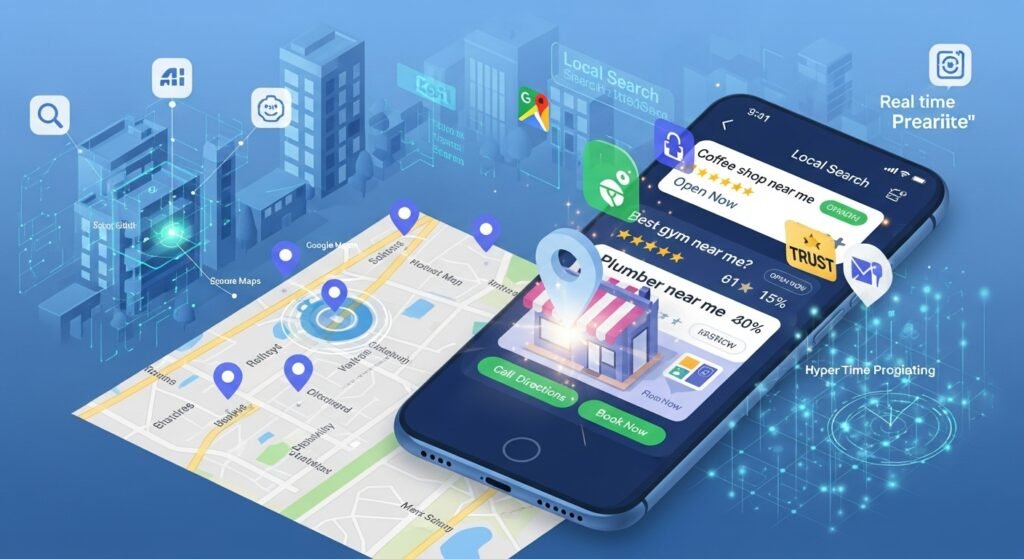
Hyperlocal SEO: Ranking for ‘Near Me’ Searches in 2026 (Complete Guide)
🌟 Introduction (300-Word Summary)
In 2026, local search has become hyperlocal. Customers no longer search broadly — they search “near me,” “open now,” “best nearby,” or “within 5 km.” These searches are driven by mobile phones, voice assistants, and instant decision-making.
When someone searches “salon near me,” “gym near me,” or “dentist near me,” Google doesn’t show hundreds of results. It shows 3–5 hyper-relevant local businesses — often on Google Maps — and most users choose from those results without scrolling further.
This means one thing: if your business is not optimized for hyperlocal SEO, you are invisible to ready-to-buy customers.
Hyperlocal SEO goes beyond traditional local SEO. It focuses on:
- Exact location intent
- Real-time signals (open now, reviews, proximity)
- Micro-areas (localities, streets, landmarks)
- Mobile & voice search behavior
For small and local businesses, hyperlocal SEO is a game-changer. It allows you to compete with big brands by targeting customers right when they are nearby and ready to act — whether that’s calling, visiting, or booking.
This article explains how businesses can rank for ‘near me’ searches in 2026, using practical, proven strategies. You’ll learn why hyperlocal SEO matters, how it works step-by-step, real case studies, success stories, content ideas, tools, and FAQs — all designed for local business owners, marketers, and agencies.
If your customers are searching nearby, your business must show up nearby.
🧭 Guide
✅ Why Hyperlocal SEO Is Critical in 2026
Hyperlocal SEO works because it targets high-intent searches.
🔥 Benefits of Hyperlocal SEO
- Higher foot traffic
- Better call conversion
- Lower competition than broad keywords
- Strong local trust signals
- Faster buying decisions
📊 Local Search Insight:
Over 76% of “near me” searches result in a visit or call within 24 hours.
🧰 Tutorial
✅ Step-by-Step: How to Rank for ‘Near Me’ Searches
Step 1: Optimize Google Business Profile (GBP) Perfectly
Your GBP is the #1 ranking factor.
Do this:
- Use accurate business name & category
- Add exact address & service areas
- Update hours (especially “open now”)
- Upload photos weekly
- Post regular updates
Step 2: Collect & Manage Reviews Actively
Reviews influence:
- Rankings
- Clicks
- Trust
Tips:
- Ask every happy customer
- Reply to all reviews
- Use keywords naturally in replies
Step 3: Use Hyperlocal Keywords
Target:
- Area names
- Landmarks
- Pincode-based keywords
Examples:
- Gym near Sector 18 Noida
- Salon near MG Road Metro
Step 4: Create Location-Specific Pages
For multi-area coverage:
- One page per locality
- Unique content per page
- Embedded Google Map
Step 5: Optimize for Mobile & Voice Search
Most “near me” searches are:
- Mobile
- Voice-based
Ensure:
- Fast loading website
- Click-to-call buttons
- Conversational content
Step 6: Build Local Citations
Maintain NAP consistency across:
- Justdial
- Sulekha
- IndiaMart
📊 Case Study
✅ How Kanity Solutions Ranked a Local Business for ‘Near Me’ Searches
Client: Local service business
Challenge:
❌ Not appearing in Google Maps
❌ No calls from local search
Hyperlocal Strategy
✔ Complete GBP optimization
✔ Review generation campaign
✔ Area-specific service pages
✔ Mobile optimization
Results (90 Days)
📈 Top 3 Google Map ranking
📞 2.4x increase in calls
📍 Higher walk-ins
🌟 Success Story
⭐ From Page 2 to Google Maps Top 3
A small retail store:
- Focused on reviews
- Added local keywords
- Optimized “open now” signals
Now when users search:
“Store near me”
The business consistently appears in the top map pack.
🎥 Video
🎬 Video Idea: “How ‘Near Me’ Searches Work on Google”
Video flow:
- How Google decides local rankings
- Real search examples
- Optimization tips
- Mistakes to avoid
Perfect for Reels, Shorts & YouTube.
🧩 Pillar Page
🚀 Hyperlocal SEO Toolkit for Local Businesses (2026)
Core Ranking Factors
- Proximity
- Relevance
- Prominence
Essential Tools
| Purpose | Tool |
| Local Listings | Google Business Profile |
| Keyword Research | Google Autocomplete |
| Reviews | WhatsApp + QR Codes |
| Tracking | Google Search Console |
Best Practices
- Keep GBP active
- Focus on real locations
- Encourage genuine reviews
- Optimize for mobile
- Track monthly performance
❓ FAQs (Frequently Asked Questions)
1. What is hyperlocal SEO?
SEO focused on very specific nearby searches.
2. How is it different from local SEO?
It targets micro-areas and real-time intent.
3. Are ‘near me’ keywords still important?
Yes, especially for mobile and voice search.
4. Do I need a website for hyperlocal SEO?
Yes, but GBP is even more important.
5. How long does hyperlocal SEO take to work?
Usually 4–8 weeks with consistent effort.
🏁 Final Thoughts
Hyperlocal SEO is no longer optional — it’s how customers find businesses today.
Businesses that win in 2026:
✔ Show up nearby
✔ Build trust locally
✔ Act fast on reviews
✔ Optimize for mobile & voice
At Kanity Solutions, we help businesses:
- Rank for “near me” searches
- Dominate Google Maps
- Convert local searches into customers
🌐 www.kanity.in
📞 9454784602