
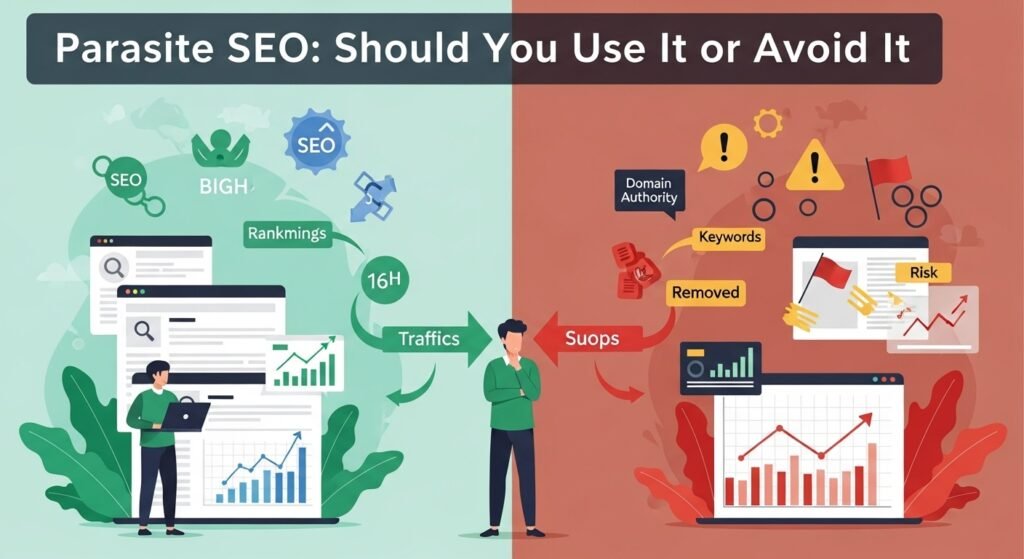
Introduction to Parasite SEO
As a digital marketing strategist and SEO consultant, I have come across various techniques that brands use to improve their online visibility and drive organic growth. One such technique that has gained significant attention in recent years is Parasite SEO. In this article, we will delve into the world of Parasite SEO, exploring its definition, benefits, and drawbacks, as well as discussing whether it is a strategy that you should consider for your brand.
Parasite SEO refers to the practice of leveraging the authority and ranking power of other websites to improve your own website’s visibility and search engine rankings. This is typically achieved by creating high-quality, relevant, and informative content on other websites, such as blogs, forums, and social media platforms, and then linking back to your own website. The idea behind Parasite SEO is to piggyback on the success of other websites, using their existing authority and credibility to boost your own online presence.
The concept of Parasite SEO may seem appealing, especially for new websites or those struggling to gain traction in the search engine results pages (SERPs). By partnering with established websites, you can potentially tap into their existing audience and credibility, driving more traffic and sales to your own website. However, as with any SEO strategy, it is essential to approach Parasite SEO with caution and carefully consider the potential risks and benefits.
In my experience, Parasite SEO can be an effective way to build backlinks, increase brand awareness, and drive referral traffic to your website. For instance, guest blogging is a popular form of Parasite SEO, where you create high-quality content for other websites in exchange for a link back to your own website. This can help you build relationships with other website owners, establish your authority in your niche, and attract new audiences to your brand. Similarly, resource pages can be used to create a list of useful resources and links to other websites, including your own, which can help to drive traffic and improve your website’s visibility.
Another example of Parasite SEO is affiliate marketing, where you partner with other websites to promote their products or services, earning a commission on any sales generated through your unique referral link. This can be a win-win for both parties, as the affiliate marketer can earn revenue, while the product owner can increase their sales and reach a wider audience. However, it is crucial to ensure that any affiliate marketing efforts are transparent, compliant with search engine guidelines, and provide value to your audience.
To illustrate the potential benefits of Parasite SEO, let’s consider a case study. Suppose you are a fashion brand looking to increase your online visibility and drive sales. You partner with a popular fashion blog to create a series of guest posts, each linking back to your website. As a result, you are able to tap into the blog’s existing audience, driving traffic and sales to your website, while also building your brand’s authority and credibility in the fashion niche.
However, as with any SEO strategy, there are also potential drawbacks to consider. For instance, over-optimization can be a significant risk, as search engines may view excessive linking or keyword stuffing as spammy behavior. Similarly, low-quality content can damage your brand’s reputation and credibility, while also failing to provide value to your audience. It is essential to approach Parasite SEO with a focus on quality, relevance, and transparency, ensuring that your efforts are aligned with search engine guidelines and provide value to your audience.
In the next section, we will explore the benefits and drawbacks of Parasite SEO in more detail, discussing the potential risks and rewards of this strategy, as well as providing guidance on how to implement it effectively. Whether you are a seasoned digital marketer or just starting out, it is essential to understand the nuances of Parasite SEO and how it can be used to drive growth and success for your brand.
Some of the key benefits of Parasite SEO include:
- Increased online visibility: By leveraging the authority and ranking power of other websites, you can increase your own website’s visibility and reach a wider audience.
- Improved brand credibility: Partnering with established websites can help to build your brand’s credibility and authority in your niche.
- Driving referral traffic: Parasite SEO can help to drive traffic to your website, increasing the potential for sales and revenue growth.
- Building backlinks: Creating high-quality content on other websites can help to build backlinks to your own website, improving your search engine rankings and online visibility.
However, there are also potential drawbacks to consider, including:
- Over-optimization: Excessive linking or keyword stuffing can be viewed as spammy behavior by search engines.
- Low-quality content: Creating low-quality content can damage your brand’s reputation and credibility, while also failing to provide value to your audience.
- Lack of control: When partnering with other websites, you may have limited control over the content and messaging, which can be a risk for your brand.
- Dependence on other websites: Parasite SEO relies on the success and credibility of other websites, which can be a risk if those websites experience a decline in popularity or credibility.
In conclusion, Parasite SEO can be a powerful strategy for driving growth and success for your brand, but it is essential to approach it with caution and carefully consider the potential risks and benefits. By understanding the nuances of Parasite SEO and implementing it effectively, you can increase your online visibility, build your brand’s credibility, and drive referral traffic to your website. In the next section, we will explore the benefits and drawbacks of Parasite SEO in more detail, providing guidance on how to implement this strategy effectively and achieve success for your brand.
How Parasite SEO Works
As a seasoned digital marketing strategist and SEO consultant, I have encountered various techniques that aim to manipulate search engine rankings. One such technique is Parasite SEO, which has gained significant attention in recent years. In this section, we will delve into the inner workings of Parasite SEO, exploring its mechanics, benefits, and drawbacks. By understanding how Parasite SEO operates, you can make informed decisions about whether to incorporate it into your digital marketing strategy or avoid it altogether.
Parasite SEO is a technique that involves leveraging the authority and ranking power of other websites to improve your own website’s search engine rankings. This is achieved by creating content on high-authority platforms, such as Medium, LinkedIn Pulse, or Quora, and linking back to your own website. The idea behind Parasite SEO is to piggyback on the credibility and trust that these platforms have established with search engines, thereby increasing your own website’s visibility and ranking.
The process of implementing Parasite SEO typically involves the following steps:
- Identifying high-authority platforms that are relevant to your niche or industry
- Creating high-quality, engaging content on these platforms, often in the form of articles, blog posts, or answers to questions
- Including links to your own website within the content, either directly or indirectly, to funnel traffic and authority to your site
- Optimizing the content on these platforms to improve its visibility and ranking, using techniques such as keyword research and optimization
- Monitoring and analyzing the performance of the content on these platforms, using metrics such as traffic, engagement, and conversion rates
A key aspect of Parasite SEO is the use of anchor text to link back to your own website. Anchor text refers to the text that is used to create a hyperlink, and it plays a crucial role in determining the relevance and authority of the link. By using descriptive and relevant anchor text, you can help search engines understand the context and purpose of the link, which can improve the ranking power of the link.
For example, suppose you are a fashion brand, and you create an article on Medium about the latest trends in sustainable fashion. Within the article, you include a link to your own website, using anchor text such as “learn more about eco-friendly clothing.” This anchor text helps search engines understand that the link is relevant to the topic of sustainable fashion, which can improve the ranking power of the link.
Another important consideration in Parasite SEO is the concept of domain authority. Domain authority refers to the credibility and trust that a website has established with search engines, based on factors such as its age, popularity, and content quality. By linking to your own website from high-authority platforms, you can transfer some of that authority to your own site, which can improve your search engine rankings.
However, it is essential to note that Parasite SEO is not without its risks and drawbacks. One of the main concerns is that search engines may view Parasite SEO as a form of manipulation, which can lead to penalties or even banning of your website. Additionally, Parasite SEO can be time-consuming and resource-intensive, requiring significant effort and investment to create high-quality content on multiple platforms.
Despite these risks, many marketers and SEO practitioners swear by the effectiveness of Parasite SEO. By leveraging the authority and ranking power of other websites, you can potentially drive more traffic and sales to your own website. Moreover, Parasite SEO can help you establish your brand as a thought leader in your industry, by creating high-quality content that resonates with your target audience.
In the next section, we will explore the pros and cons of Parasite SEO in more detail, examining the potential benefits and drawbacks of this technique. By understanding the advantages and disadvantages of Parasite SEO, you can make informed decisions about whether to incorporate it into your digital marketing strategy, and how to use it effectively to achieve your business goals.
Benefits and Advantages of Parasite SEO
As a digital marketing strategist and SEO consultant, I have worked with numerous brands to help them scale globally through advanced SEO frameworks and performance-driven digital strategies. One of the techniques that has gained significant attention in recent years is Parasite SEO. In this section, we will delve into the benefits and advantages of Parasite SEO, and explore whether it is a strategy that you should consider for your online presence.
Parasite SEO, also known as “parasitic marketing” or “parasitic SEO,” refers to the practice of leveraging the authority and credibility of other high-ranking websites to improve your own website’s search engine rankings. This is typically achieved by creating high-quality, relevant, and informative content on other websites, such as blogs, forums, or social media platforms, and including a link back to your own website. The goal of Parasite SEO is to tap into the existing authority and trust that these websites have built with search engines, and to use that authority to boost your own website’s visibility and credibility.
One of the primary benefits of Parasite SEO is that it allows you to tap into existing audiences and establish your brand as an authority in your industry. By creating high-quality content on other websites, you can reach a larger audience and build trust with potential customers. This can be particularly effective for new websites or businesses that are struggling to establish themselves online. By leveraging the authority of other websites, you can increase your online visibility and drive more traffic to your website.
Another advantage of Parasite SEO is that it can improve your website’s backlink profile. Backlinks are a critical component of search engine rankings, and having a diverse and authoritative backlink profile can significantly improve your website’s visibility and credibility. By creating high-quality content on other websites and including a link back to your own website, you can build high-quality backlinks that can help to improve your website’s search engine rankings.
Parasite SEO can also be a cost-effective way to improve your online presence. Unlike traditional SEO strategies, which can require significant investments of time and money, Parasite SEO can be implemented with relatively little cost. By leveraging the authority and credibility of other websites, you can achieve significant improvements in your online visibility and search engine rankings without having to invest in expensive SEO campaigns or link building strategies.
In addition to these benefits, Parasite SEO can also be a flexible and adaptable strategy. Because it involves creating content on other websites, you can target a wide range of keywords and topics, and adjust your strategy as needed to respond to changes in the market or search engine algorithms. This flexibility can be particularly valuable for businesses that operate in competitive or rapidly changing industries.
Some examples of Parasite SEO in action include:
- Guest blogging: This involves writing high-quality, informative articles for other websites and including a link back to your own website. Guest blogging can be an effective way to build backlinks, establish your brand as an authority, and tap into existing audiences.
- Forum marketing: This involves participating in online forums and discussions related to your industry, and including a link back to your website in your signature or profile. Forum marketing can be a great way to build relationships with potential customers and establish your brand as a trusted authority.
- Social media marketing: This involves creating high-quality, engaging content on social media platforms, and including a link back to your website. Social media marketing can be an effective way to build brand awareness, drive traffic, and improve your website’s online visibility.
It’s worth noting that while Parasite SEO can be a powerful strategy for improving your online presence, it’s not without its risks. If you’re not careful, you can end up spamming other websites with low-quality content, which can damage your brand’s reputation and result in penalties from search engines. To avoid these risks, it’s essential to focus on creating high-quality, relevant, and informative content that adds value to the websites and audiences you’re targeting.
In conclusion, Parasite SEO can be a valuable strategy for improving your online presence and driving more traffic to your website. By leveraging the authority and credibility of other high-ranking websites, you can tap into existing audiences, establish your brand as an authority, and improve your website’s backlink profile. However, it’s essential to approach Parasite SEO with caution and to focus on creating high-quality content that adds value to the websites and audiences you’re targeting. With the right strategy and approach, Parasite SEO can be a powerful tool for driving growth and success online.
Risks and Drawbacks of Parasite SEO
As a digital marketing strategist and SEO consultant, I have come across various techniques that promise to boost a website’s search engine rankings quickly. One such technique is Parasite SEO, which involves optimizing and leveraging other high-authority websites to improve one’s own website’s visibility. However, as tempting as it may seem, Parasite SEO comes with its own set of risks and drawbacks that can potentially harm your brand’s online reputation and search engine rankings in the long run.
The primary risk associated with Parasite SEO is the violation of Google’s Webmaster Guidelines. Google explicitly states that any attempt to manipulate search engine rankings through artificial means, including Parasite SEO, can lead to penalties, including a drop in rankings or even a complete ban from search engine results. For instance, if you use a high-authority website to host your content and then link back to your own website, you may be seen as attempting to manipulate the system, which can result in severe consequences.
Another significant drawback of Parasite SEO is the lack of control over the hosting website. When you rely on another website to host your content, you are at the mercy of the website owner or administrator. If the hosting website experiences technical issues, is hacked, or is penalized by Google, your Parasite SEO efforts can be severely impacted, and your website’s visibility can suffer as a result. For example, if the hosting website is affected by a Google algorithm update, your content may be removed or demoted, leaving you with little to no control over the situation.
Furthermore, Parasite SEO can also lead to a lack of transparency and accountability. When you use another website to host your content, it can be challenging to track the performance of your SEO efforts. You may not have access to the same level of analytics and insights that you would have if you were hosting the content on your own website. This lack of transparency can make it difficult to measure the effectiveness of your Parasite SEO strategy and make data-driven decisions to improve your online presence.
In addition to these risks, Parasite SEO can also be detrimental to your brand’s reputation. If your content is hosted on a low-quality or spammy website, it can reflect poorly on your brand and damage your credibility. For instance, if your content is hosted on a website that is known for publishing low-quality or fake news, it can harm your brand’s reputation and erode trust with your target audience. On the other hand, if your content is hosted on a high-quality website, but the website is not relevant to your niche or industry, it can still confuse your target audience and dilute your brand’s message.
To illustrate the potential consequences of Parasite SEO, let’s consider a few examples. Suppose you are a fashion brand, and you decide to use a high-authority news website to host your content. While the news website may have a high domain authority, it may not be relevant to your niche or industry, which can make it challenging for your target audience to find and engage with your content. Alternatively, if you use a low-quality website to host your content, you may be able to attract a large audience in the short term, but you risk damaging your brand’s reputation and credibility in the long term.
Some common examples of Parasite SEO include:
- Guest blogging on low-quality or spammy websites
- Using article directories or content farms to host your content
- Creating and optimizing profiles on low-authority social media platforms
- Participating in link schemes or private blog networks
- Using high-authority websites to host your content, but not providing any value to the website or its audience
It’s essential to note that while these techniques may provide short-term gains, they can ultimately harm your website’s search engine rankings and reputation. Instead of relying on Parasite SEO, it’s crucial to focus on creating high-quality, relevant, and valuable content that resonates with your target audience. By doing so, you can build a strong online presence, establish your brand as an authority in your industry, and drive sustainable and long-term growth.
In conclusion, while Parasite SEO may seem like a quick fix to improve your website’s search engine rankings, it’s essential to be aware of the risks and drawbacks associated with this technique. By understanding the potential consequences of Parasite SEO, you can make informed decisions about your digital marketing strategy and focus on building a strong online presence that drives sustainable growth and revenue for your business. As a digital marketing strategist and SEO consultant, I always recommend that my clients prioritize transparency, accountability, and high-quality content to achieve long-term success in the competitive online landscape.
Ultimately, the key to success in search engine optimization is to focus on creating value for your target audience and establishing your brand as an authority in your industry. By doing so, you can build a strong online presence, drive sustainable growth, and achieve long-term success in the competitive online landscape. As Amit Tyagi, I will continue to emphasize the importance of transparency, accountability, and high-quality content in all my digital marketing strategies, and I recommend that you do the same to achieve success in your online endeavors.
Conclusion and Future of Parasite SEO
As we conclude our discussion on Parasite SEO, it is essential to reiterate the significance of understanding the implications and potential risks associated with this strategy. As a digital marketing strategist and SEO consultant, I, Amit Tyagi, have worked with numerous brands, helping them navigate the complex landscape of search engine optimization. With over 15 years of experience in the industry, I have witnessed the evolution of SEO tactics, including the emergence of Parasite SEO. In this conclusion, we will summarize the key takeaways from our discussion and explore the future of Parasite SEO.
The concept of Parasite SEO has sparked intense debate among digital marketers and SEO professionals. While some argue that it is a viable strategy for boosting online visibility, others warn against its potential risks and consequences. As we have discussed earlier, Parasite SEO involves leveraging the authority and credibility of other websites to improve one’s own search engine rankings. This can be achieved through various tactics, such as guest blogging, content marketing, and leveraging online platforms like Medium or LinkedIn Pulse.
However, it is crucial to approach Parasite SEO with caution, as it can be considered a form of black-hat SEO if not executed properly. Search engines like Google have strict guidelines and algorithms in place to detect and penalize websites that engage in manipulative or spammy tactics. If you decide to use Parasite SEO, it is essential to ensure that your strategies are aligned with the search engines’ terms of service and guidelines. Failure to comply can result in severe penalties, including website de-indexing or ranking demotions.
So, should you use Parasite SEO or avoid it? The answer depends on your specific goals, target audience, and online marketing strategy. If you are looking for a quick fix or a way to manipulate search engine rankings, then Parasite SEO might not be the best approach. However, if you are willing to invest time and effort into creating high-quality, relevant, and valuable content, then Parasite SEO can be a useful tactic for expanding your online reach and authority.
To illustrate this point, let’s consider an example. Suppose you are a fashion brand looking to increase your online visibility and drive more traffic to your website. You could create high-quality, informative content on platforms like Medium or LinkedIn Pulse, leveraging the authority and credibility of these sites to reach a broader audience. By doing so, you can attract more eyeballs to your brand, drive traffic to your website, and potentially increase conversions. However, it is essential to ensure that your content is relevant, valuable, and aligned with the platform’s guidelines and terms of service.
In terms of the future of Parasite SEO, it is likely that search engines will continue to evolve and refine their algorithms to detect and penalize manipulative tactics. As a result, it is crucial to stay up-to-date with the latest best practices and guidelines, ensuring that your SEO strategies are aligned with the search engines’ terms of service. Here are some key takeaways to keep in mind:
- Focus on creating high-quality, relevant, and valuable content that resonates with your target audience.
- Ensure that your SEO strategies are aligned with the search engines’ terms of service and guidelines.
- Avoid manipulative or spammy tactics, as they can result in severe penalties and damage to your online reputation.
- Invest time and effort into building a strong online presence, including a robust website, engaging social media presence, and high-quality content.
- Stay up-to-date with the latest best practices and guidelines, ensuring that your SEO strategies are future-proof and aligned with the search engines’ evolving algorithms.
In conclusion, Parasite SEO can be a useful tactic for expanding your online reach and authority, but it is essential to approach it with caution and ensure that your strategies are aligned with the search engines’ terms of service and guidelines. By focusing on creating high-quality, relevant, and valuable content, and investing time and effort into building a strong online presence, you can increase your online visibility, drive more traffic to your website, and ultimately achieve your digital marketing goals. As a digital marketing strategist and SEO consultant, I recommend that you prioritize a white-hat SEO approach, focusing on sustainable, long-term strategies that drive real value to your target audience. By doing so, you can ensure that your online marketing efforts are future-proof and aligned with the evolving landscape of search engine optimization.