
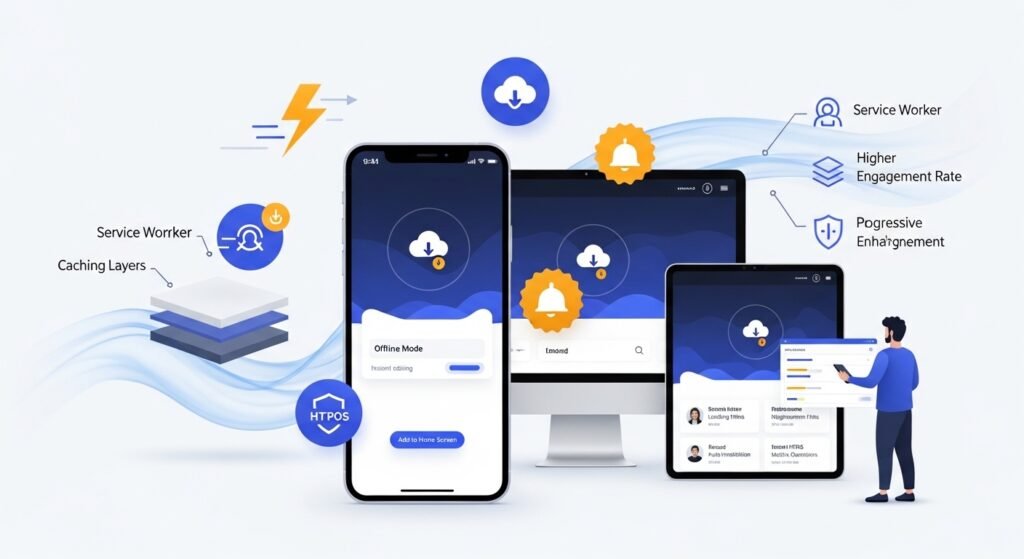
Progressive Web Apps (PWAs) are transforming how small businesses build and deliver digital experiences. In an era where users expect fast loading speeds, mobile-friendly interfaces, and seamless performance—even on slow networks—PWAs offer a powerful solution. A Progressive Web App is essentially a website that behaves like a mobile app. It loads quickly, works offline, sends push notifications, and can be installed directly on a user’s device without requiring download from app stores. For small businesses, this means they can offer an app-like experience without the high cost of developing separate Android and iOS applications. PWAs combine the best features of traditional websites and native apps, improving engagement, retention, and conversions.
Speed is one of the most critical ranking and user experience factors. PWAs use service workers to cache content, allowing pages to load almost instantly after the first visit. This improves SEO performance and reduces bounce rates. Additionally, PWAs are responsive by design, ensuring consistent performance across smartphones, tablets, and desktops. They also support push notifications, enabling businesses to send promotional offers, reminders, and updates directly to users—even when they are not browsing the site.
For small businesses operating in competitive markets, PWAs create a significant advantage. They reduce dependency on app stores, lower development costs, improve customer retention, and enhance performance metrics. As mobile usage continues to dominate web traffic, investing in a PWA is not just a technical upgrade—it is a strategic growth move. Businesses that adopt this technology early will provide superior user experiences and build stronger digital relationships with their customers.
What Is a Progressive Web App (PWA)?
A Progressive Web App is a web application built using modern web technologies that delivers an app-like experience in the browser.
Key features include:
- Offline functionality
- Fast loading speed
- Push notifications
- Home screen installation
- Responsive design
- Secure HTTPS connection
PWAs bridge the gap between websites and mobile apps.
Why PWAs Matter for Small Businesses
1️⃣ Faster Website Performance
PWAs cache data using service workers, enabling quick load times—even on slow internet connections.
2️⃣ No App Store Dependency
Customers can install the PWA directly from the browser without downloading from Google Play or App Store.
3️⃣ Lower Development Cost
Instead of building separate Android and iOS apps, businesses can maintain one web-based solution.
4️⃣ Better User Engagement
Push notifications and smooth performance increase retention rates.
Key Benefits of PWAs
1. Improved SEO
PWAs are indexed like regular websites, helping maintain strong search visibility.
Fast loading speeds and mobile optimization improve rankings.
2. Offline Access
Customers can browse previously loaded pages even without internet connectivity.
This is valuable in regions with unstable networks.
3. Enhanced User Experience
PWAs feel like native apps:
✔ Smooth transitions
✔ Clean interface
✔ Full-screen browsing
✔ Quick response times
Better experience leads to higher conversions.
4. Push Notifications
Businesses can send:
- Promotional offers
- Flash sales alerts
- Cart reminders
- Event announcements
Push notifications significantly boost engagement.
Technical Components of a PWA
1. Service Workers
Scripts that run in the background to cache content and enable offline functionality.
2. Web App Manifest
Defines app name, icon, theme, and installation settings.
3. HTTPS Security
PWAs must run on secure connections for data protection.
Example Strategy for Small Business
For an e-commerce store:
Step 1: Convert website to mobile-first design
Step 2: Implement service workers for caching
Step 3: Add web app manifest
Step 4: Enable push notifications
Step 5: Test offline functionality
This improves speed and customer retention.
Industries That Benefit Most
- E-commerce stores
- Restaurants
- Coaching institutes
- Local service providers
- News and blog platforms
Any business relying on repeat visitors benefits from PWA adoption.
Common Mistakes to Avoid
❌ Ignoring mobile optimization
❌ Poor push notification strategy
❌ Not testing offline functionality
❌ Skipping HTTPS security
❌ Overloading with unnecessary features
Keep the experience simple and fast.
Measuring PWA Success
Track:
- Page load speed
- Bounce rate
- Conversion rate
- Repeat visitor percentage
- Push notification engagement
- Average session duration
Improved metrics indicate effective implementation.
Future of PWAs
As mobile usage grows and users expect faster interactions, PWAs will become standard for modern websites.
Advantages in the future include:
- Improved app-like integrations
- Better AI personalization
- Increased cross-device synchronization
- Higher adoption in developing markets
PWAs represent the evolution of web performance.
Final Thoughts
Progressive Web Apps are more than a trend—they are the future of high-performing small business websites. By combining speed, reliability, and engagement features in one cost-effective solution, PWAs help businesses deliver superior user experiences without heavy investment.
In a competitive digital landscape where attention spans are short and expectations are high, performance equals profit. Small businesses that adopt PWAs early will build faster websites, stronger engagement, and long-term digital success. 🚀