
Introduction to Sales Funnels for Service Businesses
As a digital marketing strategist and SEO consultant, I have worked with numerous service-based businesses, helping them scale their operations and increase revenue through targeted online marketing efforts. One of the most crucial components of a successful digital marketing strategy is the sales funnel. In this section, we will delve into the world of sales funnels, exploring what they are, how they work, and why they are essential for service businesses.
A sales funnel is a step-by-step process that guides potential customers through a series of interactions, ultimately leading them to make a purchase or become a client. It is a strategic approach to converting leads into paying customers, and it is particularly useful for service businesses that rely on building relationships and trust with their clients. By understanding the sales funnel and how it works, service businesses can optimize their marketing efforts, increase conversions, and drive revenue growth.
The concept of a sales funnel is not new, but its application in the digital age has become more sophisticated. With the advent of advanced digital marketing tools and technologies, businesses can now create highly targeted and personalized sales funnels that cater to the specific needs and preferences of their ideal customers. In this section, we will explore the different stages of a sales funnel, from awareness to conversion, and provide examples of how service businesses can apply this framework to their marketing efforts.
For instance, a consulting firm that specializes in providing financial advisory services to small businesses can create a sales funnel that begins with awareness-building activities such as blogging, social media marketing, and email marketing. The next stage of the funnel might involve offering free consultations or assessments to potential clients, followed by a series of targeted email campaigns that provide valuable insights and advice. As the potential client moves through the funnel, the consulting firm can continue to build trust and credibility, ultimately leading to a conversion, such as a paid consulting engagement.
The key to creating an effective sales funnel is to understand the needs and pain points of your ideal customer. By developing a deep understanding of your target audience, you can create a sales funnel that speaks directly to their concerns and provides value at every stage of the process. This is where data-driven marketing comes into play, as businesses can use analytics and tracking tools to monitor the performance of their sales funnel and make data-driven decisions to optimize its effectiveness.
Some of the benefits of using a sales funnel for service businesses include:
- Increased conversions: By guiding potential customers through a series of targeted interactions, businesses can increase the likelihood of conversion and drive revenue growth.
- Improved customer engagement: Sales funnels allow businesses to build relationships with their customers and provide value at every stage of the process, leading to increased customer satisfaction and loyalty.
- Enhanced customer insights: By tracking the performance of their sales funnel, businesses can gain valuable insights into the needs and preferences of their target audience, allowing them to refine their marketing efforts and improve overall performance.
- Reduced marketing costs: By targeting specific stages of the sales funnel, businesses can reduce waste and optimize their marketing spend, leading to improved return on investment (ROI).
In conclusion, a sales funnel is a powerful tool for service businesses, allowing them to guide potential customers through a series of targeted interactions and ultimately drive revenue growth. By understanding the different stages of a sales funnel and applying data-driven marketing principles, businesses can create highly effective sales funnels that convert leads into paying customers and drive long-term success. In the next section, we will explore the different stages of a sales funnel in more detail, providing examples and explanations of how service businesses can apply this framework to their marketing efforts.
As a digital marketing strategist and SEO consultant, I have seen firsthand the impact that a well-designed sales funnel can have on a service business. By leveraging the power of sales funnels, businesses can differentiate themselves from their competitors, build strong relationships with their customers, and drive long-term growth and success. Whether you are a small consulting firm or a large professional services company, a sales funnel can help you achieve your marketing goals and drive revenue growth.
Throughout this section, we will explore the different components of a sales funnel, from awareness and consideration to conversion and retention. We will also examine the role of digital marketing channels, such as social media, email marketing, and content marketing, in supporting the sales funnel and driving conversions. By the end of this section, you will have a deep understanding of how to create and optimize a sales funnel for your service business, and you will be equipped with the knowledge and skills to drive revenue growth and achieve long-term success.
One of the key challenges that service businesses face when creating a sales funnel is understanding the needs and preferences of their ideal customer. This is where customer personas come into play, as they allow businesses to develop a deep understanding of their target audience and create marketing efforts that speak directly to their concerns. By creating buyer personas, businesses can identify the pain points and challenges that their ideal customer faces, and develop a sales funnel that provides value and solutions at every stage of the process.
For example, a law firm that specializes in providing legal services to startups can create a buyer persona that outlines the needs and preferences of their ideal customer. This persona might include demographic information, such as age and occupation, as well as psychographic information, such as values and goals. By understanding the needs and preferences of their ideal customer, the law firm can create a sales funnel that provides value and solutions at every stage of the process, from awareness and consideration to conversion and retention.
In addition to creating buyer personas, businesses can also use data and analytics to inform their sales funnel and drive conversions. By tracking the performance of their sales funnel, businesses can identify areas for improvement and optimize their marketing efforts to drive better results. This might involve using tools such as Google Analytics to track website traffic and conversion rates, or using marketing automation software to personalize and optimize the customer experience.
By leveraging the power of data and analytics, businesses can create sales funnels that are highly targeted and effective, driving conversions and revenue growth. In the next section, we will explore the different stages of a sales funnel in more detail, providing examples and explanations of how service businesses can apply this framework to their marketing efforts. We will also examine the role of digital marketing channels in supporting the sales funnel, and provide tips and best practices for optimizing the customer experience and driving conversions.
Understanding the Stages of a Sales Funnel for Service Businesses
As a digital marketing strategist and SEO consultant, I have worked with numerous service-based businesses, helping them navigate the complex landscape of online marketing and sales. One of the most crucial concepts in achieving success in this realm is the sales funnel. A sales funnel is a strategic framework that outlines the various stages a potential customer goes through, from initial awareness to conversion. In this section, we will delve into the stages of a sales funnel for service businesses, exploring the intricacies of each step and providing actionable insights for implementation.
A sales funnel is often visualized as a inverted pyramid, with the widest part at the top, representing the initial awareness stage, and the narrowest part at the bottom, representing the conversion stage. The service business sales funnel typically consists of several stages, including awareness, consideration, decision, and retention. Each stage is critical, and understanding the unique characteristics of each is essential for crafting an effective sales strategy.
The awareness stage is the initial point of contact between a potential customer and a service business. This is where the customer becomes aware of the business and its offerings. The goal of this stage is to generate interest and create a buzz around the business. Service businesses can achieve this through various marketing channels, such as social media, content marketing, and paid advertising. For instance, a consultancy firm may create informative blog posts, videos, or podcasts to showcase their expertise and build trust with potential clients.
The consideration stage is where the potential customer starts to evaluate the service business and its offerings. At this stage, the customer is considering multiple options and weighing the pros and cons of each. The goal of this stage is to educate the customer and provide them with the necessary information to make an informed decision. Service businesses can achieve this by providing case studies, testimonials, and demonstrations of their services. For example, a software development company may offer a free trial or a demo of their product to allow potential customers to experience the benefits firsthand.
The decision stage is where the potential customer makes a decision to purchase the service or not. This is a critical stage, as the customer is now ready to commit to a particular service business. The goal of this stage is to provide a seamless and convenient experience for the customer. Service businesses can achieve this by streamlining their sales process, providing clear and transparent pricing, and offering excellent customer support. For instance, a financial services firm may offer a simple and secure online application process, allowing customers to easily sign up for their services.
The retention stage is where the service business focuses on maintaining a long-term relationship with the customer. The goal of this stage is to ensure customer satisfaction and loyalty. Service businesses can achieve this by providing ongoing support, offering loyalty programs, and continuously delivering high-quality services. For example, a marketing agency may offer regular check-ins with their clients, providing them with performance reports and strategy recommendations to help them achieve their marketing goals.
In addition to these stages, it is also important to consider the customer journey as a whole. The customer journey refers to the entire experience a customer has with a service business, from initial awareness to post-purchase support. Understanding the customer journey is critical, as it allows service businesses to identify pain points and areas for improvement. By mapping out the customer journey, service businesses can create a more seamless and enjoyable experience for their customers, ultimately leading to increased satisfaction and loyalty.
To illustrate the sales funnel stages in action, let’s consider an example. Suppose we have a digital marketing agency that offers social media management services to small businesses. The agency’s sales funnel may look like this:
- Awareness: The agency creates informative blog posts and videos on social media marketing, showcasing their expertise and building trust with potential clients.
- Consideration: The agency offers free consultations and provides case studies of their successful social media campaigns to educate potential clients and demonstrate their capabilities.
- Decision: The agency streamlines their sales process, providing clear and transparent pricing and offering a simple and secure online sign-up process for their services.
- Retention: The agency provides ongoing support and regular check-ins with their clients, offering performance reports and strategy recommendations to help them achieve their social media marketing goals.
By understanding the stages of a sales funnel and the customer journey, service businesses can create a strategic framework for guiding potential customers through the sales process. By providing value at each stage and focusing on customer satisfaction and loyalty, service businesses can increase conversions and drive long-term growth.
In conclusion, the sales funnel is a critical component of any service business’s marketing strategy. By understanding the various stages of the sales funnel and the customer journey, service businesses can craft an effective sales strategy that resonates with their target audience and drives conversions. In the next section, we will explore the importance of lead magnets and how they can be used to attract potential customers and guide them through the sales funnel.
Step-by-Step Guide to Creating a Sales Funnel for Service Businesses
As a service business owner, you understand the importance of having a well-structured sales process in place to attract and retain customers. A sales funnel is a strategic approach that helps you guide potential customers through each stage of the buying process, from initial awareness to conversion. In this section, we will walk you through a step-by-step guide to creating a sales funnel for your service business, helping you to maximize your revenue and growth.
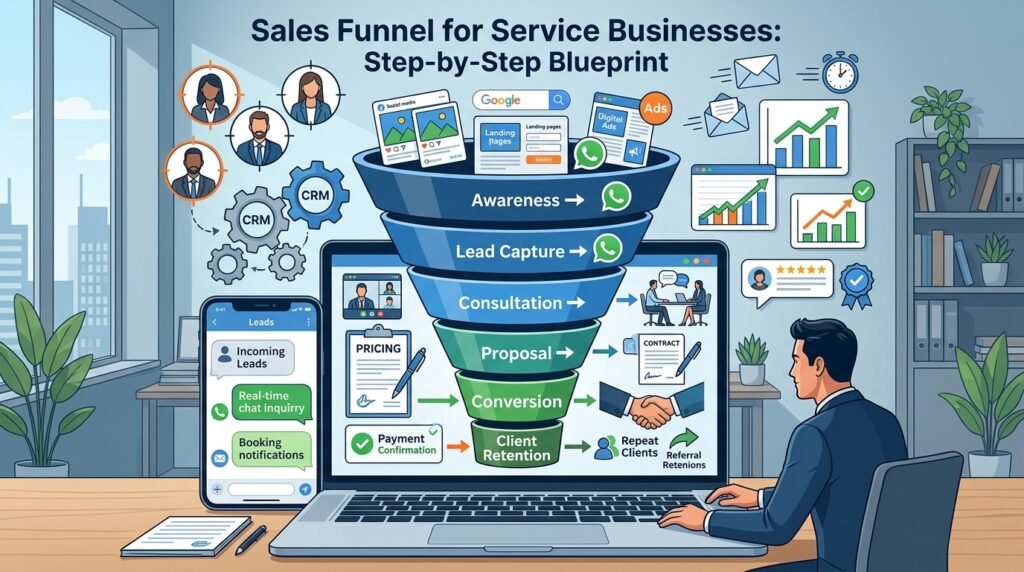
The concept of a sales funnel is simple: it’s a visual representation of the customer journey, where each stage is designed to nurture and qualify leads, ultimately converting them into paying customers. The key to creating an effective sales funnel is to understand your target audience, their needs, and the pain points they face. By doing so, you can tailor your sales process to address these concerns and provide value to your customers at every stage.
To create a sales funnel for your service business, you need to start by identifying your ideal customer. This involves researching your target market, understanding their demographics, interests, and behaviors. You can use tools like Google Analytics, social media insights, and customer surveys to gather data about your target audience. For example, if you’re a digital marketing agency, your ideal customer might be a small business owner looking to increase their online presence. Once you have a clear understanding of your target audience, you can start designing your sales funnel.
The first stage of the sales funnel is awareness, where potential customers become aware of your service business and the solutions you offer. This can be achieved through various marketing channels, such as social media advertising, content marketing, and search engine optimization (SEO). The goal at this stage is to grab the attention of your target audience and entice them to learn more about your services. For instance, you can create informative blog posts, videos, or podcasts that provide value to your audience and establish your authority in the industry.
Once you’ve captured the attention of your target audience, the next stage is to generate interest and desire. This is where you provide more detailed information about your services, highlighting the benefits and results that customers can expect. You can use email marketing campaigns, webinars, and case studies to showcase your expertise and build trust with your audience. For example, if you’re a consulting firm, you can offer a free consultation or a complimentary assessment to prospective clients, giving them a taste of your services and expertise.
The third stage of the sales funnel is consideration, where potential customers evaluate your services and compare them with those of your competitors. At this stage, you need to provide social proof, such as customer testimonials, reviews, and ratings, to demonstrate your credibility and reliability. You can also use trust badges, certifications, and awards to reinforce your authority and expertise. For instance, if you’re a software development company, you can display your certifications, such as ISO 9001 or Microsoft Gold Partner, to showcase your commitment to quality and excellence.
After consideration comes the conversion stage, where potential customers become paying clients. This is where you need to make it easy for customers to take the next step, whether it’s signing up for a free trial, scheduling a consultation, or making a purchase. You can use clear and compelling calls-to-action (CTAs), such as “Sign up now” or “Get started today,” to encourage customers to take action. For example, if you’re an e-learning platform, you can offer a free trial or a discounted subscription to new customers, giving them a risk-free opportunity to experience your services.
Finally, the last stage of the sales funnel is retention, where you focus on building long-term relationships with your customers. This involves providing exceptional customer service, delivering high-quality solutions, and continuously adding value to your customers. You can use customer loyalty programs, referral incentives, and regular communication to keep your customers engaged and satisfied. For instance, if you’re a marketing agency, you can offer ongoing support and maintenance services to your clients, helping them to achieve their marketing goals and objectives.
By following these steps and tailoring your sales funnel to your service business, you can create a powerful and effective sales process that drives revenue and growth. Remember to continuously monitor and optimize your sales funnel, using data and analytics to refine your approach and improve your results. With a well-designed sales funnel, you can attract and retain customers, build trust and credibility, and establish your service business as a leader in your industry.
Here are some key takeaways to keep in mind when creating a sales funnel for your service business:
- Understand your target audience and their needs, pain points, and behaviors
- Design a sales funnel that addresses each stage of the customer journey, from awareness to retention
- Use a variety of marketing channels and tactics to attract and engage your target audience
- Provide value and social proof at every stage of the sales funnel
- Make it easy for customers to take the next step, whether it’s signing up for a free trial or making a purchase
- Focus on building long-term relationships with your customers, delivering exceptional customer service and adding value to their businesses
Some examples of service businesses that have successfully implemented sales funnels include:
- Digital marketing agencies, which use SEO, social media, and content marketing to attract and retain clients
- Consulting firms, which offer free consultations and assessments to prospective clients
- Software development companies, which provide free trials and demos to showcase their products and services
- E-learning platforms, which offer free courses and certifications to attract and engage students
- Marketing agencies, which offer ongoing support and maintenance services to their clients
In conclusion, creating a sales funnel for your service business is a strategic approach that helps you guide potential customers through each stage of the buying process, from initial awareness to conversion. By following the steps outlined in this guide, you can design a sales funnel that addresses the unique needs and pain points of your target audience, providing value and social proof at every stage. Remember to continuously monitor and optimize your sales funnel, using data and analytics to refine your approach and improve your results.
As a digital marketing strategist and SEO consultant, I have helped numerous service businesses create and implement effective sales funnels, driving revenue and growth for their companies. If you’re looking to create a sales funnel for your service business, I encourage you to follow the steps outlined in this guide and to continuously monitor and optimize your approach. With a well-designed sales funnel, you can attract and retain customers, build trust and credibility, and establish your service business as a leader in your industry.
To get started, take the first step by identifying your ideal customer and designing a sales funnel that addresses their unique needs and pain points. Use a variety of marketing channels and tactics to attract and engage your target audience, and provide value and social proof at every stage of the sales funnel. With persistence and dedication, you can create a sales funnel that drives revenue and growth for your service business, helping you to achieve your goals and objectives.
In the next section, we will explore some advanced strategies for optimizing and refining your sales funnel, including the use of AI-driven tools and technologies. We will also discuss some common mistakes to avoid when creating a sales funnel, and provide some tips and best practices for measuring and evaluating the effectiveness of your sales funnel. By following these strategies and tips, you can take your sales funnel to the next level, driving even more revenue and growth for your service business.
Some of the key strategies we will cover in the next section include:
- Using AI-driven tools and technologies to personalize and optimize your sales funnel
- Implementing account-based marketing strategies to target and engage high-value accounts
- Creating customer journey maps to visualize and optimize the customer experience
- Using data and analytics to measure and evaluate the effectiveness of your sales funnel
- Implementing continuous testing and optimization to refine and improve your sales funnel
By following these strategies and tips, you can create a sales funnel that is tailored to your service business and drives revenue and growth for your company. Remember to stay focused on your target audience and their needs, and to continuously monitor and optimize your sales funnel to ensure maximum effectiveness.
Optimizing and Automating the Sales Funnel for Maximum Efficiency
As a digital marketing strategist, I have worked with numerous service businesses to help them optimize and automate their sales funnels for maximum efficiency. In this section, we will delve into the importance of optimizing and automating the sales funnel, and provide a step-by-step guide on how to achieve this. A well-optimized and automated sales funnel is crucial for service businesses to streamline their sales process, reduce costs, and increase revenue.
The sales funnel is a critical component of any service business, as it represents the journey that potential customers take from initial awareness to conversion. A typical sales funnel consists of several stages, including lead generation, lead nurturing, conversion, and retention. However, many service businesses struggle to optimize and automate their sales funnels, resulting in inefficiencies and lost revenue. By optimizing and automating the sales funnel, service businesses can ensure that each stage of the funnel is working seamlessly, and that potential customers are being nurtured and converted at the highest possible rate.
So, how can service businesses optimize and automate their sales funnels for maximum efficiency? The first step is to identify areas of inefficiency in the current sales funnel. This can be done by analyzing key performance indicators (KPIs) such as conversion rates, lead generation costs, and sales cycle length. By identifying areas of inefficiency, service businesses can develop targeted strategies to optimize and automate the sales funnel. For example, if the sales funnel is experiencing a high drop-off rate at the lead nurturing stage, the service business may need to develop more effective lead nurturing campaigns to keep potential customers engaged.
Another key strategy for optimizing and automating the sales funnel is to leverage technology and automation tools. There are many sales funnel automation tools available, including marketing automation software, customer relationship management (CRM) systems, and sales automation platforms. These tools can help service businesses to automate repetitive tasks, personalize the customer experience, and track key metrics and KPIs. For instance, marketing automation software can be used to automate email campaigns, social media posts, and other lead nurturing activities, freeing up time for sales teams to focus on high-value activities such as conversion and retention.
In addition to leveraging technology and automation tools, service businesses can also optimize and automate their sales funnels by developing targeted content and messaging. This can include developing buyer personas, creating targeted content campaigns, and crafting compelling sales messaging. By developing targeted content and messaging, service businesses can ensure that they are resonating with their target audience, and that their sales funnel is aligned with the needs and pain points of their potential customers. For example, a service business that offers IT consulting services may develop a buyer persona for IT managers, and create targeted content campaigns that speak to the specific pain points and challenges of this audience.
Furthermore, service businesses can also optimize and automate their sales funnels by streamlining their sales processes and eliminating unnecessary steps. This can include simplifying the sales process, reducing the number of decision-makers involved, and eliminating unnecessary paperwork and bureaucracy. By streamlining the sales process, service businesses can reduce the sales cycle length, increase conversion rates, and improve the overall customer experience. For instance, a service business that offers financial planning services may simplify its sales process by reducing the number of meetings required, and eliminating unnecessary paperwork and documentation.
It is also important for service businesses to continuously monitor and optimize their sales funnels to ensure that they are working at maximum efficiency. This can be done by tracking key metrics and KPIs, such as conversion rates, lead generation costs, and sales cycle length. By continuously monitoring and optimizing the sales funnel, service businesses can identify areas of inefficiency, and develop targeted strategies to improve the performance of the sales funnel. For example, a service business that offers marketing services may track its conversion rates, and identify that a particular stage of the sales funnel is experiencing a high drop-off rate. The service business can then develop targeted strategies to improve the performance of this stage, such as developing more effective lead nurturing campaigns or simplifying the sales process.
To illustrate the importance of optimizing and automating the sales funnel, let’s consider a few examples. Suppose a service business that offers consulting services has a sales funnel that consists of the following stages: lead generation, lead nurturing, conversion, and retention. The service business is experiencing a high drop-off rate at the lead nurturing stage, resulting in a low conversion rate. To optimize and automate the sales funnel, the service business develops targeted lead nurturing campaigns, including email campaigns, social media posts, and content marketing. The service business also leverages marketing automation software to automate the lead nurturing process, and tracks key metrics and KPIs to monitor the performance of the sales funnel. As a result, the service business is able to increase its conversion rate, reduce its sales cycle length, and improve the overall customer experience.
In another example, a service business that offers software development services has a sales funnel that consists of the following stages: lead generation, lead nurturing, conversion, and retention. The service business is experiencing a long sales cycle length, resulting in high lead generation costs and low conversion rates. To optimize and automate the sales funnel, the service business streamlines its sales process, reducing the number of decision-makers involved and eliminating unnecessary paperwork and bureaucracy. The service business also develops targeted content and messaging, including buyer personas, content campaigns, and sales messaging. As a result, the service business is able to reduce its sales cycle length, increase its conversion rate, and improve the overall customer experience.
In conclusion, optimizing and automating the sales funnel is critical for service businesses to streamline their sales process, reduce costs, and increase revenue. By identifying areas of inefficiency, leveraging technology and automation tools, developing targeted content and messaging, streamlining the sales process, and continuously monitoring and optimizing the sales funnel, service businesses can ensure that their sales funnel is working at maximum efficiency. Whether it’s developing targeted lead nurturing campaigns, simplifying the sales process, or leveraging marketing automation software, there are many strategies that service businesses can use to optimize and automate their sales funnels. By following these strategies, service businesses can improve the performance of their sales funnel, increase revenue, and drive long-term growth and success.
Some of the key benefits of optimizing and automating the sales funnel include:
- Improved conversion rates: By optimizing and automating the sales funnel, service businesses can increase their conversion rates, resulting in more sales and revenue.
- Reduced sales cycle length: Optimizing and automating the sales funnel can help service businesses to reduce their sales cycle length, resulting in faster sales and revenue growth.
- Increased efficiency: Automating the sales funnel can help service businesses to eliminate unnecessary steps and reduce the amount of time spent on repetitive tasks, resulting in increased efficiency and productivity.
- Enhanced customer experience: Optimizing and automating the sales funnel can help service businesses to provide a better customer experience, resulting in increased customer satisfaction and loyalty.
- Improved scalability: Optimizing and automating the sales funnel can help service businesses to scale their sales process more easily, resulting in increased revenue and growth.
Overall, optimizing and automating the sales funnel is a critical component of any service business’s sales strategy. By following the strategies outlined in this section, service businesses can improve the performance of their sales funnel, increase revenue, and drive long-term growth and success. As a digital marketing strategist, I have seen firsthand the impact that optimizing and automating the sales funnel can have on a service business’s bottom line. Whether it’s developing targeted lead nurturing campaigns, leveraging marketing automation software, or streamlining the sales process, there are many ways that service businesses can optimize and automate their sales funnels to achieve maximum efficiency.
Measuring Success and Continuous Improvement of the Sales Funnel
As a digital marketing strategist and SEO consultant, I have worked with numerous service businesses to help them create and optimize their sales funnels. One crucial aspect of sales funnel management is measuring its success and continuously improving it to maximize conversions and revenue. In this section, we will delve into the key performance indicators (KPIs) that service businesses should track to measure the success of their sales funnel and discuss strategies for continuous improvement.
To measure the success of a sales funnel, it is essential to track the right KPIs. These may vary depending on the specific business and its goals, but some common KPIs include conversion rates, lead generation, customer acquisition cost, customer lifetime value, and sales revenue. By monitoring these KPIs, service businesses can identify areas of their sales funnel that need improvement and make data-driven decisions to optimize their marketing strategies.
For instance, let’s consider a consulting firm that offers digital marketing services to small businesses. The firm’s sales funnel consists of the following stages: awareness, consideration, and conversion. To measure the success of their sales funnel, the firm tracks the following KPIs:
- Website traffic: The number of visitors to their website, which indicates the effectiveness of their awareness stage.
- Lead generation: The number of leads generated through their website, social media, and other marketing channels, which measures the success of their consideration stage.
- Conversion rate: The percentage of leads that become paying clients, which evaluates the effectiveness of their conversion stage.
- Customer acquisition cost: The cost of acquiring a new client, including marketing and sales expenses, which helps the firm optimize its marketing budget.
- Customer lifetime value: The total revenue generated by a client over their lifetime, which enables the firm to prioritize high-value clients and tailor its marketing strategies accordingly.
By analyzing these KPIs, the consulting firm can identify bottlenecks in their sales funnel and make adjustments to improve its performance. For example, if the firm notices that their conversion rate is low, they may need to refine their sales pitch, offer more personalized services, or provide additional value to their clients. On the other hand, if their customer acquisition cost is high, they may need to explore more cost-effective marketing channels or optimize their existing marketing strategies.
In addition to tracking KPIs, service businesses should also conduct regular analysis and testing to continuously improve their sales funnel. This may involve:
- A/B testing: Comparing the performance of different versions of a webpage, email, or marketing campaign to determine which one is more effective.
- Customer feedback: Collecting feedback from clients and prospects to identify areas for improvement and optimize the sales funnel accordingly.
- Competitor analysis: Analyzing the sales funnels of competitors to identify best practices and areas for differentiation.
- Market research: Conducting market research to stay up-to-date with industry trends, customer needs, and preferences.
By continuously monitoring and improving their sales funnel, service businesses can maximize their conversions, revenue, and customer satisfaction. It is essential to remember that a sales funnel is not a static entity, but a dynamic system that requires ongoing optimization and refinement to achieve optimal results.
Another critical aspect of sales funnel management is the use of data analytics tools. These tools enable service businesses to track their KPIs, analyze their sales funnel performance, and make data-driven decisions to optimize their marketing strategies. Some popular data analytics tools include Google Analytics, Mixpanel, and HubSpot. By leveraging these tools, service businesses can gain valuable insights into their sales funnel and make informed decisions to drive growth and revenue.
In conclusion, measuring the success of a sales funnel and continuously improving it is crucial for service businesses to maximize their conversions, revenue, and customer satisfaction. By tracking the right KPIs, conducting regular analysis and testing, and leveraging data analytics tools, service businesses can optimize their sales funnel and achieve their marketing goals. As a digital marketing strategist and SEO consultant, I have seen numerous service businesses benefit from a well-optimized sales funnel, and I believe that by following the strategies outlined in this section, service businesses can drive significant growth and revenue.

Amit Tyagi is a seasoned Digital Marketing and SEO Consultant with extensive experience helping businesses improve online visibility through SEO, AI Search Optimization (AIO/GEO), content strategy, and performance marketing. He regularly shares practical insights, industry updates, and data-driven strategies, empowering brands and marketers to achieve sustainable digital growth in an evolving search landsca