
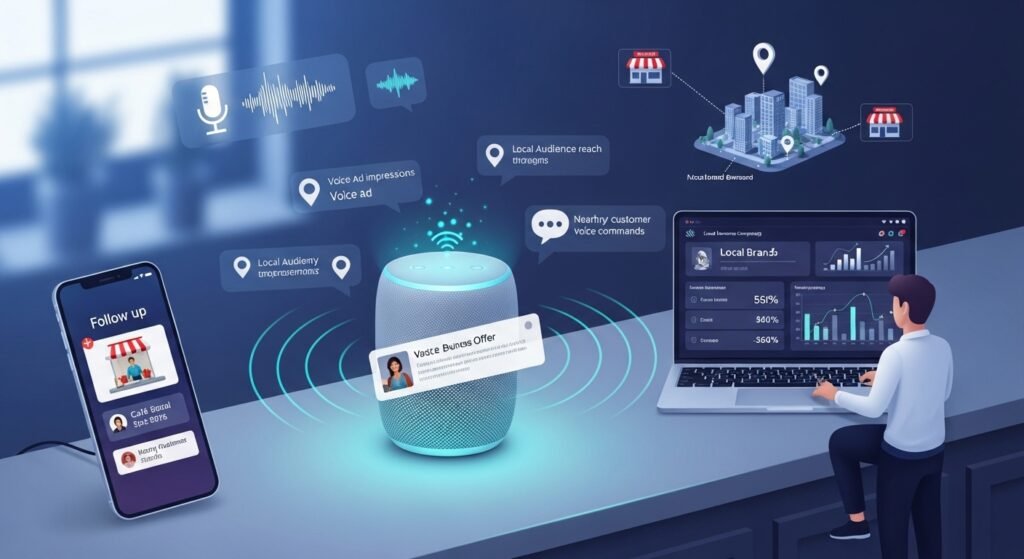
Introduction to Voice Ads on Smart Speakers
As a digital marketing strategist and SEO consultant, I have been at the forefront of witnessing the evolution of advertising and search visibility. With the advent of smart speakers, a new frontier for local brands has emerged in the form of voice ads. These innovative devices have revolutionized the way we interact with technology, and their impact on the advertising landscape cannot be overstated. In this section, we will delve into the world of voice ads on smart speakers, exploring their potential, benefits, and the opportunities they present for local brands.
The rise of smart speakers has been nothing short of phenomenal, with millions of devices being sold worldwide. These devices, such as Amazon Echo, Google Home, and Apple HomePod, have become an integral part of our daily lives, providing us with a seamless and convenient way to access information, control our homes, and enjoy entertainment. As the adoption of smart speakers continues to grow, it is imperative for local brands to take notice of this trend and explore the opportunities that voice ads on smart speakers have to offer.
So, what exactly are voice ads on smart speakers? In simple terms, voice ads are audio-based advertisements that are played on smart speakers in response to voice commands or queries. These ads are designed to be non-intrusive, relevant, and engaging, providing users with valuable information about products or services that match their interests. For local brands, voice ads on smart speakers offer a unique opportunity to reach their target audience in a more personalized and intimate way, increasing brand awareness, driving sales, and ultimately, revenue growth.
One of the key benefits of voice ads on smart speakers is their ability to provide a more immersive and engaging experience for users. Unlike traditional ads, which can be easily ignored or skipped, voice ads on smart speakers are more likely to capture the user’s attention, as they are delivered in a more conversational and interactive way. This is particularly important for local brands, which often struggle to stand out in a crowded market. By leveraging voice ads on smart speakers, local brands can create a more personal connection with their target audience, building trust and loyalty in the process.
Another significant advantage of voice ads on smart speakers is their ability to provide a more targeted and relevant advertising experience. Smart speakers are equipped with advanced algorithms and machine learning capabilities, which enable them to learn the user’s preferences, interests, and behavior over time. This information can be used to deliver highly targeted ads that are more likely to resonate with the user, increasing the chances of conversion and return on investment (ROI). For local brands, this means that they can reach their target audience with greater precision, reducing waste and improving the overall effectiveness of their advertising campaigns.
Examples of successful voice ad campaigns on smart speakers are already beginning to emerge. For instance, Procter & Gamble has launched a series of voice ads on Amazon Echo, promoting its Tide laundry detergent brand. The ads are designed to be interactive, allowing users to ask questions and receive personalized recommendations for their laundry needs. Similarly, Domino’s Pizza has launched a voice ad campaign on Google Home, enabling users to order pizzas and track their delivery status using voice commands. These campaigns demonstrate the potential of voice ads on smart speakers to drive engagement, sales, and customer loyalty.
To get the most out of voice ads on smart speakers, local brands need to understand the key principles of creating effective voice ad campaigns. This includes
- developing a clear and concise messaging strategy
- using high-quality audio and sound design
- optimizing ad copy for voice search and natural language processing (NLP)
- leveraging user data and analytics to refine targeting and ad delivery
- measuring and optimizing campaign performance using key performance indicators (KPIs) such as ROI, conversion rates, and customer acquisition costs
As the voice ad market on smart speakers continues to evolve, it is essential for local brands to stay ahead of the curve and explore the opportunities that this new frontier has to offer. By understanding the benefits, best practices, and key principles of voice ads on smart speakers, local brands can create effective and engaging campaigns that drive real results and help them achieve their business goals. In the next section, we will delve deeper into the world of voice ads on smart speakers, exploring the technical requirements, creative considerations, and strategic implications of launching a successful voice ad campaign.
Benefits of Voice Ads for Local Brands
As a digital marketing strategist, I have been following the evolution of voice ads on smart speakers with great interest. The rapid growth of smart speaker adoption has created a new frontier for local brands to reach their target audience. Voice ads on smart speakers offer a unique opportunity for local businesses to connect with customers in a more personalized and intimate way. In this section, we will explore the benefits of voice ads for local brands and how they can leverage this emerging channel to drive growth and revenue.
One of the primary benefits of voice ads on smart speakers is their ability to provide a more immersive and engaging experience for users. Unlike traditional visual ads, voice ads can create a sense of presence and immediacy, making it feel like the brand is speaking directly to the customer. This can be particularly effective for local brands, as it allows them to build a stronger emotional connection with their audience and establish a sense of trust and familiarity. For example, a local coffee shop can use voice ads to promote their daily specials and offers, making it feel like they are inviting customers to visit their store.
Another benefit of voice ads on smart speakers is their ability to target users based on their location and interests. Smart speakers like Amazon Echo and Google Home have access to a vast amount of user data, including their search history, location, and device usage patterns. This allows local brands to target their ads to users who are most likely to be interested in their products or services. For instance, a local gym can use voice ads to target users who have shown an interest in fitness and wellness, increasing the likelihood of conversion. By leveraging this data, local brands can create highly targeted and effective voice ad campaigns that drive real results.
In addition to their targeting capabilities, voice ads on smart speakers also offer a range of creative possibilities. Brands can use voice ads to tell stories, create engaging narratives, and showcase their personality and tone. This can be particularly effective for local brands, as it allows them to differentiate themselves from larger national brands and establish a unique identity. For example, a local boutique can use voice ads to tell the story of their brand, highlighting their unique products and services, and creating a sense of exclusivity and scarcity.
Some of the key benefits of voice ads for local brands include:
- Increased brand awareness: Voice ads can help local brands increase their visibility and reach a wider audience, making it more likely that users will think of them when they need a product or service.
- Improved targeting: Voice ads can be targeted to users based on their location, interests, and behaviors, increasing the likelihood of conversion and driving real results.
- Enhanced customer experience: Voice ads can create a more immersive and engaging experience for users, making it feel like the brand is speaking directly to them and building a stronger emotional connection.
- Cost-effective: Voice ads can be more cost-effective than traditional forms of advertising, such as print or television ads, making it a more accessible channel for local brands.
- Measurable results: Voice ads can provide measurable results, allowing local brands to track the effectiveness of their campaigns and make data-driven decisions.
To get the most out of voice ads, local brands need to understand how to create effective campaigns that resonate with their target audience. This includes developing a clear and concise message, using high-quality audio, and leveraging user data to target their ads. By following these best practices, local brands can create voice ad campaigns that drive real results and help them achieve their business goals.
For example, a local restaurant can use voice ads to promote their daily specials and offers, targeting users who have shown an interest in food and dining. They can use a clear and concise message, highlighting the benefits of their restaurant and encouraging users to visit. By leveraging user data and targeting their ads effectively, the restaurant can increase the likelihood of conversion and drive more customers to their business.
In conclusion, voice ads on smart speakers offer a range of benefits for local brands, from increased brand awareness and improved targeting to enhanced customer experience and cost-effective advertising. By understanding the benefits and best practices of voice ads, local brands can create effective campaigns that drive real results and help them achieve their business goals. As a digital marketing strategist, I believe that voice ads on smart speakers are a key channel for local brands to explore, and I am excited to see how this emerging technology will continue to evolve and grow in the future.
Optimizing for Voice Search and Voice Ads
As a digital marketing strategist, I have witnessed the rapid evolution of search engine optimization (SEO) and its increasing importance in the digital landscape. With the rise of smart speakers and voice assistants, a new frontier has emerged for local brands to reach their target audience: voice ads on smart speakers. Optimizing for voice search and voice ads is no longer a novelty, but a necessity for businesses looking to stay ahead of the curve. In this section, we will delve into the world of voice search and voice ads, exploring the opportunities and challenges that come with this emerging technology.
Smart speakers, such as Amazon Echo and Google Home, have become an integral part of many households, with millions of units sold worldwide. These devices have enabled users to interact with the internet using voice commands, revolutionizing the way we search, shop, and consume information. According to recent statistics, over 50% of smart speaker users use their devices to search for local businesses, making voice search a vital channel for local brands to tap into.
To optimize for voice search and voice ads, businesses need to understand the nuances of voice-based interactions. Voice search queries tend to be more conversational and longer-tailed than traditional text-based searches. For instance, a user might ask, “What are the best Italian restaurants near me?” or “What is the weather like today in New York City?” To capitalize on these types of queries, local brands should incorporate natural language and long-tail keywords into their SEO strategy.
Another crucial aspect of optimizing for voice search is claiming and optimizing your Google My Business listing. This is because Google often pulls information from Google My Business listings to answer voice search queries. By ensuring that your business’s listing is accurate, complete, and up-to-date, you can increase your chances of appearing in voice search results. This includes providing detailed and consistent information about your business, such as your address, phone number, and hours of operation.
In addition to optimizing for voice search, local brands should also consider the potential of voice ads on smart speakers. Voice ads offer a unique opportunity for businesses to reach their target audience in a more personalized and engaging way. Unlike traditional display ads, voice ads are audio-based and more immersive, allowing businesses to connect with users on a deeper level. For example, a local coffee shop could run a voice ad on Amazon Echo, offering users a discount on their next purchase and providing directions to their store.
When it comes to creating effective voice ads, there are several best practices to keep in mind. Firstly, keep your ads concise and to the point, as users are likely to tune out if your ad is too long or convoluted. Secondly, use a conversational tone that resonates with your target audience and reflects your brand’s personality. Finally, include a clear call-to-action that encourages users to take action, such as visiting your website or making a purchase.
Some examples of successful voice ads on smart speakers include:
- Coca-Cola’s voice ad on Amazon Echo, which offered users a chance to win a free Coke by answering a trivia question
- Dominos’ voice ad on Google Home, which allowed users to order pizza using voice commands
- Whole Foods’ voice ad on Amazon Echo, which provided users with recipes and cooking tips using voice commands
These examples demonstrate the potential of voice ads to drive engagement, sales, and brand awareness for local businesses. By leveraging the power of voice search and voice ads, businesses can reach their target audience in a more personalized and immersive way, setting themselves apart from the competition and establishing a strong presence in the digital landscape.
In conclusion, optimizing for voice search and voice ads is a critical component of any digital marketing strategy for local brands. By understanding the nuances of voice-based interactions, claiming and optimizing your Google My Business listing, and creating effective voice ads, businesses can tap into the growing trend of smart speaker adoption and reach their target audience in a more engaging and personalized way. As the technology continues to evolve, it is essential for local brands to stay ahead of the curve and capitalize on the opportunities presented by voice search and voice ads.
To take your business to the next level, consider the following key takeaways:
- Optimize your website for voice search by incorporating natural language and long-tail keywords into your SEO strategy
- Claim and optimize your Google My Business listing to increase your chances of appearing in voice search results
- Create effective voice ads that are concise, conversational, and include a clear call-to-action
- Monitor and measure the performance of your voice ads to refine your strategy and improve results
By following these best practices and staying up-to-date with the latest developments in voice search and voice ads, local brands can establish a strong presence in the digital landscape and drive business growth through this emerging channel.
Measuring Success and ROI of Voice Ads
As a digital marketing strategist, I have worked with numerous local brands to help them navigate the ever-evolving landscape of voice advertising on smart speakers. One of the most critical aspects of voice ads is measuring their success and return on investment (ROI). In this section, we will delve into the world of voice ad metrics, exploring the various ways to gauge the effectiveness of your voice ad campaigns and calculate their ROI.
The first step in measuring the success of voice ads is to establish clear goals and key performance indicators (KPIs). These goals can range from increasing brand awareness and driving website traffic to generating leads and boosting sales. By defining your objectives, you can create a roadmap for your voice ad strategy and track your progress accordingly. For instance, if your goal is to drive more foot traffic to your physical store, you can use metrics such as in-store visits and direction requests to measure the success of your voice ads.
Another crucial aspect of measuring voice ad success is ad attribution. Ad attribution refers to the process of assigning credit to the marketing channel or campaign that drove a particular conversion or action. In the context of voice ads, attribution can be more complex due to the conversational nature of the medium. However, by leveraging advanced analytics tools and techniques, such as multi-touch attribution modeling, you can gain a deeper understanding of how your voice ads are contributing to your overall marketing efforts.
When it comes to calculating the ROI of voice ads, there are several metrics to consider. These include:
- Cost per acquisition (CPA): This metric measures the cost of acquiring a single customer or conversion through your voice ad campaign. By tracking your CPA, you can determine the efficiency of your ad spend and make data-driven decisions to optimize your campaigns.
- Return on ad spend (ROAS): This metric calculates the revenue generated by your voice ad campaign compared to the cost of the ads themselves. By monitoring your ROAS, you can evaluate the overall profitability of your voice ad strategy and identify areas for improvement.
- Conversion rate: This metric measures the percentage of users who complete a desired action, such as making a purchase or filling out a form, after interacting with your voice ad. By optimizing your conversion rate, you can increase the effectiveness of your voice ads and drive more revenue for your business.
To illustrate the importance of measuring success and ROI in voice ads, let’s consider a real-world example. Suppose you are a local coffee shop owner who wants to use voice ads to drive more customers to your store. You create a voice ad campaign targeting users who have shown an interest in coffee or have searched for coffee shops in your area. By tracking the metrics mentioned above, you can determine the effectiveness of your campaign and make adjustments to optimize your ad spend. For instance, if you notice that your CPA is higher than expected, you may need to refine your targeting or ad creative to better resonate with your target audience.
In addition to these metrics, it’s essential to consider the customer journey when evaluating the success of your voice ad campaigns. The customer journey refers to the series of interactions a user has with your brand, from initial awareness to conversion and beyond. By mapping the customer journey and identifying pain points or areas of friction, you can create more targeted and effective voice ad campaigns that address the specific needs and concerns of your target audience.
Furthermore, voice ad analytics play a vital role in measuring the success of your campaigns. Voice ad analytics provide insights into user behavior, such as ad engagement, ad recall, and conversational metrics. By leveraging these analytics, you can refine your voice ad strategy, optimize your ad creative, and improve the overall performance of your campaigns. For example, if you notice that users are engaging more with your ads during certain times of the day or week, you can adjust your ad scheduling to maximize your reach and impact.
In conclusion, measuring the success and ROI of voice ads is a complex but critical aspect of any voice advertising strategy. By establishing clear goals and KPIs, tracking ad attribution, and calculating key metrics such as CPA, ROAS, and conversion rate, you can gain a deeper understanding of your voice ad campaigns and make data-driven decisions to optimize your ad spend. As a digital marketing strategist, I have seen firsthand the impact that effective voice ad measurement and optimization can have on a business’s bottom line. By leveraging the strategies and techniques outlined in this section, you can unlock the full potential of voice ads and drive more revenue, customers, and growth for your local brand.
Future of Voice Ads and Local Search
The rise of smart speakers has revolutionized the way people interact with technology, and voice ads are poised to become a significant component of local search. As a digital marketing strategist, I have been following the developments in voice ads and their potential to transform the way local brands reach their target audience. With the increasing adoption of smart speakers, such as Amazon Echo and Google Home, voice ads are becoming an essential tool for local businesses to connect with their customers.
According to recent studies, over 60% of smart speaker owners use their devices to search for local businesses, and this number is expected to grow exponentially in the coming years. This presents a tremendous opportunity for local brands to leverage voice ads and increase their visibility in local search results. By optimizing their online presence and utilizing voice ads, local businesses can improve their chances of being discovered by potential customers who are searching for products or services in their area.
One of the key advantages of voice ads is their ability to provide a more personalized and immersive experience for users. Unlike traditional text-based ads, voice ads can engage users through audio content, making them more memorable and impactful. For example, a local restaurant can create a voice ad that highlights their daily specials, promotions, and events, making it more likely for users to visit their establishment. Additionally, voice ads can be targeted to specific demographics, interests, and behaviors, allowing local brands to reach their target audience more effectively.
Another significant benefit of voice ads is their potential to drive foot traffic to local businesses. By providing users with directions, hours of operation, and other essential information, voice ads can encourage users to visit physical stores, thereby increasing the chances of conversion. For instance, a local retail store can create a voice ad that offers exclusive discounts to users who visit their store within a specific timeframe, creating a sense of urgency and driving sales.
To capitalize on the potential of voice ads, local brands need to develop a comprehensive strategy that incorporates both online and offline elements. This includes optimizing their website and online presence for voice search, creating high-quality audio content, and leveraging data analytics to track the performance of their voice ads. By doing so, local brands can maximize their return on investment and establish a strong presence in the voice ads landscape.
Some of the key considerations for local brands when developing a voice ad strategy include:
- Keyword research: Conducting thorough keyword research to identify relevant voice search terms and phrases that users are likely to use when searching for local businesses.
- Audio content creation: Developing high-quality audio content that is engaging, informative, and optimized for voice search.
- Targeting options: Utilizing targeting options such as location, demographics, and interests to reach the target audience more effectively.
- Ad formats: Exploring different ad formats such as audio ads, sponsored content, and interactive ads to determine which ones work best for their brand.
- Measurement and tracking: Using data analytics to track the performance of voice ads, including metrics such as click-through rates, conversion rates, and return on investment.
By understanding these key considerations and developing a well-rounded voice ad strategy, local brands can stay ahead of the competition and capitalize on the growing demand for voice search. As the voice ads landscape continues to evolve, it is essential for local brands to be proactive and adapt to the changing needs of their target audience.
For example, a local fitness studio can create a voice ad that offers a free trial class to users who book a session through their website. The ad can be targeted to users who have shown an interest in fitness and wellness, and can be optimized for voice search terms such as “yoga classes near me” or “personal training sessions.” By utilizing voice ads, the fitness studio can increase its visibility, drive foot traffic, and ultimately boost sales.
In conclusion, voice ads on smart speakers represent a significant opportunity for local brands to connect with their target audience and drive business growth. By developing a comprehensive voice ad strategy that incorporates keyword research, audio content creation, targeting options, ad formats, and measurement and tracking, local brands can establish a strong presence in the voice ads landscape and stay ahead of the competition. As the demand for voice search continues to grow, it is essential for local brands to be proactive and adapt to the changing needs of their target audience, and voice ads are poised to play a critical role in this process.