
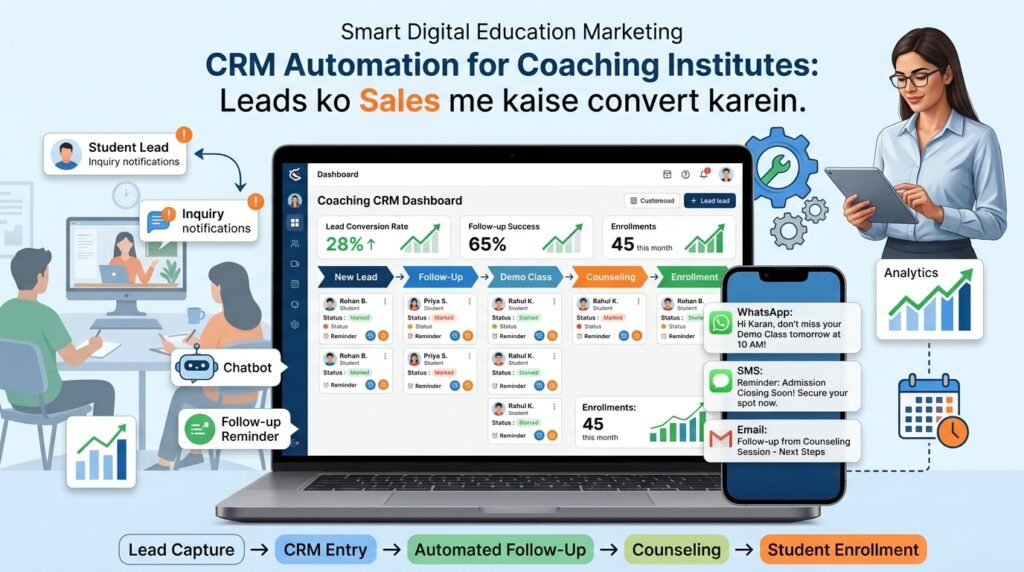
Introduction to CRM Automation for Coaching Institutes
As a digital marketing strategist and SEO consultant, I have worked with numerous coaching institutes to help them streamline their operations and improve their sales processes. One of the most effective ways to achieve this is by leveraging CRM automation. In this section, we will explore the concept of CRM automation and its benefits for coaching institutes, with a focus on how it can help convert leads into sales.
Customer Relationship Management (CRM) automation refers to the use of software and technology to automate various tasks and processes involved in managing customer interactions and relationships. For coaching institutes, CRM automation can be a game-changer, as it enables them to efficiently manage their leads, track student interactions, and personalize their marketing efforts. By automating routine tasks, coaching institutes can free up more time to focus on high-value activities such as teaching, counseling, and building relationships with their students.
The traditional approach to managing leads and sales in coaching institutes often involves manual data entry, spreadsheets, and manual follow-ups. However, this approach can be time-consuming, prone to errors, and often leads to missed opportunities. With CRM automation, coaching institutes can automate tasks such as lead tracking, email marketing, and follow-ups, allowing them to respond quickly to new leads and nurture them through the sales funnel. This not only improves the overall efficiency of the sales process but also enhances the student experience, leading to higher conversion rates and increased revenue.
For instance, let’s consider a coaching institute that offers preparation courses for competitive exams. The institute receives a high volume of inquiries from students interested in their courses. Without CRM automation, the institute’s staff would have to manually respond to each inquiry, track the student’s progress, and follow up with them to encourage enrollment. This can be a daunting task, especially during peak seasons. With CRM automation, the institute can set up automated workflows that send personalized emails to new leads, assign follow-up tasks to staff members, and track the student’s interactions with the institute. This enables the institute to provide a more personalized and responsive experience to their students, increasing the chances of converting them into paying customers.
Some of the key benefits of CRM automation for coaching institutes include:
- Improved lead management: CRM automation enables coaching institutes to track and manage their leads more efficiently, ensuring that no lead falls through the cracks.
- Enhanced student experience: By automating routine tasks, coaching institutes can focus on providing a more personalized and responsive experience to their students, leading to higher satisfaction rates and increased loyalty.
- Increased efficiency: CRM automation streamlines the sales process, reducing the time and effort required to manage leads and convert them into sales.
- Better decision-making: With access to real-time data and analytics, coaching institutes can make more informed decisions about their marketing and sales strategies, optimizing their efforts for better results.
- Scalability: CRM automation enables coaching institutes to handle a large volume of leads and sales without compromising on efficiency or effectiveness, making it an ideal solution for growing businesses.
For example, a coaching institute that uses CRM automation can set up a workflow that sends a welcome email to new leads, followed by a series of nurturing emails that provide valuable information about their courses and services. The workflow can also assign follow-up tasks to staff members, ensuring that leads are contacted at the right time to encourage enrollment. By automating these tasks, the institute can ensure that every lead is followed up with consistently, regardless of the volume of inquiries they receive.
In the next section, we will delve deeper into the features and functionalities of CRM automation and how coaching institutes can leverage them to convert leads into sales. We will also explore some real-world examples of coaching institutes that have successfully implemented CRM automation, highlighting the benefits and results they have achieved.
As a digital marketing strategist and SEO consultant, I have seen firsthand the impact that CRM automation can have on coaching institutes. By streamlining their operations, improving their sales processes, and enhancing the student experience, coaching institutes can achieve significant growth and increase their revenue. In the following sections, we will explore the concept of CRM automation in more detail, providing coaching institutes with the knowledge and insights they need to succeed in today’s competitive market.
With the help of CRM automation, coaching institutes can streamline their sales process, improve their student experience, and increase their revenue. By automating routine tasks and focusing on high-value activities, coaching institutes can achieve significant growth and establish themselves as leaders in their industry. In the next section, we will explore the features and functionalities of CRM automation and how coaching institutes can leverage them to achieve their goals.
Understanding the Lead Conversion Process in Coaching Institutes
As a digital marketing strategist, I have worked with numerous coaching institutes to help them streamline their lead conversion process. In my experience, many coaching institutes struggle to convert leads into sales, resulting in lost revenue and wasted marketing efforts. In this section, we will delve into the lead conversion process in coaching institutes and explore how CRM automation can help bridge the gap between leads and sales.
The lead conversion process in coaching institutes typically involves several stages, including lead generation, lead nurturing, and conversion. Lead generation refers to the process of attracting potential customers to the coaching institute, while lead nurturing involves building a relationship with these leads to increase their chances of converting into sales. Conversion, on the other hand, occurs when a lead decides to enroll in a course or program offered by the coaching institute.
However, many coaching institutes face challenges in converting leads into sales. Some common challenges include a lack of effective lead nurturing strategies, inadequate follow-up, and poor communication. For instance, a coaching institute may generate a large number of leads through its website or social media channels, but fail to follow up with these leads in a timely and effective manner. This can result in leads becoming disengaged and ultimately deciding not to enroll in the coaching institute’s programs.
To overcome these challenges, coaching institutes can leverage CRM automation to streamline their lead conversion process. CRM automation involves using software to automate repetitive tasks, such as email follow-ups and lead assignments, to free up staff to focus on higher-value tasks. By automating these tasks, coaching institutes can ensure that leads are followed up with in a timely and effective manner, increasing their chances of converting into sales.
For example, a coaching institute can use CRM automation to send automated email follow-ups to leads who have expressed interest in a particular course or program. These email follow-ups can include relevant information about the course or program, such as course syllabus, fee structure, and admission requirements. By providing leads with timely and relevant information, coaching institutes can build trust and credibility with their leads, increasing their chances of converting into sales.
In addition to email follow-ups, CRM automation can also be used to assign leads to sales teams. For instance, a coaching institute can use CRM automation to assign leads to sales teams based on factors such as lead source, location, and course interest. This ensures that leads are assigned to the most relevant sales team, increasing their chances of converting into sales.
Another way CRM automation can help coaching institutes convert leads into sales is by providing personalized communication. Coaching institutes can use CRM automation to send personalized emails and messages to leads, addressing their specific needs and concerns. For example, a coaching institute can use CRM automation to send a personalized email to a lead who has expressed interest in a particular course, highlighting the benefits of the course and how it can help the lead achieve their goals.
Furthermore, CRM automation can also help coaching institutes to track and analyze their lead conversion process. By tracking key metrics such as lead source, conversion rate, and sales revenue, coaching institutes can gain valuable insights into their lead conversion process and make data-driven decisions to improve it. For instance, a coaching institute can use CRM automation to track the conversion rate of leads from different sources, such as social media, website, and referrals. This can help the coaching institute to identify the most effective lead sources and allocate its marketing budget accordingly.
To illustrate the benefits of CRM automation in lead conversion, let’s consider an example. Suppose a coaching institute offers courses in digital marketing, data science, and programming. The coaching institute generates a large number of leads through its website and social media channels, but struggles to convert these leads into sales. By implementing CRM automation, the coaching institute can automate email follow-ups, lead assignments, and personalized communication, resulting in a significant increase in lead conversion rates.
Some of the key benefits of using CRM automation for lead conversion in coaching institutes include:
- Improved lead follow-up: CRM automation ensures that leads are followed up with in a timely and effective manner, increasing their chances of converting into sales.
- Increased personalization: CRM automation enables coaching institutes to send personalized emails and messages to leads, addressing their specific needs and concerns.
- Enhanced sales team productivity: By automating repetitive tasks, CRM automation frees up sales teams to focus on higher-value tasks, such as building relationships with leads and closing sales.
- Better data analysis: CRM automation provides coaching institutes with valuable insights into their lead conversion process, enabling them to make data-driven decisions to improve it.
- Increased revenue: By streamlining the lead conversion process, CRM automation can help coaching institutes to increase their revenue and achieve their business goals.
In conclusion, CRM automation can play a crucial role in helping coaching institutes convert leads into sales. By automating email follow-ups, lead assignments, and personalized communication, coaching institutes can build trust and credibility with their leads, increase their chances of converting into sales, and ultimately drive revenue growth. As a digital marketing strategist, I have seen firsthand the benefits of CRM automation in lead conversion, and I highly recommend that coaching institutes consider implementing it to streamline their lead conversion process.
By understanding the lead conversion process in coaching institutes and leveraging CRM automation, coaching institutes can overcome common challenges, such as a lack of effective lead nurturing strategies and inadequate follow-up, and achieve their business goals. Whether you are a small coaching institute or a large one, CRM automation can help you to convert leads into sales, increase revenue, and drive business growth.
Key Features of CRM Automation for Coaching Institutes
As a digital marketing strategist, I have worked with numerous coaching institutes, helping them streamline their operations and enhance their sales processes through CRM automation. In this section, we will delve into the key features of CRM automation that can help coaching institutes convert leads into sales. CRM automation is a powerful tool that enables coaching institutes to manage their leads, customers, and sales teams more efficiently, ultimately driving revenue growth and improving customer satisfaction.
One of the primary advantages of CRM automation is its ability to automate repetitive tasks, freeing up staff to focus on high-value activities such as lead nurturing and customer engagement. For instance, a coaching institute can use CRM automation to send automated email responses to new leads, providing them with valuable information about their courses and services. This not only saves time but also ensures that leads receive timely and personalized communication, increasing the likelihood of conversion.
Another key feature of CRM automation is its ability to track and analyze customer interactions. This enables coaching institutes to gain valuable insights into customer behavior, preferences, and pain points, allowing them to tailor their marketing strategies and sales approaches to meet the unique needs of their target audience. For example, a coaching institute can use CRM automation to track the online activities of its leads, such as website visits, social media engagement, and email opens. This data can be used to create personalized marketing campaigns, increasing the chances of converting leads into sales.
Crm automation also enables coaching institutes to manage their sales pipelines more effectively. By automating tasks such as lead assignment, follow-up reminders, and sales forecasting, coaching institutes can ensure that their sales teams are working efficiently and effectively. For instance, a coaching institute can use CRM automation to assign new leads to sales representatives based on their location, language, or other criteria. This ensures that leads receive timely and relevant communication, increasing the likelihood of conversion.
In addition to these features, CRM automation also provides coaching institutes with real-time reporting and analytics. This enables them to track their sales performance, identify areas for improvement, and make data-driven decisions to optimize their sales strategies. For example, a coaching institute can use CRM automation to track the conversion rates of its leads, identifying which marketing channels and sales approaches are most effective. This data can be used to refine their marketing strategies, increasing the return on investment (ROI) and driving revenue growth.
Some of the other key features of CRM automation for coaching institutes include:
- Lead scoring: This feature enables coaching institutes to assign scores to leads based on their behavior, demographics, and other criteria. This helps sales teams to prioritize leads, focusing on those that are most likely to convert.
- Marketing automation: This feature enables coaching institutes to automate their marketing campaigns, sending personalized messages to leads and customers based on their interests, preferences, and behaviors.
- Customer service management: This feature enables coaching institutes to manage customer complaints, issues, and feedback more effectively, ensuring that customers receive timely and satisfactory resolutions.
- Sales force automation: This feature enables coaching institutes to automate their sales processes, including lead assignment, follow-up reminders, and sales forecasting.
- Integration with other tools: This feature enables coaching institutes to integrate their CRM system with other tools and applications, such as social media, email marketing, and customer service software.
In conclusion, CRM automation is a powerful tool that can help coaching institutes convert leads into sales. By automating repetitive tasks, tracking customer interactions, managing sales pipelines, and providing real-time reporting and analytics, coaching institutes can drive revenue growth, improve customer satisfaction, and gain a competitive edge in the market. As a digital marketing strategist, I highly recommend that coaching institutes consider implementing CRM automation to streamline their operations, enhance their sales processes, and achieve their business goals.
For example, let’s consider a coaching institute that offers online courses and tutorials. By using CRM automation, the institute can automate the process of sending welcome emails to new leads, providing them with information about their courses and services. The institute can also use CRM automation to track the online activities of its leads, such as website visits and social media engagement. This data can be used to create personalized marketing campaigns, increasing the chances of converting leads into sales. Additionally, the institute can use CRM automation to manage its sales pipeline, assigning new leads to sales representatives based on their location, language, or other criteria.
Another example is a coaching institute that offers offline courses and tutorials. By using CRM automation, the institute can automate the process of sending reminders to students about upcoming classes, assignments, and deadlines. The institute can also use CRM automation to track the attendance and performance of its students, providing them with personalized feedback and support. This can help the institute to improve its student retention rates, increase customer satisfaction, and drive revenue growth.
In both cases, CRM automation can help coaching institutes to streamline their operations, enhance their sales processes, and achieve their business goals. By automating repetitive tasks, tracking customer interactions, managing sales pipelines, and providing real-time reporting and analytics, coaching institutes can gain a competitive edge in the market, drive revenue growth, and improve customer satisfaction. As a digital marketing strategist, I highly recommend that coaching institutes consider implementing CRM automation to take their business to the next level.
Implementing CRM Automation for Effective Lead Conversion
As a digital marketing strategist, I have worked with numerous coaching institutes to help them streamline their lead conversion process. One of the most effective ways to achieve this is by implementing CRM automation. In this section, we will explore the benefits of CRM automation for coaching institutes and provide a step-by-step guide on how to implement it for effective lead conversion.
CRM automation is the process of using software to automate repetitive tasks, such as data entry, email follow-ups, and lead nurturing. This allows coaching institutes to focus on high-value tasks, such as building relationships with leads and converting them into sales. With CRM automation, coaching institutes can personalize their communication with leads, track their behavior, and tailor their marketing efforts to meet their specific needs.
For example, let’s say a coaching institute offers a free trial class to prospective students. With CRM automation, the institute can set up a workflow that automatically sends a follow-up email to the lead after the trial class, thanking them for their interest and inviting them to enroll in a paid course. This personalized communication helps to build trust and increases the chances of converting the lead into a sale.
Another benefit of CRM automation is that it allows coaching institutes to track the behavior of their leads and tailor their marketing efforts accordingly. For instance, if a lead has shown interest in a particular course, the institute can use CRM automation to send them targeted promotional emails and offers, increasing the chances of conversion.
To implement CRM automation for effective lead conversion, coaching institutes should follow these steps:
- Define the sales funnel: The first step is to define the sales funnel, which is the series of steps that a lead goes through from initial contact to conversion. This includes stages such as lead generation, lead nurturing, and sales conversion.
- Identify the leads: The next step is to identify the leads and categorize them based on their behavior, interests, and demographics. This helps to create targeted marketing campaigns and personalized communication.
- Set up workflows: Coaching institutes should set up workflows that automate repetitive tasks, such as data entry and email follow-ups. This helps to save time and reduce the risk of human error.
- Integrate with marketing tools: CRM automation should be integrated with marketing tools, such as email marketing software and social media management tools. This helps to create a seamless and personalized customer experience.
- Monitor and analyze performance: Finally, coaching institutes should monitor and analyze the performance of their CRM automation workflows, making adjustments as needed to optimize lead conversion.
For example, a coaching institute that offers online courses can use CRM automation to send personalized emails to leads who have abandoned their shopping cart, reminding them to complete their purchase. This can be done by setting up a workflow that triggers an email campaign when a lead abandons their cart, increasing the chances of conversion.
In addition to email automation, coaching institutes can also use CRM automation to automate other tasks, such as lead scoring and assignment. Lead scoring involves assigning a score to each lead based on their behavior and demographics, while lead assignment involves assigning leads to sales representatives based on their expertise and availability.
By implementing CRM automation, coaching institutes can streamline their lead conversion process, personalize their communication with leads, and increase their chances of conversion. With the right CRM automation strategy in place, coaching institutes can take their business to the next level and achieve their revenue goals.
Some of the key benefits of CRM automation for coaching institutes include:
- Increased efficiency: CRM automation helps to automate repetitive tasks, freeing up time for coaching institutes to focus on high-value tasks.
- Improved personalization: CRM automation allows coaching institutes to personalize their communication with leads, increasing the chances of conversion.
- Enhanced customer experience: CRM automation helps to create a seamless and personalized customer experience, increasing customer satisfaction and loyalty.
- Better decision-making: CRM automation provides coaching institutes with valuable insights and data, enabling them to make informed decisions about their marketing and sales strategies.
- Increased revenue: By streamlining the lead conversion process and personalizing communication with leads, coaching institutes can increase their revenue and achieve their business goals.
In conclusion, CRM automation is a powerful tool for coaching institutes to streamline their lead conversion process, personalize their communication with leads, and increase their revenue. By implementing CRM automation, coaching institutes can take their business to the next level and achieve their revenue goals. As a digital marketing strategist, I have seen firsthand the benefits of CRM automation for coaching institutes, and I highly recommend it to any institute looking to improve their lead conversion rates.
Measuring Success and Optimizing CRM Automation for Coaching Institutes
As a digital marketing strategist, I have worked with numerous coaching institutes to implement CRM automation solutions that drive sales and revenue growth. Measuring the success of these solutions is crucial to understanding their impact and identifying areas for improvement. In this section, we will explore the key metrics for measuring the success of CRM automation for coaching institutes and provide actionable tips for optimizing these solutions.
When it comes to measuring the success of CRM automation for coaching institutes, there are several key metrics to consider. These include lead conversion rates, sales revenue, customer retention rates, and return on investment (ROI). By tracking these metrics, coaching institutes can gain valuable insights into the effectiveness of their CRM automation solutions and make data-driven decisions to optimize their strategies.
For example, let’s consider a coaching institute that offers test preparation courses for students. The institute implements a CRM automation solution that sends personalized email campaigns to leads and automates follow-up communications with prospective students. By tracking lead conversion rates, the institute can determine the effectiveness of its email campaigns and make adjustments to improve conversion rates. If the data shows that a particular email campaign has a low conversion rate, the institute can modify the campaign to better resonate with its target audience.
In addition to tracking key metrics, coaching institutes can also use CRM automation to optimize their sales processes. For instance, a coaching institute can use CRM automation to assign leads to sales representatives based on their location, interests, or other criteria. This ensures that leads are followed up with in a timely and personalized manner, which can improve conversion rates and drive sales revenue.
Another way to optimize CRM automation for coaching institutes is to use data analytics to identify trends and patterns in customer behavior. By analyzing customer data, coaching institutes can gain insights into the most effective marketing channels, the most popular courses or programs, and the demographics of their target audience. This information can be used to refine marketing strategies, improve customer engagement, and drive revenue growth.
Some of the key benefits of using CRM automation for coaching institutes include:
- Improved lead conversion rates: CRM automation can help coaching institutes convert more leads into sales by automating follow-up communications and providing personalized customer experiences.
- Increased sales revenue: By optimizing sales processes and improving customer engagement, coaching institutes can drive sales revenue and grow their business.
- Enhanced customer retention: CRM automation can help coaching institutes build stronger relationships with their customers, which can improve customer retention rates and drive long-term growth.
- Better data-driven decision making: CRM automation provides coaching institutes with valuable insights into customer behavior, marketing effectiveness, and sales performance, which can inform data-driven decision making and drive business growth.
To illustrate the benefits of CRM automation for coaching institutes, let’s consider a case study. A coaching institute that offers language courses implemented a CRM automation solution that automated email campaigns, lead assignment, and customer follow-up. As a result, the institute saw a 25% increase in lead conversion rates, a 15% increase in sales revenue, and a 30% improvement in customer retention rates. These results demonstrate the potential of CRM automation to drive business growth and improve customer engagement for coaching institutes.
In conclusion, measuring the success of CRM automation for coaching institutes is critical to understanding the effectiveness of these solutions and identifying areas for improvement. By tracking key metrics, optimizing sales processes, and using data analytics to inform decision making, coaching institutes can drive sales revenue, improve customer retention, and achieve long-term growth. As a digital marketing strategist, I recommend that coaching institutes invest in CRM automation solutions that are tailored to their specific needs and goals, and that they continually monitor and optimize their strategies to achieve maximum ROI.
Furthermore, coaching institutes can also use CRM automation to personalize the customer experience and build stronger relationships with their customers. For example, a coaching institute can use CRM automation to send personalized birthday messages, anniversary messages, or other special occasion messages to their customers. This can help build trust and loyalty with customers, which can improve customer retention rates and drive long-term growth.
In addition to personalization, coaching institutes can also use CRM automation to improve their customer service. For instance, a coaching institute can use CRM automation to automate customer support requests, provide instant responses to customer inquiries, and route complex issues to human customer support representatives. This can help improve customer satisfaction, reduce support costs, and drive business growth.
Some of the best practices for implementing CRM automation for coaching institutes include:
- Defining clear goals and objectives: Coaching institutes should define clear goals and objectives for their CRM automation solutions, such as improving lead conversion rates or driving sales revenue.
- Choosing the right CRM automation platform: Coaching institutes should choose a CRM automation platform that is tailored to their specific needs and goals, and that provides the necessary features and functionality to achieve their objectives.
- Integrating CRM automation with other systems: Coaching institutes should integrate their CRM automation solutions with other systems, such as marketing automation, customer service, and sales force automation, to provide a seamless customer experience and drive business growth.
- Continually monitoring and optimizing: Coaching institutes should continually monitor and optimize their CRM automation solutions to ensure that they are achieving their goals and objectives, and to identify areas for improvement.
By following these best practices and using CRM automation to personalize the customer experience, improve customer service, and drive business growth, coaching institutes can achieve long-term success and stay ahead of the competition. As a digital marketing strategist, I recommend that coaching institutes invest in CRM automation solutions that are tailored to their specific needs and goals, and that they continually monitor and optimize their strategies to achieve maximum ROI.
In the ever-evolving landscape of digital marketing, CRM automation is a powerful tool that can help coaching institutes drive sales revenue, improve customer retention, and achieve long-term growth. By measuring the success of CRM automation, optimizing sales processes, and using data analytics to inform decision making, coaching institutes can stay ahead of the competition and achieve their goals. As Amit Tyagi, a digital marketing strategist and SEO consultant, I am committed to helping coaching institutes achieve success through advanced SEO frameworks, Generative Engine Optimization (GEO), and performance-driven digital strategies.

Amit Tyagi is a seasoned Digital Marketing and SEO Consultant with extensive experience helping businesses improve online visibility through SEO, AI Search Optimization (AIO/GEO), content strategy, and performance marketing. He regularly shares practical insights, industry updates, and data-driven strategies, empowering brands and marketers to achieve sustainable digital growth in an evolving search landsca