
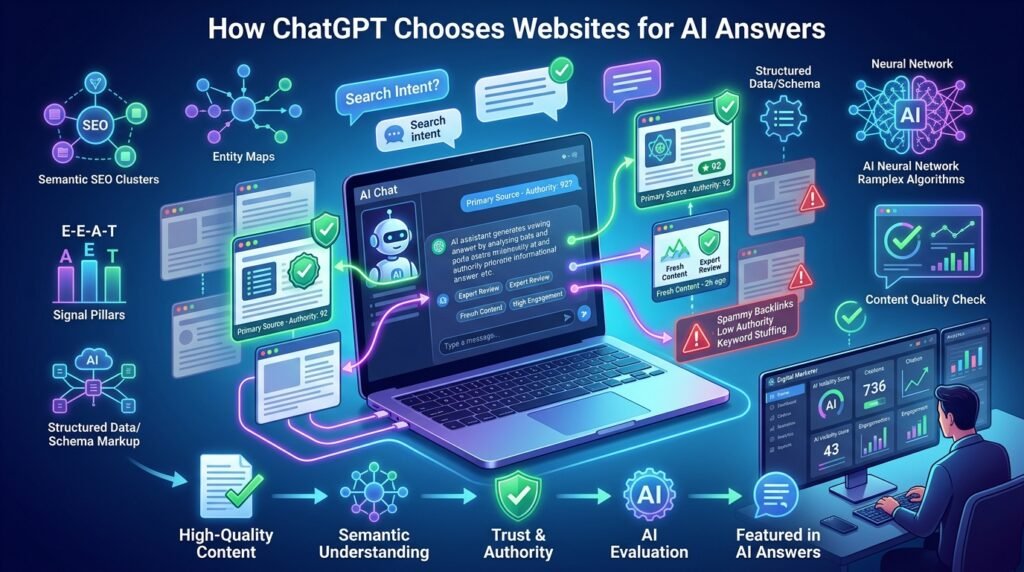
Introduction to ChatGPT and AI-Driven Search Visibility
As a digital marketing strategist and SEO consultant, I have been fascinated by the rapid evolution of artificial intelligence (AI) and its impact on search visibility. The emergence of ChatGPT, a cutting-edge AI chatbot, has revolutionized the way we interact with search engines and retrieve information online. In this section, we will delve into the world of ChatGPT and explore how it chooses websites for AI-driven answers, a crucial aspect of search visibility that can make or break a brand’s online presence.
ChatGPT is an AI-powered chatbot that uses natural language processing (NLP) to understand and respond to user queries. It has been trained on a massive dataset of text from various sources, including books, articles, and websites, to generate human-like responses. The chatbot’s ability to provide accurate and relevant answers has made it an essential tool for businesses and individuals seeking to improve their online visibility. However, the question remains: how does ChatGPT choose websites for AI-driven answers, and what factors influence its decision-making process?
To understand the intricacies of ChatGPT’s website selection process, it is essential to examine the chatbot’s underlying algorithm and the factors that contribute to its decision-making. The algorithm is based on a complex system of natural language processing, machine learning, and knowledge graph-based reasoning. When a user asks a question, the chatbot analyzes the query, identifies the relevant context, and retrieves information from its vast knowledge base to generate a response. The response is then ranked based on its relevance, accuracy, and usefulness, with the goal of providing the most informative and helpful answer possible.
The factors that influence ChatGPT’s website selection process can be broadly categorized into three groups: relevance, authority, and user experience. Relevance refers to the degree to which a website’s content matches the user’s query, while authority refers to the website’s credibility, trustworthiness, and expertise in the subject matter. User experience, on the other hand, encompasses factors such as page loading speed, mobile responsiveness, and overall usability. By considering these factors, ChatGPT can provide users with the most relevant, accurate, and helpful information available online.
A key aspect of ChatGPT’s website selection process is its ability to evaluate the quality and credibility of online content. The chatbot uses various signals, including the website’s domain authority, page authority, and content freshness, to assess the trustworthiness and reliability of the information. For instance, a website with a high domain authority, such as a government or educational institution, is more likely to be selected as a source of information than a website with a low domain authority. Similarly, a website with regularly updated content is more likely to be chosen than a website with outdated or stale content.
Another crucial factor that influences ChatGPT’s website selection process is the context in which the user’s query is made. The chatbot takes into account the user’s location, search history, and device type to provide personalized and relevant answers. For example, if a user asks about the best restaurants in New York City, ChatGPT will consider the user’s location and provide recommendations for restaurants in their vicinity. This context-aware approach enables the chatbot to provide more accurate and helpful answers, which in turn enhances the user’s overall experience.
In addition to these factors, ChatGPT’s website selection process is also influenced by the structure and organization of online content. The chatbot prefers websites with clear, concise, and well-structured content that is easy to navigate and understand. Websites with a clear hierarchy of information, headings, and subheadings are more likely to be selected as sources of information than websites with poorly organized or confusing content. This emphasis on content structure and organization highlights the importance of search engine optimization (SEO) in improving a website’s visibility and credibility.
Some examples of websites that are well-optimized for ChatGPT’s algorithm include:
- Wikipedia, which provides comprehensive and well-structured information on a wide range of topics
- Government websites, such as the United States Department of Health and Human Services, which offer authoritative and trustworthy information on health-related topics
- Educational institutions, such as Harvard University, which provide high-quality and well-researched content on various subjects
- News websites, such as The New York Times, which offer up-to-date and well-organized information on current events
These websites demonstrate the importance of quality content, authority, and user experience in improving a website’s visibility and credibility. By following best practices in SEO and content creation, businesses and individuals can increase their chances of being selected as sources of information by ChatGPT and other AI-powered chatbots.
In conclusion, ChatGPT’s website selection process is a complex and multi-faceted system that takes into account a wide range of factors, including relevance, authority, user experience, context, and content structure. By understanding these factors and optimizing their websites accordingly, businesses and individuals can improve their online visibility, credibility, and overall presence in the digital landscape. As a digital marketing strategist and SEO consultant, I believe that ChatGPT and other AI-powered chatbots will continue to play a significant role in shaping the future of search visibility and online marketing.
How ChatGPT Selects Websites for AI Answers: An Overview
As a digital marketing strategist and SEO consultant, I have been fascinated by the rapid evolution of artificial intelligence (AI) and its impact on search visibility and authority building. With the emergence of ChatGPT, a conversational AI model, I have been exploring how it selects websites for AI answers. In this section, I will provide an in-depth overview of the process, highlighting the key factors that influence ChatGPT’s decision-making.
ChatGPT’s primary goal is to provide accurate and relevant answers to user queries. To achieve this, it relies on a massive database of web pages, which are crawled, indexed, and ranked using advanced algorithms. The ranking process is critical, as it determines the order in which websites are presented as potential sources of information. So, how does ChatGPT choose the most relevant websites for AI answers?
The selection process involves a combination of natural language processing (NLP), machine learning, and information retrieval techniques. When a user asks a question, ChatGPT analyzes the query and breaks it down into key phrases, entities, and intent. This analysis helps the model to identify the most relevant web pages that match the user’s query. The relevance is determined by various factors, including the page’s content, structure, and authority.
One of the primary factors that influence ChatGPT’s selection process is the content quality of a website. The model evaluates the page’s content to determine its relevance, accuracy, and comprehensiveness. Websites with high-quality, well-researched, and engaging content are more likely to be selected as sources of information. For example, if a user asks about the benefits of meditation, ChatGPT may select a website that provides a detailed, well-structured, and informative article on the topic.
Another critical factor is the authority of a website. ChatGPT assesses the website’s authority by evaluating its domain reputation, backlink profile, and user engagement metrics. Websites with a strong authority are more likely to be trusted by ChatGPT and presented as sources of information. For instance, if a user asks about the latest medical research on a specific topic, ChatGPT may select a website from a reputable academic institution or a well-established medical journal.
In addition to content quality and authority, ChatGPT also considers the user experience of a website. The model evaluates the page’s layout, design, and usability to determine how easily users can access and consume the information. Websites with a user-friendly interface, clear navigation, and fast loading speeds are more likely to be selected by ChatGPT. For example, if a user asks about the best restaurants in a specific city, ChatGPT may select a website with a clean design, easy-to-use filters, and fast loading speeds.
Furthermore, ChatGPT’s selection process is also influenced by the contextual relevance of a website. The model analyzes the user’s query and determines the most relevant context in which to provide an answer. Websites that are contextually relevant to the user’s query are more likely to be selected by ChatGPT. For instance, if a user asks about the best hiking trails in a specific national park, ChatGPT may select a website that provides detailed information on hiking trails, park regulations, and safety guidelines.
To illustrate the selection process, let’s consider an example. Suppose a user asks ChatGPT, “What are the benefits of using solar energy?” In response, ChatGPT may select a website from the National Renewable Energy Laboratory (NREL) or the United States Department of Energy (DOE). These websites are likely to be selected because they have:
- High-quality, well-researched content on solar energy and its benefits
- A strong authority in the field of renewable energy, with a reputable domain and backlink profile
- A user-friendly interface, with clear navigation and fast loading speeds
- Contextual relevance to the user’s query, providing detailed information on the benefits of solar energy
In conclusion, ChatGPT’s selection process for websites is a complex and multi-faceted one, involving a range of factors, including content quality, authority, user experience, and contextual relevance. By understanding these factors, website owners and digital marketers can optimize their online presence and increase their chances of being selected by ChatGPT as a source of information. In the next section, I will delve deeper into the technical aspects of ChatGPT’s selection process, exploring the algorithms and techniques used to rank and retrieve web pages.
Technical SEO Factors Influencing ChatGPT’s Website Selection
As a digital marketing strategist and SEO consultant, I have always been fascinated by the inner workings of AI-powered tools like ChatGPT. One of the most critical aspects of ChatGPT’s functionality is its ability to choose relevant websites to provide accurate and reliable answers to user queries. In this section, we will delve into the technical SEO factors that influence ChatGPT’s website selection, and explore how these factors can impact a website’s visibility and authority in the eyes of this powerful AI tool.
ChatGPT’s algorithm is designed to analyze a vast array of technical SEO factors to determine the credibility and relevance of a website. These factors can be broadly categorized into two groups: on-page and off-page factors. On-page factors refer to the elements that are present on the website itself, such as content quality, keyword usage, and meta tags. Off-page factors, on the other hand, refer to the external signals that point to the website, such as backlinks, social media mentions, and online reviews.
One of the most critical on-page factors that influences ChatGPT’s website selection is content quality. ChatGPT’s algorithm is designed to analyze the content of a website to determine its relevance, accuracy, and usefulness. Websites with high-quality, well-researched, and engaging content are more likely to be selected by ChatGPT as a reliable source of information. For example, a website that provides in-depth guides, tutorials, and articles on a specific topic is more likely to be chosen by ChatGPT than a website with thin, low-quality content.
Another important on-page factor is keyword usage. ChatGPT’s algorithm analyzes the keyword usage on a website to determine its relevance to a particular topic or query. Websites that use relevant keywords strategically and naturally are more likely to be selected by ChatGPT than websites that engage in keyword stuffing or other forms of keyword manipulation. For instance, a website that uses long-tail keywords and phrases in its content is more likely to be chosen by ChatGPT than a website that focuses solely on short-tail keywords.
In addition to on-page factors, ChatGPT’s algorithm also analyzes off-page factors to determine the credibility and authority of a website. One of the most critical off-page factors is backlinks. Backlinks are links from other websites that point to a website, and they are a key indicator of a website’s authority and credibility. Websites with high-quality backlinks from reputable sources are more likely to be selected by ChatGPT than websites with low-quality or spammy backlinks. For example, a website that has backlinks from government websites, educational institutions, or other reputable sources is more likely to be chosen by ChatGPT than a website with backlinks from low-quality or spammy sources.
Other off-page factors that influence ChatGPT’s website selection include social media mentions and online reviews. Social media mentions refer to the number of times a website is mentioned on social media platforms, while online reviews refer to the reviews and ratings that a website receives from its customers or users. Websites with a strong social media presence and positive online reviews are more likely to be selected by ChatGPT than websites with a weak social media presence or negative online reviews.
Here are some of the key technical SEO factors that influence ChatGPT’s website selection:
- Page speed: ChatGPT’s algorithm analyzes the page speed of a website to determine its usability and user experience. Websites with fast page speeds are more likely to be selected by ChatGPT than websites with slow page speeds.
- Mobile-friendliness: ChatGPT’s algorithm analyzes the mobile-friendliness of a website to determine its accessibility and usability. Websites that are mobile-friendly are more likely to be selected by ChatGPT than websites that are not.
- SSL encryption: ChatGPT’s algorithm analyzes the SSL encryption of a website to determine its security and trustworthiness. Websites with SSL encryption are more likely to be selected by ChatGPT than websites without SSL encryption.
- XML sitemap: ChatGPT’s algorithm analyzes the XML sitemap of a website to determine its structure and organization. Websites with a well-organized XML sitemap are more likely to be selected by ChatGPT than websites with a poorly organized XML sitemap.
- Robots.txt: ChatGPT’s algorithm analyzes the robots.txt file of a website to determine its crawlability and indexability. Websites with a well-configured robots.txt file are more likely to be selected by ChatGPT than websites with a poorly configured robots.txt file.
In conclusion, ChatGPT’s website selection is influenced by a complex array of technical SEO factors, including on-page and off-page factors. By optimizing these factors, website owners and digital marketers can improve their website’s visibility and authority in the eyes of ChatGPT, and increase their chances of being selected as a reliable source of information. As a digital marketing strategist and SEO consultant, I recommend that website owners and digital marketers focus on creating high-quality content, using relevant keywords strategically, building high-quality backlinks, and optimizing their website’s technical SEO factors to improve their website’s visibility and authority in the eyes of ChatGPT.
By doing so, website owners and digital marketers can not only improve their website’s visibility and authority but also provide a better user experience for their target audience. As ChatGPT continues to evolve and improve, it is essential for website owners and digital marketers to stay up-to-date with the latest technical SEO best practices and trends to ensure that their website remains visible and authoritative in the eyes of this powerful AI tool. With the right technical SEO strategy and techniques, website owners and digital marketers can unlock the full potential of ChatGPT and drive more traffic, engagement, and conversions to their website.
Content Strategy for Optimizing ChatGPT Answers and Engagement
As a digital marketing strategist and SEO consultant, I have always been fascinated by the potential of artificial intelligence (AI) to transform the way we interact with online content. With the rise of ChatGPT, a conversational AI designed to generate human-like responses to user queries, it has become increasingly important for businesses and content creators to optimize their online presence for AI-driven search visibility. In this section, we will delve into the content strategy for optimizing ChatGPT answers and engagement, exploring the factors that influence ChatGPT’s decision-making process when choosing websites for AI answers.
The primary goal of any content strategy is to create high-quality, engaging, and informative content that resonates with the target audience. However, when it comes to optimizing for ChatGPT, the approach needs to be slightly different. ChatGPT’s algorithm is designed to evaluate the relevance, accuracy, and usefulness of online content, and it uses a range of factors to determine which websites to prioritize when generating answers to user queries. By understanding these factors and incorporating them into your content strategy, you can increase the chances of your website being chosen by ChatGPT for AI answers.
One of the key factors that ChatGPT considers when evaluating online content is the authority and credibility of the website. This is determined by a range of metrics, including the website’s domain authority, page authority, and the quality of backlinks pointing to the site. To optimize for ChatGPT, it is essential to focus on building high-quality backlinks from authoritative sources, as well as creating content that demonstrates expertise and thought leadership in your industry. For example, if you are a healthcare professional, you could create in-depth guides to common medical conditions, or conduct interviews with leading experts in the field.
Another important factor that ChatGPT considers is the relevance and accuracy of the content. This means creating content that is closely aligned with the user’s query, and providing accurate and up-to-date information. To achieve this, it is essential to conduct thorough keyword research and create content that is optimized for the target keywords. For instance, if you are a financial advisor, you could create content that provides guidance on retirement planning, investment strategies, or tax optimization. By using keywords and phrases that are relevant to the user’s query, you can increase the chances of your content being chosen by ChatGPT.
In addition to authority and relevance, ChatGPT also evaluates the engagement and user experience of the website. This includes factors such as page speed, mobile responsiveness, and the overall design and layout of the site. To optimize for ChatGPT, it is essential to ensure that your website provides a seamless and intuitive user experience, with fast loading speeds, easy navigation, and a clean and modern design. For example, you could use a website builder like WordPress or Wix to create a responsive and mobile-friendly website, or invest in a content delivery network (CDN) to improve page speed.
ChatGPT also considers the freshness and recency of the content, with a preference for websites that regularly publish new and updated content. This means that it is essential to maintain a consistent content schedule, with a focus on creating high-quality and engaging content that resonates with the target audience. For instance, you could create a blog series that explores a particular topic or theme, or use social media to share updates and insights from your industry. By demonstrating a commitment to freshness and recency, you can increase the chances of your website being chosen by ChatGPT for AI answers.
Furthermore, ChatGPT evaluates the technical optimization of the website, including factors such as schema markup, meta tags, and header tags. To optimize for ChatGPT, it is essential to ensure that your website is technically sound, with proper schema markup, meta tags, and header tags. For example, you could use a plugin like Yoast or All in One SEO Pack to optimize your meta tags and header tags, or invest in a technical SEO audit to identify and fix any technical issues with your website.
To create an effective content strategy for optimizing ChatGPT answers and engagement, consider the following steps:
- Conduct thorough keyword research to identify relevant and high-traffic keywords and phrases
- Create high-quality and engaging content that demonstrates expertise and thought leadership in your industry
- Optimize your website for technical SEO, including schema markup, meta tags, and header tags
- Focus on building high-quality backlinks from authoritative sources
- Ensure that your website provides a seamless and intuitive user experience, with fast loading speeds, easy navigation, and a clean and modern design
- Maintain a consistent content schedule, with a focus on creating fresh and updated content that resonates with the target audience
By following these steps and incorporating them into your content strategy, you can increase the chances of your website being chosen by ChatGPT for AI answers, and improve your online visibility and engagement. As a digital marketing strategist and SEO consultant, I have seen firsthand the impact that a well-executed content strategy can have on a business’s online presence and revenue. By optimizing for ChatGPT and other AI-driven search platforms, you can stay ahead of the competition and achieve your online marketing goals.
In conclusion, optimizing for ChatGPT requires a deep understanding of the factors that influence its decision-making process, as well as a commitment to creating high-quality and engaging content that resonates with the target audience. By incorporating the steps outlined above into your content strategy, you can increase the chances of your website being chosen by ChatGPT for AI answers, and improve your online visibility and engagement. As the use of AI-driven search platforms continues to grow and evolve, it is essential to stay ahead of the curve and adapt your content strategy to meet the changing needs of your target audience.
As Amit Tyagi, a digital marketing strategist and SEO consultant with over 15 years of experience, I have helped numerous businesses and brands scale globally through advanced SEO frameworks, Generative Engine Optimization (GEO), and performance-driven digital strategies. My expertise in AI-driven search visibility, authority building, and revenue-focused organic growth has enabled me to deliver results-driven solutions that meet the unique needs of each client. Whether you are looking to improve your online visibility, drive more traffic to your website, or increase your revenue through AI-driven search platforms, I can help you achieve your goals and stay ahead of the competition.
Future-Proofing Your SEO Strategy for ChatGPT and AI-Driven Search
As the digital landscape continues to evolve, it’s becoming increasingly important for businesses and marketers to stay ahead of the curve when it comes to search engine optimization (SEO). With the rise of ChatGPT and other AI-driven search engines, the way we approach SEO is changing rapidly. As a digital marketing strategist and SEO consultant, I’ve had the opportunity to work with numerous brands and help them navigate the complexities of AI-driven search visibility. In this section, we’ll explore the importance of future-proofing your SEO strategy for ChatGPT and AI-driven search, and provide actionable tips and insights to help you stay ahead of the competition.
ChatGPT, in particular, has been making waves in the digital marketing world with its ability to provide accurate and informative answers to user queries. But have you ever wondered how ChatGPT chooses the websites it uses to provide answers? The answer lies in the algorithm used by ChatGPT to rank and select websites. This algorithm takes into account a range of factors, including the website’s authority, relevance, and overall quality of content. For instance, if a user asks ChatGPT a question about the benefits of meditation, the algorithm will scour the internet to find the most authoritative and relevant sources on the topic, and provide an answer based on that information.
In order to future-proof your SEO strategy for ChatGPT and AI-driven search, it’s essential to understand how these algorithms work and what factors they take into account when ranking and selecting websites. One key factor is the use of high-quality, engaging, and informative content. This type of content is more likely to be selected by ChatGPT and other AI-driven search engines, as it provides value to the user and helps to establish your brand as an authority in your industry. For example, a website that provides in-depth guides and tutorials on a particular topic is more likely to be selected by ChatGPT than a website that simply provides a brief overview of the topic.
Another important factor to consider when future-proofing your SEO strategy is the use of technical SEO best practices. This includes optimizing your website’s structure and architecture, ensuring that it is mobile-friendly and easy to navigate, and using schema markup to help search engines understand the context and meaning of your content. By implementing these technical SEO best practices, you can help improve your website’s visibility and ranking in ChatGPT and other AI-driven search engines. For instance, a website that uses schema markup to highlight its business hours and location is more likely to appear in ChatGPT’s results for user queries related to that business.
In addition to high-quality content and technical SEO best practices, it’s also important to focus on building your brand’s authority and reputation online. This can be achieved through a range of strategies, including guest blogging, influencer outreach, and social media marketing. By establishing your brand as a trusted and authoritative source in your industry, you can increase your chances of being selected by ChatGPT and other AI-driven search engines. For example, a brand that partners with influencers in its industry to create high-quality content is more likely to be seen as an authority by ChatGPT and other AI-driven search engines.
Here are some additional tips and insights to help you future-proof your SEO strategy for ChatGPT and AI-driven search:
- Use natural language processing (NLP) principles to optimize your content for AI-driven search engines. This includes using conversational language and focusing on the user’s intent and needs.
- Optimize your website for voice search, as this is becoming an increasingly popular way for users to interact with search engines. This includes using long-tail keywords and focusing on the user’s intent and needs.
- Use data and analytics to track your website’s performance and understand how users are interacting with your content. This includes using tools like Google Analytics and Search Console to track your website’s traffic and ranking.
- Stay up-to-date with the latest developments and trends in AI-driven search and SEO. This includes attending industry conferences and events, and following industry leaders and experts on social media.
- Focus on creating a positive user experience, as this is becoming an increasingly important factor in search engine rankings. This includes using responsive design, fast loading speeds, and easy navigation to create a seamless and intuitive user experience.
By following these tips and insights, you can help future-proof your SEO strategy for ChatGPT and AI-driven search, and stay ahead of the competition in the ever-changing digital landscape. Remember, the key to success in AI-driven search is to focus on creating high-quality, engaging, and informative content that provides value to the user, and to use technical SEO best practices to optimize your website for search engines. With the right strategy and approach, you can increase your chances of being selected by ChatGPT and other AI-driven search engines, and drive more traffic and revenue to your website.
As we move forward in the world of AI-driven search, it’s essential to stay flexible and adapt to the changing landscape. By focusing on the user’s needs and intent, and using the latest developments and trends in AI-driven search and SEO, you can help ensure that your brand stays ahead of the curve and continues to thrive in the digital age. Whether you’re a seasoned marketer or just starting out, the key to success in AI-driven search is to stay informed, stay adaptable, and always keep the user in mind. With the right approach and strategy, you can unlock the full potential of AI-driven search and drive real results for your business.

Amit Tyagi is a seasoned Digital Marketing and SEO Consultant with extensive experience helping businesses improve online visibility through SEO, AI Search Optimization (AIO/GEO), content strategy, and performance marketing. He regularly shares practical insights, industry updates, and data-driven strategies, empowering brands and marketers to achieve sustainable digital growth in an evolving search landsca