
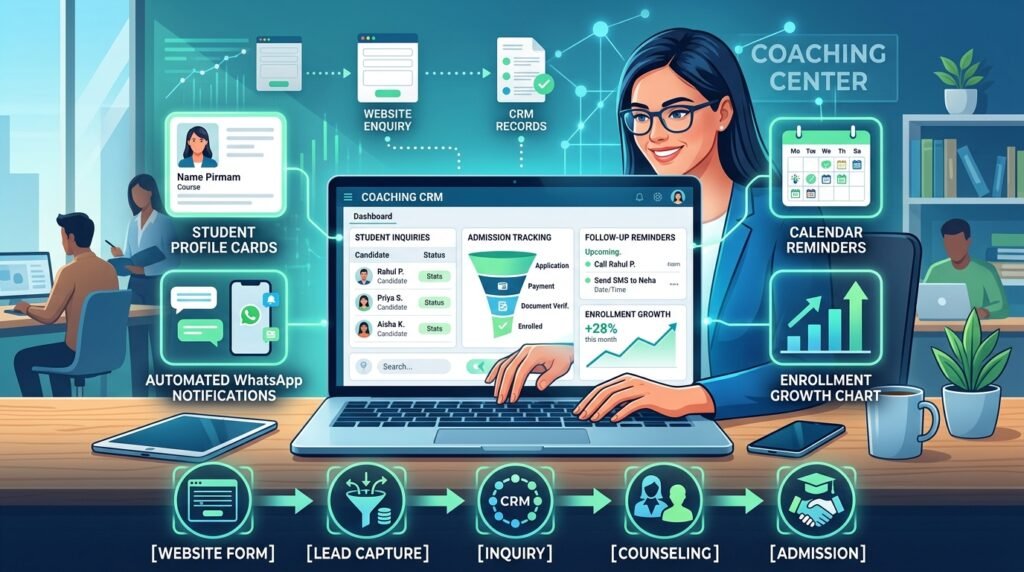
Introduction to CRM for Coaching Institutes
As a digital marketing strategist and SEO consultant, I have worked with numerous coaching institutes to help them scale their operations and improve their customer relationships. In today’s competitive education landscape, it is essential for coaching institutes to have a robust Customer Relationship Management (CRM) system in place. A well-implemented CRM setup can help coaching institutes to streamline their processes, enhance customer satisfaction, and ultimately drive revenue growth.
In this section, we will delve into the world of CRM for coaching institutes, exploring the benefits, features, and best practices for setting up an effective CRM system. We will also examine the specific challenges faced by coaching institutes and how a tailored CRM approach can help address these challenges. Whether you are a small coaching institute or a large educational organization, this guide will provide you with valuable insights and practical tips to help you get the most out of your CRM investment.
A CRM system is essentially a software application that enables businesses to manage and analyze customer interactions, data, and relationships. In the context of coaching institutes, a CRM system can be used to track student inquiries, manage admissions, and provide support to students throughout their academic journey. By leveraging CRM technology, coaching institutes can gain a better understanding of their students’ needs, preferences, and behaviors, allowing them to deliver personalized services and improve overall customer satisfaction.
One of the primary benefits of implementing a CRM system for coaching institutes is that it helps to automate many routine tasks and processes. For example, a CRM system can be used to send automated emails to students, reminding them of upcoming deadlines, appointments, or events. This not only saves time and resources but also ensures that students receive timely and relevant communications, enhancing their overall experience with the coaching institute.
In addition to automation, a CRM system can also provide coaching institutes with valuable insights and analytics. By tracking student interactions, behavior, and feedback, coaching institutes can identify areas for improvement and make data-driven decisions to optimize their operations. For instance, a CRM system can help coaching institutes to identify the most effective marketing channels, track the success of their campaigns, and measure the return on investment (ROI) of their marketing efforts.
To illustrate the benefits of CRM for coaching institutes, let’s consider an example. Suppose a coaching institute offers preparatory courses for competitive exams, such as the GRE or GMAT. The institute receives a high volume of inquiries from prospective students, but its admissions team struggles to keep track of these inquiries and follow up with leads in a timely manner. By implementing a CRM system, the coaching institute can create a centralized database of student inquiries, automate follow-up communications, and assign leads to specific admissions counselors. This not only improves the efficiency of the admissions process but also enhances the overall experience of prospective students, increasing the likelihood of conversion.
In the next section, we will explore the key features and functionalities of a CRM system for coaching institutes, including contact management, lead tracking, and campaign management. We will also discuss the importance of integrating CRM with other systems, such as marketing automation and customer service platforms, to create a seamless and omnichannel experience for students.
Some of the key benefits of CRM for coaching institutes include:
- Improved customer satisfaction: By providing personalized services and timely communications, coaching institutes can enhance the overall experience of their students.
- Increased efficiency: Automation of routine tasks and processes can help coaching institutes to reduce costs, save time, and allocate resources more effectively.
- Enhanced insights and analytics: CRM systems can provide coaching institutes with valuable data and insights, enabling them to make informed decisions and optimize their operations.
- Better lead management: CRM systems can help coaching institutes to track and manage leads more effectively, increasing the likelihood of conversion and improving the overall quality of their student intake.
- Improved collaboration: CRM systems can facilitate collaboration and communication among different teams and departments, ensuring that coaching institutes can respond quickly and effectively to changing student needs and market conditions.
In conclusion, a well-implemented CRM system is essential for coaching institutes to succeed in today’s competitive education landscape. By understanding the benefits, features, and best practices of CRM, coaching institutes can create a tailored approach that meets their specific needs and goals. In the next section, we will delve deeper into the key features and functionalities of a CRM system for coaching institutes, exploring how these can be leveraged to drive growth, improve customer satisfaction, and enhance overall performance.
Key Features of an Ideal CRM for Coaching Institutes
As a digital marketing strategist and SEO consultant, I have worked with numerous coaching institutes to help them streamline their operations and improve their customer relationships. In my experience, a well-designed Customer Relationship Management (CRM) system is essential for coaching institutes to manage their students, staff, and marketing efforts effectively. In this section, we will discuss the key features of an ideal CRM for coaching institutes.
A coaching institute’s CRM system should be designed to cater to the unique needs of the education sector. It should be able to handle a large volume of student data, track student progress, and facilitate communication between students, teachers, and staff. An ideal CRM for coaching institutes should have the following key features:
- Student Information Management: The CRM should be able to store and manage student information, including contact details, academic records, and payment history. This will help coaching institutes to keep track of their students’ progress and communicate with them effectively.
- Course Management: The CRM should be able to manage course information, including course schedules, fees, and enrollment details. This will help coaching institutes to streamline their course management processes and reduce administrative tasks.
- Payment Gateway Integration: The CRM should be integrated with a payment gateway to facilitate online payments and reduce the risk of payment errors. This will help coaching institutes to collect fees and payments from students securely and efficiently.
- Marketing Automation: The CRM should have marketing automation features to help coaching institutes automate their marketing campaigns and reach out to potential students. This will help coaching institutes to save time and resources on marketing efforts and focus on more strategic activities.
- Reporting and Analytics: The CRM should have reporting and analytics features to help coaching institutes track their performance and make data-driven decisions. This will help coaching institutes to identify areas of improvement and optimize their operations for better results.
For example, a coaching institute that offers online courses can use a CRM to manage their course enrollment, track student progress, and automate their marketing campaigns. The CRM can be integrated with the institute’s website to collect leads and follow up with potential students. The CRM can also be used to send reminders and notifications to students about upcoming courses, payment deadlines, and other important events.
Another example is a coaching institute that offers offline courses. The CRM can be used to manage student information, track attendance, and automate communication with students and parents. The CRM can also be used to manage course schedules, fees, and enrollment details, and to generate reports on student performance and progress.
In addition to these features, an ideal CRM for coaching institutes should also be user-friendly, scalable, and customizable. The CRM should be easy to use and navigate, even for staff members who are not tech-savvy. The CRM should also be scalable to accommodate growing student numbers and increasing course offerings. The CRM should be customizable to meet the unique needs of the coaching institute, including integration with existing systems and software.
Some popular CRM options for coaching institutes include HubSpot, Salesforce, and Zoho CRM. These CRMs offer a range of features and functionalities that can be tailored to meet the specific needs of coaching institutes. They also offer integration with other software and systems, including marketing automation tools, payment gateways, and learning management systems.
When selecting a CRM for a coaching institute, it is essential to consider the specific needs of the institute and the features that are required to meet those needs. The CRM should be evaluated based on its functionality, scalability, and customization options, as well as its user-friendliness and support. The coaching institute should also consider the cost of the CRM and the return on investment (ROI) that it can expect to achieve.
By implementing a well-designed CRM system, coaching institutes can streamline their operations, improve their customer relationships, and increase their revenue. A CRM can help coaching institutes to manage their students, staff, and marketing efforts more effectively, and to make data-driven decisions that drive growth and success. As a digital marketing strategist and SEO consultant, I have seen firsthand the benefits that a well-designed CRM can bring to coaching institutes, and I highly recommend that coaching institutes invest in a CRM to take their business to the next level.
In conclusion, an ideal CRM for coaching institutes should have a range of key features, including student information management, course management, payment gateway integration, marketing automation, and reporting and analytics. The CRM should be user-friendly, scalable, and customizable, and should be evaluated based on its functionality, scalability, and customization options. By selecting the right CRM for their needs, coaching institutes can improve their operations, customer relationships, and revenue, and achieve long-term success and growth.
Best CRM Setup Strategies for Coaching Institutes
As a digital marketing strategist and SEO consultant, I have worked with numerous coaching institutes to help them streamline their operations and improve their customer relationships. One of the most critical tools for achieving this is a well-designed Customer Relationship Management (CRM) system. In this section, we will explore the best CRM setup strategies for coaching institutes, and how they can be implemented to drive growth and success.
A coaching institute’s primary goal is to provide high-quality education and training to its students. However, to achieve this, they need to manage a vast array of tasks, including lead generation, student enrollment, course management, and communication. A CRM system can help coaching institutes to automate and organize these tasks, freeing up staff to focus on what matters most – providing excellent education and support to their students.
When it comes to setting up a CRM system for a coaching institute, there are several strategies that can be employed. Firstly, it is essential to define the institute’s goals and objectives. What does the institute want to achieve with its CRM system? Is it to increase student enrollment, improve student retention, or enhance the overall student experience? By clearly defining these goals, the institute can tailor its CRM setup to meet its specific needs.
Another critical aspect of a successful CRM setup is data management. Coaching institutes deal with a vast amount of data, including student information, course details, and communication records. A CRM system can help to organize and analyze this data, providing valuable insights that can inform decision-making. For example, a coaching institute can use its CRM system to track student engagement and identify areas where they may need additional support.
In addition to data management, automation is another key feature of a well-designed CRM system. By automating routine tasks, such as email marketing and follow-up communications, coaching institutes can free up staff to focus on more critical tasks. For instance, a coaching institute can set up automated email campaigns to nurture leads and encourage them to enroll in courses.
When selecting a CRM system for a coaching institute, there are several factors to consider. Scalability is one crucial aspect, as the institute needs a system that can grow with it. The system should also be user-friendly, with an intuitive interface that makes it easy for staff to navigate and use. Furthermore, the system should integrate seamlessly with other tools and software used by the institute, such as email marketing platforms and payment gateways.
Some popular CRM systems for coaching institutes include Zoho CRM, HubSpot CRM, and Salesforce. These systems offer a range of features, including lead management, contact management, and sales pipeline management. They also provide advanced analytics and reporting capabilities, enabling coaching institutes to track their performance and make data-driven decisions.
To illustrate the benefits of a well-designed CRM system, let’s consider an example. Suppose a coaching institute offers courses in programming and web development. The institute uses a CRM system to manage its leads and students, and to track the progress of its courses. The system allows the institute to segment its leads based on their interests and qualifications, and to create targeted marketing campaigns to encourage them to enroll in courses.
The CRM system also enables the institute to track student engagement and identify areas where they may need additional support. For instance, the system can track student attendance and participation in online discussions, and provide alerts to instructors when a student is struggling. This allows the instructors to intervene early and provide the necessary support, improving the overall student experience and increasing the chances of student success.
In addition to these benefits, a well-designed CRM system can also help coaching institutes to enhance their customer service. By providing a centralized platform for managing student interactions, the system enables staff to respond quickly and efficiently to student inquiries and concerns. This helps to build trust and loyalty with students, and can lead to positive word-of-mouth and online reviews.
Some of the key features of a CRM system for coaching institutes include:
- Lead management: This feature allows coaching institutes to manage their leads and track their progress through the sales pipeline.
- Contact management: This feature enables coaching institutes to store and manage contact information for their students, instructors, and other stakeholders.
- Course management: This feature allows coaching institutes to manage their courses, including scheduling, enrollment, and grading.
- Communication management: This feature enables coaching institutes to manage their communications with students, including email, phone, and social media.
- Analytics and reporting: This feature provides coaching institutes with insights into their performance, including student enrollment, retention, and engagement.
In conclusion, a well-designed CRM system is essential for coaching institutes that want to streamline their operations, improve their customer relationships, and drive growth and success. By defining their goals and objectives, managing their data, automating routine tasks, and selecting a scalable and user-friendly CRM system, coaching institutes can set themselves up for success in the competitive education market. Whether you are a small coaching institute or a large one, a CRM system can help you to achieve your goals and provide a better experience for your students.
As a digital marketing strategist and SEO consultant, I have seen firsthand the benefits that a well-designed CRM system can bring to coaching institutes. By implementing the strategies outlined in this section, coaching institutes can improve their operations, enhance their customer service, and drive growth and success. If you are looking to implement a CRM system for your coaching institute, I encourage you to consider the features and benefits outlined in this section, and to seek out the advice of a qualified digital marketing strategist or SEO consultant.
Top CRM Tools and Software for Coaching Institutes
As a digital marketing strategist and SEO consultant, I have worked with numerous coaching institutes to help them streamline their operations and improve their customer relationships. One of the most critical components of any coaching institute’s success is its CRM (Customer Relationship Management) system. A well-implemented CRM setup can help coaching institutes manage their leads, students, and alumni more effectively, ultimately leading to increased revenue and growth. In this section, we will explore the top CRM tools and software that are best suited for coaching institutes.
Before we dive into the top CRM tools, it is essential to understand what makes a CRM system suitable for coaching institutes. A coaching institute’s CRM system should be able to handle a wide range of tasks, including lead management, student enrollment, payment tracking, and communication. The system should also be able to provide valuable insights into student behavior, preferences, and performance, enabling coaching institutes to make data-driven decisions.
Some of the key features that coaching institutes should look for in a CRM system include:
- Lead management: The ability to capture, track, and manage leads from various sources, such as website forms, social media, and referrals.
- Student enrollment: The ability to manage student enrollment, including course registration, payment processing, and enrollment status tracking.
- Payment tracking: The ability to track and manage payments, including payment schedules, invoices, and receipts.
- Communication: The ability to communicate with students, parents, and staff through email, SMS, and other channels.
- Reporting and analytics: The ability to generate reports and analytics on student performance, enrollment, and other key metrics.
With these features in mind, let us explore some of the top CRM tools and software that are best suited for coaching institutes. Some of the top CRM tools include:
Salesforce is one of the most popular CRM systems on the market, and for good reason. It offers a wide range of features, including lead management, student enrollment, payment tracking, and communication. Salesforce also provides advanced reporting and analytics capabilities, enabling coaching institutes to gain valuable insights into their operations.
HubSpot is another popular CRM system that is well-suited for coaching institutes. It offers a range of features, including lead management, student enrollment, and communication. HubSpot also provides advanced reporting and analytics capabilities, as well as integration with other tools and platforms.
Zoho CRM is a cost-effective CRM system that is designed specifically for small and medium-sized businesses, including coaching institutes. It offers a range of features, including lead management, student enrollment, and payment tracking. Zoho CRM also provides advanced reporting and analytics capabilities, as well as integration with other Zoho tools and platforms.
Microsoft Dynamics 365 is a powerful CRM system that is designed for larger coaching institutes. It offers a wide range of features, including lead management, student enrollment, payment tracking, and communication. Microsoft Dynamics 365 also provides advanced reporting and analytics capabilities, as well as integration with other Microsoft tools and platforms.
In addition to these CRM systems, there are also a number of specialized CRM tools that are designed specifically for coaching institutes. For example, Classe365 is a cloud-based CRM system that is designed for educational institutions, including coaching institutes. It offers a range of features, including student enrollment, payment tracking, and communication. Classe365 also provides advanced reporting and analytics capabilities, as well as integration with other tools and platforms.
Another example is Fedena, which is an open-source CRM system that is designed for educational institutions, including coaching institutes. It offers a range of features, including student enrollment, payment tracking, and communication. Fedena also provides advanced reporting and analytics capabilities, as well as integration with other tools and platforms.
When choosing a CRM system for your coaching institute, it is essential to consider your specific needs and requirements. You should also consider the cost of the CRM system, as well as the level of support and training provided by the vendor. By selecting the right CRM system, you can streamline your operations, improve your customer relationships, and ultimately drive growth and revenue for your coaching institute.
In conclusion, the top CRM tools and software for coaching institutes include Salesforce, HubSpot, Zoho CRM, Microsoft Dynamics 365, Classe365, and Fedena. Each of these CRM systems offers a range of features and capabilities that are designed to meet the specific needs of coaching institutes. By selecting the right CRM system, you can improve your customer relationships, streamline your operations, and drive growth and revenue for your coaching institute.
Optimizing and Maintaining a CRM System for Coaching Institutes
As a digital marketing strategist and SEO consultant, I have worked with numerous coaching institutes to help them streamline their operations and improve their customer relationships. One of the most critical tools for achieving this is a Customer Relationship Management (CRM) system. A well-designed CRM system can help coaching institutes manage their interactions with students, parents, and staff, ultimately leading to increased efficiency, productivity, and revenue growth. In this section, we will explore the best practices for optimizing and maintaining a CRM system for coaching institutes.
A CRM system is a powerful tool that allows coaching institutes to store, manage, and analyze customer data, as well as track interactions and communications with students and parents. By leveraging a CRM system, coaching institutes can gain valuable insights into their customers’ needs, preferences, and behaviors, enabling them to make data-driven decisions and develop targeted marketing strategies. However, setting up and maintaining a CRM system requires careful planning, execution, and ongoing optimization to ensure its effectiveness.
To optimize a CRM system for a coaching institute, it is essential to start by defining the institute’s specific needs and goals. This may involve identifying the types of data to be collected, the workflows to be automated, and the integrations to be established with other systems. For example, a coaching institute may want to track student enrollment, attendance, and performance, as well as parent interactions and feedback. By understanding these requirements, the institute can configure its CRM system to capture and analyze the relevant data, providing valuable insights to inform decision-making.
Another critical aspect of optimizing a CRM system is data quality. Coaching institutes must ensure that the data entered into the system is accurate, complete, and up-to-date. This can be achieved by implementing data validation rules, automating data imports, and establishing regular data review and cleaning processes. For instance, a coaching institute can set up a workflow to automatically update student contact information when a new enrollment is processed, reducing the risk of errors and inconsistencies.
In addition to data quality, coaching institutes must also consider user adoption and training when implementing a CRM system. It is essential to provide staff with comprehensive training on the system’s features, functionality, and best practices to ensure they can effectively use the system to manage customer relationships. This may involve conducting regular workshops, webinars, or one-on-one coaching sessions to address specific needs and concerns. By investing in user training and support, coaching institutes can maximize the benefits of their CRM system and minimize the risk of user resistance or abandonment.
Furthermore, coaching institutes must also establish a process for ongoing maintenance and optimization of their CRM system. This may involve regular software updates, data backups, and system audits to ensure the system remains secure, stable, and performing optimally. For example, a coaching institute can schedule regular system checks to identify and address any technical issues, such as data duplication or workflow bottlenecks, before they become major problems. By prioritizing ongoing maintenance and optimization, coaching institutes can ensure their CRM system continues to meet their evolving needs and deliver long-term value.
Some of the key features that coaching institutes should look for when selecting a CRM system include:
- Customizable workflows and automation rules to streamline processes and improve efficiency
- Advanced reporting and analytics capabilities to provide insights into customer behavior and preferences
- Integration with other systems, such as student information systems, email marketing tools, and social media platforms
- Mobile accessibility and responsive design to enable staff to access the system from anywhere, at any time
- Robust security and data protection measures to ensure the confidentiality and integrity of customer data
Examples of CRM systems that are well-suited for coaching institutes include Salesforce, HubSpot, and Zoho. These systems offer a range of features and functionalities that can be tailored to meet the specific needs of coaching institutes, from contact management and sales automation to marketing analytics and customer service. By selecting a CRM system that aligns with their goals and objectives, coaching institutes can create a powerful tool for managing customer relationships and driving business growth.
In conclusion, optimizing and maintaining a CRM system is critical for coaching institutes to achieve their goals and objectives. By defining specific needs and goals, ensuring data quality, providing user training and support, and establishing a process for ongoing maintenance and optimization, coaching institutes can unlock the full potential of their CRM system and drive long-term success. Whether it’s improving student outcomes, enhancing parent engagement, or increasing revenue growth, a well-designed CRM system can help coaching institutes achieve their vision and create a brighter future for their students and communities.
As a digital marketing strategist and SEO consultant, I have seen firsthand the impact that a well-designed CRM system can have on a coaching institute’s operations and bottom line. By leveraging the power of CRM, coaching institutes can streamline their processes, improve their customer relationships, and drive business growth. If you are a coaching institute looking to optimize your CRM system or implement a new one, I encourage you to reach out to me to discuss your specific needs and goals. With my expertise and guidance, you can create a CRM system that drives real results and helps you achieve your vision for success.

Amit Tyagi is a seasoned Digital Marketing and SEO Consultant with extensive experience helping businesses improve online visibility through SEO, AI Search Optimization (AIO/GEO), content strategy, and performance marketing. He regularly shares practical insights, industry updates, and data-driven strategies, empowering brands and marketers to achieve sustainable digital growth in an evolving search landsca