
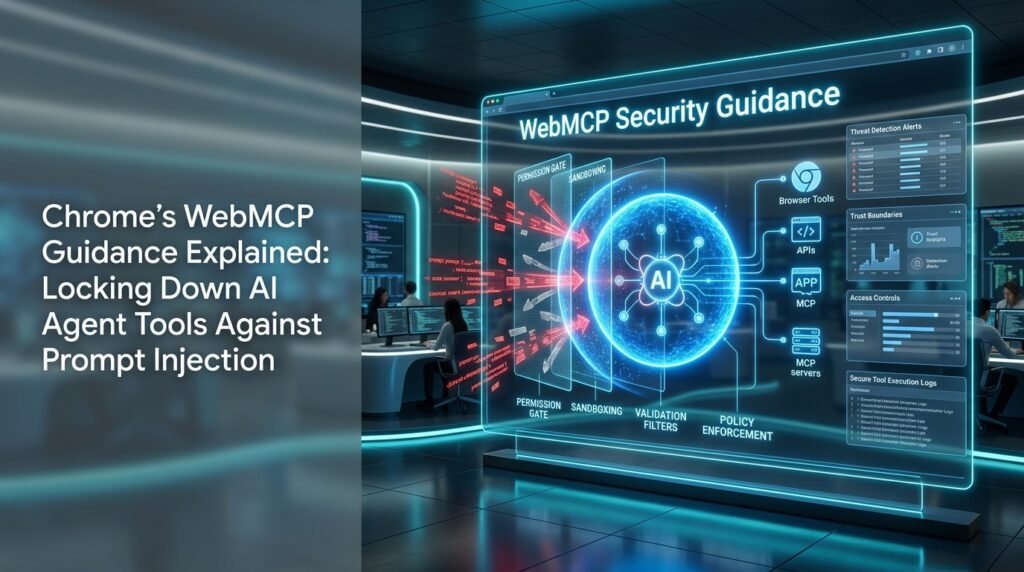
Introduction to Chrome’s WebMCP Guidance
As a digital marketing strategist and SEO consultant, I have been following the developments in the field of Artificial Intelligence (AI) and its applications in various industries. One of the most significant advancements in AI is the use of AI agent tools, which have the potential to revolutionize the way we interact with technology. However, with the increasing use of AI agent tools, there is also a growing concern about the security risks associated with them. One such risk is prompt injection, which can compromise the integrity of AI systems and lead to unintended consequences. To address this issue, Chrome has released WebMCP guidance, which provides a framework for locking down AI agent tools against prompt injection. In this article, we will delve into the details of Chrome’s WebMCP guidance and explore its implications for the development and deployment of AI agent tools.
The WebMCP (Web Model Confinement Protocol) is a set of guidelines and best practices for developing and deploying AI agent tools in a secure and controlled environment. The primary goal of WebMCP is to prevent prompt injection attacks, which occur when an attacker manipulates the input prompts to an AI system, causing it to produce unintended or malicious outputs. By following the WebMCP guidance, developers can ensure that their AI agent tools are designed and implemented with security in mind, reducing the risk of prompt injection attacks and protecting the integrity of the AI system.
Chrome’s WebMCP guidance is based on the principles of confidentiality, integrity, and availability. These principles are fundamental to the development of secure AI systems, and they provide a foundation for the WebMCP guidance. Confidentiality refers to the protection of sensitive information, such as user data or proprietary algorithms, from unauthorized access or disclosure. Integrity refers to the accuracy and reliability of the AI system’s outputs, ensuring that they are not compromised by malicious inputs or other security threats. Availability refers to the ability of the AI system to function as intended, without interruption or disruption, even in the face of security threats or other challenges.
The WebMCP guidance provides a comprehensive framework for addressing these principles and ensuring the security of AI agent tools. It includes guidelines for input validation, output sanitization, and error handling, as well as recommendations for secure coding practices and penetration testing. By following these guidelines, developers can ensure that their AI agent tools are designed and implemented with security in mind, reducing the risk of prompt injection attacks and other security threats.
For example, the WebMCP guidance recommends that developers implement input validation mechanisms to ensure that user inputs are valid and do not contain malicious code. This can be achieved through techniques such as data normalization and input sanitization, which help to prevent attackers from injecting malicious code into the AI system. Additionally, the WebMCP guidance recommends that developers implement output sanitization mechanisms to ensure that the AI system’s outputs are free from sensitive information or other security risks.
Another key aspect of the WebMCP guidance is the use of secure coding practices. This includes techniques such as code reviews and penetration testing, which help to identify and address security vulnerabilities in the AI system. By following secure coding practices, developers can ensure that their AI agent tools are designed and implemented with security in mind, reducing the risk of prompt injection attacks and other security threats.
In addition to these technical guidelines, the WebMCP guidance also provides recommendations for incident response and security monitoring. This includes procedures for responding to security incidents, such as prompt injection attacks, as well as guidelines for monitoring the AI system’s security posture and identifying potential security risks. By following these recommendations, developers can ensure that their AI agent tools are prepared to respond to security incidents and minimize the impact of prompt injection attacks.
Some of the key benefits of following the WebMCP guidance include:
- Improved security: By following the WebMCP guidance, developers can ensure that their AI agent tools are designed and implemented with security in mind, reducing the risk of prompt injection attacks and other security threats.
- Increased trust: By demonstrating a commitment to security and transparency, developers can increase trust in their AI agent tools and build confidence with users.
- Regulatory compliance: The WebMCP guidance is aligned with regulatory requirements and industry standards for AI security, helping developers to ensure compliance with relevant laws and regulations.
- Reduced risk: By following the WebMCP guidance, developers can reduce the risk of security incidents and minimize the impact of prompt injection attacks.
In conclusion, Chrome’s WebMCP guidance provides a comprehensive framework for locking down AI agent tools against prompt injection attacks. By following the guidelines and best practices outlined in the WebMCP guidance, developers can ensure that their AI agent tools are designed and implemented with security in mind, reducing the risk of prompt injection attacks and other security threats. As the use of AI agent tools continues to grow and evolve, it is essential that developers prioritize security and follow the WebMCP guidance to protect the integrity of AI systems and prevent unintended consequences.
Understanding Prompt Injection Attacks on AI Agent Tools
As a digital marketing strategist and SEO consultant, I have witnessed the rapid evolution of Artificial Intelligence (AI) and its integration into various tools and technologies. One such area where AI has made significant inroads is in the development of AI agent tools, designed to automate tasks, provide customer support, and enhance user experience. However, with the increasing reliance on these tools comes the risk of prompt injection attacks, which can compromise their security and integrity. In this section, we will delve into the world of prompt injection attacks, exploring what they are, how they work, and the potential consequences for AI agent tools.
Prompt injection attacks refer to a type of cyber attack where an attacker manipulates the input or prompt given to an AI agent tool, with the intention of altering its behavior or extracting sensitive information. These attacks can be particularly devastating, as they can be used to bypass security measures, gain unauthorized access to sensitive data, or even take control of the AI agent tool itself. The rise of prompt injection attacks has significant implications for organizations that rely on AI agent tools, as it can lead to a loss of trust, reputational damage, and financial losses.
To understand the mechanics of prompt injection attacks, let’s consider an example. Suppose we have an AI-powered chatbot designed to provide customer support for an e-commerce website. The chatbot is programmed to respond to user queries, provide product information, and even facilitate transactions. However, an attacker could potentially inject a malicious prompt into the chatbot’s system, tricking it into revealing sensitive information, such as customer data or payment details. This could be achieved by crafting a cleverly worded prompt that exploits a vulnerability in the chatbot’s programming or by using social engineering tactics to manipulate the chatbot into divulging sensitive information.
The consequences of prompt injection attacks can be severe, and organizations must take proactive measures to protect their AI agent tools against these types of attacks. Some of the potential consequences of prompt injection attacks include:
- Data breaches: Prompt injection attacks can be used to extract sensitive information, such as customer data, payment details, or confidential business information.
- System compromise: Attackers can use prompt injection attacks to gain unauthorized access to AI agent tools, allowing them to manipulate the system, steal data, or disrupt operations.
- Reputational damage: Organizations that fall victim to prompt injection attacks can suffer significant reputational damage, leading to a loss of customer trust and loyalty.
- Financial losses: The financial consequences of prompt injection attacks can be substantial, ranging from the cost of remediation and recovery to potential legal liabilities and regulatory fines.
Given the risks associated with prompt injection attacks, it is essential for organizations to implement robust security measures to protect their AI agent tools. This includes developing secure coding practices, implementing input validation and sanitization, and conducting regular security audits and penetration testing. Additionally, organizations should prioritize employee education and awareness, ensuring that those who interact with AI agent tools are aware of the risks of prompt injection attacks and know how to identify and respond to potential security threats.
In the context of Chrome’s WebMCP guidance, locking down AI agent tools against prompt injection attacks is critical to ensuring the security and integrity of these systems. By following WebMCP guidelines and implementing robust security measures, organizations can reduce the risk of prompt injection attacks and protect their AI agent tools against potential threats. In the next section, we will explore Chrome’s WebMCP guidance in more detail, examining the specific recommendations and best practices for securing AI agent tools against prompt injection attacks.
Chrome’s WebMCP Guidance: Best Practices for Locking Down AI Agent Tools
As a digital marketing strategist and SEO consultant specializing in AI-driven search visibility, I have had the opportunity to work with various AI agent tools that rely on WebMCP (Web Multipurpose Content Protocol) to interact with web applications. The increasing use of AI agent tools has also led to a growing concern about the security risks associated with these tools, particularly when it comes to prompt injection attacks. In this section, we will delve into Chrome’s WebMCP guidance and explore the best practices for locking down AI agent tools against prompt injection attacks.
Chrome’s WebMCP guidance provides a set of guidelines and recommendations for developers to ensure the secure integration of AI agent tools with web applications. The guidance emphasizes the importance of validating and sanitizing user input, implementing robust security measures, and following best practices for secure coding. By following these guidelines, developers can significantly reduce the risk of prompt injection attacks and protect their AI agent tools from malicious exploitation.
One of the key recommendations in Chrome’s WebMCP guidance is to validate and sanitize user input. This involves verifying that user input conforms to expected formats and patterns, and removing any malicious or unauthorized characters. For example, if an AI agent tool accepts user input in the form of text prompts, the tool should validate that the input is within a specified character limit and does not contain any malicious code or characters. By doing so, the tool can prevent attackers from injecting malicious prompts that could compromise the security of the tool or the underlying web application.
Another important aspect of Chrome’s WebMCP guidance is the implementation of robust security measures. This includes using secure communication protocols, such as HTTPS, to encrypt data transmitted between the AI agent tool and the web application. Additionally, developers should implement authentication and authorization mechanisms to ensure that only authorized users can access and interact with the AI agent tool. For instance, a developer can use JSON Web Tokens (JWT) to authenticate and authorize users, and then use the authenticated user’s credentials to authorize access to the AI agent tool.
Chrome’s WebMCP guidance also emphasizes the importance of following best practices for secure coding. This includes using secure coding libraries and frameworks, keeping software up-to-date with the latest security patches, and avoiding common web application vulnerabilities, such as SQL injection and cross-site scripting (XSS). By following these best practices, developers can reduce the risk of security vulnerabilities in their AI agent tools and prevent attackers from exploiting these vulnerabilities to launch prompt injection attacks.
To illustrate the importance of following Chrome’s WebMCP guidance, let’s consider an example of a prompt injection attack on an AI agent tool. Suppose an AI agent tool is designed to provide customer support chat services, and it uses WebMCP to interact with a web application. An attacker could potentially inject a malicious prompt into the chat service, which could compromise the security of the web application or steal sensitive user data. However, if the developer of the AI agent tool follows Chrome’s WebMCP guidance and implements robust security measures, such as input validation and secure communication protocols, the attacker would be unable to inject malicious prompts, and the security of the web application would be protected.
In addition to following Chrome’s WebMCP guidance, developers can also take several other steps to lock down their AI agent tools against prompt injection attacks. Some of these steps include:
- Implementing a Web Application Firewall (WAF): A WAF can help detect and prevent common web application attacks, including prompt injection attacks. By configuring a WAF to monitor traffic to and from the AI agent tool, developers can identify and block malicious traffic before it reaches the tool.
- Using a Content Security Policy (CSP): A CSP can help prevent cross-site scripting (XSS) attacks by defining which sources of content are allowed to be executed within a web application. By implementing a CSP, developers can reduce the risk of XSS attacks, which are often used to launch prompt injection attacks.
- Conducting regular security audits and penetration testing: Regular security audits and penetration testing can help identify vulnerabilities in the AI agent tool and the underlying web application. By addressing these vulnerabilities, developers can reduce the risk of prompt injection attacks and other types of security threats.
- Providing ongoing training and support for users: Finally, developers should provide ongoing training and support for users to ensure that they understand how to use the AI agent tool securely. This can include providing guidance on how to identify and report suspicious activity, as well as how to use the tool in a way that minimizes the risk of security threats.
In conclusion, Chrome’s WebMCP guidance provides a set of best practices and recommendations for locking down AI agent tools against prompt injection attacks. By following these guidelines and implementing robust security measures, developers can significantly reduce the risk of security threats and protect their AI agent tools from malicious exploitation. As the use of AI agent tools continues to grow, it is essential for developers to prioritize security and follow best practices for secure coding, input validation, and secure communication protocols. By doing so, they can ensure the secure integration of AI agent tools with web applications and protect users from security threats.
As a digital marketing strategist and SEO consultant, I have seen firsthand the importance of prioritizing security in AI agent tools. By following Chrome’s WebMCP guidance and implementing robust security measures, developers can not only protect their AI agent tools from security threats but also improve the overall user experience and build trust with their users. In the next section, we will explore additional strategies for securing AI agent tools and protecting against prompt injection attacks.
Technical Implementation of WebMCP Guidance for AI Agent Tools
As a digital marketing strategist and SEO consultant, I have worked with numerous brands to scale their online presence and improve their search visibility. With the increasing use of AI-driven tools, it’s essential to ensure that these tools are secure and protected against potential threats. In this section, we will delve into the technical implementation of Chrome’s WebMCP guidance for AI agent tools, focusing on locking down these tools against prompt injection.
The WebMCP (Web Model Communication Protocol) is a set of guidelines and standards for building and interacting with AI models on the web. By following these guidelines, developers can create more secure and efficient AI agent tools that can effectively communicate with web models. The technical implementation of WebMCP guidance involves several key steps, including understanding the protocol, implementing secure communication channels, and ensuring data validation and sanitization.
One of the primary concerns when implementing AI agent tools is the risk of prompt injection. Prompt injection occurs when an attacker manipulates the input or prompts provided to an AI model, potentially leading to unauthorized access or malicious behavior. To mitigate this risk, it’s essential to implement robust security measures, such as input validation, data sanitization, and secure communication protocols. By following the WebMCP guidance, developers can ensure that their AI agent tools are protected against prompt injection and other potential threats.
Understanding the WebMCP Protocol is the first step in implementing the guidance for AI agent tools. The protocol provides a set of standards and guidelines for building and interacting with AI models on the web. It covers aspects such as model architecture, data formats, and communication protocols. By understanding the protocol, developers can create AI agent tools that are compatible with the WebMCP standards, ensuring seamless communication and interaction with web models.
The next step is to Implement Secure Communication Channels. This involves using secure protocols such as HTTPS (Hypertext Transfer Protocol Secure) to encrypt data transmitted between the AI agent tool and the web model. By using secure communication channels, developers can prevent eavesdropping, tampering, and other types of attacks that could compromise the security of the AI agent tool. Additionally, secure communication channels can help prevent prompt injection by ensuring that input data is transmitted securely and cannot be manipulated by attackers.
Data Validation and Sanitization are also crucial steps in implementing the WebMCP guidance. Data validation involves verifying that input data is correct and conforms to expected formats, while data sanitization involves removing any malicious or unwanted characters from the input data. By validating and sanitizing input data, developers can prevent prompt injection and other types of attacks that rely on manipulating input data. For example, if an AI agent tool is designed to respond to user queries, data validation and sanitization can help ensure that the input queries are legitimate and do not contain malicious code.
Here are some examples of how to implement data validation and sanitization in AI agent tools:
- Using regular expressions to validate input data against expected patterns
- Implementing whitelist-based validation to only allow specific input formats
- Using libraries and frameworks that provide built-in data validation and sanitization functions
- Performing input data normalization to remove any unwanted characters or formatting
In addition to these technical implementation steps, it’s also essential to Monitor and Test AI Agent Tools regularly. Monitoring involves tracking the performance and behavior of the AI agent tool, while testing involves simulating various scenarios to identify potential vulnerabilities. By monitoring and testing AI agent tools, developers can quickly identify and address any security issues that may arise, ensuring that the tools remain secure and protected against prompt injection and other threats.
For instance, developers can use various testing frameworks and tools to simulate different input scenarios, including malicious input data. This can help identify potential vulnerabilities in the AI agent tool and ensure that the tool is robust and secure. Additionally, monitoring the tool’s performance and behavior can help detect any unusual activity that may indicate a security breach or other issue.
In conclusion, the technical implementation of Chrome’s WebMCP guidance for AI agent tools is a critical step in ensuring the security and integrity of these tools. By following the guidelines and standards outlined in the WebMCP protocol, developers can create AI agent tools that are protected against prompt injection and other potential threats. By understanding the protocol, implementing secure communication channels, validating and sanitizing input data, and monitoring and testing the tools regularly, developers can ensure that their AI agent tools are robust, secure, and effective in providing value to users.
As a digital marketing strategist and SEO consultant, I have seen firsthand the importance of securing AI-driven tools and technologies. By prioritizing security and implementing the WebMCP guidance, brands and organizations can protect their online presence and ensure that their AI agent tools are working effectively and efficiently. Whether you’re a developer, marketer, or business leader, it’s essential to understand the importance of securing AI agent tools and to take proactive steps to protect against prompt injection and other potential threats.
Conclusion and Future of AI Agent Tool Security with WebMCP Guidance
As we conclude our in-depth exploration of Chrome’s WebMCP guidance, it is essential to emphasize the significance of securing AI agent tools against prompt injection attacks. The future of AI-driven applications and tools hinges on the ability to prevent such attacks, which can compromise the integrity and reliability of these systems. In this section, we will delve into the implications of WebMCP guidance on the future of AI agent tool security and discuss the potential consequences of neglecting to implement these guidelines.
The WebMCP guidance provides a comprehensive framework for developers to follow when designing and implementing AI agent tools, with a focus on preventing prompt injection attacks. By adhering to these guidelines, developers can significantly reduce the risk of their tools being exploited by malicious actors. It is crucial for organizations to prioritize the security of their AI agent tools, as the consequences of a prompt injection attack can be severe, ranging from data breaches to financial losses.
A key aspect of the WebMCP guidance is the emphasis on input validation and sanitization. This involves verifying that user input conforms to expected formats and patterns, thereby preventing malicious actors from injecting harmful prompts. For instance, a chatbot designed to provide customer support may be vulnerable to prompt injection attacks if it does not properly validate user input. By implementing robust input validation and sanitization mechanisms, developers can prevent such attacks and ensure the integrity of their AI agent tools.
Another critical component of the WebMCP guidance is the use of secure communication protocols. This includes protocols such as HTTPS and TLS, which provide end-to-end encryption and authentication. By using these protocols, developers can ensure that communication between the AI agent tool and its users remains secure and protected from eavesdropping and tampering. For example, a virtual assistant that uses HTTPS to communicate with its users can prevent malicious actors from intercepting and modifying user input, thereby reducing the risk of prompt injection attacks.
In addition to these technical measures, the WebMCP guidance also emphasizes the importance of ongoing monitoring and testing. This involves regularly assessing the security of AI agent tools and identifying potential vulnerabilities that could be exploited by malicious actors. By conducting thorough security audits and penetration testing, developers can identify weaknesses in their tools and address them before they can be exploited. For instance, a company that develops AI-powered chatbots may conduct regular security audits to identify potential vulnerabilities in their tools and implement patches and updates to address these weaknesses.
So, what does the future hold for AI agent tool security with WebMCP guidance? As AI continues to evolve and become increasingly integrated into various aspects of our lives, the need for secure and reliable AI agent tools will only continue to grow. Organizations that prioritize the security of their AI agent tools will be better positioned to capitalize on the benefits of AI while minimizing the risks associated with prompt injection attacks. Conversely, those that neglect to implement the WebMCP guidance may find themselves vulnerable to attacks, which can damage their reputation and bottom line.
To illustrate the importance of WebMCP guidance, let us consider a few examples of AI agent tools that are vulnerable to prompt injection attacks. These include:
- Virtual assistants that do not properly validate user input, allowing malicious actors to inject harmful prompts and compromise the security of the assistant.
- Chatbots that do not use secure communication protocols, making it possible for malicious actors to intercept and modify user input.
- Language translation tools that do not implement robust input validation and sanitization mechanisms, allowing malicious actors to inject malicious prompts and compromise the integrity of the tool.
In each of these examples, the failure to implement the WebMCP guidance can have significant consequences, ranging from data breaches to financial losses. By prioritizing the security of AI agent tools and following the WebMCP guidance, organizations can minimize the risk of prompt injection attacks and ensure the integrity and reliability of their AI-driven applications.
In conclusion, the WebMCP guidance provides a critical framework for securing AI agent tools against prompt injection attacks. By emphasizing the importance of input validation and sanitization, secure communication protocols, and ongoing monitoring and testing, the WebMCP guidance helps developers create secure and reliable AI agent tools. As AI continues to evolve and become increasingly integrated into our lives, it is essential for organizations to prioritize the security of their AI agent tools and follow the WebMCP guidance to minimize the risk of prompt injection attacks. By doing so, organizations can capitalize on the benefits of AI while ensuring the integrity and reliability of their AI-driven applications.

Amit Tyagi is a seasoned Digital Marketing and SEO Consultant with extensive experience helping businesses improve online visibility through SEO, AI Search Optimization (AIO/GEO), content strategy, and performance marketing. He regularly shares practical insights, industry updates, and data-driven strategies, empowering brands and marketers to achieve sustainable digital growth in an evolving search landsca