
Introduction to the AI Visibility Conundrum
As a digital marketing strategist and SEO consultant, I have witnessed firsthand the rapid evolution of search engine optimization (SEO) and its intersection with artificial intelligence (AI). With over 15 years of experience in helping brands scale globally through advanced SEO frameworks, Generative Engine Optimization (GEO), and performance-driven digital strategies, I have come to realize that the pursuit of AI visibility can be a double-edged sword. On one hand, AI-driven search visibility can catapult a brand to unprecedented heights, yielding unparalleled revenue and growth. On the other hand, the unbridled chase for AI visibility can trigger a Google-style crackdown, leaving even the most well-intentioned brands in ruins.
The recent surge in AI adoption has led to a proliferation of AI-generated content, AI-optimized websites, and AI-driven marketing campaigns. While these advancements have undoubtedly improved the efficiency and effectiveness of digital marketing, they have also raised concerns about the potential for manipulation and exploitation. As brands increasingly rely on AI to boost their online visibility, they risk triggering a backlash from search engines like Google, which have long been the gatekeepers of online authority and credibility.
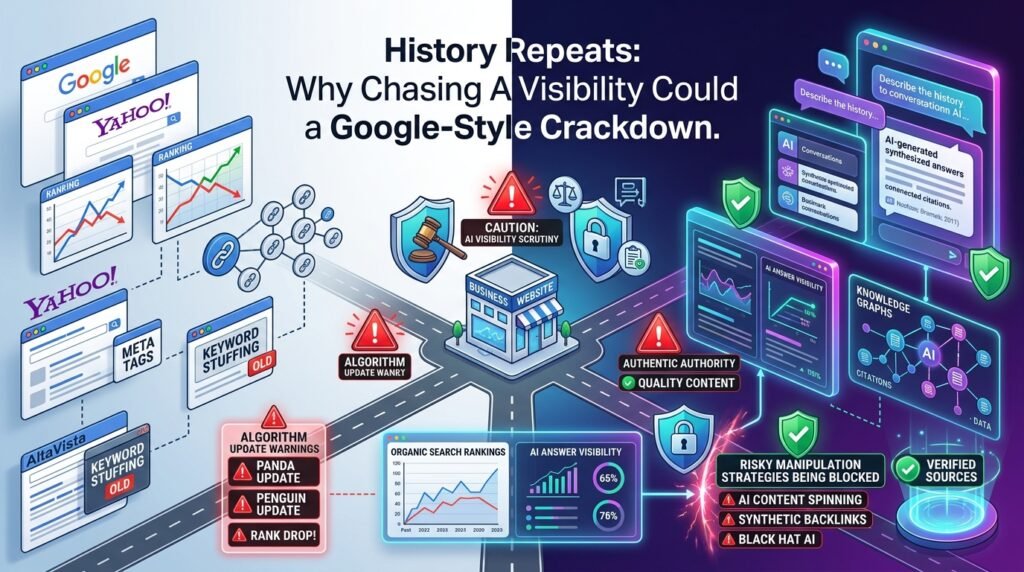
The parallels between the current AI visibility conundrum and the Google crackdowns of the past are striking. In the early 2000s, Google launched a series of algorithmic updates aimed at curbing the excesses of SEO practitioners who had resorted to manipulative tactics to game the system. The Panda and Penguin updates, in particular, sent shockwaves through the digital marketing community, as they targeted websites that had engaged in keyword stuffing, link farming, and other forms of search engine manipulation. Similarly, the current AI-driven gold rush has the potential to attract the attention of Google’s algorithmic watchdogs, who may view the proliferation of AI-generated content and AI-optimized websites as a threat to the integrity of their search results.
To understand the risks associated with chasing AI visibility, it is essential to examine the factors that contribute to Google’s algorithmic updates. These updates are designed to promote high-quality, user-centric content that provides value to search engine users. Conversely, they penalize websites that engage in manipulative or deceptive practices, such as:
- Keyword stuffing and density manipulation
- Link schemes and artificial link building
- Thin, low-quality, or duplicate content
- Over-optimization and spammy keyword usage
Similarly, the unbridled pursuit of AI visibility can lead to a range of undesirable consequences, including:
- Over-reliance on AI-generated content, which can lack the nuance, empathy, and emotional resonance that human-created content provides
- AI-driven keyword manipulation, which can result in content that is overly optimized for search engines but fails to provide value to human users
- Algorithmic gaming, which can lead to a cat-and-mouse game between brands and search engines, as each side attempts to outmaneuver the other
As the digital marketing landscape continues to evolve, it is crucial for brands to adopt a balanced approach to AI visibility, one that prioritizes user-centricity, quality, and authenticity. By doing so, they can minimize the risk of triggering a Google-style crackdown and instead focus on building a sustainable, long-term online presence that yields meaningful revenue and growth. In the next section, we will delve deeper into the implications of the AI visibility conundrum and explore strategies for mitigating its risks while maximizing its rewards.
The Google Crackdowns: Lessons from History
As a digital marketing strategist and SEO consultant, I have witnessed numerous trends and techniques emerge in the pursuit of search visibility. One trend that has caught my attention in recent times is the increasing emphasis on Artificial Intelligence (AI) visibility. While AI-driven search optimization is undoubtedly a powerful tool, I believe it is essential to learn from history and recognize the potential risks of chasing AI visibility. In this article, I will explore the lessons from Google’s past crackdowns and why a similar fate could befall those who aggressively pursue AI visibility.
Google has a long history of cracking down on practices that it deems manipulative or spammy. One of the most notable examples is the Panda update, which was launched in 2011 to target low-quality content farms. The update had a significant impact on the search landscape, with many websites experiencing drastic drops in traffic and rankings. The Panda update was followed by the Penguin update, which targeted link spam and keyword stuffing. These updates, along with several others, have helped Google refine its algorithm and improve the overall quality of its search results.
So, what can we learn from these crackdowns? Firstly, it is clear that Google is committed to maintaining the integrity of its search results. The company has consistently demonstrated a willingness to take action against practices that it believes are manipulative or deceptive. Secondly, the crackdowns have shown that Google is willing to adapt and evolve its algorithm to stay ahead of those who would seek to manipulate it. This means that even if a particular technique or strategy is effective in the short term, it is unlikely to remain so in the long term.
Now, let’s consider the current trend of chasing AI visibility. While AI-driven search optimization is undoubtedly a powerful tool, I believe that it poses a significant risk of triggering a Google-style crackdown. Here are a few reasons why:
- Over-optimization: The pursuit of AI visibility can lead to over-optimization, which is a practice that Google has historically frowned upon. When websites are optimized too heavily for search engines, they can end up looking unnatural and spammy. This can lead to a range of problems, including penalties and even bans from Google’s index.
- Lack of transparency: Some AI-driven search optimization techniques can be opaque, making it difficult for Google to understand what is happening behind the scenes. This lack of transparency can lead to mistrust and even accusations of manipulation, which can trigger a crackdown.
- Manipulation of user signals: AI-driven search optimization can also involve the manipulation of user signals, such as click-through rates and bounce rates. While these signals can be useful in improving the user experience, they can also be gamed and manipulated. Google is likely to take a dim view of any practice that seeks to manipulate these signals, and could potentially crack down on websites that engage in such behavior.
So, what can you do to avoid triggering a Google-style crackdown? Here are a few tips:
- Focus on user experience: Rather than chasing AI visibility, focus on creating a high-quality user experience. This means producing engaging, informative, and relevant content that meets the needs of your target audience.
- Use AI-driven search optimization judiciously: While AI-driven search optimization can be a powerful tool, it is essential to use it judiciously. Avoid over-optimizing your website, and make sure that any techniques you use are transparent and above board.
- Monitor your analytics closely: Keep a close eye on your analytics, and be prepared to adapt and evolve your strategy as needed. This will help you stay ahead of any potential crackdowns, and ensure that your website remains visible and relevant in the search results.
In conclusion, while AI-driven search optimization is undoubtedly a powerful tool, it is essential to approach it with caution. By learning from the lessons of history, and recognizing the potential risks of chasing AI visibility, you can avoid triggering a Google-style crackdown and ensure that your website remains visible and relevant in the search results. As a digital marketing strategist and SEO consultant, I have seen firsthand the importance of taking a careful and considered approach to search optimization. By focusing on user experience, using AI-driven search optimization judiciously, and monitoring your analytics closely, you can stay ahead of the curve and achieve long-term success in the search results.
Google’s algorithm is constantly evolving, and it is essential to stay up-to-date with the latest developments and best practices. By doing so, you can ensure that your website remains visible and relevant, and that you are well-positioned to take advantage of any new opportunities that arise. Whether you are a seasoned SEO professional or just starting out, I hope that this article has provided you with a useful insight into the potential risks and benefits of chasing AI visibility. By taking a careful and considered approach, you can achieve long-term success in the search results, and drive more traffic and revenue to your website.
Achieving AI Visibility: The Double-Edged Sword
As a digital marketing strategist and SEO consultant, I have witnessed firsthand the allure of achieving AI visibility in the digital landscape. With the increasing sophistication of artificial intelligence and machine learning algorithms, it’s no wonder that businesses are eager to leverage these technologies to boost their online presence. However, in the pursuit of AI-driven search visibility, brands must be cautious not to trigger a Google-style crackdown. In this article, we will delve into the complexities of achieving AI visibility and explore the potential risks and consequences of aggressively chasing this goal.
The concept of AI visibility refers to the ability of a brand or website to be prominently displayed in search engine results pages (SERPs) through the use of artificial intelligence and machine learning algorithms. This can be achieved through various means, such as optimizing content with AI-driven keyword research, using machine learning-based link building strategies, and leveraging natural language processing (NLP) to improve content quality and relevance. While these tactics can be highly effective in improving search visibility, they can also raise red flags with search engines like Google, which are constantly working to combat manipulative and spammy practices.
One of the primary concerns with aggressively chasing AI visibility is the risk of over-optimization. When brands rely too heavily on AI-driven tactics, they can inadvertently create content that appears unnatural or spammy to search engines. For example, keyword stuffing is a common practice where brands repeat keywords excessively in their content to manipulate search rankings. While AI algorithms can help identify and exploit keyword gaps, they can also lead to over-optimization, which can result in penalties or even bans from search engines. To avoid this, brands must strike a balance between leveraging AI-driven insights and creating high-quality, user-focused content that provides value to their audience.
Another risk associated with chasing AI visibility is the potential for algorithmic manipulation. As AI algorithms become more sophisticated, they can be used to manipulate search rankings and deceive search engines. For instance, some brands may use AI-driven link schemes to artificially inflate their authority and relevance. However, search engines are constantly evolving to combat these tactics, and brands that engage in manipulative practices risk being caught and penalized. To mitigate this risk, brands must focus on creating high-quality, relevant content that earns links and authority naturally, rather than relying on artificial means.
To illustrate the potential consequences of chasing AI visibility, let’s consider the example of Guest Blogging 2.0. In the early 2010s, guest blogging emerged as a popular tactic for building links and improving search visibility. However, as the practice became more widespread, it attracted the attention of search engines, which began to crack down on low-quality and spammy guest posts. Today, brands that engage in large-scale guest blogging campaigns risk being penalized or even banned from search engines. Similarly, the aggressive pursuit of AI visibility could lead to a similar crackdown, where search engines impose penalties on brands that manipulate or deceive their algorithms.
So, what can brands do to achieve AI visibility without triggering a Google-style crackdown? The key is to focus on user-centricity and quality. Rather than relying solely on AI-driven tactics, brands should prioritize creating high-quality, relevant, and engaging content that provides value to their audience. This can be achieved by:
- Conducting thorough keyword research to identify gaps and opportunities
- Creating comprehensive and well-structured content that addresses user needs and questions
- Leveraging AI-driven insights to inform and optimize content, rather than relying solely on algorithms
- Building high-quality, relevant links through natural means, such as outreach and relationships
- Monitoring and adjusting AI-driven tactics to avoid over-optimization and algorithmic manipulation
By prioritizing user-centricity and quality, brands can achieve AI visibility while minimizing the risk of triggering a Google-style crackdown. It’s essential to remember that search engines are constantly evolving to provide the best possible experience for users, and brands that focus on creating value and relevance will be better positioned to succeed in the long term. As a digital marketing strategist and SEO consultant, my goal is to help brands navigate the complexities of AI visibility and achieve sustainable, long-term success in the digital landscape.
In conclusion, achieving AI visibility is a double-edged sword. While AI-driven tactics can be highly effective in improving search visibility, they can also raise red flags with search engines and lead to penalties or bans. To avoid this, brands must prioritize user-centricity and quality, focusing on creating high-quality, relevant, and engaging content that provides value to their audience. By striking a balance between leveraging AI-driven insights and creating natural, user-focused content, brands can achieve AI visibility while minimizing the risk of triggering a Google-style crackdown. As the digital landscape continues to evolve, it’s essential for brands to stay ahead of the curve and prioritize sustainable, long-term strategies that prioritize user experience and relevance.
Generative Engine Optimization (GEO): The Future of SEO
As a digital marketing strategist and SEO consultant, I have had the privilege of witnessing the evolution of search engine optimization (SEO) over the years. With the advent of artificial intelligence (AI) and its increasing integration into search engines, the landscape of SEO is undergoing a significant transformation. One of the most exciting developments in this space is the emergence of Generative Engine Optimization (GEO), a new approach that leverages AI-driven techniques to enhance search visibility and authority. In this section, we will delve into the world of GEO, exploring its potential to revolutionize the way we approach SEO and the implications of chasing AI visibility.
GEO is an advanced SEO framework that utilizes AI-powered algorithms to generate high-quality, relevant, and engaging content that resonates with both search engines and human users. By harnessing the power of machine learning and natural language processing, GEO enables brands to create content that is optimized for search engines, while also providing value to their target audience. This approach has the potential to disrupt the traditional SEO paradigm, where keyword stuffing and link manipulation were often used to manipulate search rankings. With GEO, the focus shifts from manipulation to creation, where high-quality content is generated to meet the needs of both search engines and users.
The concept of GEO is built around the idea that search engines are becoming increasingly sophisticated, using AI-driven algorithms to evaluate the relevance and authority of content. As search engines continue to evolve, they will rely more heavily on machine learning models to determine the ranking of search results. This means that traditional SEO techniques, such as keyword optimization and link building, will become less effective, and a new approach will be required to achieve visibility and authority in search results. GEO is poised to fill this gap, providing a framework for brands to create content that is optimized for the AI-driven search engines of the future.
So, how does GEO work? The process begins with a deep understanding of the brand’s target audience, including their needs, preferences, and pain points. This information is used to generate high-quality, relevant, and engaging content that resonates with the target audience. The content is then optimized for search engines, using AI-powered algorithms to identify the most relevant keywords, phrases, and topics. The optimized content is then published and promoted across various channels, including social media, email, and other digital platforms. As the content is consumed and engaged with by the target audience, the brand’s authority and visibility in search results increase, driving more traffic and revenue to the brand’s website.
The benefits of GEO are numerous, and brands that adopt this approach can expect to see significant improvements in their search visibility and authority. Some of the key benefits of GEO include:
- Improved search rankings: By generating high-quality, relevant, and engaging content, brands can improve their search rankings and increase their visibility in search results.
- Increased authority: GEO helps brands establish themselves as authorities in their industry, driving more traffic and revenue to their website.
- Enhanced user experience: By providing high-quality, relevant, and engaging content, brands can enhance the user experience, driving more engagement, conversions, and customer loyalty.
- Better ROI: GEO provides a more efficient and effective approach to SEO, helping brands achieve better ROI on their digital marketing investments.
- Future-proofing: By leveraging AI-driven algorithms and machine learning models, GEO provides a future-proof approach to SEO, ensuring that brands remain competitive in the ever-evolving search landscape.
However, as exciting as GEO is, there is a potential downside to chasing AI visibility. As brands begin to adopt GEO and other AI-driven SEO techniques, there is a risk that search engines will crack down on these approaches, deeming them manipulative or spammy. This could lead to a Google-style crackdown, where brands that have invested heavily in GEO and other AI-driven SEO techniques find themselves penalized or even banned from search results. This risk is very real, and brands must be cautious when adopting GEO and other AI-driven SEO approaches.
For example, in the early 2000s, Google launched a crackdown on keyword stuffing and link manipulation, penalizing brands that had relied heavily on these techniques to achieve high search rankings. Similarly, in 2011, Google launched the Panda update, which targeted content farms and low-quality content, causing many brands to see significant declines in their search traffic. More recently, Google has launched a series of updates, including the BERT update, which have further emphasized the importance of high-quality, relevant, and engaging content. As search engines continue to evolve, it is likely that we will see further crackdowns on manipulative or spammy SEO techniques, including those that rely on AI-driven algorithms.
To mitigate this risk, brands must adopt a balanced approach to GEO and other AI-driven SEO techniques. This means focusing on creating high-quality, relevant, and engaging content that provides value to the target audience, while also using AI-powered algorithms to optimize and promote that content. By taking a holistic approach to SEO, brands can reduce their risk of being penalized or banned, while also achieving significant improvements in their search visibility and authority.
In conclusion, Generative Engine Optimization (GEO) is a powerful approach to SEO that leverages AI-driven algorithms to generate high-quality, relevant, and engaging content. While GEO has the potential to revolutionize the way we approach SEO, there is a risk that search engines will crack down on these approaches, deeming them manipulative or spammy. To mitigate this risk, brands must adopt a balanced approach to GEO, focusing on creating high-quality content that provides value to the target audience, while also using AI-powered algorithms to optimize and promote that content. By taking a holistic approach to SEO, brands can achieve significant improvements in their search visibility and authority, while also reducing their risk of being penalized or banned.
Navigating the Future of AI Visibility and SEO
As a digital marketing strategist and SEO consultant, I have been at the forefront of the evolving landscape of search engine optimization and artificial intelligence. With over 15 years of experience in helping brands scale globally through advanced SEO frameworks and performance-driven digital strategies, I have witnessed firsthand the impact of AI on search visibility and the potential risks of chasing AI visibility without a well-thought-out strategy. In this article, we will delve into the importance of navigating the future of AI visibility and SEO, and why chasing AI visibility could trigger a Google-style crackdown.
The integration of artificial intelligence into search engine algorithms has revolutionized the way we approach SEO. AI-powered algorithms can analyze vast amounts of data, identify patterns, and make predictions about user behavior. This has led to a significant shift in the way search engines rank websites, with a greater emphasis on relevance, user experience, and content quality. However, this shift has also created new challenges for digital marketers and SEO consultants, who must now navigate the complex and ever-changing landscape of AI-driven search visibility.
One of the key challenges of AI-driven search visibility is the risk of over-optimization. As AI algorithms become increasingly sophisticated, they are able to detect and penalize websites that engage in manipulative or spammy tactics. This has led to a crackdown on practices such as keyword stuffing, link schemes, and other forms of SEO spam. However, the line between legitimate SEO practices and over-optimization can be blurry, and even well-intentioned digital marketers can inadvertently trigger a Google-style crackdown.
For example, a company may use AI-powered tools to generate large volumes of content, hoping to increase their search visibility and drive more traffic to their website. However, if this content is of poor quality, or if it is duplicated across multiple websites, it can trigger a penalty from Google. Similarly, a business may use AI-driven link building strategies, such as automated guest blogging or link exchange programs, without realizing that these tactics are against Google’s guidelines. In both cases, the company may be chasing AI visibility without realizing the potential risks and consequences.
To navigate the future of AI visibility and SEO, digital marketers and SEO consultants must take a more nuanced and strategic approach. This involves understanding the strengths and limitations of AI-powered algorithms, as well as the potential risks and benefits of different SEO strategies. It also requires a deep understanding of Google’s guidelines and best practices, as well as the ability to adapt to changing algorithms and trends.
Some key strategies for navigating the future of AI visibility and SEO include:
- Focus on creating high-quality, user-centric content that provides value to the target audience. This can include blog posts, videos, podcasts, and other forms of content that are optimized for relevance and user experience.
- Use AI-powered tools and analytics to inform and optimize SEO strategies, but avoid relying solely on automation. Human judgment and oversight are still essential for ensuring that SEO strategies are effective and compliant with Google’s guidelines.
- Build high-quality backlinks from authoritative sources, using strategies such as guest blogging, broken link building, and resource pages. Avoid link schemes and other manipulative tactics that can trigger a penalty from Google.
- Optimize website technical performance, including page speed, mobile responsiveness, and SSL encryption. This can help improve user experience and increase search visibility.
- Stay up-to-date with the latest algorithm updates and trends, and be prepared to adapt SEO strategies accordingly. This can include attending industry conferences, following SEO thought leaders, and participating in online forums and discussions.
By taking a strategic and nuanced approach to AI visibility and SEO, digital marketers and SEO consultants can help their clients achieve greater search visibility, drive more traffic and revenue, and build a strong online presence. However, this requires a deep understanding of the complex and ever-changing landscape of AI-driven search visibility, as well as the potential risks and benefits of different SEO strategies.
In conclusion, navigating the future of AI visibility and SEO requires a combination of technical expertise, strategic thinking, and creative problem-solving. By understanding the strengths and limitations of AI-powered algorithms, and by taking a nuanced and adaptive approach to SEO, digital marketers and SEO consultants can help their clients achieve greater success and avoid the potential risks of a Google-style crackdown. As the landscape of AI visibility and SEO continues to evolve, it is essential to stay ahead of the curve and be prepared to adapt to changing algorithms and trends.
As a digital marketing strategist and SEO consultant, I have seen firsthand the impact of AI on search visibility and the potential risks of chasing AI visibility without a well-thought-out strategy. By taking a strategic and nuanced approach to AI visibility and SEO, and by staying up-to-date with the latest algorithm updates and trends, digital marketers and SEO consultants can help their clients achieve greater success and build a strong online presence. The future of AI visibility and SEO is complex and ever-changing, but with the right approach and mindset, it is possible to navigate this landscape and achieve greater search visibility, drive more traffic and revenue, and build a strong online presence.
The importance of understanding the potential risks and benefits of different SEO strategies cannot be overstated. By taking a deep understanding of Google’s guidelines and best practices, and by being aware of the potential risks of over-optimization and manipulative tactics, digital marketers and SEO consultants can help their clients avoid the potential risks of a Google-style crackdown. This requires a combination of technical expertise, strategic thinking, and creative problem-solving, as well as a commitment to staying up-to-date with the latest algorithm updates and trends.
In the end, navigating the future of AI visibility and SEO is a complex and ongoing challenge that requires a deep understanding of the landscape and a commitment to staying ahead of the curve. By taking a strategic and nuanced approach to AI visibility and SEO, and by being aware of the potential risks and benefits of different SEO strategies, digital marketers and SEO consultants can help their clients achieve greater success and build a strong online presence. The future of AI visibility and SEO is bright, but it is also complex and ever-changing, and it is essential to be prepared to adapt to changing algorithms and trends in order to stay ahead of the curve.

Amit Tyagi is a seasoned Digital Marketing and SEO Consultant with extensive experience helping businesses improve online visibility through SEO, AI Search Optimization (AIO/GEO), content strategy, and performance marketing. He regularly shares practical insights, industry updates, and data-driven strategies, empowering brands and marketers to achieve sustainable digital growth in an evolving search landsca