
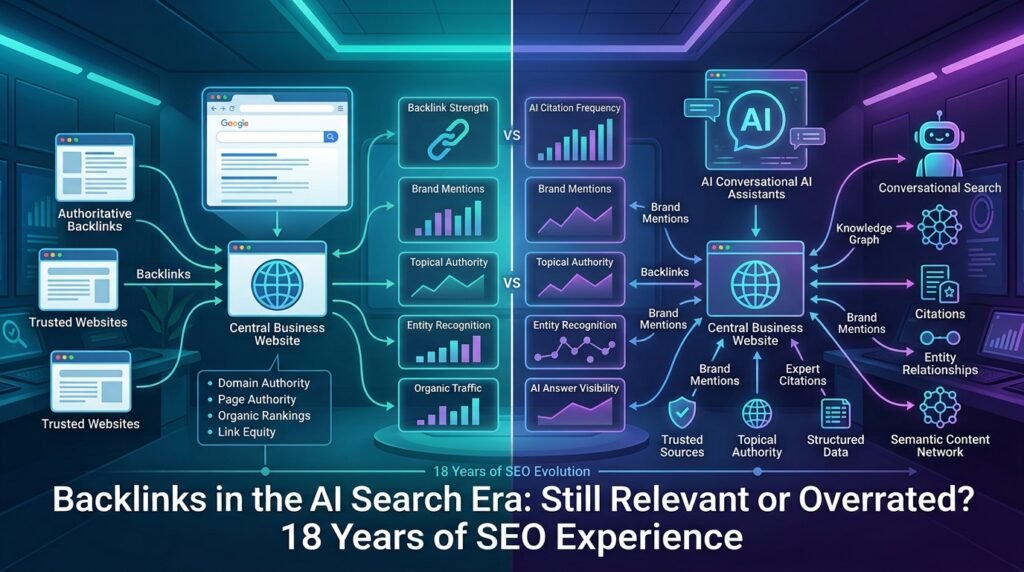
Introduction to Backlinks in the AI Search Era
As a digital marketing strategist and SEO consultant with over 18 years of experience, I have witnessed the evolution of search engine optimization (SEO) and its various components, including backlinks. In the AI search era, the relevance and importance of backlinks have become a topic of debate among SEO professionals and digital marketers. While some argue that backlinks are still a crucial ranking factor, others believe that they are overrated and no longer hold the same significance. In this article, we will delve into the world of backlinks, exploring their history, evolution, and current relevance in the AI-driven search landscape.
The concept of backlinks dates back to the early days of the internet, when search engines like Google and Yahoo used link analysis to determine the relevance and authority of web pages. The idea was simple: if a webpage had many high-quality backlinks from other reputable websites, it was likely to be a valuable resource for users. Over time, backlinks became a key ranking factor, and SEO professionals focused on building high-quality backlink profiles to improve their website’s visibility and search engine rankings.
However, with the advent of AI-powered search engines, the role of backlinks has undergone significant changes. Modern search engines like Google use complex algorithms that incorporate machine learning and natural language processing (NLP) to understand user intent, context, and behavior. These algorithms can analyze vast amounts of data, including user interactions, content quality, and technical performance, to deliver more accurate and personalized search results. As a result, the importance of backlinks has diminished, and other factors like content relevance, user experience, and technical optimization have gained more prominence.
Despite these changes, backlinks still hold some value in the AI search era. High-quality backlinks from authoritative sources can help establish a website’s credibility and trustworthiness, which are essential for building a strong online presence. Moreover, backlinks can drive referral traffic, increase brand awareness, and provide valuable insights into a website’s content and audience. However, the way we approach backlink building and optimization has changed significantly. Instead of focusing solely on quantity and anchor text diversity, we need to prioritize quality, relevance, and context.
For instance, a well-researched and informative article on a niche topic can attract high-quality backlinks from other reputable websites, blogs, and online publications. Similarly, a website with a strong brand presence and social media following can generate backlinks from other websites, forums, and online communities. In both cases, the focus is on creating value, building relationships, and establishing authority, rather than manipulating or buying backlinks.
To illustrate this point, let’s consider an example. Suppose we have an e-commerce website that sells outdoor gear and equipment. Instead of trying to acquire backlinks from low-quality blogs or directories, we can focus on creating high-quality content that resonates with our target audience. We can publish articles on outdoor activities, gear reviews, and travel guides, which can attract backlinks from other reputable websites and blogs in the outdoor niche. We can also partner with influencers, bloggers, and outdoor enthusiasts to promote our brand and products, generating backlinks and social media buzz in the process.
The key to successful backlink building in the AI search era is to focus on relevance, quality, and context. We need to understand our target audience, their needs, and preferences, and create content that resonates with them. We need to build relationships with other websites, bloggers, and influencers in our niche, and collaborate with them to create value and drive traffic. We need to prioritize user experience, technical optimization, and content quality, and use backlinks as a secondary metric to measure our website’s authority and credibility.
In conclusion, backlinks are still relevant in the AI search era, but their importance has diminished significantly. Instead of relying solely on backlinks, we need to focus on creating high-quality content, building strong relationships, and establishing authority in our niche. By prioritizing relevance, quality, and context, we can build a strong online presence, drive traffic, and generate revenue, even in a landscape dominated by AI-powered search engines. In the next section, we will explore the evolution of backlinks and their current role in SEO, providing more insights and examples to help you navigate the complex world of backlink building and optimization.
Some of the key takeaways from this section include:
- Backlinks are still relevant in the AI search era, but their importance has diminished.
- High-quality backlinks from authoritative sources can help establish credibility and trustworthiness.
- The focus should be on creating value, building relationships, and establishing authority, rather than manipulating or buying backlinks.
- Relevance, quality, and context are crucial for successful backlink building in the AI search era.
- Content quality, user experience, and technical optimization are more important than backlinks in the AI-driven search landscape.
By understanding these key points and adapting to the changing landscape of search engine optimization, we can build a strong online presence, drive traffic, and generate revenue, even in a world dominated by AI-powered search engines. In the next section, we will delve deeper into the evolution of backlinks and their current role in SEO, providing more examples, explanations, and insights to help you succeed in the AI search era.
The Impact of AI on Backlink Strategies
As a digital marketing strategist and SEO consultant with over 18 years of experience, I have witnessed the evolution of search engine optimization (SEO) and its various components, including backlinks. The rise of artificial intelligence (AI) in search has significantly impacted the way we approach backlink strategies. In this section, we will delve into the effects of AI on backlinks and explore whether they are still relevant or overrated in the current SEO landscape.
The integration of AI in search engines has led to a more sophisticated understanding of content, context, and user intent. AI-powered algorithms can analyze vast amounts of data, identify patterns, and make predictions with unprecedented accuracy. This has resulted in a more nuanced approach to evaluating backlinks, moving beyond traditional metrics such as quantity and keyword relevance. Today, search engines consider a broader range of factors, including the quality, diversity, and context of backlinks, as well as the authority and trustworthiness of the linking sites.
One of the primary ways AI has impacted backlink strategies is by emphasizing the importance of high-quality, relevant, and diverse links. In the past, it was common for SEO practitioners to focus on acquiring large numbers of backlinks, often through questionable means such as link farming or buying links from low-quality sites. However, with the advent of AI-driven search, this approach is no longer effective. Instead, search engines prioritize links from authoritative, relevant, and trustworthy sources, such as reputable news sites, academic journals, and industry-leading blogs.
For instance, a study by Ahrefs found that the number of referring domains (i.e., unique websites linking to a site) is a stronger indicator of ranking potential than the total number of backlinks. This highlights the importance of diversity in backlink profiles, as well as the need to focus on acquiring high-quality links from a variety of sources. To achieve this, SEO practitioners can employ strategies such as guest blogging, resource page links, and broken link building, which involve creating high-quality content and leveraging relationships with other reputable sites to acquire links.
Another significant impact of AI on backlink strategies is the increased emphasis on contextual relevance. AI-powered algorithms can analyze the content and context of both the linking and linked pages, allowing them to better understand the relationships between sites and the value of the links. This means that links from sites with similar content, themes, or topics are given more weight, as they are seen as more relevant and useful to users. For example, a link from a reputable health website to a fitness blog is more valuable than a link from a completely unrelated site, such as a technology blog.
To illustrate this point, consider the following example:
- A fitness blog publishes an article on the benefits of yoga for stress relief, and a reputable health website links to it as a resource.
- A technology blog publishes an article on the latest smartphone trends and links to the same fitness blog, despite the lack of relevance between the two topics.
In this scenario, the link from the health website is more valuable, as it is contextually relevant and provides users with useful information. The link from the technology blog, on the other hand, may be seen as less relevant and potentially even spammy.
The rise of AI has also led to a greater emphasis on entity-based optimization, which involves optimizing content and links around specific entities, such as people, places, and organizations. This approach recognizes that entities are often the core of a user’s search query, and that optimizing for these entities can help improve relevance and visibility. For instance, a company like Apple can optimize its content and links around the entity “Apple” to improve its visibility for related searches.
Furthermore, AI has enabled search engines to better detect and penalize manipulative link schemes, such as link spam, link farming, and paid links. These tactics, which were once common in the SEO industry, are now seen as attempts to manipulate search rankings and are punished accordingly. As a result, SEO practitioners must focus on acquiring links through legitimate means, such as creating high-quality content, building relationships with other sites, and leveraging social media and other online channels.
In conclusion, the impact of AI on backlink strategies has been significant, and it is clear that backlinks remain a crucial component of SEO. However, the way we approach backlinks has changed, with a greater emphasis on quality, diversity, contextual relevance, and entity-based optimization. By focusing on these factors and avoiding manipulative link schemes, SEO practitioners can build high-quality backlink profiles that drive visibility, authority, and revenue for their clients. As the search landscape continues to evolve, it is essential to stay up-to-date with the latest developments and best practices in backlink strategies to remain competitive and achieve success in the AI-driven search era.
Relevance of Backlinks in the AI Search Era
As a digital marketing strategist with over 18 years of experience in SEO, I have witnessed the evolution of search engine optimization from its infancy to the current AI-driven landscape. One of the most debated topics in the SEO community is the relevance of backlinks in the AI search era. With the advent of artificial intelligence and machine learning algorithms, many are questioning whether backlinks still hold the same significance as they did in the past. In this section, we will delve into the importance of backlinks in the AI search era and explore their role in shaping a website’s online visibility and authority.
Backlinks, also known as incoming links or inbound links, are links from one website to another. They have long been considered a crucial ranking factor by search engines, as they indicate the credibility, trustworthiness, and popularity of a website. However, with the increasing use of AI-powered algorithms, some SEO professionals believe that backlinks may no longer be as relevant. But, is this really the case? Let’s examine the current state of backlinks in the AI search era and their impact on a website’s search engine ranking.
In the past, backlinks were the primary factor in determining a website’s ranking. Search engines like Google used link equity, which is the value of links pointing to a website, to assess its authority and relevance. The more high-quality backlinks a website had, the higher it would rank in search engine results pages (SERPs). However, with the introduction of AI-powered algorithms, search engines can now analyze a vast array of signals, including user behavior, content quality, and technical optimization, to determine a website’s ranking.
Despite these changes, backlinks remain a vital component of a website’s online visibility and authority. High-quality backlinks from authoritative sources can still significantly improve a website’s ranking, especially for competitive keywords. Moreover, backlinks can drive referral traffic, increase brand awareness, and enhance a website’s credibility. For instance, a study by Ahrefs found that websites with more backlinks tend to have higher organic traffic and better search engine rankings. This suggests that backlinks are still a key ranking factor, even in the AI search era.
So, what makes a backlink high-quality in the AI search era? There are several factors to consider, including:
- Relevance: The linking website should be relevant to the content and niche of the linked website. Irrelevant links can be seen as spammy and may not carry much weight.
- Authority: The linking website should be an authority in its niche, with a strong online presence and high-quality content. Links from low-quality or spammy websites can harm a website’s ranking.
- Context: The link should be placed within the context of high-quality, relevant content. This can include blog posts, articles, or other forms of content that add value to the user.
- Diversity: A diverse range of backlinks from different sources can help to increase a website’s authority and reduce its dependence on any one link. This can include links from different domains, subdomains, and IP addresses.
Another important aspect of backlinks in the AI search era is their role in building a website’s entity and authority. Search engines like Google are using entity-based optimization to better understand the context and relevance of a website’s content. This involves creating a knowledge graph that connects entities, such as people, places, and organizations, to provide more accurate and relevant search results. Backlinks can help to build a website’s entity and authority by creating connections between different entities and showcasing its expertise and credibility.
For example, a website that provides high-quality content and resources on a specific topic can attract backlinks from other authoritative sources, which can help to establish its entity and authority. This, in turn, can improve its search engine ranking and increase its online visibility. Moreover, by building a strong entity and authority, a website can also improve its chances of being featured in Google’s Knowledge Panel, which can drive significant traffic and increase its online credibility.
In conclusion, backlinks remain a crucial component of a website’s online visibility and authority in the AI search era. While AI-powered algorithms have changed the way search engines analyze and rank websites, high-quality backlinks from authoritative sources can still significantly improve a website’s ranking and drive referral traffic. By focusing on relevance, authority, context, and diversity, SEO professionals can build a strong backlink profile that supports their website’s entity and authority, and drives long-term organic growth.
As a digital marketing strategist with over 18 years of experience in SEO, I have seen the importance of backlinks in driving online success. By understanding the role of backlinks in the AI search era and creating a comprehensive SEO strategy that incorporates high-quality link building, businesses can improve their online visibility, drive more traffic and sales, and stay ahead of the competition. Whether you’re a seasoned SEO professional or just starting out, it’s essential to remember that backlinks are still a vital component of a website’s online success, and should be a key focus of your SEO strategy.
Advanced Backlink Building Strategies for AI Search
As a seasoned digital marketing strategist with over 18 years of experience in SEO, I, Amit Tyagi, have witnessed the evolution of search engine optimization from its humble beginnings to the current AI-driven landscape. One aspect that has remained a cornerstone of SEO, despite the shifts in search algorithms and technologies, is backlink building. The question, however, is whether backlinks remain as relevant in the AI search era as they were in the past, or have they become overrated? In this section, we will delve into the importance of backlinks in the context of AI search and explore advanced strategies for building high-quality backlinks that can boost your website’s visibility and authority.
The advent of AI in search engines has significantly altered how search results are ranked and displayed. With the integration of machine learning algorithms and natural language processing, search engines can now understand the context and intent behind a search query more accurately than ever before. This has led to a shift in focus from mere keyword matching to understanding the relevance, usefulness, and authority of content. In this backdrop, backlinks continue to play a crucial role as they serve as a vote of confidence from one website to another, indicating to search engines that the content is valuable and worthy of citation.
However, the approach to backlink building has to be more sophisticated and aligned with the nuances of AI search. Gone are the days of spamming links from low-quality directories, blog comments, and other manipulative tactics. Today, the emphasis is on acquiring backlinks from authoritative, relevant, and high-quality sources that resonate with your brand’s message and audience. This is where advanced backlink building strategies come into play, designed to not only comply with AI-driven search algorithms but to leverage them for enhanced visibility and credibility.
One of the key strategies involves content collaborations with influencers and other authoritative figures in your industry. By co-creating content that is informative, engaging, and relevant to your shared audience, you can earn high-quality backlinks from the influencer’s website or social media channels. For instance, if you’re a fashion brand, collaborating with a popular fashion blogger on a style guide or trend forecast can yield backlinks from the blogger’s website, as well as mentions on their social media platforms, thereby increasing your brand’s reach and authority in the fashion niche.
Another strategy is to leverage user-generated content (UGC) as a means to acquire backlinks. By encouraging customers or users to share their experiences, reviews, or testimonials about your brand on their personal blogs or social media, you can generate a stream of organic backlinks. For example, a travel company could launch a campaign asking customers to share their travel stories or photos on social media, using a specific hashtag. This not only fosters engagement but also leads to backlinks from the users’ profiles, contributing to the company’s online reputation and search visibility.
Furthermore, guest blogging remains a viable strategy for building backlinks, provided it’s done with the right intent and quality standards. Writing guest posts for reputable websites in your industry can help you earn backlinks to your website, while also positioning you as an authority in your field. The key is to focus on providing value through your content, rather than merely seeking to acquire links. A well-researched, insightful, and engaging guest post can lead to natural backlinks from the host website, as well as attract readers who may link to your content from their own websites or share it on social media.
In addition to these strategies, resource pages can be a powerful tool for acquiring backlinks. By creating a comprehensive resource page on your website that links to other high-quality, relevant websites in your industry, you can attract backlinks from these sites. This approach works on the principle of reciprocity, where other websites are more likely to link back to you if you’ve linked to them. Moreover, resource pages can become a go-to destination for users seeking information on a particular topic, thereby increasing your website’s authority and attracting natural backlinks.
It’s also important to utilize PR and outreach as part of your backlink building strategy. Reaching out to media outlets, journalists, and bloggers in your industry can lead to mentions and backlinks from high-authority sources. This could involve pitching stories, offering expert insights, or providing data and research that supports a journalist’s story. For instance, a health and wellness brand could offer expert commentary on a recent health trend, leading to a backlink from a reputable news outlet and enhancing the brand’s credibility in the health and wellness space.
To further amplify your backlink building efforts, repurposing and updating existing content can be a highly effective strategy. By refreshing outdated content, expanding on existing topics, or converting content into different formats (such as turning a blog post into a video or infographic), you can attract new backlinks and revive interest in your existing content. This approach not only helps in maintaining a fresh and relevant content portfolio but also encourages other websites to link to your updated resources, thereby boosting your website’s authority and search rankings.
In conclusion, backlinks remain a vital component of SEO in the AI search era, but the approach to acquiring them has evolved significantly. By adopting advanced backlink building strategies that focus on quality, relevance, and authority, you can enhance your website’s visibility, credibility, and search rankings. Remember, the goal of backlink building is not merely to accumulate links but to demonstrate your brand’s value and expertise to both users and search engines. By doing so, you can future-proof your SEO efforts and thrive in the ever-changing landscape of AI-driven search.
Here are some key takeaways and best practices for advanced backlink building in the AI search era:
- Focus on acquiring high-quality backlinks from authoritative and relevant sources.
- Utilize content collaborations, user-generated content, guest blogging, resource pages, PR and outreach, and repurposing existing content as part of your backlink building strategy.
- Ensure that your backlink building efforts are aligned with your brand’s message and audience.
- Monitor and adjust your backlink building strategy based on the latest trends and best practices in AI-driven search.
- Prioritize providing value and demonstrating expertise through your content and backlink building efforts.
By embracing these strategies and best practices, you can harness the power of backlinks to elevate your brand’s online presence, drive organic growth, and succeed in the competitive landscape of AI-driven search.
Future-Proofing Your SEO with AI-Driven Backlink Strategies
As we navigate the ever-evolving landscape of search engine optimization (SEO), it’s essential to assess the relevance of backlinks in the AI search era. With over 18 years of experience in the field, I, Amit Tyagi, have witnessed the rise and fall of various SEO strategies. In this section, we’ll delve into the significance of backlinks in the context of AI-driven search and explore how to future-proof your SEO with AI-driven backlink strategies.
The emergence of artificial intelligence (AI) in search engines has transformed the way we approach SEO. AI-powered algorithms can analyze vast amounts of data, understand user behavior, and provide more accurate search results. In this new era, the role of backlinks has become a topic of debate among SEO professionals. While some argue that backlinks are no longer a crucial ranking factor, others believe that they remain essential for establishing authority and driving organic growth.
To understand the current state of backlinks, let’s take a step back and examine their historical significance. In the early days of SEO, backlinks were a primary ranking factor, as they indicated the popularity and relevance of a website. Search engines like Google used link equity to determine the authority of a site, with high-quality backlinks contributing to improved rankings. However, as SEO evolved, Google introduced various algorithm updates, such as Panda, Penguin, and Hummingbird, to combat link spam and manipulate rankings.
Fast forward to the AI search era, and we see a more sophisticated approach to evaluating backlinks. AI-powered algorithms can now analyze the context, relevance, and quality of backlinks, making it more challenging to manipulate rankings through link schemes. This shift has led some to question the importance of backlinks in modern SEO. Nevertheless, backlinks remain a vital component of a comprehensive SEO strategy, and their significance can be amplified when combined with AI-driven approaches.
So, how can you future-proof your SEO with AI-driven backlink strategies? Here are some key considerations:
- Focus on relevance and context: Ensure that your backlinks are relevant to your content and come from authoritative sources. AI algorithms can analyze the context of backlinks, so it’s essential to prioritize quality over quantity.
- Leverage entity-based optimization: Entity-based optimization involves optimizing your content around specific entities, such as people, places, and things. This approach can help you build a stronger online presence and attract high-quality backlinks.
- Utilize AI-powered content creation: AI-powered content creation tools can help you generate high-quality, engaging content that attracts backlinks naturally. These tools can analyze your target audience, identify gaps in the market, and create content that resonates with your users.
- Invest in digital PR and outreach: Digital PR and outreach involve building relationships with influencers, bloggers, and other authoritative sources in your industry. By doing so, you can attract high-quality backlinks and establish your brand as a thought leader in your space.
- Monitor and adjust your backlink profile: Regularly monitor your backlink profile to identify areas for improvement. Use AI-powered tools to analyze your backlinks, identify patterns, and adjust your strategy accordingly.
For example, let’s say you’re a fashion brand looking to improve your online presence. You could use AI-powered content creation tools to generate high-quality blog posts, social media content, and product descriptions that attract backlinks from authoritative sources. Additionally, you could leverage entity-based optimization by optimizing your content around specific fashion-related entities, such as designers, models, or fashion trends. By combining these approaches, you can build a stronger online presence, attract high-quality backlinks, and drive organic growth.
In another example, a healthcare company could use AI-driven backlink strategies to establish themselves as a thought leader in their industry. They could use digital PR and outreach to build relationships with healthcare influencers, bloggers, and researchers, and attract high-quality backlinks from authoritative sources. By doing so, they can improve their online authority, drive organic traffic, and attract more patients to their website.
In conclusion, backlinks remain a vital component of a comprehensive SEO strategy, even in the AI search era. By focusing on relevance and context, leveraging entity-based optimization, utilizing AI-powered content creation, investing in digital PR and outreach, and monitoring and adjusting your backlink profile, you can future-proof your SEO and drive organic growth. As an SEO consultant with over 18 years of experience, I’ve seen firsthand the impact that AI-driven backlink strategies can have on a website’s online presence and authority. By embracing these strategies and staying ahead of the curve, you can ensure that your website remains competitive and thriving in the ever-evolving landscape of SEO.
As we move forward in the AI search era, it’s essential to remember that backlinks are just one piece of the SEO puzzle. By combining AI-driven backlink strategies with other SEO approaches, such as technical optimization, content marketing, and user experience optimization, you can create a robust SEO strategy that drives real results. Whether you’re a seasoned SEO professional or just starting out, it’s crucial to stay up-to-date with the latest trends and best practices in AI-driven SEO. By doing so, you can ensure that your website remains visible, authoritative, and competitive in the ever-changing landscape of search.
Ultimately, the key to success in the AI search era lies in embracing a holistic approach to SEO, one that combines the power of AI-driven backlink strategies with other essential SEO components. By doing so, you can create a strong online presence, drive organic growth, and achieve your business goals in a rapidly evolving digital landscape. As a digital marketing strategist and SEO consultant, I’m committed to helping brands navigate the complexities of AI-driven SEO and achieve success in the ever-changing world of search.

Amit Tyagi is a seasoned Digital Marketing and SEO Consultant with extensive experience helping businesses improve online visibility through SEO, AI Search Optimization (AIO/GEO), content strategy, and performance marketing. He regularly shares practical insights, industry updates, and data-driven strategies, empowering brands and marketers to achieve sustainable digital growth in an evolving search landsca