
The Real Problem: You Don’t Know Which Marketing Channels Actually Make Money
You run Google Ads, invest in social media campaigns, hire an SEO agency, and post consistently on Instagram. At the end of the month, you see revenue coming in, but you cannot tell which marketing effort actually drove those paying customers. Did the Google Search ad close the deal? Was it the organic search traffic from months of SEO work? Or did the WhatsApp message from a previous customer referral seal the sale?
Without a clear attribution model and proper ROI calculation framework, you are essentially flying blind. Vanity metrics like raw website traffic, ad impressions, and click counts do not pay bills; qualified, revenue-generating conversions do. Before spending another rupee on digital marketing, you need to understand exactly where your customer acquisition money is going and what return you are getting on it.
Understanding ROI Calculation: The Foundation of Smart Marketing Spend
ROI (Return on Investment) is a financial metric that measures the actual profit generated from every rupee spent on marketing. Unlike raw ad clicks or website impressions, ROI directly ties your marketing spend to business revenue and profit.
The basic formula is straightforward:
ROI (%) = ((Revenue from Marketing – Total Marketing Cost) / Total Marketing Cost) × 100
However, the challenge lies in defining “revenue from marketing.” This is where attribution modeling enters the picture.
Let us walk through a practical example:
If you spend ₹50,000 on Google Ads in a month and generate ₹2,50,000 in direct sales attributed to those ads, your marketing ROI is:
((₹2,50,000 – ₹50,000) / ₹50,000) × 100 = 400%
This means for every rupee spent on Google Ads, you earned ₹4 in profit (assuming all revenue translates to profit, which is a simplified assumption).
But here is the catch: How do you know that ₹2,50,000 in sales actually came from your Google Ads and not from organic search, direct visits, or referrals?
Attribution Modeling: The Core Technical Framework
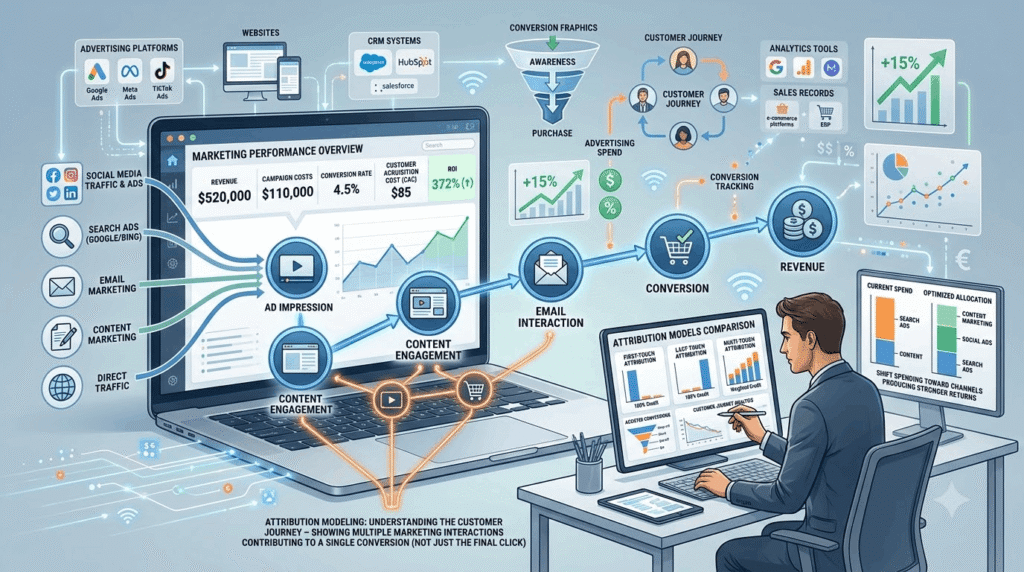
Attribution modeling is the process of assigning credit to different marketing touchpoints along the customer journey. A potential customer rarely converts after a single interaction; instead, they touch your brand multiple times across different channels before making a purchase decision.
There are five primary attribution models used in digital marketing:
1. First-Click Attribution
Credit 100% of the conversion to the first marketing touchpoint that brought the customer to your website. This model overvalues awareness campaigns and undervalues final conversion channels. It works if your goal is to understand which channels bring new audiences, but it distorts true ROI measurement.
2. Last-Click Attribution
Credit 100% of the conversion to the last touchpoint before the purchase. Google Analytics and Google Ads default to this model. It favors bottom-funnel channels (like remarketing ads or organic search) but ignores earlier awareness activities that may have been equally critical. For e-commerce and service-based businesses, last-click often inflates the perceived ROI of direct response channels.
3. Linear Attribution
Distribute credit equally across all touchpoints. If a customer interacts with your brand through four different channels before converting, each channel receives 25% credit. This model is fair but does not account for the relative importance of each touchpoint.
4. Time-Decay Attribution
Assign more credit to touchpoints closer in time to the conversion. For example, 40% credit to the last touchpoint, 30% to the second-last, 20% to the third-last, and 10% to the first. This model works well for shorter sales cycles but requires careful configuration.
5. Data-Driven Attribution (Machine Learning Attribution)
Google Analytics 4 uses machine learning to analyze your historical conversion data and assign credit based on the actual impact each touchpoint has on conversions. This is the most accurate model for sophisticated businesses with sufficient conversion volume and multi-channel marketing.
Technical Implementation: Setting Up Your Attribution & ROI Tracking
For a typical Indian business targeting local or pan-India buyers, here is how to set up proper attribution and ROI measurement:
Step 1: Implement Conversion Tracking Across All Channels
Before calculating ROI, you must accurately capture conversions. This includes:
For e-commerce: Use Google Tag Manager (GTM) to fire conversion tags when a customer completes a purchase. Track the transaction value, product category, and order ID.
For service-based businesses: Set up conversion events for form submissions, phone calls, or WhatsApp inquiries. Assign a standard lead value based on your historical close rate. For example, if you close 1 in 10 leads with an average customer lifetime value of ₹50,000, each qualified lead is worth ₹5,000.
For local service providers: Implement call tracking using platforms like CallRail or Twilio integrated with GTM. This allows you to attribute phone calls to specific ad campaigns and organic channels.
Step 2: Choose Your Attribution Model Based on Business Type
- E-commerce (short purchase cycles): Use data-driven attribution or time-decay attribution.
- B2B services (long sales cycles): Use linear or time-decay attribution to recognize the impact of content and awareness campaigns.
- Local service (plumbing, electrical, repairs): Use first-click or linear to understand which local channels drive initial awareness.
Step 3: Configure Google Analytics 4 (GA4) for Multi-Channel Attribution
GA4 offers native attribution modeling features. Navigate to Admin > Data Display > Conversion Paths to select your preferred model. Cross-reference this with Google Ads data to validate consistency.
Step 4: Calculate Blended CAC (Customer Acquisition Cost)
From a technical SEO and performance marketing standpoint, understanding your Customer Acquisition Cost across all channels is critical.
Blended CAC = Total Marketing & Ad Costs (across all channels) / Total New Customers Acquired
Example calculation for a local electricals business:
| Channel | Spend (₹) | Customers Acquired | Channel CAC (₹) |
| Google Ads | ₹80,000 | 32 | ₹2,500 |
| Organic Search (SEO) | ₹0 | 18 | ₹0 |
| Local Citations & GBP | ₹12,000 | 12 | ₹1,000 |
| Facebook/Instagram Ads | ₹40,000 | 8 | ₹5,000 |
| TOTAL | ₹1,32,000 | 70 | ₹1,886 |
Your blended CAC across all channels is ₹1,886 per customer. If your average customer lifetime value is ₹15,000, your CAC ratio is 1:8, which indicates healthy marketing efficiency.
Real-World Case Study: A Lucknow-Based B2B Electrical Supplier
Let us apply these concepts to SS Enterprises, a multi-brand electrical dealership operating in Lucknow.
Monthly Marketing Spend:
- Google Ads: ₹60,000
- Local SEO & Technical Optimization: ₹15,000 (in-house labor)
- Content & GBP Management: ₹8,000
- Total: ₹83,000
Monthly Revenue Attribution (using data-driven model in GA4):
- Google Search Ads: ₹4,20,000 (attributed to 28 customers)
- Organic Search: ₹2,80,000 (attributed to 16 customers)
- Direct & Referral: ₹1,40,000 (attributed to 8 customers)
- Google Business Profile: ₹1,80,000 (attributed to 12 customers)
- Total Revenue: ₹9,20,000
ROI Calculation by Channel:
Google Ads ROI: ((₹4,20,000 – ₹60,000) / ₹60,000) × 100 = 600%
Organic Search ROI: ((₹2,80,000 – ₹15,000) / ₹15,000) × 100 = 1,767%
Google Business Profile ROI: ((₹1,80,000 – ₹8,000) / ₹8,000) × 100 = 2,150%
Insight: While Google Ads generates the most revenue in absolute terms, organic search and local optimization deliver the highest ROI. This insight informs budget allocation for the next quarter.
Optimization & Tool Selection for ROI Tracking
Google Analytics 4 (Free): Essential for multi-touch attribution. Requires proper GTM setup and e-commerce plugin configuration.
Google Ads Conversion Tracking (Free): Built into Google Ads. Shows last-click ROI, but integrate with GA4 for cross-channel attribution.
Semrush or Ahrefs (Paid): Useful for understanding organic search’s true contribution to revenue when combined with GA4 data.
CallRail or CallLogic (Paid, ₹3,000 to ₹10,000/month): Essential for service-based businesses relying on phone conversions. Provides call recording and source attribution.
Shopify / WooCommerce Built-in Analytics (Free to Low-Cost): Adequate for small e-commerce stores. Integrate with GA4 for advanced attribution.
Common Attribution & ROI Mistakes That Waste Marketing Budget
Mistake 1: Relying solely on last-click attribution. You will overinvest in bottom-funnel channels and starve top-funnel awareness campaigns that drive eventual conversions.
Mistake 2: Not setting a consistent lead value. Service-based businesses often fail to assign monetary value to leads. Without this, you cannot calculate ROI accurately.
Mistake 3: Ignoring the sales cycle length. B2B businesses with 60-90 day sales cycles cannot measure ROI accurately in a single month. You must measure ROI quarterly or annually.
Mistake 4: Mixing organic and paid attribution without proper segmentation. Organic search appears free, but SEO and content creation involve real cost. Never claim 2,000% ROI on organic without accounting for labor and tool costs.
Mistake 5: Using conversion tracking without quality validation. A form submission is not a qualified lead. Validate that your tracking actually captures revenue-generating customers, not spam or irrelevant inquiries.
Actionable Conclusion: Build Your ROI Dashboard
Your next steps are clear:
- Implement GA4 conversion tracking across all website activities (form submissions, purchases, calls, downloads).
- Integrate Google Ads, Facebook Ads, and any other paid channels with GA4.
- Select a data-driven or linear attribution model appropriate to your sales cycle.
- Calculate your blended CAC and compare it against your average customer lifetime value.
- Review channel-specific ROI monthly and adjust budget allocation quarterly based on actual performance.
Do not chase vanity metrics. Focus on revenue-generating ROI, accurate attribution, and disciplined budget allocation. This is how sustainable, profitable digital growth works in India’s competitive market.
FAQs: Marketing ROI Calculation & Attribution Modeling
1. What is a good ROI percentage for digital marketing?
For paid advertising (Google Ads, Facebook), a minimum ROI of 200% to 300% (meaning ₹2 to ₹3 in revenue for every ₹1 spent) is considered healthy. Organic search and content marketing often deliver 500% to 1,500% ROI over time. Industry and competitive intensity affect benchmarks significantly.
2. How long should I wait to measure marketing ROI?
For Google Ads and immediate channels, measure ROI monthly. For SEO and content marketing, wait 3 to 6 months before drawing conclusions. For B2B businesses with long sales cycles, measure ROI quarterly or annually.
3. Why does my Google Ads ROI look different in Google Ads Manager versus Google Analytics?
Google Ads uses last-click attribution by default, while GA4 allows configurable models. Google Ads also attributes based on clicks, while GA4 may include view-through conversions. Reconcile both platforms monthly; minor discrepancies are normal.
4. Should I use first-click or last-click attribution?
Use last-click for immediate performance measurement and budget optimization. Use first-click or data-driven attribution for understanding which awareness channels feed your conversion funnel long-term.
5. How do I calculate ROI for Google Business Profile or organic search?
Assign the revenue generated from organic traffic to GA4. Deduct your SEO labor costs (either in-house salary allocation or agency fees). The formula remains: ((Revenue – Costs) / Costs) × 100.
6. What is the difference between CAC and CPC?
Cost Per Click (CPC) is what you pay per ad click (typically in Google Ads). Customer Acquisition Cost (CAC) is the total marketing spend divided by customers actually acquired. CAC includes ad spend, labor, tools, and accounts for the fact that clicks do not always convert to customers.
7. Can I attribute offline sales (phone calls or store visits) to my digital marketing?
Yes, using call tracking software (CallRail, CallLogic) or unique promo codes distributed via digital channels. For store visits, use foot traffic analytics or GPS-based attribution if the cost justifies implementation.
8. Which attribution model should I use for an Indian e-commerce store?
Use data-driven attribution in GA4 if you have at least 500 conversions monthly. Otherwise, use time-decay attribution (40/30/20/10 split). This recognizes both awareness channels and final conversion channels fairly.

Amit Tyagi is a seasoned Digital Marketing and SEO Consultant with extensive experience helping businesses improve online visibility through SEO, AI Search Optimization (AIO/GEO), content strategy, and performance marketing. He regularly shares practical insights, industry updates, and data-driven strategies, empowering brands and marketers to achieve sustainable digital growth in an evolving search landsca