
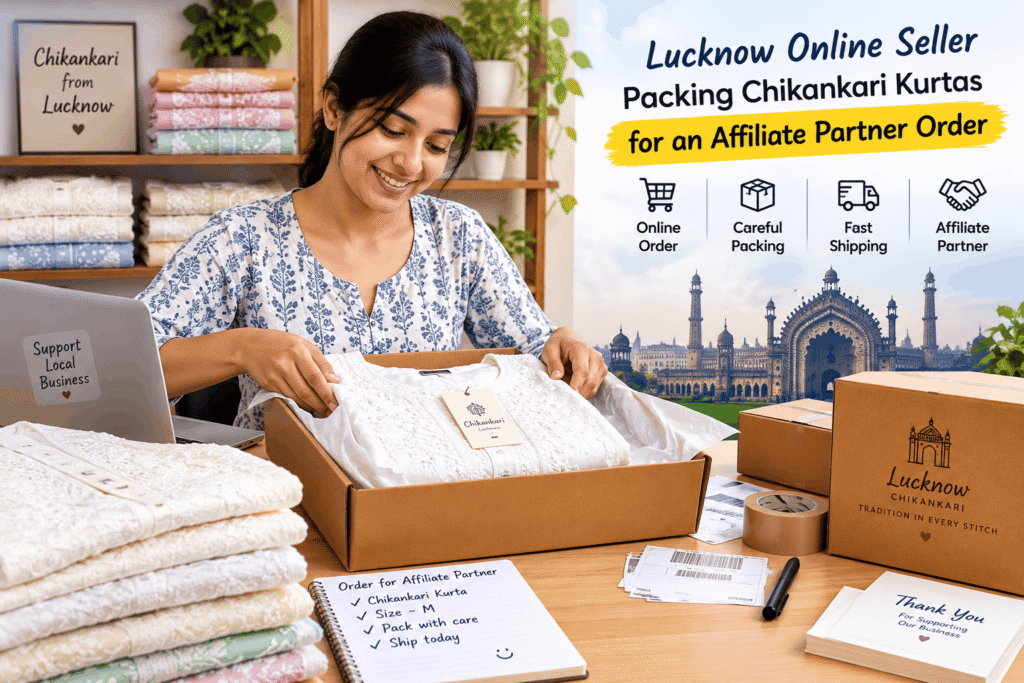
Pause your ads and your orders stop. That’s the deal many Lucknow online sellers have accepted, and it’s an expensive one. Affiliate marketing and strategic partnerships offer a way out: channels that bring in customers and pay out only when a sale actually lands.
What are affiliate marketing and strategic partnerships?
Affiliate marketing is a performance deal. A creator, blogger or website promotes your product through a tracked link and earns a commission on each completed sale. You pay for orders, not for impressions or clicks.
Strategic partnerships work differently. Instead of per-sale commissions, you agree a joint plan with another business: a co-branded bundle, a shared giveaway, a cross-promotion to each other’s customers. Money moves less often, but the audience you borrow is usually warmer.
| Channel | You pay | Best for | Main risk |
| Affiliate marketing | Commission per sale | Steady, measurable sales | Partners who chase discounts, not fit |
| Strategic partnership | Flat fee, revenue share or swapped exposure | Reaching a new, trusted audience | Slow to set up and harder to track |
| Paid ads | Per click or impression | Quick tests and launches | Orders stop when the budget stops |
Why does affiliate marketing suit Lucknow e-commerce businesses?
Lucknow sellers start with a product story people already search for. Chikankari, the city’s signature hand embroidery, is Lucknow’s pick under the Uttar Pradesh government’s One District One Product scheme, and it carries a Geographical Indication tag. That gives an affiliate something real to talk about.
Think about who’s already talking. Fashion bloggers write about Lucknowi kurtas. Food creators cover the city’s kebabs and sweets. Wedding planners hunt for gifting ideas. Each of them has an audience that trusts them more than any banner ad. And because you’re local, you can meet partners in person, send samples the same day and fix problems fast.
There’s a pricing angle too. On a marketplace you sit beside dozens of lookalike listings, and shoppers compare on price. When a partner sends someone to your store, that person arrives already interested in your story, which tends to take some pressure off price.
How do you set up an affiliate program that doesn’t drain your margin?
Start with your margin, then work backwards to a commission rate. Everything else is tracking and relationships.
- Know your numbers. Say a kurta sells for ₹1,800 and leaves ₹600 after product cost, packaging and shipping. A 10% commission is ₹180, which leaves you ₹420. Compare that with what a paid-ad order costs you today. (These figures are illustrative. Use your own.)
- Set commission by margin. Don’t copy a competitor’s rate. A 15% commission that wipes out your profit is worse than no program at all.
- Track every click. Use an affiliate platform, or unique coupon codes and UTM-tagged links, so you can see which partner drove which order. Give each partner a code as well as a link, because codes catch the orders that links miss.
- Pay after the return window. Returns and cash-on-delivery refusals are a fact of Indian e-commerce. Pay commission on delivered orders that have cleared your return period, and put that rule in the agreement before anyone signs.
- Hand partners a kit. Give them clean product photos, a short brief, a landing page and one honest selling point. Partners promote what’s easy to promote.
Which strategic partnerships work for Lucknow brands?
The best partnerships pair two businesses that sell to the same customer but don’t compete.
Co-branded bundles
A chikankari label and a local jewellery maker can sell one festive gift set. Each brand reaches the other’s buyers without paying for a single ad.
Cross-promotion with complementary sellers
Swap newsletter mentions or packaging inserts. A card tucked into a parcel costs almost nothing, and people read it.
Event and venue tie-ups
Wedding planners, boutique hotels and craft cooperatives hold audiences you can’t buy. A revenue-share arrangement keeps both sides motivated.
Pick one partnership to start. A single deal that’s tracked properly teaches you more than three that are half-run.
What are the disclosure rules for affiliate marketing in India?
If a partner has a material connection with your brand, including payment or commission, they need to disclose it clearly. The Advertising Standards Council of India issued its Guidelines for Influencer Advertising in Digital Media in 2021, and the Central Consumer Protection Authority has endorsement rules of its own.
A platform’s built-in “paid partnership” tag may not be enough on its own. Neither is a label buried under thirty hashtags. Put the disclosure up front, write it into your partner agreement and check posts after they go live. This is general information, not legal advice, so run your agreement past a lawyer.
How do you know if your affiliate program is working?
Judge it on cost per delivered order, not on clicks. Three numbers tell you most of what you need:
- Cost per delivered order for each partner, including commission and any free samples.
- Return rate for each partner. A partner with cheap orders and heavy returns is expensive.
- Repeat purchase rate of customers a partner brought in.
Review these monthly. Drop partners who send returns, and give your best performers a better rate or early access to new collections.
Partners send the click. Your funnel has to close it. That’s where a digital marketing company in Lucknow earns its fee: fast landing pages, SEO so people can find your brand after seeing a partner’s post, Google Ads on your brand name, and email automation that brings first-time buyers back. Kanity Solutions, based in Indira Nagar, offers SEO, social media marketing, Google Ads, website development and email automation under one roof, and can map a partner program onto them.
FAQs about affiliate marketing for Lucknow sellers
How much commission should a Lucknow e-commerce store pay affiliates?
Set the rate from your own margin, not from a market average. Subtract product cost, packaging, shipping and payment fees from the selling price, then decide how much of the remaining profit you can give away and still earn on the order. Start with a small group of partners and adjust after you see real numbers.
Is affiliate marketing legal in India?
Yes, it’s a common way to promote products online. What matters is how partners promote you. They need to disclose the commission or payment clearly and avoid misleading claims. Have a lawyer review your partner agreement before you launch.
How is affiliate marketing different from influencer marketing?
Influencer deals usually pay a flat fee for a post or video, whether or not anyone buys. Affiliate deals pay per sale. Plenty of creators do both, so agree the payment model in writing before work starts.
How long does an affiliate program take to show results?
Plan on at least two to three months of data before you judge a partner. Recruiting and onboarding takes a few weeks, and you need enough delivered orders to compare partners fairly. Launch before a festive rush, not in the middle of it.
Do I need a digital marketing company in Lucknow to run an affiliate program?
Not to start. A small store can run a coupon-code program on its own. An agency becomes useful once you need proper tracking, landing pages and search or social ads that support the traffic your partners send.
Where should you start?
Pick your five best-selling products and work out the margin on each. Recruit three partners who already talk to your buyers. Keep the first test small enough that a mistake is cheap. Run the program for a quarter, then decide what to keep. If you want help with tracking, landing pages or the ads that back partners up, talk to Kanity Solutions at kanity.in.

Amit Tyagi is a seasoned Digital Marketing and SEO Consultant with extensive experience helping businesses improve online visibility through SEO, AI Search Optimization (AIO/GEO), content strategy, and performance marketing. He regularly shares practical insights, industry updates, and data-driven strategies, empowering brands and marketers to achieve sustainable digital growth in an evolving search landsca