
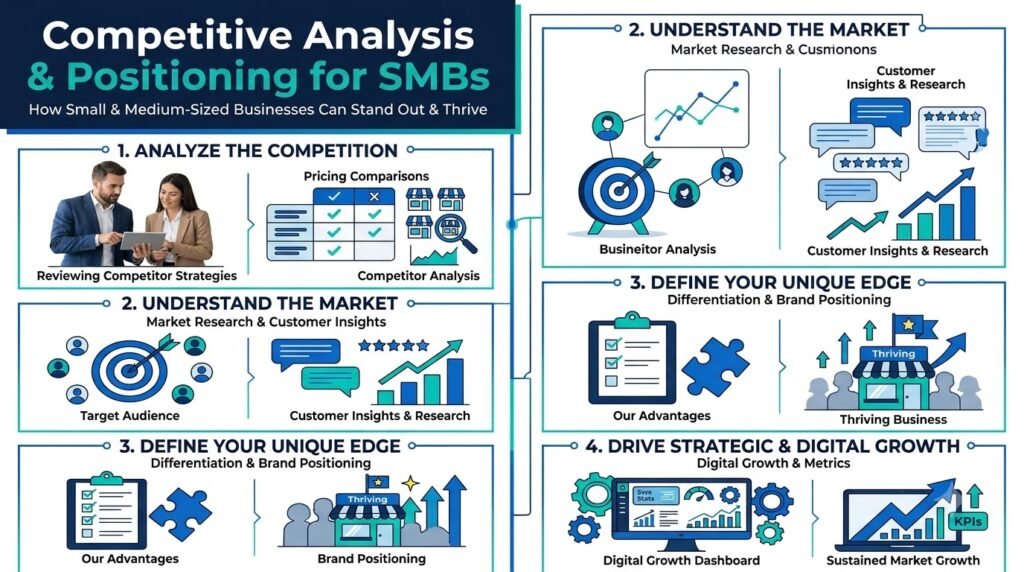
Most small businesses I speak with can name their competitors but cannot explain why a customer should pick them instead. They copy a rival’s pricing, mimic their ad copy, and end up competing on discounts, which is the fastest way to shrink margins. Competitive analysis and positioning fix this. Analysis tells you what the market already offers, and positioning tells you which space you can own. This guide covers a repeatable process for SMBs: identifying real competitors, auditing them technically, costing out the competition, and building a position that survives a price war.
What Is Competitive Analysis and Why Does It Matter for SMBs?
Competitive analysis is the structured study of rival businesses to find gaps in price, offer, search visibility and customer experience that you can use. For SMBs it matters because a limited budget cannot be spread across every channel; it must go where competitors are weak.
Definition block:
- Competitive analysis: A repeatable review of competitors’ products, pricing, marketing channels, website performance and customer feedback.
- Positioning: The specific place your business occupies in the customer’s mind relative to alternatives, based on one clear reason to choose you.
Before spending a single rupee on Google Ads, make sure you know who else is bidding on your keywords and what they are promising. Vanity metrics like raw impressions don’t pay bills; qualified conversions do. Competitive data helps you decide where qualified conversions are cheapest to win.
Step 1: Identify Your Real Competitors
Your real competitors are the businesses that appear when your customer searches, not only the ones you see on your street. There are three groups, and most SMBs track only the first.
| Competitor Type | Description | Where to Find Them | Example (Appliance Dealer) |
| Direct | Same product, same area | Google Maps, local pack | Another dealer in your city |
| Indirect | Different product, same need | Customer interviews, forums | A used-appliance reseller |
| Search | Anyone ranking for your keywords | Google results, SEO tools | Marketplaces, aggregators, review sites |
For a typical Indian business targeting local or pan-India buyers, search competitors are often national marketplaces and directories, not the shop next door. Searching your top ten commercial keywords in an incognito window, on mobile, from your target city, shows who actually holds attention. Also search in Hindi or your regional language. Tier 2 and Tier 3 buyers often type or speak queries in transliterated Hindi, and the competitor set can look quite different.
Step 2: Run a Technical Competitive Audit
A technical competitive audit compares your website, search visibility and ad presence against three to five rivals using the same checklist. Keep the list short. Ten competitors produce a spreadsheet nobody reads.
SEO and Website Checks
From a technical SEO standpoint, start with what search engines and users can verify:
- Indexation and structure: Search site:competitor.com to gauge how many pages are indexed and which categories they prioritise.
- Page speed and Core Web Vitals: Run their key pages through PageSpeed Insights. Slow competitors are an opening for you.
- Schema markup: View source or use Google’s Rich Results Test to check for LocalBusiness, Product, FAQ and Review schema.
- Content depth: Note which queries they cover with buying guides, comparisons and local landing pages, and which they ignore.
- Backlink profile: Review referring domains in your chosen backlink tool. Identify legitimate sources such as industry directories, local media and supplier pages that you could earn links from ethically.
- Google Business Profile: Compare review count, rating, response rate, photos, categories and posting frequency.
Paid Search Checks
- Open Google Ads Auction Insights for your own campaigns to see impression share and overlap rate against competitors.
- Review the Ads Transparency Center to see the creatives rivals are running.
- Record their offers, calls to action, pricing claims and landing page structure.
Conversion Path Checks
Submit an enquiry on each competitor’s site and note the response time. Many Indian service businesses lose leads because nobody answers a form for six hours. Check whether they offer a call button, a WhatsApp link and a quote form, and how many taps each takes on mobile. Let’s look at the actual campaign data from your own side too: if your cost per lead is fine but lead-to-sale conversion is weak, the gap may be speed of response rather than traffic.
Using Search Console Data
Your own Search Console shows where you already rank on pages two and three. These are the quickest wins against competitors. Filter queries with regex to separate branded from non-branded searches:
^(your brand|yourbrand|your brand name)
Apply this as a “Custom (regex)” filter, then invert the match to view non-branded demand. Compare those non-branded queries to the competitor keywords you collected.
Step 3: Calculate What Competing Will Cost
Before choosing a battleground, estimate the cost of winning a customer there. A channel is only worth entering if the projected CAC sits comfortably below your customer profit.
A simple calculation can help project your customer acquisition cost:
- CAC = total marketing and sales costs ÷ new customers acquired
- Break-even CPC = profit per sale × lead-to-sale rate × click-to-lead rate
Assume a Lucknow-based electrical contractor earns ₹3,000 profit per job, closes 20% of leads, and converts 5% of clicks into leads. Break-even CPC = 3,000 × 0.20 × 0.05 = ₹30. If competitors bid ₹60 to ₹90 on the main keyword (CPCs for commercial service keywords in Indian cities commonly span roughly ₹15 to ₹150, or about $0.20 to $2, and much higher for sectors like insurance, education and real estate), you cannot compete there profitably. Your options are to improve conversion rates, target long-tail and local variants, or lean on organic and Google Business Profile visibility instead.
Also remember that ROAS = (revenue from ads ÷ ad spend) × 100. A high ROAS on a low-margin product can still lose money, so read it alongside gross margin. Your actual search rank and quality score will depend on relevance, expected click-through rate and landing page experience, not just budget, which is why a well-built page can beat a richer competitor.
Step 4: Build Your Positioning
Positioning works when it names a specific customer, a specific problem and a provable reason you are better. If a claim could appear on any rival’s website, it is not positioning.
Use this simple statement:
For [target customer] who need [specific problem solved], [business name] is the [category] that [key benefit], because [proof].
Where Positioning Gaps Usually Exist
- Speed: Same-day installation or one-hour quote response.
- Trust: Authorised service, warranty handling, verified reviews and visible GST invoicing.
- Specialisation: Focus on one segment such as commercial wiring, solar-ready inverters or home appliances for small families.
- Language and access: Hindi-first support, WhatsApp ordering, regional language content.
- Transparency: Published price ranges and clear service terms, where competitors hide behind “call for price”.
Choose one primary position. Businesses that try to be cheapest, fastest and best at once end up with a message nobody believes. Then make the position visible everywhere: page titles, headings, Google Business Profile description, ad copy and WhatsApp greeting.
Making Positioning Machine-Readable
Technical implementation matters here. Add LocalBusiness and Service schema with accurate service areas, create dedicated pages for each service and city, and publish content that answers the questions customers ask before buying. Structured, factual pages are also easier for AI-driven search tools to parse and cite.
Practical Example: A Tier 2 City B2B Supplier
Consider an illustrative scenario, not client data: an industrial supplies dealer in a Tier 2 city competing with two local rivals and a national marketplace.
The audit shows the following with assumed observations:
- Rivals and the marketplace bid heavily on generic keywords such as “industrial supplies”.
- Local rivals have slow websites, no schema and few reviews.
- Nobody publishes specification guides or comparison pages for specific product categories.
- Competitor enquiry forms take a day to respond.
The dealer positions itself as “the supplier with verified specifications, GST billing and same-day dispatch within the city”. The action plan:
- Shift paid budget from generic terms to specific product-and-city keywords with tighter match types and negative keywords.
- Build ten product pages with specification tables, FAQ schema and clear call and WhatsApp buttons.
- Collect reviews from existing B2B clients by asking genuinely, with no incentives.
- Commit to a 30-minute response standard for enquiries.
The point is not the exact numbers. The dealer stopped competing where it was weakest and started competing where rivals were careless.
Choosing Tools for Competitive Research
Choose tools by the decision they support, not by brand. Many SMBs can do 80% of competitive research with free tools.
| Task | Free or Built-In Option | Paid Option Category | Consider When |
| Rank and traffic data | Google Search Console, GA4 | Semrush, Ahrefs, Similarweb-type tools | You track many keywords or competitors |
| Technical crawling | Limited free crawls | Screaming Frog or similar | You manage large sites |
| Ad research | Ads Transparency Center, Auction Insights | Third-party ad intelligence | Paid search is a major channel |
| Speed testing | PageSpeed Insights | Monitoring platforms | You need regular alerts |
| Reviews and sentiment | Google Maps, marketplace pages | Review management tools | You handle many locations |
Estimates from third-party tools are modelled, not measured. Use them to compare relative strength between sites, and trust your own analytics for actual performance.
Common Blunders and Black-Hat Pitfalls
The costliest mistakes in competitive strategy are copying rivals, using unethical tactics against them, and misrepresenting your own offer.
- Copying a competitor’s pricing and copy. You inherit their weaknesses and cannot differentiate.
- Bidding on competitor brand names with misleading ads. Competitor keyword targeting is allowed in some cases, but trademark misuse and deceptive claims violate Google Ads policies.
- Negative SEO or fake reviews against rivals. This is unethical, can be illegal, and harms your own reputation.
- Scraping or copying competitor content. Duplicate content earns no ranking benefit and risks legal action.
- Buying links or using private blog networks. In white-hat digital marketing, links are earned. Artificial schemes risk penalties and domain suppression.
- Cloaking or keyword stuffing to chase competitors’ rankings.
- Making unverifiable claims such as “number one in the city” without evidence.
- One-time analysis. Markets shift, so schedule reviews rather than treating this as a single project.
Actionable Conclusion and Next Steps
Competitive analysis shows you where the market is crowded, and positioning shows you where you can win without a price war. Treat both as ongoing operating habits.
- List three to five competitors across all three types: direct, indirect and search.
- Audit them against the same checklist: speed, schema, content, reviews and ad offers.
- Calculate your break-even CPC and CAC before committing budget to any keyword group.
- Write one positioning statement and apply it across your website, Google Business Profile and ads.
- Fix one conversion gap, such as response time or a missing WhatsApp button.
- Re-run the audit every quarter and adjust.
Frequently Asked Questions
What is competitive analysis in digital marketing?
It is the process of studying competitors’ search visibility, advertising, website quality, pricing and customer feedback to find opportunities you can act on.
How do I find my online competitors?
Search your main commercial keywords from your target location, in both English and regional language variations. Note repeated domains, marketplaces and local pack businesses. Search Console and Auction Insights add data on overlap.
How many competitors should an SMB analyse?
Three to five is practical. That gives enough comparison without producing data you cannot act on. Include at least one search competitor, not just local rivals.
Do I need paid tools like Semrush or Ahrefs?
Not always. Free tools such as Search Console, GA4, PageSpeed Insights and Google’s ad transparency tools cover many needs. Paid tools help when you track many keywords or need backlink data, but their figures are estimates.
What is a positioning statement?
It is a one-sentence description of who you serve, what problem you solve, how you differ from alternatives and why customers should believe you.
How often should I update my competitive analysis?
Do a light review monthly for ads and pricing, and a full audit each quarter. Revisit it sooner after a major algorithm update or a new competitor launch.
Is it legal to bid on competitors’ brand names in Google Ads?
Bidding on a competitor’s name as a keyword is generally permitted, but using their trademark in ad text may be restricted, and misleading claims violate policy. Check Google Ads trademark policies and consult a legal professional for your situation.
Can small businesses compete with large marketplaces?
Yes, by focusing on local intent, specialised expertise, faster service and trust signals that marketplaces cannot easily match, rather than competing on breadth or price alone.

Amit Tyagi is a seasoned Digital Marketing and SEO Consultant with extensive experience helping businesses improve online visibility through SEO, AI Search Optimization (AIO/GEO), content strategy, and performance marketing. He regularly shares practical insights, industry updates, and data-driven strategies, empowering brands and marketers to achieve sustainable digital growth in an evolving search landsca