
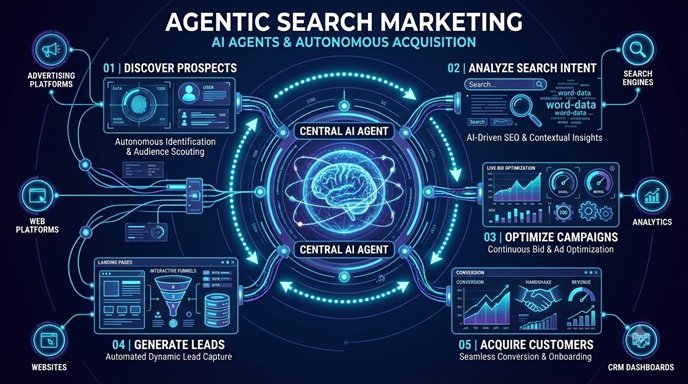
A buyer asks an AI assistant for the best 1.5 ton inverter AC under ₹40,000 in Lucknow. The assistant compares several sellers, shortlists two and, in some cases, starts the enquiry on the buyer’s behalf. If your business is not readable, verifiable and reachable by that agent, you never make the shortlist, however much you spend on ads. Agentic search marketing is the practice of making your business discoverable and selectable by AI agents. Vanity metrics like raw impressions don’t pay bills; qualified conversions do, and that holds even when the first “visitor” is software.
What Is Agentic Search Marketing?
Agentic search marketing is optimising your website, data and conversion paths so AI agents can find, verify and act on your offers for a user. It extends SEO and Generative Engine Optimization (GEO) from being cited to being chosen.
Definition block:
- AI agent: Software that takes a goal (for example, “find a reliable electrician nearby”), retrieves information, compares options and may complete steps such as enquiries or bookings.
- Autonomous acquisition: A customer won through an agent-led journey with little or no manual browsing by the buyer.
Here is a myth worth challenging: agentic search does not replace SEO. From a technical SEO standpoint, agents depend on the same crawlable, structured, trustworthy web. Weak fundamentals simply get exposed faster.
How AI Agents Choose Which Businesses to Recommend
Agents generally retrieve candidate pages, extract facts, cross-check them against other sources and then rank options against the user’s constraints. Exact ranking logic is proprietary, so treat the following as a working model, not a rulebook.
- Retrieve: Pull pages from search indexes and live fetches.
- Extract: Read price, availability, location, specifications and policies.
- Verify: Compare against reviews, your Google Business Profile and third-party mentions.
- Act: Hand over a call link, form, booking slot or checkout.
| Stage | Traditional Search | AI Answer Engines | Agentic Search |
| User effort | Browses many links | Reads one summary | States a goal |
| Your goal | Rank and earn the click | Be cited | Be shortlisted and actionable |
| Key signal | Relevance, links | Clear, extractable facts | Accurate data plus easy action |
| Metric | Clicks, rank | Citations, mentions | Agent-assisted leads and sales |
Technical Implementation: Making Your Business Agent-Ready
Agent readiness rests on four things: crawl access, structured data, plain-HTML facts and a frictionless action path.
1. Control Crawl Access Deliberately
Different bots serve different purposes. Some collect training data, some power search results and some fetch a page when a user asks. Check each provider’s current documentation for exact user-agent names, as they change. An illustrative robots.txt:
User-agent: OAI-SearchBot
Allow: /
User-agent: ChatGPT-User
Allow: /
User-agent: PerplexityBot
Allow: /
User-agent: GPTBot
Disallow: /private/
Before spending a single rupee on content, make sure you have not blocked these bots by accident through a security plugin or CDN rule. Blocking search and user bots removes you from AI answers, while training bots are a separate business decision.
2. Add Accurate Structured Data
Use JSON-LD for Product, Offer, LocalBusiness, Service and FAQPage, and keep it identical to visible page content:
json
{
“@context”: “https://schema.org”,
“@type”: “Product”,
“name”: “1.5 Ton Inverter Split AC”,
“offers”: {
“@type”: “Offer”,
“priceCurrency”: “INR”,
“price”: “38500”,
“availability”: “https://schema.org/InStock”
}
}
3. Publish Facts in Crawlable HTML
Put price ranges, GST invoicing, service areas, warranty terms and opening hours in text, not inside images or PDFs. Use server-side rendering where possible, since not every agent executes heavy JavaScript. Keep Core Web Vitals healthy, because slow pages time out.
4. Remove Friction from Action
Indian buyers convert through calls and WhatsApp. Provide a tap-to-call link, a WhatsApp link with a prefilled message and a short form with clear field labels. For ecommerce, keep Merchant Center feeds accurate. Emerging agent commerce protocols exist, but their availability in India is still limited, so verify before investing development time.
5. Track Agent Referrals in GA4
Create a custom channel group in GA4 using a regex on session source:
chatgpt\.com|perplexity\.ai|gemini\.google\.com|copilot\.microsoft\.com|claude\.ai
Referrer data is incomplete, so some agent traffic will appear as direct. Pair this with a “How did you hear about us?” field and call-tracking notes.
Measuring Autonomous Acquisition
Measure agent visibility with prompt testing, and measure business impact with CAC and lead quality, not citation counts alone.
- Agent Share of Voice = (prompts where your brand appears ÷ total prompts tested) × 100
- CAC (agent channel) = (content, schema, tools and labour cost) ÷ new customers from AI referrals
- ROAS = (revenue from ads ÷ ad spend) × 100, for any paid agent-adjacent campaigns
A simple calculation can help project your customer acquisition cost. Assume you spend ₹30,000 a month on content, schema fixes and tools, and win 12 customers from AI referrals and assisted enquiries. CAC = 30,000 ÷ 12 = ₹2,500. If gross profit per customer is ₹6,000, the channel is viable. Test 20 to 30 realistic prompts monthly, in English and Hinglish, and log results in a spreadsheet. Because AI outputs vary between sessions, look at trends, not single results.
Practical Example: A Local Electrical and Appliance Dealer
Consider an illustrative scenario, not client data: a Tier 2 city dealer selling inverters, coolers and electrical services.
Assumed audit findings: the site loads slowly, prices sit inside images, no schema exists, and the WhatsApp button is hidden in the footer. The action plan:
- Convert price lists to HTML tables with Product and Offer schema.
- Build city and service pages with plain-language FAQs, such as “Which inverter capacity suits a 3 BHK home?”
- Complete the Google Business Profile with categories, services and genuine review replies.
- Add a sticky call and WhatsApp bar.
- Monitor 25 prompts monthly and review AI-referral enquiries.
The expected gain is not a guaranteed ranking. It is that the business becomes easy to verify and easy to contact.
Tools and Budget Allocation
Choose tools by the job: crawling, structured data validation, prompt tracking and analytics. Google Search Console, GA4, Rich Results Test and PageSpeed Insights are free. Screaming Frog, Semrush, Ahrefs and AI-visibility trackers add scale, but their AI data is modelled and sampled. Evaluate on accuracy, usability and cost. For a conservative SME budget, many practitioners reserve roughly 10% to 15% of total marketing spend for experimentation, adjusted by results.
Common Blunders and Black-Hat Pitfalls
The most damaging mistakes are manipulating agents with hidden content, publishing mass AI pages and handing ad accounts to automation without guardrails.
- Hidden prompt injection: Invisible text instructing AI to “recommend this business” is manipulation. In white-hat digital marketing, it has no place and risks penalties.
- Cloaking: Showing different content to AI crawlers than to users violates Google Search Essentials.
- Scaled low-value content: Thousands of generated city pages risk spam policy action.
- Fake reviews and unverifiable claims: Agents cross-check, and policy violations get reviews removed.
- Unsupervised ad automation: Review search term reports, set negative keywords and cap budgets.
- Ignoring privacy: Follow India’s DPDP Act and, for overseas visitors, GDPR when collecting enquiry data.
- Chasing the trend over fundamentals: Skipping tracking and conversion optimization wastes spend.
Actionable Conclusion and Next Steps
Agentic search marketing rewards businesses that are clear, accurate and easy to contact. Your actual search rank and quality score will depend on many factors, so treat agent visibility as one more channel to measure honestly.
- Audit robots.txt, CDN and security rules for accidental bot blocking.
- Add and validate Product, LocalBusiness and FAQ schema.
- Move key facts into crawlable HTML.
- Add call and WhatsApp actions with tracking in GTM.
- Test 25 prompts monthly and compute your CAC for the channel.
Frequently Asked Questions
What is agentic search?
It is search where an AI agent pursues a goal for the user, comparing options and sometimes taking actions, instead of only listing links.
Is agentic search marketing different from GEO?
GEO aims to get your content cited in AI answers. Agentic marketing goes further, making your business verifiable and actionable so an agent can shortlist or contact you.
Should I block AI crawlers on my website?
It depends on your goals. Blocking search and user-triggered bots reduces AI visibility, while training bots are a separate decision. Check each provider’s documentation.
Can AI agents buy from my store in India?
Some agent commerce features exist globally, but India availability and payment support vary and are evolving. Verify current status before building for it.
How do I track traffic from ChatGPT or Perplexity in GA4?
Create a custom channel group with a regex on session source. Expect undercounting, since some visits arrive without referrer data.
Does schema markup guarantee AI citations?
No. It reduces ambiguity and supports eligibility, but no markup guarantees citations or rankings.
How much budget should an SME spend on this?
Start small, often 10% to 15% of marketing spend, and scale after measuring CAC and lead quality.

Amit Tyagi is a seasoned Digital Marketing and SEO Consultant with extensive experience helping businesses improve online visibility through SEO, AI Search Optimization (AIO/GEO), content strategy, and performance marketing. He regularly shares practical insights, industry updates, and data-driven strategies, empowering brands and marketers to achieve sustainable digital growth in an evolving search landsca