
Introduction
In 2026, search engine optimization has moved far beyond ranking individual pages for isolated keywords. Google’s algorithms now prioritize topical authority, content depth, and semantic relationships between pages. This evolution has made content clusters one of the most effective and sustainable SEO strategies for businesses that want long-term organic growth rather than short-lived rankings.
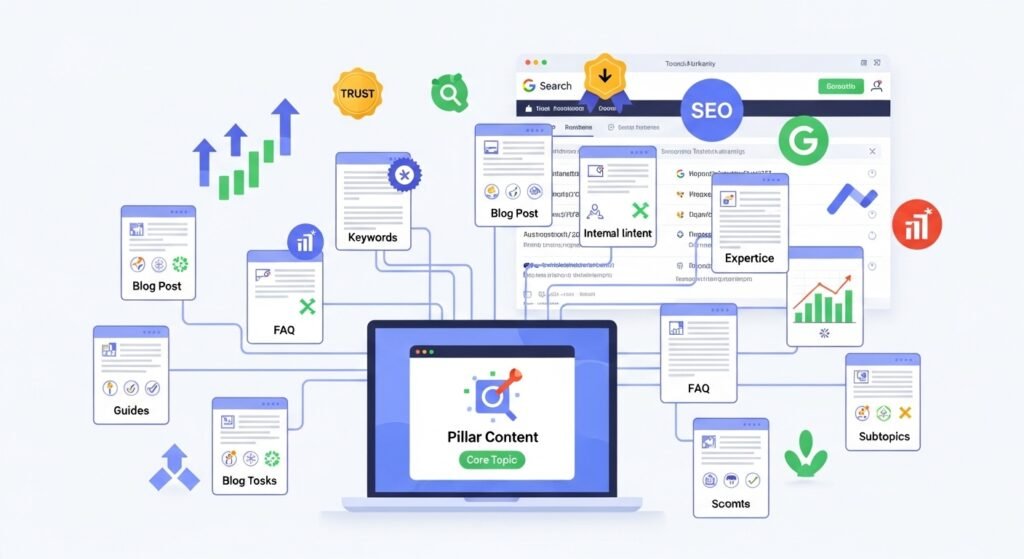
Content clusters organize your website around topics instead of single keywords. At the center of each cluster is a comprehensive pillar page that broadly covers a core subject. Surrounding it are multiple supporting articles that explore subtopics in detail. All these pages are strategically interlinked, helping search engines understand the structure, relevance, and expertise of your website.
For small and mid-sized businesses, content clusters level the playing field. You don’t need massive backlink budgets or hundreds of pages. With the right structure, even a modest website can outperform larger competitors by clearly demonstrating expertise in a niche. Content clusters improve crawlability, prevent keyword cannibalization, increase user engagement, and distribute internal link equity effectively.
From a business standpoint, topic-based SEO improves the customer journey. Visitors naturally move from educational content to deeper guides, case studies, and service pages. This builds trust, keeps users on your site longer, and significantly increases conversion rates.
In this article, you’ll learn what content clusters are, why they matter in 2026, how to build them step by step, real examples of traffic growth, success stories, video content ideas, a pillar-page framework, and answers to common questions—all explained in a practical, actionable way.
What Are Content Clusters and Why They Matter
Content clusters are groups of related pages built around a single topic. Instead of optimizing separate pages for similar keywords, content clusters help search engines see your website as an authority on a subject, not just a collection of posts.
When Google recognizes strong topic coverage, it is more likely to::
- Rank multiple pages from your site
- Trust your content for competitive keywords
- Show your pages in featured snippets and rich results
This approach aligns perfectly with how modern search engines evaluate quality and relevance.
How to Build Content Clusters Step by Step
Step 1: Choose a Core Topic
Select a topic that aligns directly with your business goals, such as “Local SEO,” “Digital Marketing for Small Businesses,” or “E-commerce Growth.”
Step 2: Create a Pillar Page
The pillar page should:
- Cover the topic broadly
- Answer high-level questions
- Act as the main internal linking hub
Step 3: Identify Supporting Subtopics
These include:
- How-to guides
- FAQs
- Comparisons
- Case studies
- Tool reviews
Step 4: Implement Strategic Internal Linking
Every supporting article should link back to the pillar page and, where relevant, to other subtopics.
Step 5: Avoid Keyword Cannibalization
Each page must have:
- One clear primary keyword
- A distinct search intent
Case Study: How Content Clusters Improved SEO Performance
A service-based business was publishing blogs regularly but saw little SEO traction. Multiple pages competed for similar keywords, and Google struggled to identify their expertise.
After reorganizing content into structured clusters around core services, the results were significant.
Within four months:
- Organic traffic increased by 45%
- Several pages reached page one rankings
- Average session duration nearly doubled
The structured approach helped Google recognize topical authority.
Success Story: Turning Blog Content into a Lead-Generating Asset
A digital marketing agency built content clusters around SEO, paid ads, and social media marketing. Each cluster included one pillar page supported by 10–15 in-depth articles.
Within a year, the website ranked for hundreds of related keywords and generated consistent inbound leads—without relying heavily on paid advertising. Content became a long-term growth engine rather than a one-time effort.
Video Content Ideas for Content Clusters
A powerful video concept is “How Content Clusters Work for SEO”, where you:
- Visually map pillar pages and subtopics
- Explain internal linking flow
- Show ranking improvements
These videos perform exceptionally well on YouTube, LinkedIn, and Instagram Reels for business audiences.
Pillar Page Framework for Topic-Based SEO
A strong content cluster system includes:
- One comprehensive pillar page
- 8–15 supporting articles
- Consistent internal linking
- Regular updates based on search trends
Recommended Tools
- Google Search Console
- Ahrefs or SEMrush
- Screaming Frog
- Google Analytics
Best Practices
- Update pillar pages quarterly
- Refresh older supporting content
- Expand clusters as new subtopics emerge
- Align clusters with conversion goals
FAQs: Content Clusters & Topic-Based SEO
What is a content cluster in SEO?
A structured group of interlinked pages built around a central topic to establish authority.
Do content clusters work for small websites?
Yes. They help smaller sites compete by improving structure and relevance.
How many articles should one cluster have?
Typically 8–15 supporting articles per pillar page.
Do content clusters replace keyword SEO?
No. They organize and strengthen keyword targeting.
How long does it take to see results?
Most sites see noticeable improvements within 3–6 months.
Final Thoughts
Content clusters are no longer optional—they are essential for modern SEO. Businesses that structure content by topics rather than isolated keywords build authority, trust, and sustainable rankings.
In 2026, the websites that win are those that:
- Cover topics deeply
- Link content strategically
- Align SEO with user intent and business goals
At Kanity Solutions, we help brands build powerful content clusters, pillar pages, and long-term SEO strategies that drive real growth.
🌐 www.kanity.in
📞 9454784602