
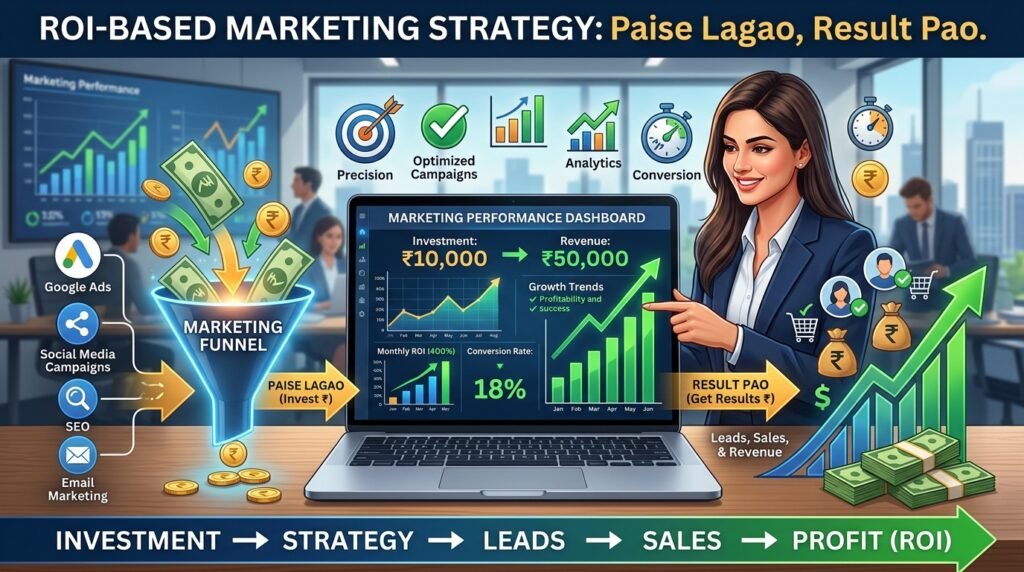
Introduction to ROI-Based Marketing Strategy
As a digital marketing strategist and SEO consultant, I have worked with numerous brands over the years, helping them scale globally through advanced SEO frameworks, Generative Engine Optimization (GEO), and performance-driven digital strategies. One of the most critical components of a successful digital marketing campaign is a well-planned ROI-based marketing strategy. In this section, we will delve into the world of ROI-based marketing, exploring its importance, benefits, and how to implement it effectively.
A ROI-based marketing strategy, also known as return on investment-based marketing, is a approach that focuses on measuring the return on investment of every marketing campaign, channel, and tactic. The primary goal of this strategy is to ensure that every marketing dollar spent generates a positive return, thereby maximizing the overall revenue and growth of the business. By using data-driven insights and analytics, marketers can make informed decisions about where to allocate their budget, which channels to prioritize, and how to optimize their campaigns for better performance.
In today’s digital landscape, businesses are faced with a plethora of marketing options, each with its own set of benefits and drawbacks. From social media and email marketing to search engine optimization (SEO) and pay-per-click (PPC) advertising, the choices can be overwhelming. A ROI-based marketing strategy helps businesses cut through the noise and focus on the channels and tactics that drive the greatest return on investment. By doing so, marketers can optimize their budget, reduce waste, and achieve their marketing goals more efficiently.
The concept of ROI-based marketing is not new, but its importance has grown exponentially in recent years. With the rise of digital marketing, businesses have access to a vast array of data and analytics tools, making it easier to track and measure the performance of their marketing campaigns. By leveraging these tools, marketers can gain a deeper understanding of their target audience, identify areas of improvement, and make data-driven decisions to drive better results.
So, what are the benefits of a ROI-based marketing strategy? First and foremost, it helps businesses maximize their return on investment, ensuring that every marketing dollar spent generates a positive return. Secondly, it enables marketers to make informed decisions about budget allocation, channel prioritization, and campaign optimization. Thirdly, it provides a framework for measuring and evaluating the performance of marketing campaigns, allowing businesses to identify areas of improvement and optimize their strategies accordingly.
To illustrate the benefits of a ROI-based marketing strategy, let’s consider an example. Suppose a business is running a social media campaign, allocating $1,000 per month to Facebook ads. By using data-driven insights and analytics, the marketer discovers that the campaign is generating a 20% return on investment, with a significant portion of the sales coming from a specific demographic. Armed with this information, the marketer can adjust the campaign to target that demographic more effectively, increasing the return on investment and driving better results.
In addition to maximizing return on investment, a ROI-based marketing strategy also helps businesses to:
- Optimize their marketing budget, reducing waste and allocating resources more efficiently
- Improve their marketing ROI, driving better results and increasing revenue
- Enhance their customer experience, by delivering targeted and relevant marketing messages
- Gain a competitive edge, by leveraging data-driven insights and analytics to inform marketing decisions
- Measure and evaluate the performance of marketing campaigns, identifying areas of improvement and optimizing strategies accordingly
In conclusion, a ROI-based marketing strategy is a critical component of a successful digital marketing campaign. By focusing on measuring the return on investment of every marketing campaign, channel, and tactic, businesses can maximize their return on investment, optimize their budget, and drive better results. In the next section, we will explore the key components of a ROI-based marketing strategy, including how to set goals and objectives, measure and track ROI, and optimize marketing campaigns for better performance.
Understanding the Paise Lagao Concept
As a seasoned digital marketing strategist and SEO consultant, I, Amit Tyagi, have worked with numerous businesses, helping them scale globally and achieve remarkable revenue growth through advanced SEO frameworks and performance-driven digital strategies. One concept that has gained significant attention in recent years is the “Paise Lagao” approach, which translates to “investing money” in Hindi. This ROI-based marketing strategy is designed to help businesses maximize their returns on investment by allocating resources effectively and efficiently. In this section, we will delve into the Paise Lagao concept, exploring its principles, benefits, and applications in the digital marketing landscape.
The Paise Lagao concept is rooted in the idea that every marketing effort should be measured and optimized to generate the highest possible return on investment. This approach requires a deep understanding of the target audience, market trends, and the competitive landscape. By investing in the right marketing channels and strategies, businesses can drive significant revenue growth, increase brand awareness, and establish a strong online presence. The Paise Lagao concept is not just about spending money; it’s about making informed, data-driven decisions that yield tangible results.
To illustrate the Paise Lagao concept, let’s consider a hypothetical example. Suppose we have an e-commerce company that sells fashion apparel online. The company has a budget of $10,000 per month for digital marketing. Instead of allocating the entire budget to a single channel, such as Facebook ads, the company decides to adopt a Paise Lagao approach. They start by analyzing their target audience, identifying the most effective marketing channels, and allocating the budget accordingly. They invest $3,000 in search engine optimization (SEO), $2,000 in pay-per-click (PPC) advertising, $2,000 in social media marketing, and $3,000 in influencer partnerships. By diversifying their marketing efforts and investing in the right channels, the company is able to reach a wider audience, drive more conversions, and generate a higher return on investment.
The Paise Lagao concept is built on several key principles, including:
- Return on Investment (ROI) Analysis: This involves measuring the revenue generated by each marketing channel and calculating the return on investment. By analyzing the ROI, businesses can identify the most effective marketing channels and allocate their budget accordingly.
- Data-Driven Decision Making: The Paise Lagao approach relies heavily on data and analytics. By leveraging tools like Google Analytics, businesses can track their website traffic, conversion rates, and revenue growth, making informed decisions about their marketing strategies.
- Marketing Channel Diversification: This involves investing in multiple marketing channels to reach a wider audience and reduce dependence on a single channel. By diversifying their marketing efforts, businesses can mitigate risks and increase their chances of success.
- Continuous Optimization: The Paise Lagao concept requires continuous monitoring and optimization of marketing strategies. By tracking their performance and making adjustments as needed, businesses can ensure that their marketing efforts are aligned with their goals and objectives.
The benefits of the Paise Lagao concept are numerous. By adopting this ROI-based marketing strategy, businesses can:
- Maximize Their Returns on Investment: By investing in the right marketing channels and strategies, businesses can generate significant revenue growth and increase their returns on investment.
- Increase Brand Awareness: The Paise Lagao concept helps businesses establish a strong online presence, increasing brand awareness and credibility.
- Drive Conversions: By optimizing their marketing strategies and investing in the right channels, businesses can drive more conversions and sales.
- Stay Ahead of the Competition: The Paise Lagao concept requires continuous monitoring and optimization, helping businesses stay ahead of the competition and adapt to changing market trends.
In conclusion, the Paise Lagao concept is a powerful ROI-based marketing strategy that can help businesses maximize their returns on investment, increase brand awareness, and drive conversions. By adopting this approach, businesses can make informed, data-driven decisions, invest in the right marketing channels, and achieve significant revenue growth. As a digital marketing strategist and SEO consultant, I have seen firsthand the impact of the Paise Lagao concept on businesses, and I highly recommend it to anyone looking to take their marketing efforts to the next level.
Key Components of an Effective ROI-Based Marketing Strategy
As a digital marketing strategist and SEO consultant, I have worked with numerous brands to develop and implement effective ROI-based marketing strategies that drive revenue and growth. In my experience, a well-crafted ROI-based marketing strategy is crucial for businesses to achieve their goals and stay ahead of the competition. In this section, we will delve into the key components of an effective ROI-based marketing strategy, exploring the essential elements that will help you create a winning strategy for your business.
A successful ROI-based marketing strategy is built on a deep understanding of your target audience, their needs, and preferences. It requires a data-driven approach, leveraging advanced analytics and metrics to measure the effectiveness of your marketing campaigns. By focusing on the key components outlined below, you can create a tailored strategy that drives real results and maximizes your return on investment.
The first component of an effective ROI-based marketing strategy is clear goal setting. Establishing specific, measurable, achievable, relevant, and time-bound (SMART) goals is crucial for determining the success of your marketing efforts. Your goals should be aligned with your business objectives, whether it’s to increase website traffic, generate leads, or drive sales. For example, a company like Amazon might set a goal to increase its sales revenue by 20% within the next quarter, while a company like HubSpot might aim to boost its website traffic by 30% within the next six months.
Another critical component of an effective ROI-based marketing strategy is target audience analysis. Understanding your target audience is vital for creating marketing campaigns that resonate with them and drive engagement. This involves analyzing demographics, behaviors, preferences, and pain points to develop buyer personas that guide your marketing efforts. For instance, a company like Coca-Cola might identify its target audience as young adults aged 18-35 who are active on social media and enjoy music and entertainment. By understanding their audience’s preferences and behaviors, Coca-Cola can create targeted marketing campaigns that speak directly to them.
In addition to goal setting and target audience analysis, channel selection is also a key component of an effective ROI-based marketing strategy. With so many marketing channels available, it’s essential to select the channels that will provide the best return on investment for your business. This might include social media, email marketing, search engine optimization (SEO), pay-per-click (PPC) advertising, or content marketing. The key is to choose channels that align with your target audience’s preferences and behaviors, as well as your business goals and objectives. For example, a company like Facebook might focus on social media marketing, while a company like Google might focus on search engine marketing.
Furthermore, budget allocation is a critical component of an effective ROI-based marketing strategy. Allocating your marketing budget effectively is crucial for maximizing your return on investment. This involves assigning budget to each marketing channel based on its potential return on investment, as well as your business goals and objectives. For instance, a company like Microsoft might allocate 30% of its marketing budget to social media marketing, 20% to email marketing, and 50% to search engine marketing. By allocating its budget effectively, Microsoft can ensure that its marketing efforts are optimized for maximum return on investment.
Another essential component of an effective ROI-based marketing strategy is performance measurement. Measuring the performance of your marketing campaigns is vital for determining their effectiveness and identifying areas for improvement. This involves tracking key performance indicators (KPIs) such as website traffic, engagement, conversions, and return on investment. By monitoring these metrics, you can refine your marketing strategy and optimize your campaigns for better results. For example, a company like Apple might track its website traffic, social media engagement, and sales revenue to measure the effectiveness of its marketing campaigns.
In addition to the components mentioned above, continual optimization is also a key component of an effective ROI-based marketing strategy. Continually optimizing your marketing campaigns is crucial for maximizing your return on investment and staying ahead of the competition. This involves analyzing your performance data, identifying areas for improvement, and making adjustments to your marketing strategy accordingly. For instance, a company like Netflix might analyze its performance data to identify areas where it can improve its customer engagement and retention, and then make adjustments to its marketing strategy to optimize its results.
To illustrate the key components of an effective ROI-based marketing strategy, let’s consider an example. Suppose we have a company called XYZ Inc. that sells outdoor gear and equipment. XYZ Inc. wants to develop a marketing strategy that drives sales and revenue growth. To achieve this, the company sets a goal to increase its sales revenue by 25% within the next year. XYZ Inc. then conducts target audience analysis to understand its customers’ demographics, behaviors, and preferences. Based on this analysis, the company identifies its target audience as outdoor enthusiasts aged 25-45 who are active on social media and enjoy hiking and camping.
Next, XYZ Inc. selects the marketing channels that will provide the best return on investment for its business. The company decides to focus on social media marketing, email marketing, and search engine optimization (SEO). XYZ Inc. then allocates its marketing budget effectively, assigning 40% to social media marketing, 30% to email marketing, and 30% to SEO. The company also establishes key performance indicators (KPIs) to measure the effectiveness of its marketing campaigns, including website traffic, engagement, conversions, and return on investment.
Throughout the year, XYZ Inc. continually optimizes its marketing campaigns based on its performance data. The company analyzes its data to identify areas for improvement and makes adjustments to its marketing strategy accordingly. By continually optimizing its campaigns, XYZ Inc. is able to maximize its return on investment and achieve its sales revenue goal. The company’s effective ROI-based marketing strategy enables it to drive sales and revenue growth, while also building a strong brand and customer loyalty.
In conclusion, an effective ROI-based marketing strategy is built on several key components, including clear goal setting, target audience analysis, channel selection, budget allocation, performance measurement, and continual optimization. By understanding these components and how they work together, you can create a tailored marketing strategy that drives real results and maximizes your return on investment. Whether you’re a small business or a large corporation, an effective ROI-based marketing strategy is essential for achieving your business goals and staying ahead of the competition.
Some of the key benefits of an effective ROI-based marketing strategy include:
- Increased sales and revenue growth
- Improved customer engagement and retention
- Enhanced brand awareness and loyalty
- Maximized return on investment
- Better decision-making through data-driven insights
- Increased competitiveness in the market
By incorporating these components into your marketing strategy, you can create a winning approach that drives real results and helps you achieve your business goals. Remember to continually optimize your campaigns based on your performance data, and don’t be afraid to try new approaches and tactics to stay ahead of the competition.
In the next section, we will explore the importance of data-driven decision-making in ROI-based marketing, and how you can leverage data and analytics to inform your marketing strategy and optimize your campaigns for better results.
Advanced SEO Techniques for ROI Enhancement
As a digital marketing strategist and SEO consultant, I have worked with numerous brands to help them scale globally through advanced SEO frameworks, Generative Engine Optimization (GEO), and performance-driven digital strategies. One of the key areas of focus for any business is to maximize its return on investment (ROI), and this is where advanced SEO techniques come into play. In this section, we will delve into the world of ROI-based marketing strategy, exploring the concept of “Paise lagao” and how it can be applied to enhance your business’s online presence and revenue.
The term “Paise lagao” is a Hindi phrase that translates to “invest money” in English. In the context of digital marketing, it refers to the practice of allocating resources and budget to specific SEO techniques and strategies that have the potential to drive maximum ROI. This approach requires a deep understanding of your target audience, industry trends, and the latest SEO best practices. By adopting a ROI-based marketing strategy, you can ensure that your online marketing efforts are aligned with your business goals and objectives, resulting in increased revenue and growth.
So, what are some of the advanced SEO techniques that can help enhance your ROI? Let’s take a look at some of the most effective strategies:
- Technical SEO Audits: A technical SEO audit is a comprehensive analysis of your website’s technical infrastructure, including its crawlability, indexability, and accessibility. By identifying and fixing technical issues, you can improve your website’s visibility, user experience, and search engine rankings, ultimately driving more traffic and revenue to your business.
- Keyword Research and Optimization: Keyword research is a critical component of any SEO strategy. By conducting thorough keyword research, you can identify relevant and high-traffic keywords and phrases that your target audience is searching for. Optimizing your website’s content and meta tags with these keywords can help improve your search engine rankings and drive more targeted traffic to your website.
- Content Marketing: Content marketing is a powerful SEO technique that involves creating and promoting high-quality, relevant, and valuable content to attract and engage with your target audience. By creating content that resonates with your audience, you can establish your brand as an authority in your industry, drive more traffic to your website, and increase your chances of converting visitors into customers.
- Link Building: Link building is an essential SEO technique that involves acquiring high-quality backlinks from authoritative websites to your own website. By building a strong backlink profile, you can improve your website’s authority, trust, and search engine rankings, resulting in increased visibility and revenue.
- Local SEO: Local SEO is a critical component of any SEO strategy, especially for businesses that operate in a specific geographic region. By optimizing your website for local search, you can attract more local traffic, increase your online visibility, and drive more foot traffic to your physical store or office.
These are just a few examples of advanced SEO techniques that can help enhance your ROI. By implementing these strategies and tracking their performance, you can make data-driven decisions to optimize your SEO efforts and maximize your return on investment. Remember, SEO is a continuous process that requires ongoing effort and optimization to achieve sustainable results.
Another important aspect of ROI-based marketing strategy is to track and measure the performance of your SEO efforts. This can be done using various tools and metrics, such as Google Analytics, search engine rankings, and conversion rates. By monitoring your website’s traffic, engagement, and conversion rates, you can identify areas of improvement and make data-driven decisions to optimize your SEO strategy.
For instance, let’s say you’re a business that operates in the e-commerce industry, and you’re looking to increase your online sales. By tracking your website’s traffic, conversion rates, and revenue, you can identify which SEO techniques are driving the most revenue and adjust your strategy accordingly. You may find that certain keywords or content types are driving more conversions than others, and you can adjust your SEO efforts to focus on those areas.
In addition to tracking and measuring performance, it’s also important to stay up-to-date with the latest SEO trends and best practices. The SEO landscape is constantly evolving, with new algorithms, technologies, and techniques emerging all the time. By staying informed and adapting to these changes, you can stay ahead of the competition and maintain a strong online presence.
For example, the rise of voice search and artificial intelligence has changed the way people search for information online. By optimizing your website for voice search and using AI-powered SEO tools, you can improve your website’s visibility and reach a wider audience. Similarly, the increasing importance of user experience and page speed has made it essential to optimize your website’s design, content, and technical infrastructure to provide a seamless and fast user experience.
In conclusion, a ROI-based marketing strategy is a critical component of any digital marketing effort. By adopting advanced SEO techniques, tracking and measuring performance, and staying up-to-date with the latest trends and best practices, you can maximize your return on investment and drive sustainable growth and revenue for your business. Whether you’re a small business or a large enterprise, a well-planned SEO strategy can help you achieve your online marketing goals and stay ahead of the competition.
As a digital marketing strategist and SEO consultant, I have seen firsthand the impact that a well-planned SEO strategy can have on a business’s online presence and revenue. By applying the principles of “Paise lagao” and investing in advanced SEO techniques, you can drive more traffic, increase conversions, and maximize your return on investment. So why not get started today and see the difference that a ROI-based marketing strategy can make for your business?
Implementing and Scaling a Successful ROI-Based Marketing Strategy
As a digital marketing strategist and SEO consultant, I have had the privilege of working with numerous brands across various industries, helping them scale globally through advanced SEO frameworks, Generative Engine Optimization (GEO), and performance-driven digital strategies. One of the most critical aspects of a successful marketing strategy is implementing and scaling a Return on Investment (ROI)-based approach. In this section, we will delve into the intricacies of ROI-based marketing and explore how to implement and scale such a strategy to achieve optimal results.
At its core, a ROI-based marketing strategy is designed to ensure that every marketing dollar spent generates a measurable return on investment. This approach requires a deep understanding of the brand’s target audience, market trends, and the competitive landscape. It also necessitates a data-driven mindset, where every decision is informed by accurate and reliable data. By adopting a ROI-based marketing strategy, brands can optimize their marketing spend, improve their bottom line, and drive sustainable growth.
To implement a successful ROI-based marketing strategy, brands must first define their key performance indicators (KPIs). These KPIs will serve as the benchmark for measuring the success of marketing campaigns and will help identify areas for improvement. Some common KPIs used in ROI-based marketing include:
- Conversion rates: The percentage of users who complete a desired action, such as filling out a form or making a purchase.
- Cost per acquisition (CPA): The cost of acquiring a new customer, including all marketing and sales expenses.
- Customer lifetime value (CLV): The total value of a customer over their lifetime, including all purchases and interactions.
- Return on ad spend (ROAS): The revenue generated by a marketing campaign, divided by the cost of the campaign.
Once the KPIs have been defined, brands can begin to develop a comprehensive marketing strategy that aligns with their business objectives. This strategy should include a mix of online and offline marketing channels, such as social media, email marketing, search engine optimization (SEO), pay-per-click (PPC) advertising, and content marketing. Each channel should be carefully selected based on its potential to drive ROI and contribute to the brand’s overall marketing goals.
A critical component of a ROI-based marketing strategy is tracking and measurement. Brands must be able to accurately track the performance of their marketing campaigns and measure their impact on the bottom line. This requires the use of advanced analytics tools, such as Google Analytics, and a data management platform (DMP) to collect, store, and analyze large datasets. By leveraging these tools, brands can gain a deeper understanding of their target audience, identify areas for improvement, and optimize their marketing campaigns for maximum ROI.
For example, let’s consider a leading e-commerce brand that wants to increase its online sales through a ROI-based marketing strategy. The brand defines its KPIs as conversion rates, CPA, and ROAS, and develops a comprehensive marketing strategy that includes social media advertising, email marketing, and SEO. The brand uses advanced analytics tools to track the performance of its marketing campaigns and measure their impact on the bottom line. Based on the data, the brand discovers that its social media advertising campaigns are driving a higher ROAS than its email marketing campaigns. As a result, the brand decides to allocate more budget to social media advertising and optimize its email marketing campaigns for better performance.
Another example is a B2B software company that wants to generate more leads through a ROI-based marketing strategy. The company defines its KPIs as lead generation, CPA, and CLV, and develops a comprehensive marketing strategy that includes content marketing, PPC advertising, and SEO. The company uses advanced analytics tools to track the performance of its marketing campaigns and measure their impact on the bottom line. Based on the data, the company discovers that its content marketing campaigns are driving a higher CLV than its PPC advertising campaigns. As a result, the company decides to allocate more budget to content marketing and optimize its PPC advertising campaigns for better performance.
In addition to tracking and measurement, brands must also be able to scale their ROI-based marketing strategy to achieve optimal results. This requires a deep understanding of the brand’s target audience, market trends, and the competitive landscape. It also necessitates a flexible marketing budget that can be adjusted based on the performance of marketing campaigns. By scaling a ROI-based marketing strategy, brands can drive sustainable growth, improve their bottom line, and stay ahead of the competition.
To scale a ROI-based marketing strategy, brands can use a variety of tactics, such as:
- Automating marketing campaigns: Brands can use marketing automation tools to automate repetitive tasks, such as email marketing and social media advertising, and focus on high-level strategy and optimization.
- Personalizing marketing messages: Brands can use data and analytics to personalize marketing messages and improve the customer experience.
- Optimizing marketing channels: Brands can use data and analytics to optimize marketing channels and improve the ROI of marketing campaigns.
- Expanding marketing channels: Brands can use data and analytics to identify new marketing channels and expand their reach to new audiences.
In conclusion, implementing and scaling a successful ROI-based marketing strategy requires a deep understanding of the brand’s target audience, market trends, and the competitive landscape. It also necessitates a data-driven mindset, where every decision is informed by accurate and reliable data. By defining key performance indicators, developing a comprehensive marketing strategy, tracking and measuring performance, and scaling the strategy to achieve optimal results, brands can drive sustainable growth, improve their bottom line, and stay ahead of the competition. As a digital marketing strategist and SEO consultant, I have seen firsthand the impact that a well-executed ROI-based marketing strategy can have on a brand’s success, and I am excited to help brands achieve their marketing goals through advanced SEO frameworks, Generative Engine Optimization (GEO), and performance-driven digital strategies.
By adopting a ROI-based marketing strategy, brands can ensure that every marketing dollar spent generates a measurable return on investment. This approach requires a deep understanding of the brand’s target audience, market trends, and the competitive landscape. It also necessitates a data-driven mindset, where every decision is informed by accurate and reliable data. By leveraging advanced analytics tools, marketing automation platforms, and data management platforms, brands can gain a deeper understanding of their target audience, identify areas for improvement, and optimize their marketing campaigns for maximum ROI.
Furthermore, a ROI-based marketing strategy can help brands to better allocate their marketing budget, improve their marketing efficiency, and drive sustainable growth. By tracking and measuring the performance of marketing campaigns, brands can identify areas for improvement and optimize their marketing spend to achieve optimal results. This approach can also help brands to stay ahead of the competition, improve their customer experience, and drive long-term success.
In today’s digital landscape, a ROI-based marketing strategy is no longer a luxury, but a necessity. With the increasing competition and complexity of the digital marketplace, brands must be able to demonstrate a clear return on investment for their marketing spend. By adopting a ROI-based marketing strategy, brands can ensure that every marketing dollar spent generates a measurable return on investment, drive sustainable growth, and achieve long-term success.

Amit Tyagi is a seasoned Digital Marketing and SEO Consultant with extensive experience helping businesses improve online visibility through SEO, AI Search Optimization (AIO/GEO), content strategy, and performance marketing. He regularly shares practical insights, industry updates, and data-driven strategies, empowering brands and marketers to achieve sustainable digital growth in an evolving search landsca