
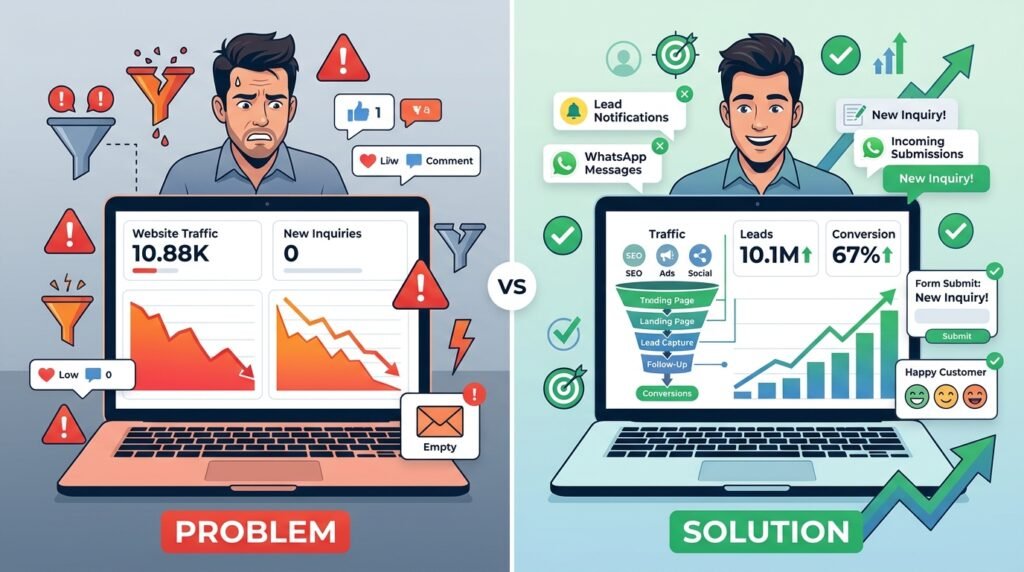
Introduction to Online Lead Generation
As a digital marketing strategist and SEO consultant, I have worked with numerous businesses across various industries, and one common challenge that many of them face is generating leads online. In today’s digital age, having a strong online presence is crucial for businesses to reach their target audience, increase brand awareness, and drive revenue. However, despite having a website and social media presence, many businesses struggle to generate leads online. In this article, we will explore the reasons why your business may not be getting leads online and provide a comprehensive solution guide to help you overcome these challenges.
Online lead generation is the process of attracting and converting strangers into potential customers through various digital channels such as search engines, social media, email marketing, and content marketing. It is a critical component of any digital marketing strategy, as it enables businesses to build a steady stream of potential customers, nurture them, and ultimately convert them into paying customers. However, online lead generation can be a complex and challenging process, especially for businesses that are new to digital marketing or lack the necessary expertise and resources.
According to a recent study, 61% of marketers consider generating traffic and leads to be their top challenge. This is not surprising, given the ever-increasing competition online and the constantly evolving nature of digital marketing. Moreover, the rise of artificial intelligence, machine learning, and other emerging technologies has created new opportunities for businesses to generate leads online, but it has also introduced new challenges and complexities. For instance, Google’s algorithm updates can significantly impact a website’s search engine rankings, making it difficult for businesses to maintain a consistent flow of leads.
To illustrate the importance of online lead generation, let’s consider an example. Suppose you are a financial services company that offers investment advice and portfolio management services. Your target audience is high-net-worth individuals who are looking for reliable and trustworthy financial advisors. To reach this audience, you create a website that showcases your services, expertise, and testimonials from satisfied clients. However, despite having a professional website, you are not generating enough leads to meet your business goals. This is where online lead generation strategies come into play. By leveraging search engine optimization (SEO), pay-per-click (PPC) advertising, social media marketing, and content marketing, you can increase your online visibility, drive more traffic to your website, and generate high-quality leads that convert into paying customers.
In addition to the example above, there are many other industries that can benefit from online lead generation. For instance, e-commerce businesses can use online lead generation to drive traffic to their websites, increase sales, and improve customer engagement. Healthcare providers can use online lead generation to attract new patients, promote their services, and build their reputation. Software companies can use online lead generation to generate leads, drive sales, and improve customer retention. The key is to understand your target audience, create a tailored online lead generation strategy, and continuously monitor and optimize your efforts to achieve the best results.
Some of the key benefits of online lead generation include:
- Increased brand awareness: Online lead generation helps to increase your brand’s visibility and reach a wider audience, which can lead to increased brand awareness and recognition.
- Improved website traffic: By optimizing your website for search engines and creating high-quality content, you can drive more traffic to your website and increase the chances of converting visitors into leads.
- Higher conversion rates: Online lead generation enables you to target specific audiences and create personalized experiences that resonate with them, leading to higher conversion rates and more sales.
- Cost-effective: Compared to traditional marketing methods, online lead generation is a cost-effective way to reach your target audience and generate leads, as it eliminates the need for print ads, direct mail, and other offline marketing tactics.
- Measurable results: With online lead generation, you can track your results in real-time, making it easier to measure the effectiveness of your campaigns and make data-driven decisions.
In conclusion, online lead generation is a critical component of any digital marketing strategy, and it offers numerous benefits for businesses of all sizes and industries. By understanding the principles of online lead generation and creating a tailored strategy that meets your business goals and target audience, you can increase your online visibility, drive more traffic to your website, and generate high-quality leads that convert into paying customers. In the next section, we will explore the common challenges that businesses face when generating leads online and provide practical solutions to help you overcome these challenges.
As we delve deeper into the world of online lead generation, it’s essential to remember that every business is unique, and what works for one company may not work for another. Therefore, it’s crucial to experiment with different strategies, track your results, and continually optimize your efforts to achieve the best possible outcomes. By doing so, you can stay ahead of the competition, drive business growth, and achieve long-term success in the ever-evolving digital landscape.
Moreover, the importance of online lead generation cannot be overstated. In today’s digital age, businesses that fail to generate leads online are likely to fall behind their competitors and struggle to survive. On the other hand, businesses that prioritize online lead generation and create effective strategies to attract and engage their target audience are more likely to thrive and achieve long-term success. As a digital marketing strategist and SEO consultant, I have seen firsthand the impact that online lead generation can have on a business, and I am excited to share my expertise with you in the following sections.
Technical SEO Issues Impacting Lead Generation
As a digital marketing strategist and SEO consultant, I have worked with numerous businesses that struggle to generate leads online. While many factors can contribute to this issue, technical SEO problems are often a significant obstacle. In this section, we will delve into the technical SEO issues that may be hindering your business’s ability to generate leads online and provide solutions to overcome these challenges.
Technical SEO refers to the process of optimizing your website’s technical aspects to improve its visibility, crawlability, and indexability. When your website is technically sound, search engines like Google can easily crawl and index your content, making it more likely to appear in search results. However, if your website is plagued by technical SEO issues, it can negatively impact your online lead generation efforts.
One of the primary technical SEO issues that can impact lead generation is slow website loading speed. A slow-loading website can lead to higher bounce rates, as users are unlikely to wait for a website to load. According to a study by Google, a delay of just one second in page loading time can result in a 7% reduction in conversions. To put this into perspective, if your website is generating 100 leads per day, a one-second delay could result in a loss of 7 leads per day. To address this issue, it’s essential to optimize your website’s images, minify CSS and JavaScript files, and leverage browser caching.
Another technical SEO issue that can impact lead generation is poor mobile responsiveness. With the majority of online searches now being conducted on mobile devices, it’s crucial that your website is optimized for mobile users. A website that is not mobile-friendly can lead to a poor user experience, resulting in higher bounce rates and lower conversion rates. To ensure that your website is mobile-friendly, it’s essential to use a responsive design that adapts to different screen sizes and devices. Additionally, you should ensure that your website’s content is easily accessible and readable on mobile devices.
Keyword cannibalization is another technical SEO issue that can impact lead generation. Keyword cannibalization occurs when multiple pages on your website are targeting the same keyword, resulting in confusion for search engines and a dilution of your website’s authority. To address this issue, it’s essential to conduct a thorough keyword analysis and ensure that each page on your website is targeting a unique keyword. You should also use header tags (H1-H6) to structure your content and highlight key phrases.
In addition to these issues, duplicate or thin content can also negatively impact your website’s ability to generate leads online. Duplicate content refers to content that is identical or very similar to content found on other websites, while thin content refers to content that lacks substance or value. To address this issue, it’s essential to create high-quality, unique, and engaging content that provides value to your target audience. You should also use a content management system to ensure that your content is regularly updated and refreshed.
Other technical SEO issues that can impact lead generation include broken links, missing or duplicate meta tags, and inadequate website security. Broken links can lead to a poor user experience and make it difficult for search engines to crawl your website. Missing or duplicate meta tags can result in confusion for search engines and make it difficult for your website to appear in search results. Inadequate website security can lead to a loss of trust among your target audience and result in a lower conversion rate.
To overcome these technical SEO issues and improve your website’s ability to generate leads online, it’s essential to conduct a thorough technical SEO audit. This audit should include a review of your website’s loading speed, mobile responsiveness, keyword strategy, content quality, and website security. You should also use tools like Google Search Console and Google Analytics to monitor your website’s performance and identify areas for improvement.
Here are some steps you can take to address technical SEO issues and improve your website’s lead generation:
- Conduct a thorough technical SEO audit to identify areas for improvement
- Optimize your website’s loading speed by compressing images, minifying CSS and JavaScript files, and leveraging browser caching
- Ensure that your website is mobile-friendly by using a responsive design and testing for mobile usability
- Conduct a keyword analysis to ensure that each page on your website is targeting a unique keyword
- Create high-quality, unique, and engaging content that provides value to your target audience
- Use header tags (H1-H6) to structure your content and highlight key phrases
- Use a content management system to ensure that your content is regularly updated and refreshed
- Fix broken links and ensure that your website has adequate website security
By addressing technical SEO issues and improving your website’s overall technical soundness, you can improve your online lead generation efforts and drive more conversions. Remember, technical SEO is an ongoing process that requires regular monitoring and maintenance to ensure that your website remains optimized and competitive in the ever-changing digital landscape.
As a digital marketing strategist and SEO consultant, I have helped numerous businesses overcome technical SEO issues and improve their online lead generation efforts. If you’re struggling to generate leads online, I encourage you to contact me to learn more about how I can help you address technical SEO issues and drive more conversions for your business.
Content Strategy and Its Impact on Lead Generation
As a digital marketing strategist and SEO consultant, I have worked with numerous businesses that struggle to generate leads online. One of the primary reasons for this struggle is a poorly planned content strategy. Your content strategy is the backbone of your online presence, and it plays a crucial role in attracting and engaging your target audience. In this section, we will delve into the importance of a well-structured content strategy and its impact on lead generation.
A content strategy is a comprehensive plan that outlines how you will create, publish, and manage content across all your online channels. It involves understanding your target audience, their pain points, and their preferences. A good content strategy should be aligned with your business goals and objectives, and it should be designed to drive revenue and growth. When it comes to lead generation, your content strategy should be focused on creating valuable and relevant content that resonates with your target audience and encourages them to take action.
There are several reasons why a poor content strategy can hinder your lead generation efforts. Firstly, low-quality content can drive away potential customers. If your content is poorly written, lacks depth, or is not optimized for search engines, it will not attract and engage your target audience. Secondly, inconsistent content can make your brand appear unprofessional and unreliable. If you are not regularly publishing content, your audience will lose interest and move on to other brands that are more proactive. Finally, irrelevant content can fail to resonate with your target audience, leading to a lack of engagement and conversion.
So, what makes a good content strategy? Here are some key elements to consider:
- Define your target audience: Understand who your ideal customer is, what their pain points are, and what they are looking for in a product or service. This will help you create content that resonates with them and addresses their needs.
- Conduct keyword research: Identify the keywords and phrases that your target audience is using to search for products or services like yours. This will help you optimize your content for search engines and increase your visibility.
- Create a content calendar: Plan and schedule your content in advance. This will help you ensure that you are consistently publishing high-quality content that is relevant to your target audience.
- Use a variety of content formats: Mix up your content formats to keep your audience engaged. This can include blog posts, videos, infographics, podcasts, and more.
- Optimize for user experience: Ensure that your content is easy to read, understand, and navigate. This includes optimizing your content for mobile devices and ensuring that it is accessible to all users.
For example, let’s say you are a fitness coach who specializes in helping people lose weight. Your target audience is likely to be individuals who are struggling with their weight and are looking for a solution. Your content strategy might involve creating a series of blog posts that provide tips and advice on healthy eating and exercise. You might also create a video series that showcases your workout routines and provides motivation and support to your audience. By creating a variety of content formats and optimizing them for user experience, you can attract and engage your target audience and encourage them to take action.
In addition to creating high-quality content, it’s also important to distribute your content effectively. This can include sharing your content on social media, email marketing, and other online channels. You should also consider repurposing your content to get the most out of it. For example, you could turn a blog post into a video or a podcast, or create a series of social media posts from a single piece of content.
Another important aspect of content strategy is measurement and analysis. You should be tracking your content’s performance and analyzing the data to see what’s working and what’s not. This can include metrics such as website traffic, engagement, and conversion rates. By analyzing your data, you can refine your content strategy and make data-driven decisions to improve your lead generation efforts.
For instance, let’s say you are a B2B software company that provides marketing automation solutions. Your content strategy might involve creating a series of whitepapers and case studies that provide valuable insights and information to your target audience. You could track the performance of these content pieces using metrics such as downloads, engagement, and conversion rates. By analyzing the data, you might find that your whitepapers are driving more leads than your case studies, and you could adjust your content strategy accordingly.
In conclusion, a well-structured content strategy is crucial for lead generation. By creating high-quality, relevant, and valuable content, distributing it effectively, and measuring and analyzing its performance, you can attract and engage your target audience and drive revenue and growth. As a digital marketing strategist and SEO consultant, I have seen firsthand the impact that a good content strategy can have on a business’s online presence and lead generation efforts. By following the tips and best practices outlined in this section, you can create a content strategy that drives real results for your business.
Local SEO and Online Visibility for Businesses
As a digital marketing strategist and SEO consultant, I have worked with numerous businesses that struggle to generate leads online. One of the primary reasons for this struggle is the lack of a solid local SEO strategy. Local SEO is crucial for businesses that rely on local customers, as it helps them increase their online visibility, drive more foot traffic to their stores, and ultimately, boost their revenue. In this section, we will delve into the importance of local SEO and online visibility for businesses, and provide actionable tips on how to improve your online presence.
Local SEO is a subset of search engine optimization that focuses on optimizing a website to rank higher in local search results. This is particularly important for businesses that have a physical location, such as restaurants, retail stores, and service-based businesses. When a user searches for a keyword related to your business, along with a location (e.g., “pizza delivery in New York”), search engines like Google will display a list of relevant results, including a map with markers indicating the location of each business. This is known as the Local Pack or Google Maps results.
To improve your business’s online visibility, it’s essential to optimize your website and online presence for local SEO. This includes claiming and verifying your Google My Business listing, building high-quality local citations, and creating content that is relevant to your local audience. By doing so, you can increase your chances of appearing in the Local Pack, drive more organic traffic to your website, and ultimately, generate more leads and sales.
For example, let’s say you own a dental practice in Los Angeles. By optimizing your website for local SEO, you can increase your visibility in search results for keywords like “dentists in Los Angeles” or “teeth whitening in LA.” This can help you attract more local patients, increase your online reputation, and establish your practice as a trusted authority in your field.
Another important aspect of local SEO is online reviews. Online reviews are a crucial factor in determining your business’s online reputation and visibility. Positive reviews can increase your business’s credibility, drive more conversions, and improve your local search rankings. On the other hand, negative reviews can harm your reputation, drive away potential customers, and decrease your online visibility. It’s essential to encourage your satisfied customers to leave reviews on your Google My Business listing and other relevant platforms.
To further improve your online visibility, it’s crucial to build high-quality local citations. Local citations are mentions of your business’s name, address, and phone number (NAP) on other websites, such as local directories, review sites, and industry-specific platforms. Consistency is key when it comes to local citations, as discrepancies in your NAP can confuse search engines and harm your online visibility. Make sure to claim and verify your listings on reputable directories like Yelp, Bing Places, and other local business listings.
In addition to local citations, content marketing plays a vital role in improving your online visibility. Creating high-quality, relevant, and engaging content can help you attract and retain a clearly defined audience, drive more organic traffic to your website, and establish your business as a trusted authority in your industry. This can include blog posts, videos, infographics, and other types of content that cater to your local audience’s needs and interests.
For instance, a fitness center in Chicago can create content around topics like “best workout routines for beginners” or “healthy eating tips for Chicagoans.” This type of content can help attract local fitness enthusiasts, increase the center’s online visibility, and drive more leads and sales.
Some other ways to improve your online visibility include:
- Optimizing your website for mobile devices, as this is now a key ranking factor, and most local searches are conducted on mobile devices.
- Using location-specific keywords in your website’s content, meta tags, and alt tags to help search engines understand your business’s location and relevance.
- Building high-quality backlinks from local websites, such as local news sites, blogs, and industry-specific platforms, to increase your website’s authority and online visibility.
- Utilizing social media platforms to engage with your local audience, share relevant content, and increase your online reputation.
- Monitoring and responding to online reviews to ensure that your business’s online reputation is positive and consistent.
In conclusion, local SEO and online visibility are crucial components of a successful digital marketing strategy. By optimizing your website and online presence for local SEO, building high-quality local citations, creating relevant content, and encouraging online reviews, you can increase your business’s online visibility, drive more organic traffic, and ultimately, generate more leads and sales. As a digital marketing strategist and SEO consultant, I recommend that businesses prioritize local SEO and online visibility to stay ahead of the competition and achieve their online marketing goals.
By implementing these strategies and staying up-to-date with the latest local SEO trends and best practices, you can improve your business’s online visibility, increase your online reputation, and drive more conversions. Remember, local SEO is a continuous process that requires ongoing effort and optimization to achieve and maintain optimal results. Stay tuned for more insights and tips on how to improve your business’s online visibility and generate more leads online.
Advanced SEO Strategies for Lead Generation and Conversion
As a digital marketing strategist and SEO consultant, I have worked with numerous businesses that struggle to generate leads online. Despite having a website and a strong online presence, many companies find it challenging to attract and convert potential customers. In this section, we will explore the advanced SEO strategies that can help your business overcome this hurdle and achieve its lead generation and conversion goals.
Search Engine Optimization (SEO) is a crucial aspect of digital marketing that can make or break your online lead generation efforts. By optimizing your website and content for search engines, you can increase your visibility, drive more traffic, and ultimately generate more leads. However, with the ever-evolving search landscape and increasing competition, it’s essential to stay ahead of the curve and adopt advanced SEO strategies that can help you outperform your competitors.
One of the most critical aspects of advanced SEO is understanding the intent behind your target audience’s search queries. By analyzing search data and identifying patterns, you can create content that resonates with your audience and addresses their pain points. For instance, if you’re a software company that offers project management tools, you can create content around keywords like “agile project management” or “scrum methodology” to attract potential customers who are searching for solutions to improve their project management processes.
Another essential strategy is to focus on long-tail keywords, which are more specific phrases with lower search volumes. While they may not drive as much traffic as broader keywords, long-tail keywords are often less competitive and more targeted, making them more likely to convert. For example, instead of targeting the keyword “digital marketing,” you could target long-tail keywords like “digital marketing agency for e-commerce businesses” or “digital marketing strategies for small businesses.” This approach can help you attract high-quality leads that are more likely to convert into customers.
In addition to keyword optimization, it’s essential to focus on technical SEO, which refers to the process of optimizing your website’s infrastructure and architecture to improve its crawlability, indexability, and overall performance. This includes optimizing your website’s loading speed, mobile responsiveness, and SSL encryption, as well as ensuring that your website is free of technical errors and crawl issues. By improving your website’s technical SEO, you can improve your search engine rankings, drive more traffic, and provide a better user experience for your visitors.
Moreover, advanced SEO strategies involve creating high-quality, relevant, and engaging content that resonates with your target audience. This includes blog posts, articles, videos, infographics, and other types of content that provide value to your audience and establish your brand as a thought leader in your industry. By creating content that addresses the needs and pain points of your audience, you can attract and engage with potential customers, build trust and credibility, and ultimately drive more conversions.
Some of the advanced SEO strategies that can help your business generate leads online include:
- Using Artificial Intelligence (AI) and machine learning algorithms to analyze search data and identify patterns
- Implementing voice search optimization to capitalize on the growing trend of voice searches
- Utilizing entity-based optimization to improve your website’s visibility and credibility
- Creating personalized content experiences to engage with your audience and build trust
- Using influencer marketing and outreach to build relationships with industry influencers and thought leaders
- Optimizing your website’s user experience and conversion rate optimization to improve your website’s performance and drive more conversions
For instance, a company like HubSpot, which offers inbound marketing and sales software, can use advanced SEO strategies like entity-based optimization to improve its visibility and credibility in search results. By creating high-quality content that showcases its expertise and thought leadership in the industry, HubSpot can attract and engage with potential customers, drive more traffic to its website, and ultimately generate more leads and conversions.
Another example is a company like Ahrefs, which offers SEO tools and software. Ahrefs can use advanced SEO strategies like voice search optimization to capitalize on the growing trend of voice searches. By optimizing its content and website for voice searches, Ahrefs can improve its visibility and drive more traffic to its website, ultimately generating more leads and conversions.
In conclusion, advanced SEO strategies are essential for businesses that want to generate leads online and drive conversions. By understanding the intent behind your target audience’s search queries, focusing on long-tail keywords, optimizing your website’s technical SEO, creating high-quality content, and utilizing advanced SEO strategies like AI and entity-based optimization, you can improve your search engine rankings, drive more traffic, and ultimately achieve your lead generation and conversion goals. As a digital marketing strategist and SEO consultant, I have seen firsthand the impact that advanced SEO strategies can have on a business’s online lead generation efforts, and I highly recommend that businesses invest in these strategies to stay ahead of the competition and drive long-term growth and success.
To get started with advanced SEO strategies, it’s essential to conduct a thorough analysis of your website and online presence. This includes analyzing your website’s technical SEO, content quality, and user experience, as well as identifying areas for improvement and opportunities for growth. By taking a data-driven approach to SEO, you can create a customized strategy that addresses your unique needs and goals, and drives real results for your business.
Furthermore, it’s crucial to stay up-to-date with the latest trends and best practices in SEO, as the search landscape is constantly evolving. This includes following industry leaders and thought leaders, attending conferences and webinars, and participating in online communities and forums. By staying informed and adapting to changes in the search landscape, you can stay ahead of the competition and drive long-term growth and success for your business.
In addition to these strategies, it’s also essential to focus on building high-quality backlinks from authoritative sources. This includes guest blogging, outreach, and content marketing, as well as leveraging relationships with industry influencers and thought leaders. By building high-quality backlinks, you can improve your website’s authority and credibility, drive more traffic, and ultimately generate more leads and conversions.
Finally, it’s crucial to track and measure the performance of your SEO efforts, using tools like Google Analytics and SEMrush to monitor your website’s traffic, rankings, and conversions. By tracking your performance and adjusting your strategy accordingly, you can optimize your SEO efforts and drive real results for your business. As a digital marketing strategist and SEO consultant, I highly recommend that businesses invest in advanced SEO strategies and track their performance closely, to stay ahead of the competition and drive long-term growth and success.

Amit Tyagi is a seasoned Digital Marketing and SEO Consultant with extensive experience helping businesses improve online visibility through SEO, AI Search Optimization (AIO/GEO), content strategy, and performance marketing. He regularly shares practical insights, industry updates, and data-driven strategies, empowering brands and marketers to achieve sustainable digital growth in an evolving search landsca