
Introduction to SEO for Coaching Classes
As a digital marketing strategist and SEO consultant, I have worked with numerous coaching classes and educational institutions to improve their online visibility and attract more students. In today’s digital age, having a strong online presence is crucial for coaching classes to reach their target audience and stay ahead of the competition. Search Engine Optimization (SEO) plays a vital role in this process, and in this section, we will explore the importance of SEO for coaching classes and how it can help them rank higher in local search results.
Coaching classes, whether they are for academic subjects, professional certifications, or vocational training, face intense competition in the market. With so many options available, students and parents often turn to search engines like Google to find the best coaching classes in their area. This is where SEO comes into play. By optimizing their website and online presence for search engines, coaching classes can increase their visibility, drive more traffic to their website, and ultimately attract more students.
What is SEO? SEO is the process of improving the quality and quantity of website traffic by ranking higher in search engine results pages (SERPs) for specific keywords and phrases. It involves understanding how search engines work, what people search for, and the keywords and phrases they use. By optimizing their website and content for these keywords and phrases, coaching classes can increase their chances of ranking higher in search results and attracting more relevant traffic.
For coaching classes, SEO is not just about ranking higher in search results; it’s also about building credibility and trust with their target audience. By creating high-quality, informative, and engaging content, coaching classes can establish themselves as authorities in their field and attract more students who are looking for reliable and trustworthy coaching services.
Why is SEO important for coaching classes? There are several reasons why SEO is important for coaching classes. Firstly, it helps coaching classes to reach their target audience more effectively. By optimizing their website and content for specific keywords and phrases, coaching classes can attract more relevant traffic and increase their chances of converting visitors into students. Secondly, SEO helps coaching classes to build credibility and trust with their target audience. By creating high-quality and informative content, coaching classes can establish themselves as authorities in their field and attract more students who are looking for reliable and trustworthy coaching services.
Thirdly, SEO is a cost-effective marketing strategy compared to traditional forms of marketing. By optimizing their website and content for search engines, coaching classes can reduce their marketing costs and increase their return on investment (ROI). Finally, SEO provides coaching classes with measurable results, allowing them to track their progress and make data-driven decisions to improve their online marketing strategy.
Some of the key benefits of SEO for coaching classes include:
- Increased online visibility and reach
- Improved credibility and trust with the target audience
- More relevant traffic and higher conversion rates
- Cost-effective marketing strategy
- Measurable results and data-driven decision making
In the next section, we will explore the key factors that influence SEO for coaching classes and how they can optimize their website and content to rank higher in local search results.
For example, let’s consider a coaching class that offers preparation courses for competitive exams like IIT JEE or NEET. To attract more students, this coaching class can optimize its website and content for keywords like “IIT JEE coaching classes in [city name]” or “NEET preparation courses in [city name]”. By doing so, the coaching class can increase its chances of ranking higher in search results and attracting more relevant traffic to its website.
Another example is a coaching class that offers vocational training courses in areas like digital marketing, graphic design, or web development. To attract more students, this coaching class can optimize its website and content for keywords like “digital marketing courses in [city name]” or “graphic design training in [city name]”. By doing so, the coaching class can increase its chances of ranking higher in search results and attracting more relevant traffic to its website.
In conclusion, SEO is a critical component of any coaching class’s online marketing strategy. By understanding how search engines work and what people search for, coaching classes can optimize their website and content to rank higher in local search results and attract more relevant traffic. In the next section, we will explore the key factors that influence SEO for coaching classes and how they can optimize their website and content to achieve their online marketing goals.
Keyword Research and Optimization for Coaching Classes
As a digital marketing strategist and SEO consultant, I, Amit Tyagi, have worked with numerous coaching classes to improve their online visibility and drive more students to their institutions. One of the most critical steps in this process is keyword research and optimization. In this section, we will delve into the importance of keyword research and optimization for coaching classes and provide tips on how to do it effectively.
Keyword research is the process of identifying the words and phrases that potential students use to search for coaching classes online. It is essential to understand that the keywords used by students can vary depending on the location, type of coaching class, and level of study. For example, a student looking for a coaching class in Delhi for IIT JEE preparation might use keywords like “IIT JEE coaching in Delhi” or “best IIT JEE coaching classes in Delhi”. On the other hand, a student looking for a coaching class in Mumbai for CAT preparation might use keywords like “CAT coaching in Mumbai” or “best CAT coaching classes in Mumbai”.
To conduct keyword research, you can use various tools like Google Keyword Planner, Ahrefs, SEMrush, or Moz Keyword Explorer. These tools can help you identify relevant keywords, their search volume, competition, and cost-per-click. For instance, let’s say you are a coaching class in Delhi offering IIT JEE preparation courses. Using Google Keyword Planner, you can identify keywords like “IIT JEE coaching in Delhi” with a search volume of 1,000 per month, “best IIT JEE coaching classes in Delhi” with a search volume of 500 per month, and “IIT JEE coaching classes in Delhi” with a search volume of 200 per month.
Once you have identified the relevant keywords, the next step is to optimize your website and content for those keywords. This includes optimizing your page title, meta description, headings, and content with the target keywords. For example, if your coaching class is located in Delhi and offers IIT JEE preparation courses, your page title could be “IIT JEE Coaching in Delhi | Best IIT JEE Coaching Classes in Delhi” and your meta description could be “Get the best IIT JEE coaching in Delhi with our expert faculty and comprehensive study material. Join our IIT JEE coaching classes in Delhi today and achieve your goals”.
It’s also essential to use the target keywords in your headings and content, but make sure to use them naturally and not stuff them unnecessarily. For example, your heading could be “Why Choose Our IIT JEE Coaching Classes in Delhi” and your content could be “Our IIT JEE coaching classes in Delhi are designed to provide students with a comprehensive and structured approach to IIT JEE preparation. With our expert faculty and comprehensive study material, students can achieve their goals and get into their desired colleges. We offer the best IIT JEE coaching in Delhi, and our results speak for themselves”.
In addition to optimizing your website and content, it’s also essential to create high-quality and relevant content that provides value to your target audience. This could include blog posts, articles, videos, or infographics that provide tips and advice on IIT JEE preparation, exam patterns, and other relevant topics. For example, you could create a blog post on “How to Prepare for IIT JEE in 6 Months” or “Top 10 Tips for Cracking IIT JEE Exam” and optimize it with the target keywords.
Another important aspect of keyword research and optimization is to use long-tail keywords. Long-tail keywords are more specific phrases that have lower search volumes, but are also less competitive and more targeted. For example, instead of targeting the keyword “IIT JEE coaching in Delhi”, you could target long-tail keywords like “IIT JEE coaching classes in Delhi for droppers” or “best IIT JEE coaching in Delhi for students with low percentile”. Using long-tail keywords can help you attract more targeted traffic to your website and increase your chances of conversion.
Here are some tips for conducting keyword research and optimization for coaching classes:
- Use keyword research tools to identify relevant keywords and their search volume, competition, and cost-per-click.
- Optimize your website and content with the target keywords, including page title, meta description, headings, and content.
- Use the target keywords naturally and not stuff them unnecessarily.
- Create high-quality and relevant content that provides value to your target audience.
- Use long-tail keywords to attract more targeted traffic to your website.
- Monitor and analyze your keyword performance regularly and adjust your strategy accordingly.
In conclusion, keyword research and optimization are critical steps in improving the online visibility of coaching classes and driving more students to their institutions. By conducting thorough keyword research and optimizing your website and content with the target keywords, you can increase your chances of ranking higher in search engine results pages and attracting more targeted traffic to your website. Remember to use keyword research tools, optimize your website and content naturally, create high-quality and relevant content, and use long-tail keywords to attract more targeted traffic to your website.
As a digital marketing strategist and SEO consultant, I have helped numerous coaching classes improve their online visibility and drive more students to their institutions. If you are a coaching class looking to improve your online visibility and drive more students to your institution, feel free to contact me to discuss your requirements and create a customized digital marketing strategy for your coaching class.
On-Page SEO Strategies for Coaching Classes
As a digital marketing strategist and SEO consultant, I have worked with numerous coaching classes to improve their online visibility and drive more students to their institutions. In this section, we will discuss the on-page SEO strategies that can help coaching classes rank higher in local search results. On-page SEO refers to the optimization of website elements to make them more search engine friendly, which in turn improves the website’s visibility and ranking in search engine results pages (SERPs).
Coaching classes can benefit greatly from on-page SEO, as it helps them to reach a wider audience and attract more students. By optimizing their website and content, coaching classes can increase their online presence, drive more traffic to their website, and ultimately, increase their student enrollment. In this section, we will discuss the key on-page SEO strategies that coaching classes can use to improve their online visibility and rank higher in local search results.
The first step in on-page SEO is to conduct keyword research and identify the most relevant and high-traffic keywords related to your coaching class. This can be done using tools such as Google Keyword Planner, Ahrefs, or SEMrush. Once you have identified the keywords, you can optimize your website’s content, meta tags, and other elements to include these keywords. For example, if your coaching class specializes in IIT JEE preparation, your target keywords could be “IIT JEE coaching”, “IIT JEE preparation”, “IIT JEE classes”, etc.
Another important on-page SEO strategy is to optimize your website’s meta tags, including the title tag, meta description, and keyword tag. The title tag should be a concise and descriptive summary of your website’s content, and should include your target keywords. The meta description should be a brief summary of your website’s content, and should also include your target keywords. The keyword tag is no longer a crucial factor in SEO, but it can still be useful to include your target keywords in this tag. For example, if your coaching class specializes in IIT JEE preparation, your title tag could be “IIT JEE Coaching Classes | Best IIT JEE Preparation Institute”, and your meta description could be “Get the best IIT JEE coaching classes at our institute. Our expert faculty and comprehensive study materials will help you crack the IIT JEE exam with ease.”
In addition to meta tags, it’s also important to optimize your website’s header tags, including H2, H3, H4, etc. These tags are used to structure your website’s content and make it more readable for users. They should be used to break up your content into sections and subsections, and should include your target keywords. For example, if your coaching class specializes in IIT JEE preparation, your H2 tag could be “IIT JEE Coaching Classes”, and your H3 tag could be “Why Choose Our IIT JEE Coaching Institute”.
Content optimization is also a crucial on-page SEO strategy for coaching classes. Your website’s content should be high-quality, engaging, and informative, and should include your target keywords. It’s also important to regularly update your website’s content to keep it fresh and relevant. This can be done by adding new blog posts, articles, or news sections to your website. For example, if your coaching class specializes in IIT JEE preparation, you could create a blog post on “Tips and Tricks to Crack the IIT JEE Exam”, or “How to Prepare for IIT JEE in 6 Months”.
Image optimization is also an important on-page SEO strategy for coaching classes. Your website’s images should be optimized to reduce their file size and improve page load times. This can be done by compressing your images using tools such as TinyPNG or ImageOptim. You should also include alt tags and descriptive text for your images, which should include your target keywords. For example, if your coaching class specializes in IIT JEE preparation, your image alt tag could be “IIT JEE coaching classes”, and your descriptive text could be “Our IIT JEE coaching classes are designed to help students crack the IIT JEE exam with ease.”
Internal linking is also a crucial on-page SEO strategy for coaching classes. Internal linking refers to the process of linking to other pages on your website from your current page. This helps to improve user experience, reduce bounce rates, and increase page views. It’s also important to use descriptive and keyword-rich anchor text for your internal links. For example, if your coaching class specializes in IIT JEE preparation, your internal link anchor text could be “IIT JEE coaching classes”, or “IIT JEE preparation tips”.
Mobile-friendliness is also an important on-page SEO strategy for coaching classes. With the majority of users accessing the internet through their mobile devices, it’s crucial to ensure that your website is mobile-friendly and provides a good user experience. This can be done by using responsive design, which adapts to different screen sizes and devices. You should also ensure that your website’s content is easily readable and accessible on mobile devices, and that your website’s navigation is easy to use.
To implement these on-page SEO strategies, coaching classes can follow these steps:
- Conduct keyword research to identify the most relevant and high-traffic keywords related to your coaching class
- Optimize your website’s meta tags, including the title tag, meta description, and keyword tag
- Optimize your website’s header tags, including H2, H3, H4, etc.
- Optimize your website’s content to include your target keywords and make it high-quality, engaging, and informative
- Optimize your website’s images to reduce their file size and improve page load times
- Use internal linking to improve user experience, reduce bounce rates, and increase page views
- Ensure that your website is mobile-friendly and provides a good user experience
By following these on-page SEO strategies, coaching classes can improve their online visibility, drive more traffic to their website, and increase their student enrollment. It’s also important to regularly monitor and analyze your website’s performance using tools such as Google Analytics, and make adjustments to your on-page SEO strategies as needed. With the right on-page SEO strategies in place, coaching classes can improve their online presence and attract more students to their institutions.
In conclusion, on-page SEO is a crucial aspect of digital marketing for coaching classes. By optimizing their website and content, coaching classes can improve their online visibility, drive more traffic to their website, and increase their student enrollment. The key on-page SEO strategies for coaching classes include conducting keyword research, optimizing meta tags and header tags, optimizing content and images, using internal linking, and ensuring mobile-friendliness. By following these strategies and regularly monitoring and analyzing their website’s performance, coaching classes can improve their online presence and attract more students to their institutions.
As a digital marketing strategist and SEO consultant, I have seen firsthand the impact that on-page SEO can have on a coaching class’s online presence and student enrollment. By implementing the right on-page SEO strategies, coaching classes can improve their website’s visibility, drive more traffic to their website, and increase their student enrollment. If you are a coaching class looking to improve your online presence and attract more students to your institution, I would be happy to help you develop and implement an effective on-page SEO strategy.
For example, let’s say you are a coaching class that specializes in IIT JEE preparation. Your target keywords could be “IIT JEE coaching”, “IIT JEE preparation”, “IIT JEE classes”, etc. You could optimize your website’s meta tags, header tags, and content to include these keywords, and use internal linking to improve user experience and reduce bounce rates. You could also optimize your website’s images to reduce their file size and improve page load times, and ensure that your website is mobile-friendly and provides a good user experience.
By following these on-page SEO strategies, you can improve your coaching class’s online presence, drive more traffic to your website, and increase your student enrollment. You can also use tools such as Google Analytics to monitor and analyze your website’s performance, and make adjustments to your on-page SEO strategies as needed. With the right on-page SEO strategies in place, you can improve your coaching class’s online presence and attract more students to your institution.
In addition to on-page SEO, it’s also important to consider other digital marketing strategies, such as search engine marketing (SEM), social media marketing, and email marketing. These strategies can help you to reach a wider audience, drive more traffic to your website, and increase your student enrollment. For example, you could use SEM to run targeted ads on Google and other search engines, or use social media marketing to engage with potential students and promote your coaching class.
By combining on-page SEO with other digital marketing strategies, you can create a comprehensive online marketing plan that helps you to achieve your coaching class’s goals. Whether you are looking to improve your online presence, drive more traffic to your website, or increase your student enrollment, I would be happy to help you develop and implement an effective digital marketing strategy.
In conclusion, on-page SEO is a crucial aspect of digital marketing for coaching classes. By optimizing their website and content, coaching classes can improve their online visibility, drive more traffic to their website, and increase their student enrollment. The key on-page SEO strategies for coaching classes include conducting keyword research, optimizing meta tags and header tags, optimizing content and images, using internal linking, and ensuring mobile-friendliness. By following these strategies and combining them with other digital marketing strategies, coaching classes can improve their online presence and attract more students to their institutions.
Local SEO and Google My Business for Coaching Classes
As a digital marketing strategist and SEO consultant, I have worked with numerous coaching classes to improve their online visibility and drive more students to their institutions. In today’s competitive landscape, it’s essential for coaching classes to have a strong online presence, particularly in local search results. In this section, we will discuss the importance of Local SEO and Google My Business for coaching classes and provide tips on how to optimize your online presence to attract more students.
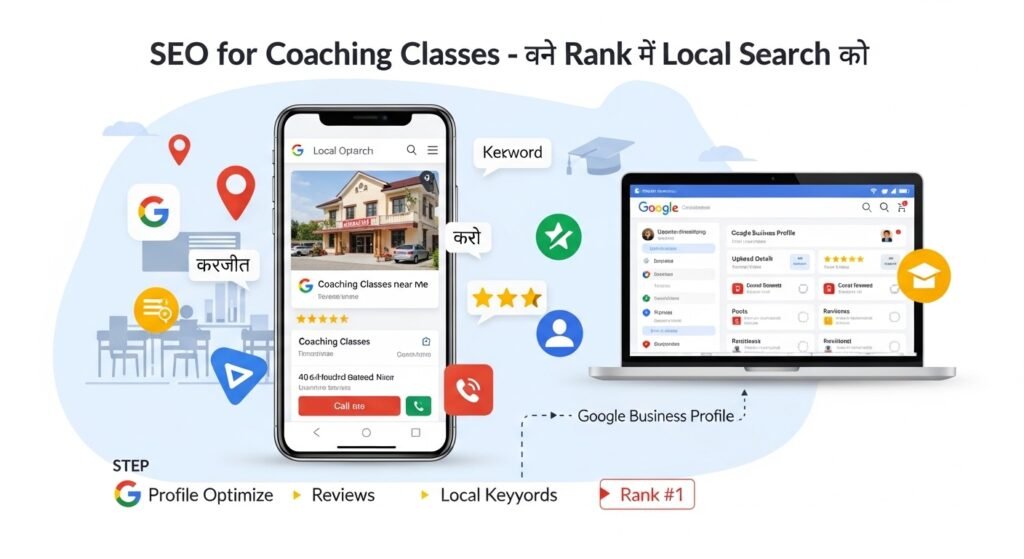
Local SEO is a crucial aspect of search engine optimization that focuses on optimizing your website and online presence to rank higher in local search results. When someone searches for “coaching classes near me” or “best coaching classes in [city],” you want your institution to appear at the top of the search results. This is where Local SEO comes into play. By optimizing your website and online presence for local search, you can increase your chances of attracting more students and driving more conversions.
One of the most effective ways to improve your Local SEO is by claiming and optimizing your Google My Business listing. Google My Business is a free tool that allows you to manage your business’s online presence across Google, including Google Maps and Google Search. By claiming your Google My Business listing, you can provide essential information about your coaching class, such as your address, phone number, and hours of operation. You can also add photos, respond to reviews, and post updates to keep your students engaged.
Here are some tips to optimize your Google My Business listing for your coaching class:
- Verify your listing: Verifying your Google My Business listing is essential to ensure that your coaching class appears on Google Maps and Google Search. You can verify your listing by phone, email, or mail.
- Complete your profile: Make sure to complete your Google My Business profile with accurate and up-to-date information, including your address, phone number, and hours of operation.
- Add high-quality photos: Add high-quality photos of your coaching class, including photos of your facilities, teachers, and students. This will help potential students get a better understanding of your institution and what you offer.
- Respond to reviews: Responding to reviews is essential to build trust and credibility with potential students. Make sure to respond to both positive and negative reviews in a professional and timely manner.
- Post updates: Posting updates on your Google My Business listing can help keep your students engaged and attract new students to your coaching class. You can post updates about new courses, special offers, or upcoming events.
Another important aspect of Local SEO is building high-quality local citations. Local citations are mentions of your coaching class on other websites, including directories, review sites, and blogs. Building high-quality local citations can help improve your Local SEO and increase your chances of ranking higher in local search results.
Here are some tips to build high-quality local citations for your coaching class:
- Claim your listings: Claim your listings on local directories, review sites, and other relevant platforms. Make sure to provide accurate and consistent information about your coaching class across all platforms.
- Use consistent NAP: Use consistent NAP (name, address, phone number) across all platforms. This will help search engines understand that your coaching class is a single entity and not multiple separate entities.
- Build high-quality backlinks: Building high-quality backlinks from other relevant websites can help improve your Local SEO and increase your chances of ranking higher in local search results.
- Monitor your citations: Monitor your citations regularly to ensure that they are accurate and up-to-date. You can use tools like Moz Local or Ahrefs to monitor your citations and identify any inconsistencies.
In addition to Local SEO and Google My Business, it’s also essential to optimize your website for local search. This includes optimizing your website’s content, meta tags, and structure to make it more search engine friendly.
Here are some tips to optimize your website for local search:
- Use location-specific keywords: Use location-specific keywords in your website’s content, meta tags, and titles to help search engines understand that your coaching class is located in a specific area.
- Optimize your meta tags: Optimize your meta tags, including your title tag, meta description, and keyword tag, to make them more search engine friendly.
- Use header tags: Use header tags (H1, H2, H3, etc.) to structure your website’s content and make it more readable for both users and search engines.
- Optimize your images: Optimize your images by adding alt tags, descriptive text, and compressing them to reduce file size.
By following these tips and optimizing your online presence for Local SEO, Google My Business, and your website, you can improve your chances of attracting more students to your coaching class and driving more conversions. Remember to always keep your online presence up-to-date and consistent, and to monitor your analytics regularly to track your progress and make data-driven decisions.
As a digital marketing strategist and SEO consultant, I have seen firsthand the impact that Local SEO and Google My Business can have on coaching classes. By optimizing your online presence and building a strong Local SEO strategy, you can increase your visibility, drive more traffic, and attract more students to your institution. If you’re looking to improve your coaching class’s online presence and drive more conversions, I recommend starting with the tips outlined above and working with a digital marketing expert to develop a customized Local SEO strategy that meets your unique needs and goals.
Measuring and Improving SEO Performance for Coaching Classes
As a digital marketing strategist and SEO consultant, I have worked with numerous coaching classes to improve their online visibility and drive more students to their institutions. Measuring and improving SEO performance is crucial for coaching classes to stay ahead of the competition and attract more students. In this section, we will discuss the importance of measuring and improving SEO performance for coaching classes and provide tips on how to do it effectively.
Search Engine Optimization (SEO) is a critical component of digital marketing that helps coaching classes to rank higher in search engine results pages (SERPs) for relevant keywords. By optimizing their website and online presence, coaching classes can increase their visibility, drive more traffic, and attract more students. However, measuring and improving SEO performance can be a challenging task, especially for coaching classes that have limited resources and expertise.
To measure SEO performance, coaching classes need to track key performance indicators (KPIs) such as website traffic, search engine rankings, and conversion rates. Website traffic refers to the number of visitors that come to the coaching class’s website, while search engine rankings refer to the position of the website in SERPs for relevant keywords. Conversion rates, on the other hand, refer to the number of visitors that take a desired action, such as filling out a form or making a phone call.
Coaching classes can use tools such as Google Analytics to track website traffic and search engine rankings. Google Analytics provides detailed insights into website traffic, including the number of visitors, page views, and bounce rates. It also provides information on search engine rankings, including the position of the website in SERPs and the number of impressions and clicks.
In addition to tracking KPIs, coaching classes need to conduct regular SEO audits to identify areas for improvement. An SEO audit involves reviewing the website’s structure, content, and meta tags to ensure that they are optimized for search engines. It also involves reviewing the website’s backlink profile to ensure that it is free from spammy links.
Coaching classes can use tools such as Ahrefs and SEMrush to conduct SEO audits. These tools provide detailed insights into the website’s structure, content, and meta tags, as well as its backlink profile. They also provide recommendations for improvement, such as optimizing meta tags, creating high-quality content, and building high-quality backlinks.
Once coaching classes have identified areas for improvement, they need to implement changes to their website and online presence. This may involve optimizing meta tags, creating high-quality content, and building high-quality backlinks. It may also involve improving the website’s user experience, such as making it mobile-friendly and improving page load times.
Coaching classes can use tools such as WordPress and Wix to optimize their website’s user experience. These tools provide templates and plugins that make it easy to create a mobile-friendly website with fast page load times. They also provide tools for creating high-quality content, such as blog posts and videos.
In addition to optimizing their website, coaching classes need to build high-quality backlinks to improve their search engine rankings. Backlinks are links from other websites that point to the coaching class’s website. They are an important ranking factor, as they indicate to search engines that the website is trustworthy and authoritative.
Coaching classes can build high-quality backlinks by creating high-quality content that other websites want to link to. They can also build backlinks by participating in online communities related to their niche. For example, a coaching class that specializes in math tutoring can participate in online forums related to math education to build backlinks and establish itself as an authority in the field.
Another way to build backlinks is to use guest blogging. Guest blogging involves writing articles for other websites in exchange for a link back to the coaching class’s website. This can be an effective way to build backlinks, as it allows coaching classes to reach a wider audience and establish themselves as authorities in their niche.
Coaching classes can also use local SEO to improve their search engine rankings. Local SEO involves optimizing the website for local search terms, such as “coaching classes in Mumbai” or “tutoring services in Delhi”. This can be an effective way to attract local students who are searching for coaching classes in their area.
To optimize for local SEO, coaching classes need to include their business’s name, address, and phone number (NAP) consistently across the web. They also need to create a Google My Business listing and optimize it with accurate and up-to-date information. This includes adding high-quality photos, responding to reviews, and posting regular updates.
Coaching classes can also use online directories to improve their local SEO. Online directories are websites that list businesses in a particular category or location. They can be an effective way to build backlinks and improve search engine rankings, as they provide a way for coaching classes to reach a wider audience and establish themselves as authorities in their niche.
Some examples of online directories that coaching classes can use include:
- Justdial
- Sulekha
- IndiaMART
- TradeIndia
Coaching classes can also use social media to improve their local SEO. Social media platforms such as Facebook and Twitter provide a way for coaching classes to reach a wider audience and establish themselves as authorities in their niche. They can also be used to build backlinks and improve search engine rankings, as they provide a way for coaching classes to share their content and engage with their audience.
For example, a coaching class can create a Facebook page and share updates about their services, such as new courses or special promotions. They can also use Twitter to share tips and advice related to their niche, such as study tips or exam preparation strategies.
In conclusion, measuring and improving SEO performance is crucial for coaching classes to stay ahead of the competition and attract more students. By tracking KPIs, conducting regular SEO audits, and implementing changes to their website and online presence, coaching classes can improve their search engine rankings and drive more traffic to their website. They can also use local SEO, online directories, and social media to build high-quality backlinks and establish themselves as authorities in their niche.
As a digital marketing strategist and SEO consultant, I recommend that coaching classes take a holistic approach to SEO that includes both on-page and off-page optimization. This includes optimizing their website’s structure, content, and meta tags, as well as building high-quality backlinks and establishing themselves as authorities in their niche. By taking a comprehensive approach to SEO, coaching classes can improve their search engine rankings, drive more traffic to their website, and attract more students to their institution.

Amit Tyagi is a seasoned Digital Marketing and SEO Consultant with extensive experience helping businesses improve online visibility through SEO, AI Search Optimization (AIO/GEO), content strategy, and performance marketing. He regularly shares practical insights, industry updates, and data-driven strategies, empowering brands and marketers to achieve sustainable digital growth in an evolving search landsca