
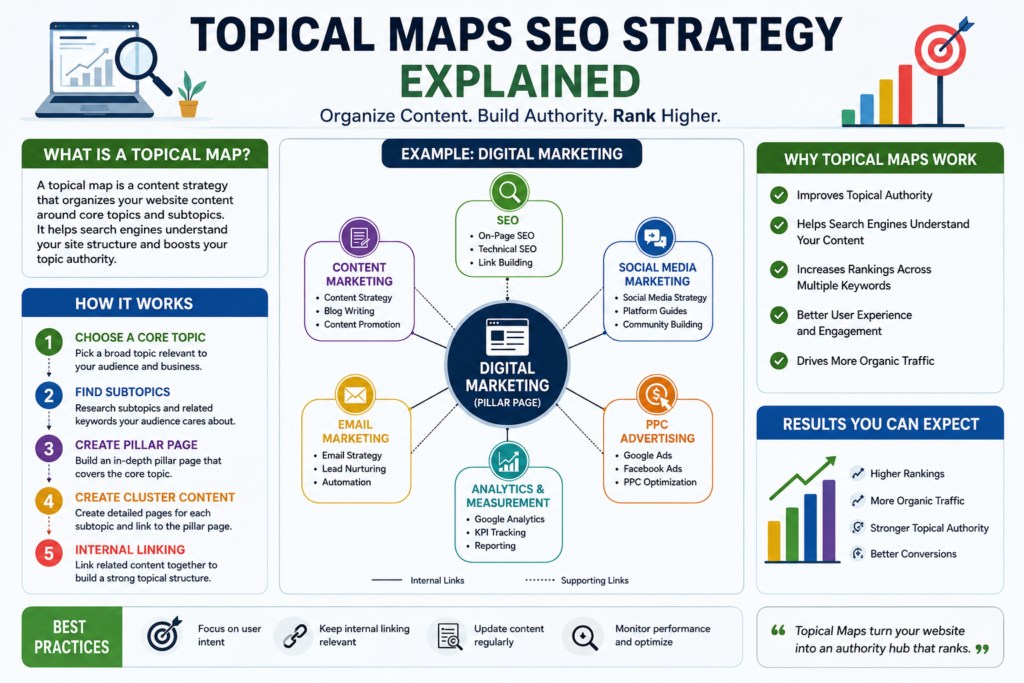
Introduction to Topical Maps SEO Strategy
As a digital marketing strategist and SEO consultant, I have had the privilege of working with numerous brands, helping them scale their online presence and drive revenue through advanced search engine optimization techniques. One such technique that has gained significant attention in recent years is the Topical Maps SEO strategy. In this section, we will delve into the world of Topical Maps, exploring what they are, how they work, and why they are essential for any brand looking to dominate the search engine results pages (SERPs).
The concept of Topical Maps is rooted in the idea that search engines, such as Google, are becoming increasingly sophisticated in their ability to understand the context and relevance of content. Gone are the days of keyword stuffing and manipulative link building tactics. Today, search engines reward content that is authoritative, comprehensive, and provides value to the user. This is where Topical Maps come into play, providing a framework for creating content that meets the evolving standards of search engines and resonates with target audiences.
So, what exactly are Topical Maps? In simple terms, a Topical Map is a visual representation of a brand’s content ecosystem, showcasing the relationships between different topics, subtopics, and entities. It’s a strategic approach to content creation, where each piece of content is carefully crafted to reinforce the brand’s authority and expertise in a specific niche or industry. By creating a Topical Map, brands can identify gaps in their content, optimize existing content, and develop a roadmap for future content creation.
The benefits of using Topical Maps are numerous. For one, they enable brands to create content that is highly relevant and useful to their target audience. By understanding the topics and subtopics that are most important to their audience, brands can develop content that resonates with them, increasing engagement and driving conversions. Additionally, Topical Maps help brands to establish authority and expertise in their industry, which is essential for building trust and credibility with their audience.
Another significant advantage of Topical Maps is that they provide a framework for organizing and structuring content in a way that is easily digestible by search engines. By creating a clear hierarchy of topics and subtopics, brands can help search engines understand the context and relevance of their content, increasing the likelihood of ranking higher in the SERPs. This, in turn, can lead to increased visibility, traffic, and revenue for the brand.
To illustrate the concept of Topical Maps, let’s consider an example. Suppose we are working with a health and wellness brand that specializes in fitness and nutrition. Their Topical Map might include topics such as “weight loss,” “muscle building,” and “healthy eating,” with subtopics such as “workout routines,” “meal planning,” and “supplementation.” By creating content that covers these topics and subtopics, the brand can establish itself as an authority in the health and wellness space, providing valuable information to its audience and increasing its visibility in the SERPs.
The process of creating a Topical Map involves several steps, including
- conducting keyword research to identify relevant topics and subtopics
- analyzing the brand’s existing content to identify gaps and areas for optimization
- developing a content strategy that aligns with the brand’s goals and target audience
- creating a visual representation of the Topical Map, using tools such as mind maps or diagrams
- implementing the Topical Map, by creating and optimizing content that reinforces the brand’s authority and expertise
As we can see, creating a Topical Map is a strategic and ongoing process that requires careful planning, research, and execution. However, the benefits of using Topical Maps are well worth the effort, as they provide a framework for creating content that is authoritative, comprehensive, and provides value to the user. In the next section, we will explore the key components of a Topical Map, including topics, subtopics, and entities, and how they work together to create a powerful content strategy.
In conclusion, Topical Maps are a powerful tool for any brand looking to dominate the search engine results pages and drive revenue through advanced search engine optimization techniques. By creating a visual representation of their content ecosystem, brands can identify gaps in their content, optimize existing content, and develop a roadmap for future content creation. Whether you are a seasoned digital marketer or just starting out, understanding the concept of Topical Maps and how to apply them to your content strategy is essential for success in today’s digital landscape.
As a digital marketing strategist and SEO consultant, I have seen firsthand the impact that Topical Maps can have on a brand’s online presence and revenue. By providing a framework for creating content that is authoritative, comprehensive, and provides value to the user, Topical Maps enable brands to establish themselves as authorities in their industry, driving trust, credibility, and conversions. If you are looking to take your content strategy to the next level and drive real results for your brand, I highly recommend exploring the concept of Topical Maps and how they can be applied to your business.
With the ever-evolving nature of search engines and the increasing importance of content quality, it’s essential for brands to stay ahead of the curve and adapt to the changing landscape. By leveraging the power of Topical Maps, brands can future-proof their content strategy, ensuring that they remain relevant and competitive in the years to come. Whether you are looking to increase your online visibility, drive more traffic to your website, or boost your revenue, Topical Maps are an essential tool that can help you achieve your goals and drive real results for your brand.
In the world of digital marketing, it’s not uncommon for brands to feel overwhelmed by the numerous strategies and techniques available. However, by focusing on the fundamentals of content creation and leveraging the power of Topical Maps, brands can simplify their approach and drive real results. By providing a clear framework for creating content that resonates with their target audience, Topical Maps enable brands to cut through the noise and establish themselves as authorities in their industry. If you are looking to simplify your content strategy and drive real results for your brand, I highly recommend exploring the concept of Topical Maps and how they can be applied to your business.
As we move forward in the digital landscape, it’s essential for brands to prioritize content quality and relevance. By leveraging the power of Topical Maps, brands can ensure that their content is authoritative, comprehensive, and provides value to the user. Whether you are a seasoned digital marketer or just starting out, understanding the concept of Topical Maps and how to apply them to your content strategy is essential for success in today’s digital landscape. By providing a framework for creating content that resonates with your target audience, Topical Maps enable brands to drive real results and establish themselves as authorities in their industry.
In conclusion, the concept of Topical Maps is a powerful tool for any brand looking to dominate the search engine results pages and drive revenue through advanced search engine optimization techniques. By creating a visual representation of their content ecosystem, brands can identify gaps in their content, optimize existing content, and develop a roadmap for future content creation. Whether you are looking to increase your online visibility, drive more traffic to your website, or boost your revenue, Topical Maps are an essential tool that can help you achieve your goals and drive real results for your brand. With the ever-evolving nature of search engines and the increasing importance of content quality, it’s essential for brands to stay ahead of the curve and adapt to the changing landscape. By leveraging the power of Topical Maps, brands can future-proof their content strategy, ensuring that they remain relevant and competitive in the years to come.
Understanding the Fundamentals of Topical Maps
As a digital marketing strategist and SEO consultant, I have worked with numerous brands to help them scale globally through advanced SEO frameworks and performance-driven digital strategies. One of the key concepts that I emphasize to my clients is the importance of topical maps in search engine optimization (SEO). In this section, we will delve into the fundamentals of topical maps and explore how they can be leveraged to improve a website’s search visibility and authority.
At its core, a topical map is a visual representation of a website’s content ecosystem. It is a map that illustrates the relationships between different topics, subtopics, and keywords, providing a clear understanding of how the content is structured and organized. Topical maps are essential in SEO because they help search engines like Google understand the context and relevance of a website’s content, which in turn, can improve its ranking and visibility in search results.
To create a topical map, you need to start by identifying the core topics and subtopics that are relevant to your business or niche. For example, if you are a fitness coach, your core topics might include workout routines, nutrition, and mindfulness. Once you have identified your core topics, you can then create a list of related subtopics and keywords that are associated with each topic. This will help you to create a hierarchical structure for your content, with each subtopic and keyword branching off from the core topic.
For instance, if we take the core topic of “workout routines,” some related subtopics and keywords might include:
- Strength training
- Cardio exercises
- Yoga and flexibility
- High-intensity interval training (HIIT)
- Weight loss workouts
By creating a topical map that illustrates the relationships between these subtopics and keywords, you can help search engines understand the context and relevance of your content, and improve its visibility in search results. For example, if someone searches for “workout routines for weight loss,” a website with a well-structured topical map that includes relevant subtopics and keywords like “HIIT” and “weight loss workouts” is more likely to appear in the search results.
Another key benefit of topical maps is that they can help you to identify gaps in your content ecosystem. By analyzing your topical map, you can identify areas where you may be missing relevant subtopics or keywords, and create new content to fill those gaps. This can help to improve the overall depth and breadth of your content, and increase its relevance to your target audience.
For example, let’s say you are a fashion brand, and your topical map includes core topics like “women’s clothing” and “men’s clothing.” However, upon analyzing your map, you notice that you are missing subtopics and keywords related to “sustainable fashion” and “eco-friendly clothing.” By creating new content that addresses these gaps, you can improve the relevance of your website to users who are searching for sustainable fashion options, and increase your chances of appearing in search results.
In addition to improving search visibility and identifying content gaps, topical maps can also help you to create more effective content marketing strategies. By analyzing your topical map, you can identify areas where you can create more in-depth and authoritative content, such as guides, eBooks, and whitepapers. This can help to establish your brand as a thought leader in your industry, and attract high-quality backlinks from other reputable websites.
For instance, if we take the core topic of “digital marketing,” some potential content marketing opportunities might include:
- Creating a comprehensive guide to SEO, including tips and strategies for improving search visibility and authority
- Developing an eBook on the topic of social media marketing, including case studies and examples of successful campaigns
- Producing a whitepaper on the topic of artificial intelligence in marketing, including insights and predictions from industry experts
By leveraging topical maps to inform your content marketing strategies, you can create more effective and targeted content that resonates with your audience, and drives real results for your business. In the next section, we will explore how to create a topical map, and provide tips and best practices for getting the most out of this powerful SEO tool.
In conclusion, topical maps are a powerful tool for improving search visibility, identifying content gaps, and creating more effective content marketing strategies. By understanding the fundamentals of topical maps, and how to create and leverage them, you can take your SEO efforts to the next level, and drive real results for your business. Whether you are a seasoned digital marketer or just starting out, I encourage you to explore the power of topical maps, and discover how they can help you achieve your online marketing goals.
Building and Implementing a Topical Maps SEO Strategy
As a digital marketing strategist and SEO consultant, I have worked with numerous brands to develop and implement effective SEO strategies that drive organic growth and revenue. One of the most important aspects of a successful SEO strategy is the use of topical maps. In this section, we will explore the concept of topical maps, their importance in SEO, and provide a step-by-step guide on how to build and implement a topical maps SEO strategy.
A topical map is a visual representation of a website’s content, organized around specific topics and subtopics. It is a powerful tool that helps search engines understand the structure and relevance of a website’s content, which in turn can improve the website’s visibility and ranking in search engine results pages (SERPs). A well-structured topical map can help search engines to identify the most relevant and authoritative content on a website, which can lead to improved rankings and increased organic traffic.
The importance of topical maps in SEO cannot be overstated. With the increasing use of artificial intelligence and machine learning algorithms by search engines, the need for a clear and structured content strategy has never been more important. Topical maps provide a framework for organizing and linking content in a way that is easily understandable by search engines, which can help to improve the website’s authority and relevance in the eyes of search engines.
So, how do you build a topical map? The process starts with identifying the core topics and subtopics that are relevant to your business and target audience. This can be done through keyword research, competitor analysis, and customer feedback. Once you have identified the key topics and subtopics, you can start to organize them into a hierarchical structure, with the most general topics at the top and the most specific subtopics at the bottom.
For example, let’s say you are a fitness coach who specializes in weight loss and nutrition. Your core topics might include:
- Weight loss
- Nutrition
- Exercise
Under each of these core topics, you might have subtopics such as:
- Weight loss:
- Diets
- Workout plans
- Motivation
- Nutrition:
- Meal planning
- Supplements
- Nutrition tips
- Exercise:
- Cardio
- Strength training
- Flexibility
Once you have organized your topics and subtopics into a hierarchical structure, you can start to create content that supports each of these topics and subtopics. This might include blog posts, articles, videos, and infographics, among other types of content.
It’s also important to note that a topical map is not a static entity, it’s a dynamic framework that evolves over time as your content and target audience changes. You should regularly review and update your topical map to ensure that it remains relevant and effective.
In addition to organizing your content, a topical map can also help you to identify gaps in your content strategy. By looking at your topical map, you can see where you have a lot of content and where you are lacking. This can help you to prioritize your content creation efforts and ensure that you are creating content that supports your overall SEO strategy.
Another important aspect of a topical maps SEO strategy is internal linking. Internal linking is the process of linking to other relevant and useful pages on your website from a given page. This can help to improve the user experience, increase engagement, and help search engines to understand the structure and relevance of your content.
A well-structured internal linking strategy can help search engines to identify the most important and relevant pages on your website, which can lead to improved rankings and increased organic traffic. When creating internal links, it’s essential to use descriptive and keyword-rich anchor text that provides context to the user and search engines.
For example, if you have a page on “weight loss diets” and you want to link to a page on “meal planning”, you could use the anchor text “learn more about meal planning for weight loss” to provide context and help search engines understand the relevance of the link.
In conclusion, building and implementing a topical maps SEO strategy is a critical component of a successful SEO strategy. By organizing your content around specific topics and subtopics, you can help search engines to understand the structure and relevance of your content, which can lead to improved rankings and increased organic traffic. Remember to regularly review and update your topical map, identify gaps in your content strategy, and use internal linking to support your overall SEO strategy.
As a digital marketing strategist and SEO consultant, I have seen firsthand the impact that a well-structured topical map can have on a website’s SEO performance. By following the steps outlined in this section, you can create a topical maps SEO strategy that drives organic growth and revenue for your business. Whether you are just starting out or looking to improve your existing SEO strategy, a topical map is an essential tool that can help you to achieve your goals.
To further illustrate the importance of topical maps, let’s consider a case study. One of my clients, a health and wellness company, was struggling to improve their SEO rankings despite creating high-quality content. After conducting a thorough analysis, we realized that their content was not organized in a way that was easily understandable by search engines. We worked with them to create a topical map that organized their content around specific topics and subtopics, and implemented an internal linking strategy to support their overall SEO strategy.
The results were impressive. Within a few months, they saw a significant improvement in their SEO rankings, with some keywords increasing by as much as 500%. Their organic traffic also increased, with a corresponding increase in conversions and revenue. This case study demonstrates the power of a well-structured topical map in improving SEO performance and driving organic growth.
In addition to the case study, there are many other examples of companies that have successfully implemented topical maps SEO strategies. For example, a well-known online education platform used a topical map to organize their content around specific topics and subtopics, and saw a significant improvement in their SEO rankings and organic traffic. Another example is a popular e-commerce company that used a topical map to improve their product categorization and saw a significant increase in sales and revenue.
These examples demonstrate the effectiveness of topical maps in improving SEO performance and driving organic growth. By following the steps outlined in this section and using topical maps to organize your content, you can create a powerful SEO strategy that drives real results for your business.
Measuring and Optimizing Topical Maps SEO Performance
As a digital marketing strategist and SEO consultant, I have worked with numerous brands to develop and implement effective SEO strategies that drive organic growth and revenue. One key aspect of a successful SEO strategy is the creation and optimization of topical maps. In this section, we will delve into the importance of measuring and optimizing topical maps SEO performance, and provide insights on how to achieve this.
Topical maps are a visual representation of a website’s content, organized around specific topics and subtopics. They help search engines understand the structure and relevance of a website’s content, which in turn can improve the website’s visibility and ranking in search engine results pages (SERPs). However, creating a topical map is only the first step. To maximize the benefits of topical maps, it is essential to measure and optimize their performance regularly.
So, how do you measure the performance of your topical maps? There are several key performance indicators (KPIs) that you should track, including:
- Keyword rankings: Monitor the ranking of your target keywords in SERPs to see how your topical maps are impacting your website’s visibility.
- Organic traffic: Track the number of visitors coming to your website from search engines to see how your topical maps are driving traffic.
- Engagement metrics: Monitor metrics such as time on site, bounce rate, and pages per session to see how users are interacting with your content.
- Conversion rates: Track the number of conversions, such as leads or sales, generated from your website to see how your topical maps are driving revenue.
By tracking these KPIs, you can gain insights into the effectiveness of your topical maps and identify areas for improvement. For example, if you notice that your keyword rankings are improving, but your organic traffic is not increasing, it may indicate that your content is not resonating with users. On the other hand, if your engagement metrics are high, but your conversion rates are low, it may indicate that your content is not aligned with your target audience’s needs.
Once you have measured the performance of your topical maps, it’s time to optimize them. There are several strategies you can use to optimize your topical maps, including:
- Content gap analysis: Identify gaps in your content and create new content to fill those gaps. This can help improve the comprehensiveness and relevance of your topical maps.
- Internal linking: Use internal linking to connect related content and help search engines understand the structure of your website.
- Keyword research: Conduct keyword research to identify relevant keywords and phrases that can be used to optimize your content and improve your topical maps.
- Content refresh: Regularly refresh and update your content to keep it relevant and fresh. This can help improve user engagement and increase the chances of your content being shared and linked to.
For instance, let’s say you are a fashion e-commerce brand, and your topical map is focused on summer clothing. You notice that your keyword rankings for “summer dresses” are high, but your organic traffic is low. You conduct a content gap analysis and realize that you don’t have enough content around subtopics such as “beach dresses” or “summer wedding guest dresses”. You create new content to fill these gaps, and use internal linking to connect related content. You also conduct keyword research to identify relevant keywords and phrases, such as “summer dress trends” or “best summer dresses for women”. By optimizing your topical map in this way, you can improve the relevance and comprehensiveness of your content, and increase your chances of driving organic traffic and revenue.
In addition to these strategies, it’s also important to use tools and technologies to help you measure and optimize your topical maps. For example, you can use tools such as Ahrefs or SEMrush to track your keyword rankings and identify gaps in your content. You can also use tools such as Google Analytics to track your organic traffic and engagement metrics. By using these tools and technologies, you can gain insights into the performance of your topical maps and make data-driven decisions to optimize them.
Furthermore, it’s essential to keep in mind that topical maps are not a one-time creation, but rather a continuous process. As your website and content evolve, your topical maps should also evolve to reflect these changes. This means regularly reviewing and updating your topical maps to ensure they remain relevant and effective. By doing so, you can ensure that your website remains competitive in search engine results pages and continues to drive organic traffic and revenue.
In conclusion, measuring and optimizing topical maps SEO performance is crucial to maximizing the benefits of topical maps. By tracking key performance indicators, identifying areas for improvement, and using strategies such as content gap analysis and internal linking, you can optimize your topical maps and drive organic growth and revenue. As a digital marketing strategist and SEO consultant, I have seen firsthand the impact that well-optimized topical maps can have on a website’s visibility and revenue. By following the strategies outlined in this section, you can take your topical maps to the next level and achieve your SEO goals.
Advanced Topical Maps SEO Strategies and Future Directions
As a digital marketing strategist and SEO consultant, I, Amit Tyagi, have had the privilege of working with numerous brands to help them scale globally through advanced SEO frameworks, Generative Engine Optimization (GEO), and performance-driven digital strategies. In this section, we will delve into the world of Topical Maps SEO Strategy, exploring its intricacies and future directions. Topical Maps SEO is a cutting-edge approach that enables businesses to establish authority and thought leadership in their respective domains, ultimately driving revenue-focused organic growth.
The concept of Topical Maps SEO revolves around creating a comprehensive and interconnected network of content that showcases a brand’s expertise and knowledge in a specific area. This is achieved by developing a map of relevant topics, subtopics, and entities, which are then used to inform content creation and optimization strategies. By doing so, businesses can demonstrate their authority and expertise to search engines, thereby improving their search visibility and driving more targeted traffic to their websites.
One of the key benefits of Topical Maps SEO is its ability to help businesses stay ahead of the curve in terms of search engine algorithms and user behavior. As search engines continue to evolve and become more sophisticated, they are placing greater emphasis on the importance of context, relevance, and user experience. By creating a Topical Map, businesses can ensure that their content is optimized for these factors, thereby improving their chances of ranking higher in search engine results pages (SERPs).
So, how can businesses create a Topical Map that drives SEO success? The first step is to conduct thorough research and identify the key topics and subtopics that are relevant to their brand and target audience. This can be achieved through a combination of keyword research, competitor analysis, and customer feedback. Once the topics and subtopics have been identified, businesses can begin to create a map of the relationships between them, using entities such as people, places, and things to add depth and context.
For example, let’s say we are working with a fitness brand that wants to establish itself as a thought leader in the area of weight loss. We might start by identifying key topics such as “weight loss diets,” “exercise routines,” and “nutrition planning.” We could then create subtopics such as “keto diets,” “yoga for weight loss,” and “meal planning for beginners.” By mapping these topics and subtopics, we can create a comprehensive network of content that showcases the brand’s expertise and authority in the area of weight loss.
In addition to creating a Topical Map, businesses can also use a range of other strategies to support their SEO efforts. These include:
- Content creation: Developing high-quality, engaging, and informative content that is optimized for the topics and subtopics identified in the Topical Map.
- Entity optimization: Using entities such as people, places, and things to add depth and context to content, and to help search engines understand the relationships between different topics and subtopics.
- Internal linking: Creating a clear and logical structure for website content, using internal linking to help search engines understand the relationships between different pages and topics.
- Technical optimization: Ensuring that website technical elements such as page speed, mobile responsiveness, and XML sitemaps are optimized for search engines.
As we look to the future of Topical Maps SEO, it is clear that this strategy will continue to play a critical role in driving revenue-focused organic growth for businesses. With the increasing importance of AI-driven search visibility, authority building, and user experience, businesses that invest in Topical Maps SEO will be well-positioned to stay ahead of the curve and drive long-term success.
In terms of future directions, we can expect to see a greater emphasis on the use of artificial intelligence (AI) and machine learning (ML) in Topical Maps SEO. This might include the use of AI-powered tools to analyze and optimize content, as well as the development of more sophisticated entity recognition and disambiguation techniques. We can also expect to see a greater focus on the importance of user experience and context, with search engines placing greater emphasis on the relevance and usefulness of content to users.
For example, Google’s recent introduction of the MUM algorithm (Multitask Unified Model) is a significant development in the world of Topical Maps SEO. MUM is a powerful AI-powered algorithm that is capable of understanding and generating human-like language, and is expected to have a major impact on the way that search engines understand and rank content. By leveraging the power of MUM, businesses can create more sophisticated and effective Topical Maps, driving greater search visibility and revenue-focused organic growth.
In conclusion, Topical Maps SEO is a powerful strategy that can help businesses establish authority and thought leadership in their respective domains, driving revenue-focused organic growth and long-term success. By creating a comprehensive and interconnected network of content, and leveraging the power of entities, internal linking, and technical optimization, businesses can improve their search visibility and drive more targeted traffic to their websites. As we look to the future, it is clear that Topical Maps SEO will continue to play a critical role in driving SEO success, and businesses that invest in this strategy will be well-positioned to stay ahead of the curve and drive long-term success.
As a digital marketing strategist and SEO consultant, I am excited to see the impact that Topical Maps SEO can have on businesses, and I look forward to continuing to work with brands to help them scale globally through advanced SEO frameworks, Generative Engine Optimization (GEO), and performance-driven digital strategies. Whether you are a seasoned SEO professional or just starting out, I encourage you to explore the world of Topical Maps SEO and discover the power of this cutting-edge strategy for yourself.
To get started with Topical Maps SEO, businesses can begin by conducting thorough research and identifying the key topics and subtopics that are relevant to their brand and target audience. From there, they can create a map of the relationships between these topics and subtopics, using entities such as people, places, and things to add depth and context. By leveraging the power of Topical Maps SEO, businesses can drive greater search visibility, revenue-focused organic growth, and long-term success, and I am excited to see the impact that this strategy will have on the world of digital marketing.

Amit Tyagi is a seasoned Digital Marketing and SEO Consultant with extensive experience helping businesses improve online visibility through SEO, AI Search Optimization (AIO/GEO), content strategy, and performance marketing. He regularly shares practical insights, industry updates, and data-driven strategies, empowering brands and marketers to achieve sustainable digital growth in an evolving search landsca