
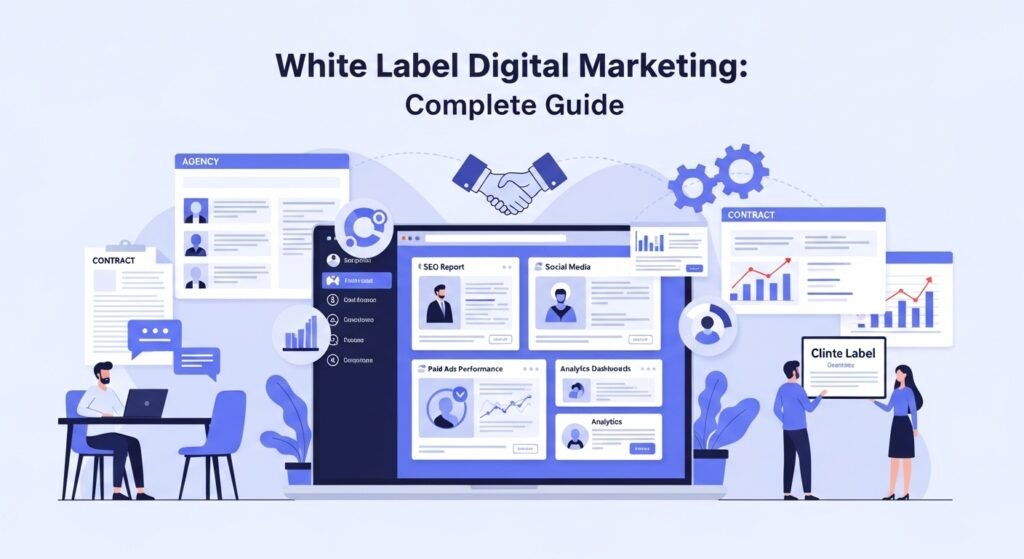
Introduction to White Label Digital Marketing
As a digital marketing strategist and SEO consultant, I have witnessed the evolution of the industry over the past 15 years. One concept that has gained significant traction in recent years is white label digital marketing. In this section, we will delve into the world of white label digital marketing, exploring its definition, benefits, and applications. By the end of this guide, you will have a comprehensive understanding of how white label digital marketing can help your business thrive in the competitive online landscape.
White label digital marketing refers to the practice of providing digital marketing services under another company’s brand name. This approach allows businesses to offer a wide range of digital marketing services to their clients without having to invest in the necessary infrastructure, expertise, or resources. In other words, a white label digital marketing agency provides the services, while the partner company resells them under their own brand, often with their own pricing and packaging.
The concept of white labeling is not new and has been widely used in various industries, such as software development, manufacturing, and even food production. However, its application in digital marketing has opened up new avenues for businesses to expand their service offerings and increase revenue streams. By leveraging the expertise of a white label digital marketing agency, companies can focus on their core competencies while still providing their clients with a comprehensive suite of digital marketing services.
For instance, a web design firm may not have the in-house expertise to provide search engine optimization (SEO) services to its clients. By partnering with a white label digital marketing agency, the web design firm can offer SEO services to its clients under its own brand, without having to hire and train additional staff. This approach not only enhances the web design firm’s service offerings but also increases its revenue potential.
The benefits of white label digital marketing are numerous. Some of the key advantages include:
- Cost savings: By outsourcing digital marketing services to a white label agency, businesses can avoid the costs associated with hiring and training in-house staff, investing in infrastructure, and developing the necessary expertise.
- Increased revenue streams: White label digital marketing allows businesses to offer a wider range of services to their clients, resulting in increased revenue streams and improved customer retention.
- Enhanced service offerings: By partnering with a white label digital marketing agency, businesses can provide their clients with a comprehensive suite of digital marketing services, enhancing their overall service offerings and competitiveness.
- Improved customer satisfaction: White label digital marketing enables businesses to provide their clients with high-quality digital marketing services, resulting in improved customer satisfaction and loyalty.
- Scalability: White label digital marketing agencies can handle large volumes of work, making it easier for businesses to scale their operations and meet growing demand.
Another significant advantage of white label digital marketing is its ability to help businesses establish themselves as authorities in their industry. By providing high-quality digital marketing services under their own brand, companies can demonstrate their expertise and build trust with their clients. This, in turn, can lead to increased brand loyalty, improved customer retention, and ultimately, revenue growth.
For example, a digital marketing agency may partner with a white label SEO agency to provide its clients with high-quality SEO services. By offering these services under its own brand, the digital marketing agency can establish itself as an authority in the SEO space, attracting new clients and increasing its revenue streams. The white label SEO agency, on the other hand, can focus on providing high-quality SEO services, without having to worry about marketing and sales.
In conclusion, white label digital marketing has revolutionized the way businesses approach digital marketing. By providing a cost-effective and efficient way to offer a wide range of digital marketing services, white label digital marketing agencies have made it possible for companies to expand their service offerings, increase revenue streams, and establish themselves as authorities in their industry. In the next section, we will explore the different types of white label digital marketing services and their applications in more detail.
Understanding the White Label Digital Marketing Process
As a digital marketing strategist and SEO consultant, I have worked with numerous businesses and agencies, helping them scale their online presence and drive revenue through advanced digital marketing strategies. One of the most effective ways to achieve this is by leveraging white label digital marketing services. In this section, we will delve into the intricacies of the white label digital marketing process, exploring its benefits, applications, and how it can be a game-changer for your business.
The white label digital marketing process involves a service provider offering digital marketing services to a client, who then rebrands and resells these services to their own customers. This process enables businesses to expand their service offerings, enhance their brand reputation, and increase revenue without having to invest in the development of new skills or infrastructure. The service provider, on the other hand, benefits from the increased demand for their services and the opportunity to partner with a larger client base.
For instance, a web design agency may not have the in-house expertise to offer SEO services to their clients. By partnering with a white label digital marketing provider, they can offer a comprehensive range of services, including SEO, social media management, and content creation, under their own brand name. This not only enhances their service offerings but also enables them to compete more effectively with larger agencies.
The white label digital marketing process typically involves the following steps:
- Service provision: The service provider offers a range of digital marketing services, including SEO, social media management, content creation, and paid advertising.
- Rebranding: The client rebrands the services under their own name, creating a seamless experience for their customers.
- Resale: The client resells the rebranded services to their customers, often at a markup, enabling them to generate additional revenue streams.
- Support and maintenance: The service provider offers ongoing support and maintenance to ensure the services continue to meet the client’s needs and those of their customers.
The benefits of white label digital marketing are numerous. For businesses, it provides an opportunity to expand their service offerings, enhance their brand reputation, and increase revenue without having to invest in the development of new skills or infrastructure. For service providers, it enables them to partner with a larger client base, increase demand for their services, and generate additional revenue streams.
For example, a digital marketing agency may partner with a white label service provider to offer SEO services to their clients. The agency can then focus on their core competencies, such as web design and development, while the service provider handles the SEO aspects. This partnership enables the agency to offer a more comprehensive range of services, enhancing their brand reputation and increasing revenue.
In addition to the benefits, there are also some potential drawbacks to consider. For instance, businesses must ensure that the white label services they offer are of high quality and align with their brand values. They must also be transparent with their customers about the services they offer and the partners they work with. Failure to do so can damage their reputation and erode customer trust.
Another important consideration is the level of control and customization offered by the white label service provider. Businesses must ensure that they have the flexibility to customize the services to meet the unique needs of their customers and to align with their brand identity. This may involve working closely with the service provider to develop tailored solutions that meet specific requirements.
Furthermore, businesses must also consider the potential risks associated with white label digital marketing. For instance, if the service provider experiences technical difficulties or fails to deliver high-quality services, it can reflect poorly on the business and damage their reputation. To mitigate these risks, businesses must conduct thorough research and due diligence when selecting a white label service provider, ensuring that they have a proven track record of delivering high-quality services and supporting their partners.
In conclusion, the white label digital marketing process offers a range of benefits for businesses and service providers alike. By understanding the process, its applications, and potential drawbacks, businesses can make informed decisions about whether to leverage white label services and how to integrate them into their overall marketing strategy. As a digital marketing strategist and SEO consultant, I have seen firsthand the impact that white label digital marketing can have on a business’s bottom line, and I believe that it is an essential component of any comprehensive digital marketing strategy.
By partnering with a reputable white label service provider, businesses can expand their service offerings, enhance their brand reputation, and increase revenue without having to invest in the development of new skills or infrastructure. Whether you are a digital marketing agency, a web design firm, or a business looking to enhance your online presence, white label digital marketing is definitely worth considering. With its numerous benefits, flexibility, and potential for growth, it is an essential tool for any business looking to succeed in the competitive digital landscape.
Key Services Offered in White Label Digital Marketing
As a digital marketing strategist and SEO consultant, I have worked with numerous brands and agencies, helping them scale their online presence through white label digital marketing services. In this section, we will delve into the key services offered in white label digital marketing, exploring the benefits and advantages of each service, along with real-world examples and explanations.
White label digital marketing refers to the practice of providing digital marketing services under another company’s brand name. This approach allows agencies and brands to offer a wide range of digital marketing services to their clients without having to invest in the necessary infrastructure, technology, and expertise. By partnering with a white label digital marketing provider, businesses can expand their service offerings, increase revenue, and improve client satisfaction.
Some of the key services offered in white label digital marketing include search engine optimization (SEO), pay-per-click (PPC) advertising, social media marketing, content creation, email marketing, and web design and development. These services are designed to help businesses improve their online visibility, drive more traffic and sales, and build a strong brand presence.
Let’s take a closer look at each of these services and how they can benefit businesses. For instance, SEO is a critical component of any digital marketing strategy, as it helps businesses rank higher in search engine results pages (SERPs) and drive more organic traffic to their website. A white label SEO provider can offer a range of services, including keyword research, on-page optimization, link building, and technical SEO. By outsourcing SEO services to a white label provider, businesses can improve their search engine rankings, increase website traffic, and drive more sales.
Another key service offered in white label digital marketing is PPC advertising. PPC advertising allows businesses to create targeted ads that appear in search engine results pages and other online platforms, helping them reach their target audience and drive more conversions. A white label PPC provider can help businesses create and manage their PPC campaigns, including keyword research, ad copywriting, bid management, and campaign optimization. By outsourcing PPC services to a white label provider, businesses can improve their ad visibility, increase conversions, and drive more revenue.
In addition to SEO and PPC, social media marketing is another important service offered in white label digital marketing. Social media marketing involves creating and implementing a social media strategy that helps businesses build a strong brand presence, engage with their target audience, and drive more website traffic and sales. A white label social media provider can offer a range of services, including social media profile creation, content creation, social media advertising, and social media management. By outsourcing social media services to a white label provider, businesses can improve their social media presence, increase engagement, and drive more sales.
Other key services offered in white label digital marketing include content creation, email marketing, and web design and development. Content creation involves creating high-quality, engaging content that helps businesses attract and retain their target audience. Email marketing involves creating and implementing email campaigns that help businesses nurture their leads and drive more conversions. Web design and development involves creating a website that is visually appealing, user-friendly, and optimized for search engines. By outsourcing these services to a white label provider, businesses can improve their online presence, increase engagement, and drive more sales.
Some of the benefits of white label digital marketing services include:
- Increased revenue: By offering a wide range of digital marketing services, businesses can increase their revenue and improve their bottom line.
- Improved client satisfaction: White label digital marketing services allow businesses to offer their clients a wide range of services, improving client satisfaction and reducing churn.
- Cost savings: By outsourcing digital marketing services to a white label provider, businesses can save money on infrastructure, technology, and personnel costs.
- Access to expertise: White label digital marketing providers have the necessary expertise and experience to deliver high-quality digital marketing services, helping businesses improve their online presence and drive more sales.
- Flexibility and scalability: White label digital marketing services can be scaled up or down to meet the needs of businesses, making it easy to adapt to changing market conditions.
In conclusion, white label digital marketing services offer a wide range of benefits and advantages for businesses looking to improve their online presence and drive more sales. By outsourcing digital marketing services to a white label provider, businesses can increase revenue, improve client satisfaction, save money, access expertise, and improve their flexibility and scalability. Whether you’re looking to improve your search engine rankings, drive more conversions, or build a strong brand presence, white label digital marketing services can help you achieve your goals.
For example, let’s say you’re a digital marketing agency that wants to offer SEO services to your clients. By partnering with a white label SEO provider, you can offer high-quality SEO services to your clients without having to invest in the necessary infrastructure and expertise. This can help you increase revenue, improve client satisfaction, and reduce churn. Similarly, if you’re an e-commerce business that wants to improve your social media presence, you can partner with a white label social media provider to create and implement a social media strategy that helps you build a strong brand presence and drive more sales.
As a digital marketing strategist and SEO consultant, I have seen firsthand the benefits of white label digital marketing services. By partnering with a white label provider, businesses can access the necessary expertise and technology to deliver high-quality digital marketing services, improving their online presence and driving more sales. Whether you’re looking to improve your search engine rankings, drive more conversions, or build a strong brand presence, white label digital marketing services can help you achieve your goals.
Best Practices for Choosing a White Label Digital Marketing Partner
As a digital marketing strategist and SEO consultant, I have worked with numerous brands and agencies, helping them scale their online presence and drive revenue through advanced SEO frameworks and performance-driven digital strategies. One crucial aspect of achieving success in the digital landscape is choosing the right white label digital marketing partner. In this section, we will delve into the best practices for selecting a reliable and efficient white label digital marketing partner, exploring the key factors to consider, and providing examples and explanations to guide you through the process.
When it comes to white label digital marketing, the primary goal is to find a partner that can seamlessly integrate with your existing infrastructure, providing high-quality services that align with your brand’s vision and objectives. A white label digital marketing partner can offer a range of services, including SEO, pay-per-click advertising, social media management, content creation, and more. However, with so many options available, it can be overwhelming to choose the right partner. By following the best practices outlined below, you can ensure that you find a reliable and efficient white label digital marketing partner that meets your needs and drives results.
The first step in choosing a white label digital marketing partner is to define your goals and objectives. What do you want to achieve through your digital marketing efforts? Are you looking to increase brand awareness, drive website traffic, generate leads, or boost sales? Once you have a clear understanding of your goals, you can begin to evaluate potential partners based on their ability to help you achieve those objectives. For example, if you are looking to improve your search engine rankings, you may want to partner with a white label digital marketing agency that specializes in SEO and has a proven track record of success in this area.
Another critical factor to consider when choosing a white label digital marketing partner is their level of expertise and experience. Look for a partner that has a deep understanding of the digital marketing landscape and has worked with clients in your industry or niche. A partner with extensive experience and expertise will be better equipped to develop and implement effective digital marketing strategies that drive results. For instance, if you are a healthcare company, you may want to partner with a white label digital marketing agency that has experience working with healthcare clients and understands the unique challenges and opportunities in this industry.
In addition to expertise and experience, it is essential to evaluate a potential white label digital marketing partner’s technological capabilities. What tools and platforms do they use to manage and optimize digital marketing campaigns? Do they have access to the latest technologies and trends, such as artificial intelligence and machine learning? A partner with advanced technological capabilities will be better positioned to drive innovation and stay ahead of the competition. For example, a white label digital marketing agency that uses AI-powered tools to optimize PPC campaigns can help you achieve better results and improve your return on investment.
When evaluating a potential white label digital marketing partner, it is also important to consider their communication and reporting processes. How will they keep you informed about the progress of your digital marketing campaigns? What kind of reporting and analytics will they provide, and how often? A partner that offers transparent and regular communication will be better able to build trust and ensure that your needs are being met. For instance, a white label digital marketing agency that provides monthly reports and regular check-ins can help you stay up-to-date on the performance of your campaigns and make data-driven decisions.
Furthermore, it is crucial to assess a potential white label digital marketing partner’s customer support and service. What kind of support will they offer, and how will they handle any issues or concerns that arise? A partner that provides excellent customer support and service will be better able to build a strong and lasting relationship with you and your team. For example, a white label digital marketing agency that offers 24/7 support and has a dedicated account manager can help you feel confident and supported throughout the partnership.
To help you get started, here are some key factors to consider when choosing a white label digital marketing partner:
- Experience and expertise: Look for a partner with extensive experience and expertise in digital marketing, particularly in your industry or niche.
- Technological capabilities: Evaluate a potential partner’s technological capabilities, including the tools and platforms they use to manage and optimize digital marketing campaigns.
- Communication and reporting processes: Consider a partner’s communication and reporting processes, including the frequency and transparency of their reporting and analytics.
- Customer support and service: Assess a potential partner’s customer support and service, including the level of support they offer and how they handle issues or concerns.
- Case studies and testimonials: Review a potential partner’s case studies and testimonials to get a sense of their track record of success and the quality of their work.
- Pricing and scalability: Evaluate a potential partner’s pricing model and scalability, including their ability to adapt to changing needs and budgets.
By following these best practices and considering these key factors, you can find a reliable and efficient white label digital marketing partner that meets your needs and drives results. Remember to define your goals and objectives, evaluate a potential partner’s expertise and experience, technological capabilities, communication and reporting processes, customer support and service, and pricing and scalability. With the right partner by your side, you can achieve success in the digital landscape and drive revenue-focused organic growth for your brand.
In conclusion, choosing the right white label digital marketing partner is a critical decision that can have a significant impact on your brand’s online presence and revenue. By taking the time to evaluate potential partners based on their expertise, technological capabilities, communication and reporting processes, customer support and service, and pricing and scalability, you can find a partner that aligns with your goals and objectives and drives results. As a digital marketing strategist and SEO consultant, I have seen firsthand the importance of finding the right partner, and I encourage you to take a thoughtful and strategic approach to this decision.
Measuring Success and ROI in White Label Digital Marketing
As a digital marketing strategist and SEO consultant, I have worked with numerous brands and agencies to help them scale their online presence and drive revenue growth through white label digital marketing. However, one of the most critical aspects of any digital marketing strategy is measuring its success and return on investment (ROI). In this section, we will delve into the importance of measuring success and ROI in white label digital marketing, and explore the various metrics and tools that can be used to achieve this.
Measuring success and ROI in white label digital marketing is crucial for several reasons. Firstly, it helps agencies and brands to understand the effectiveness of their digital marketing campaigns and identify areas for improvement. Secondly, it enables them to make data-driven decisions and allocate their resources more efficiently. Finally, it allows them to demonstrate the value of their digital marketing efforts to their clients and stakeholders, which is essential for building trust and credibility.
To measure success and ROI in white label digital marketing, agencies and brands need to track a range of metrics, including website traffic, engagement, conversions, and revenue. These metrics can be tracked using various tools, such as Google Analytics, SEO software, and social media analytics platforms. For example, Google Analytics can be used to track website traffic, bounce rates, and conversion rates, while SEO software can be used to track keyword rankings, backlinks, and technical SEO issues.
In addition to these metrics and tools, agencies and brands can also use key performance indicators (KPIs) to measure the success of their white label digital marketing campaigns. KPIs are quantifiable measures that are used to evaluate the performance of a particular campaign or strategy. Some common KPIs used in white label digital marketing include:
- Organic search traffic: This refers to the number of visitors who arrive at a website through organic search results.
- Conversion rate: This refers to the percentage of visitors who complete a desired action, such as filling out a form or making a purchase.
- Return on ad spend (ROAS): This refers to the revenue generated by a paid advertising campaign, divided by the cost of the campaign.
- Customer acquisition cost (CAC): This refers to the cost of acquiring a new customer, including the cost of marketing and sales efforts.
- Customer lifetime value (CLV): This refers to the total value of a customer over their lifetime, including repeat purchases and referrals.
For instance, let’s say a digital marketing agency is running a white label SEO campaign for an e-commerce brand. The agency can use KPIs such as organic search traffic, conversion rate, and ROAS to measure the success of the campaign. If the campaign is driving a significant amount of organic search traffic and conversions, but the ROAS is low, the agency may need to adjust its keyword targeting or ad copy to improve the campaign’s return on investment.
Another important aspect of measuring success and ROI in white label digital marketing is attribution modeling. Attribution modeling refers to the process of assigning credit to different touchpoints in a customer’s journey, from initial awareness to conversion. This can be challenging in white label digital marketing, as multiple agencies and brands may be involved in a single campaign. However, by using attribution modeling tools and techniques, such as multi-touch attribution and last-click attribution, agencies and brands can gain a better understanding of which channels and campaigns are driving the most value.
For example, a brand may be running a white label digital marketing campaign that includes social media advertising, email marketing, and SEO. By using attribution modeling, the brand can determine which channel is driving the most conversions and adjust its budget accordingly. If the brand finds that social media advertising is driving the most conversions, it may choose to allocate more budget to this channel and reduce its spend on email marketing.
In conclusion, measuring success and ROI in white label digital marketing is critical for agencies and brands that want to drive revenue growth and demonstrate the value of their digital marketing efforts. By tracking key metrics, using KPIs, and leveraging attribution modeling, agencies and brands can gain a deeper understanding of their digital marketing campaigns and make data-driven decisions to optimize their strategies. As a digital marketing strategist and SEO consultant, I have seen firsthand the impact that effective measurement and attribution can have on a brand’s bottom line, and I believe that it is essential for any brand that wants to succeed in the digital landscape.
To take it to the next level, agencies and brands can also use data visualization tools to present their data in a clear and concise manner. Data visualization tools, such as Tableau or Power BI, can be used to create interactive dashboards and reports that provide a real-time view of campaign performance. This can be particularly useful for brands that want to track their campaign performance on a daily or weekly basis, and make adjustments to their strategy accordingly.
Furthermore, agencies and brands can also use machine learning algorithms to analyze their data and identify patterns and trends. Machine learning algorithms, such as regression analysis or decision trees, can be used to predict customer behavior and identify opportunities for growth. For instance, a brand may use machine learning algorithms to analyze its customer data and identify which segments are most likely to convert. The brand can then use this information to tailor its marketing efforts and improve its overall ROI.
In addition to these tools and techniques, agencies and brands can also use benchmarking to measure the success of their white label digital marketing campaigns. Benchmarking involves comparing the performance of a campaign to a baseline or industry average. This can be useful for brands that want to understand how their campaign is performing relative to their competitors, and identify areas for improvement. For example, a brand may use benchmarking to compare its organic search traffic to that of its competitors, and identify opportunities to improve its SEO strategy.
Finally, agencies and brands can also use customer feedback to measure the success of their white label digital marketing campaigns. Customer feedback can be collected through surveys, focus groups, or social media listening, and can provide valuable insights into customer behavior and preferences. For instance, a brand may use customer feedback to identify which aspects of its campaign are resonating with customers, and which areas need improvement. The brand can then use this information to refine its marketing strategy and improve its overall customer experience.