
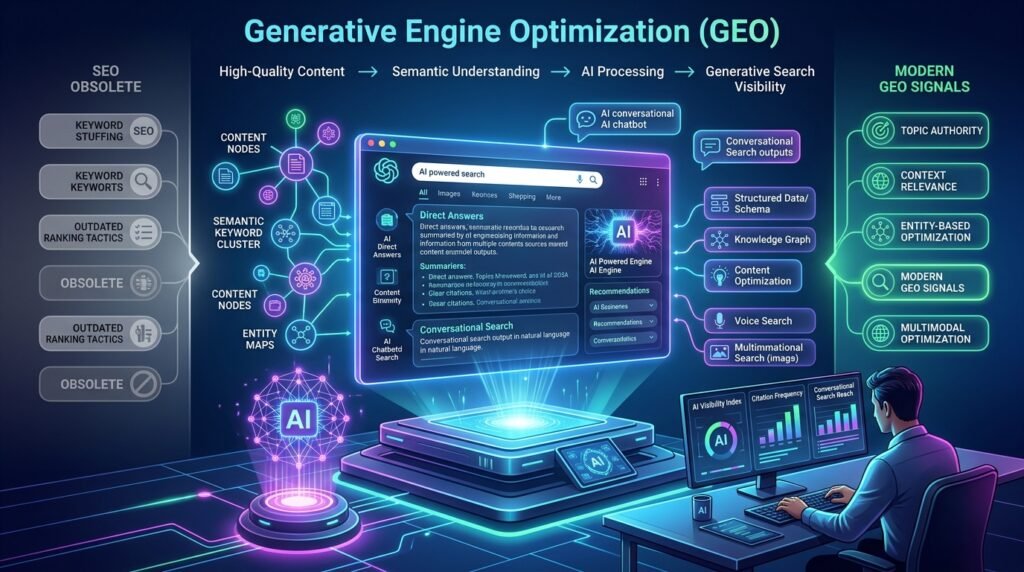
Introduction to Generative Engine Optimization (GEO)
As a digital marketing strategist and SEO consultant, I have witnessed the evolution of search engine optimization (SEO) over the years. With the rapid advancement of artificial intelligence (AI) and machine learning (ML) technologies, the landscape of SEO has undergone a significant transformation. One of the most exciting developments in this space is the emergence of Generative Engine Optimization (GEO). In this section, we will delve into the world of GEO, exploring its concepts, benefits, and applications in the digital marketing landscape.
Generative Engine Optimization (GEO) is an innovative approach that leverages the power of AI-driven algorithms to optimize website content, structure, and overall user experience. By using machine learning models, GEO enables websites to adapt and evolve in real-time, ensuring that they remain relevant, competitive, and highly visible in search engine results pages (SERPs). This approach has revolutionized the way we think about SEO, shifting the focus from traditional keyword-based optimization to a more holistic, user-centric approach.
The core idea behind GEO is to create a self-improving system that can analyze user behavior, preferences, and search patterns, and adjust the website’s content and structure accordingly. This is achieved through the use of generative models, such as Generative Adversarial Networks (GANs) and Variational Autoencoders (VAEs), which can generate new content, layouts, and designs based on user feedback and search engine algorithms. By harnessing the power of these models, GEO enables websites to stay ahead of the competition, improve user engagement, and drive more conversions.
One of the key benefits of GEO is its ability to improve website personalization. By analyzing user behavior and preferences, GEO can create tailored experiences that cater to individual needs and interests. For example, an e-commerce website using GEO can generate personalized product recommendations, offers, and content based on a user’s browsing history, search queries, and purchase behavior. This level of personalization can lead to significant increases in user engagement, conversion rates, and customer loyalty.
Another significant advantage of GEO is its ability to enhance website accessibility and usability. By analyzing user feedback and search engine algorithms, GEO can identify areas of improvement in website design, navigation, and content structure. This can lead to a more intuitive and user-friendly experience, making it easier for users to find what they are looking for and complete their desired actions. For instance, a website using GEO can generate alternative text for images, closed captions for videos, and optimized navigation menus, making it more accessible to users with disabilities.
To illustrate the potential of GEO, let’s consider a few examples. Suppose we have an e-commerce website selling outdoor gear and equipment. Using GEO, the website can generate personalized product recommendations based on a user’s search history, browsing behavior, and purchase history. For example, if a user has previously purchased hiking boots, the website can recommend complementary products such as hiking socks, trekking poles, and backpacks. This level of personalization can lead to significant increases in average order value, customer satisfaction, and loyalty.
Another example is a travel website that uses GEO to generate personalized travel recommendations based on a user’s search history, browsing behavior, and social media activity. For instance, if a user has searched for destinations in Europe, the website can recommend tailored travel itineraries, hotel suggestions, and activity recommendations based on their interests and preferences. This level of personalization can lead to significant increases in user engagement, conversion rates, and customer loyalty.
In addition to personalization and accessibility, GEO can also improve website performance and search engine rankings. By analyzing user behavior and search engine algorithms, GEO can identify areas of improvement in website speed, mobile responsiveness, and content quality. This can lead to significant improvements in search engine rankings, driving more organic traffic and revenue to the website. For example, a website using GEO can generate optimized meta tags, headings, and content structures, making it more visible and attractive to search engines.
Some of the key techniques used in GEO include:
- Generative modeling: This involves using machine learning models to generate new content, layouts, and designs based on user feedback and search engine algorithms.
- Reinforcement learning: This involves using machine learning models to learn from user behavior and adjust the website’s content and structure accordingly.
- Natural language processing: This involves using machine learning models to analyze and understand user search queries, intent, and behavior.
- Collaborative filtering: This involves using machine learning models to identify patterns and relationships in user behavior and preferences.
These techniques can be applied in various ways, such as generating personalized content, optimizing website structure and design, and improving search engine rankings. By leveraging these techniques, GEO can help websites stay ahead of the competition, improve user engagement, and drive more conversions.
In conclusion, Generative Engine Optimization (GEO) is a revolutionary approach that leverages the power of AI-driven algorithms to optimize website content, structure, and overall user experience. By using machine learning models to analyze user behavior, preferences, and search patterns, GEO enables websites to adapt and evolve in real-time, ensuring that they remain relevant, competitive, and highly visible in search engine results pages. As a digital marketing strategist and SEO consultant, I believe that GEO has the potential to transform the way we think about SEO, and I am excited to explore its applications and benefits in the digital marketing landscape.
Understanding the Fundamentals of GEO
As a digital marketing strategist and SEO consultant, I have witnessed the evolution of search engine optimization (SEO) over the years. With the advent of artificial intelligence (AI) and machine learning (ML), a new paradigm has emerged in the form of Generative Engine Optimization (GEO). In this section, we will delve into the fundamentals of GEO, exploring its core principles, key components, and the impact it has on search visibility and authority building.
GEO is a subset of SEO that focuses on optimizing content for generative search engines, which use AI and ML to generate human-like responses to user queries. Unlike traditional search engines that rely on keyword matching and link equity, generative search engines use complex algorithms to understand the context, intent, and nuances of user searches. This requires a fundamentally different approach to optimization, one that prioritizes relevance, context, and user experience over traditional SEO metrics.
To understand the fundamentals of GEO, it’s essential to grasp the concepts of contextual understanding and intent-based optimization. Contextual understanding refers to the ability of a search engine to comprehend the context in which a user is searching for information. This involves analyzing the user’s search history, location, device, and other factors to provide relevant results. Intent-based optimization, on the other hand, involves optimizing content to match the user’s intent, whether it’s informational, navigational, or transactional.
For instance, if a user searches for “best Italian restaurants in New York City,” a generative search engine would use contextual understanding to identify the user’s location and intent (in this case, transactional). The search engine would then use intent-based optimization to provide a list of relevant restaurants, complete with reviews, ratings, and directions. This approach requires content creators to optimize their content for specific user intents, rather than just targeting keywords.
The key components of GEO include entity-based optimization, knowledge graph optimization, and natural language processing (NLP) optimization. Entity-based optimization involves optimizing content for specific entities, such as people, places, and organizations. Knowledge graph optimization involves creating and optimizing content that is connected to other relevant entities and concepts. NLP optimization involves using natural language processing techniques to optimize content for readability, coherence, and relevance.
For example, if you’re a fashion brand, you might optimize your content for entities like “sustainable fashion,” “eco-friendly clothing,” and “slow fashion.” You could also create content that is connected to other relevant entities, such as fashion designers, influencers, and industry events. By using NLP optimization techniques, you could ensure that your content is readable, coherent, and relevant to your target audience.
Some of the benefits of GEO include improved search visibility, increased authority, and enhanced user experience. By optimizing content for generative search engines, businesses can increase their visibility in search results, drive more traffic to their websites, and establish themselves as authorities in their industries. GEO also enables businesses to provide a more personalized and relevant user experience, which can lead to increased engagement, conversions, and customer loyalty.
To implement GEO strategies, businesses can follow these best practices:
- Conduct thorough keyword research to identify relevant entities, concepts, and user intents
- Create high-quality, engaging, and informative content that is optimized for specific user intents
- Use entity-based optimization techniques to optimize content for specific entities and concepts
- Utilize knowledge graph optimization to create and optimize content that is connected to other relevant entities and concepts
- Leverage NLP optimization techniques to optimize content for readability, coherence, and relevance
- Monitor and analyze search engine rankings, traffic, and user engagement to refine and improve GEO strategies
By understanding the fundamentals of GEO and implementing these best practices, businesses can stay ahead of the curve in the rapidly evolving landscape of search engine optimization. As a digital marketing strategist and SEO consultant, I have seen firsthand the impact that GEO can have on search visibility, authority building, and revenue-focused organic growth. By prioritizing relevance, context, and user experience, businesses can unlock the full potential of generative search engines and drive long-term success in the digital marketplace.
In conclusion, GEO is a powerful approach to search engine optimization that requires a deep understanding of contextual understanding, intent-based optimization, and key components like entity-based optimization, knowledge graph optimization, and NLP optimization. By implementing GEO strategies and best practices, businesses can improve their search visibility, increase their authority, and provide a more personalized and relevant user experience. As the landscape of search engine optimization continues to evolve, it’s essential for businesses to stay ahead of the curve and prioritize GEO as a key component of their digital marketing strategies.
GEO Strategies for Enhanced Search Visibility
As a digital marketing strategist and SEO consultant, I have witnessed the evolution of search engine optimization (SEO) over the years. With the advent of artificial intelligence (AI) and machine learning (ML), a new paradigm has emerged in the form of Generative Engine Optimization (GEO). GEO is an advanced approach that leverages AI-driven techniques to optimize website content, structure, and user experience for improved search visibility and authority. In this section, we will delve into the strategies and best practices for implementing GEO to enhance search visibility and drive organic growth.
The primary objective of GEO is to create a symbiotic relationship between website content and search engines, enabling them to understand and interpret the context, intent, and relevance of the content. This is achieved through a combination of natural language processing (NLP), entity recognition, and knowledge graph-based approaches. By integrating these techniques, businesses can improve their online presence, increase brand visibility, and drive more qualified leads and conversions.
One of the key GEO strategies is to focus on entity-based optimization. This involves creating content that is centered around specific entities, such as people, places, organizations, and concepts. By using entity recognition techniques, businesses can help search engines understand the context and relevance of their content, thereby improving their search visibility and authority. For example, a company that specializes in artificial intelligence solutions can create content that is focused on specific entities, such as AI algorithms, machine learning models, and natural language processing techniques.
Another crucial aspect of GEO is knowledge graph optimization. A knowledge graph is a graphical representation of entities and their relationships, which helps search engines to understand the context and relevance of content. By optimizing their website content and structure to align with the knowledge graph, businesses can improve their search visibility and authority. For instance, a company that operates in the e-commerce space can create a knowledge graph that highlights the relationships between products, categories, and brands, thereby helping search engines to understand the context and relevance of their content.
In addition to entity-based and knowledge graph optimization, user experience optimization is also a critical component of GEO. This involves creating a seamless and intuitive user experience that aligns with the search intent and behavior of users. By optimizing their website design, layout, and navigation, businesses can improve their search visibility and authority, while also driving more qualified leads and conversions. For example, a company that operates in the travel industry can create a website that provides a seamless and intuitive user experience, with features such as personalized recommendations, real-time booking, and interactive maps.
To implement GEO strategies effectively, businesses need to have a deep understanding of their target audience, market trends, and search engine algorithms. They must also have the necessary tools and technologies to analyze and optimize their website content, structure, and user experience. Some of the key tools and technologies used in GEO include:
- Natural language processing (NLP) tools to analyze and optimize website content for entity recognition, sentiment analysis, and topic modeling.
- Knowledge graph-based platforms to create and optimize knowledge graphs for improved search visibility and authority.
- User experience (UX) design tools to create a seamless and intuitive user experience that aligns with search intent and behavior.
- Search engine optimization (SEO) analytics tools to track and analyze search engine rankings, traffic, and conversions.
- Artificial intelligence (AI) and machine learning (ML) platforms to analyze and optimize website content, structure, and user experience for improved search visibility and authority.
By leveraging these tools and technologies, businesses can create a robust GEO strategy that drives improved search visibility, authority, and organic growth. However, it is essential to note that GEO is a complex and evolving field that requires continuous learning, experimentation, and optimization. As search engine algorithms and user behavior continue to evolve, businesses must stay ahead of the curve by adapting and refining their GEO strategies to stay competitive in the market.
In conclusion, GEO is a powerful approach that can help businesses improve their search visibility, authority, and organic growth. By focusing on entity-based optimization, knowledge graph optimization, and user experience optimization, businesses can create a robust GEO strategy that drives qualified leads and conversions. With the right tools and technologies, businesses can analyze and optimize their website content, structure, and user experience to align with search engine algorithms and user behavior. As the digital landscape continues to evolve, it is essential for businesses to stay ahead of the curve by embracing GEO and other advanced digital marketing strategies.
As a digital marketing strategist and SEO consultant, I have helped numerous businesses scale globally through advanced SEO frameworks, Generative Engine Optimization (GEO), and performance-driven digital strategies. If you are looking to improve your search visibility, authority, and organic growth, I encourage you to explore the possibilities of GEO and other advanced digital marketing strategies. With the right approach and expertise, you can drive more qualified leads and conversions, while also establishing your brand as a thought leader in your industry.
Measuring Success and Overcoming Challenges in GEO
As a digital marketing strategist and SEO consultant, I have had the opportunity to work with numerous brands and help them scale globally through advanced SEO frameworks, including Generative Engine Optimization (GEO). One of the most critical aspects of implementing a successful GEO strategy is measuring its success and overcoming the challenges that inevitably arise. In this section, we will delve into the key performance indicators (KPIs) that can be used to measure the success of a GEO campaign, as well as the common challenges that brands may face and how to overcome them.
When it comes to measuring the success of a GEO campaign, there are several KPIs that can be used. These include organic traffic, conversion rates, search engine rankings, and return on investment (ROI). By tracking these KPIs, brands can gain a better understanding of how their GEO campaign is performing and make data-driven decisions to optimize their strategy. For example, if a brand is seeing an increase in organic traffic but not an corresponding increase in conversion rates, they may need to adjust their landing page optimization strategy to better align with the needs of their target audience.
In addition to tracking KPIs, it is also essential to conduct regular technical audits to ensure that a brand’s website is technically sound and optimized for search engines. This includes ensuring that the website is mobile-friendly, has a fast page speed, and is secure. By conducting regular technical audits, brands can identify and fix any technical issues that may be hindering their GEO campaign’s success. For instance, if a brand’s website is not mobile-friendly, it may be missing out on a significant amount of organic traffic from mobile users.
Despite the many benefits of GEO, there are also several challenges that brands may face when implementing a GEO strategy. One of the most common challenges is content creation. Creating high-quality, engaging content that resonates with a brand’s target audience can be a time-consuming and resource-intensive process. To overcome this challenge, brands can consider outsourcing their content creation to a reputable agency or investing in content creation tools that can help streamline the process. For example, a brand could use a content management system to manage their content creation workflow and ensure that all content is optimized for search engines.
Another challenge that brands may face when implementing a GEO strategy is link building. Building high-quality backlinks from authoritative sources can be a difficult and time-consuming process. To overcome this challenge, brands can consider guest blogging, broken link building, or resource page link building. For instance, a brand could reach out to other reputable websites in their industry and offer to write a guest post in exchange for a link back to their website. This can help build relationships with other websites and increase the brand’s online authority.
Finally, brands may also face challenges when it comes to tracking and measuring the ROI of their GEO campaign. To overcome this challenge, brands can consider using analytics tools such as Google Analytics to track their website’s traffic and conversion rates. They can also set up goals and events in their analytics tool to track specific actions that users take on their website, such as filling out a contact form or making a purchase. By tracking and measuring the ROI of their GEO campaign, brands can gain a better understanding of how their strategy is performing and make data-driven decisions to optimize their approach.
Some common challenges in GEO include:
- Lack of technical expertise: Implementing a successful GEO strategy requires a certain level of technical expertise, including knowledge of HTML, CSS, and JavaScript. Brands that lack this expertise may struggle to implement a GEO strategy that is technically sound.
- Insufficient content creation resources: Creating high-quality, engaging content that resonates with a brand’s target audience can be a time-consuming and resource-intensive process. Brands that lack the resources to create high-quality content may struggle to implement a successful GEO strategy.
- Difficulty building high-quality backlinks: Building high-quality backlinks from authoritative sources can be a difficult and time-consuming process. Brands that struggle to build high-quality backlinks may see limited success with their GEO strategy.
- Tracking and measuring ROI: Tracking and measuring the ROI of a GEO campaign can be challenging, especially for brands that lack experience with analytics tools. Brands that struggle to track and measure the ROI of their GEO campaign may have difficulty optimizing their strategy and achieving their goals.
In conclusion, measuring the success of a GEO campaign and overcoming the challenges that arise are critical components of a successful digital marketing strategy. By tracking key performance indicators, conducting regular technical audits, and overcoming common challenges such as content creation, link building, and tracking and measuring ROI, brands can achieve their goals and drive revenue-focused organic growth. As a digital marketing strategist and SEO consultant, I have helped numerous brands overcome these challenges and achieve success with their GEO campaigns. By working with a reputable agency or consultant, brands can gain the expertise and resources they need to implement a successful GEO strategy and drive long-term growth and success.
For example, I worked with a brand in the e-commerce industry that was struggling to drive organic traffic to their website. We implemented a GEO strategy that included keyword research, on-page optimization, and link building. We also conducted regular technical audits to ensure that the brand’s website was technically sound and optimized for search engines. As a result of our efforts, the brand saw a significant increase in organic traffic and conversion rates, and was able to drive revenue-focused organic growth.
Another example is a brand in the finance industry that was struggling to build high-quality backlinks to their website. We implemented a link building strategy that included guest blogging, broken link building, and resource page link building. We also created high-quality, engaging content that resonated with the brand’s target audience and helped to establish the brand as a thought leader in their industry. As a result of our efforts, the brand was able to build high-quality backlinks and increase their online authority, which helped to drive organic traffic and conversion rates.
By working with a reputable agency or consultant and implementing a successful GEO strategy, brands can achieve their goals and drive long-term growth and success. Whether you are a brand in the e-commerce industry, the finance industry, or any other industry, a well-implemented GEO strategy can help you drive revenue-focused organic growth and achieve your digital marketing goals.
Future of Generative Engine Optimization and Emerging Trends
As a digital marketing strategist and SEO consultant, I have had the privilege of witnessing the evolution of search engine optimization (SEO) over the years. The rapid advancements in artificial intelligence (AI) and machine learning (ML) have given rise to a new paradigm in SEO, known as Generative Engine Optimization (GEO). In this section, we will delve into the future of GEO and explore the emerging trends that are redefining the landscape of search visibility and authority building.
GEO is an AI-driven approach to SEO that leverages the power of generative models to create high-quality, engaging, and optimized content at scale. By harnessing the capabilities of natural language processing (NLP) and deep learning algorithms, GEO enables brands to generate content that resonates with their target audience, while also meeting the evolving expectations of search engines. As we move forward, we can expect GEO to play an increasingly important role in shaping the future of SEO and digital marketing.
One of the key emerging trends in GEO is the use of multimodal generation. This involves the creation of content that incorporates multiple formats, such as text, images, videos, and audio, to provide a more immersive and engaging experience for users. Multimodal generation has the potential to revolutionize the way we approach content creation, enabling brands to craft compelling narratives that captivate their audience and drive meaningful interactions. For instance, a brand could use GEO to generate a video script, along with accompanying images and captions, to create a comprehensive and engaging social media campaign.
Another significant trend in GEO is the integration of entity-based optimization. This involves the use of entity recognition and disambiguation techniques to identify and optimize content around specific entities, such as people, places, and organizations. Entity-based optimization has the potential to significantly improve the accuracy and relevance of search results, enabling users to find the information they need more quickly and efficiently. For example, a brand could use GEO to optimize its content around specific entities, such as industry thought leaders or emerging trends, to establish itself as a trusted authority in its niche.
In addition to these trends, we are also seeing a growing emphasis on explainability and transparency in GEO. As AI-driven systems become more pervasive, there is a growing need to understand how they work and make decisions. Explainability and transparency are critical in building trust with users and ensuring that GEO systems are fair, unbiased, and accountable. For instance, a brand could use GEO to generate content that provides clear and concise explanations of complex topics, such as AI and ML, to educate and inform its audience.
To illustrate the potential of GEO, let’s consider a few examples. Suppose a fashion brand wants to create a series of blog posts showcasing its latest clothing line. Using GEO, the brand could generate high-quality content that incorporates relevant keywords, phrases, and entities, while also optimizing for search engines. The generated content could include:
- Product descriptions that highlight key features and benefits
- Stylish and engaging images that showcase the clothing line
- Compelling headlines and meta descriptions that drive clicks and conversions
- Relevant and authoritative links that enhance the brand’s credibility and trustworthiness
In another example, a healthcare brand might use GEO to generate a series of videos explaining complex medical topics, such as disease diagnosis and treatment options. The generated content could include:
- Clear and concise explanations of medical concepts and terminology
- Engaging animations and visuals that illustrate key points and ideas
- Relevant and authoritative links to trusted sources and resources
- Compelling calls-to-action that encourage users to seek further information or consultation
In conclusion, the future of Generative Engine Optimization (GEO) is poised to be shaped by emerging trends such as multimodal generation, entity-based optimization, and explainability and transparency. As AI-driven systems continue to evolve and improve, we can expect GEO to play an increasingly important role in shaping the landscape of search visibility and authority building. By leveraging the power of GEO, brands can create high-quality, engaging, and optimized content that resonates with their target audience, while also meeting the evolving expectations of search engines.
As a digital marketing strategist and SEO consultant, I am excited to explore the potential of GEO and help brands navigate the complexities of this emerging field. Whether you are looking to improve your search visibility, establish your brand as a trusted authority, or drive meaningful interactions with your target audience, GEO has the potential to be a game-changer. By staying at the forefront of this emerging trend, you can unlock new opportunities for growth, innovation, and success in the ever-evolving landscape of digital marketing.

Amit Tyagi is a seasoned Digital Marketing and SEO Consultant with extensive experience helping businesses improve online visibility through SEO, AI Search Optimization (AIO/GEO), content strategy, and performance marketing. He regularly shares practical insights, industry updates, and data-driven strategies, empowering brands and marketers to achieve sustainable digital growth in an evolving search landsca