
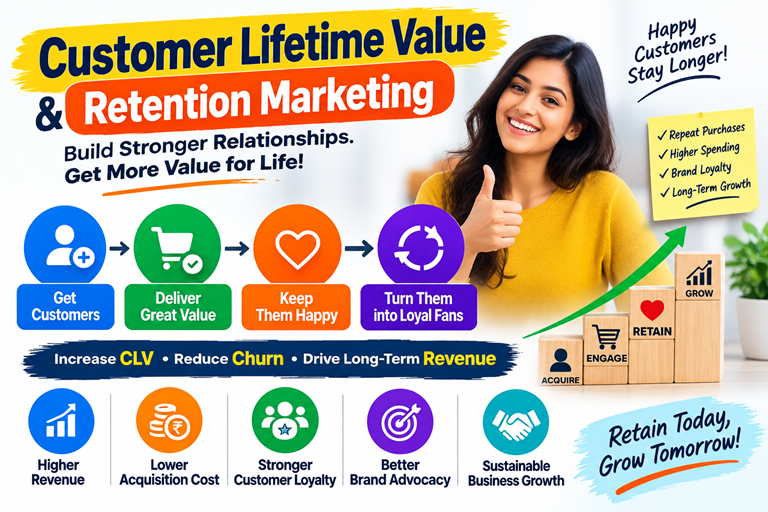
Most businesses I audit pay heavily to acquire a customer once and then never contact that customer again. The ad account shows a respectable cost per lead, the sales team closes the deal, and the relationship ends at the invoice. Meanwhile, clicks get costlier and margins get thinner. Customer lifetime value (CLV) and retention marketing address this at the root. Vanity metrics like raw impressions don’t pay bills; repeat purchases and referrals do. This guide shows you how to calculate CLV, track it properly, and build a retention system that lowers your effective acquisition cost.
What Is Customer Lifetime Value and Why Does It Matter?
Customer Lifetime Value is the total gross profit a customer generates for your business across the entire relationship. It matters because it tells you the maximum you can afford to spend to acquire that customer.
Definition block:
- Customer Lifetime Value (CLV): The expected profit from one customer over the full period they buy from you.
- Retention marketing: Email, WhatsApp, SMS, loyalty programmes, service reminders and remarketing designed to bring existing customers back.
Before spending a single rupee on Google Ads, make sure you know your CLV. If a customer is worth ₹40,000 in profit over three years, a ₹3,000 acquisition cost is comfortable. If you only measure the first order of ₹5,000, you may pause a campaign that is actually profitable. This also challenges a common myth: the cheapest lead is not the best lead. The best lead is the one with the highest lifetime profit relative to what you paid.
How to Calculate Customer Lifetime Value
The simplest CLV formula is: Average Order Value × Purchases per Year × Customer Lifespan in Years × Gross Margin %. Always use profit, not revenue, otherwise you will overestimate what you can spend.
Key formulas in plain English:
- CLV = AOV × purchases per year × years retained × gross margin
- CAC = total marketing and sales cost ÷ new customers acquired
- LTV to CAC ratio = CLV ÷ CAC
- Retention rate = ((customers at end − new customers added) ÷ customers at start) × 100
- Churn rate = 100 − retention rate
A simple calculation can help project your customer acquisition cost. Assume an electrical services business with an average order of ₹6,000, 1.5 purchases per year, a 4-year relationship and a 25% margin. CLV = 6,000 × 1.5 × 4 × 0.25 = ₹9,000. If your CAC is ₹1,500, the LTV to CAC ratio is 6:1. Many practitioners treat 3:1 as a healthy rule of thumb, but this varies by industry and cash flow, so treat it as a starting benchmark rather than a law.
Why Retention Marketing Often Beats Constant Acquisition
Retaining an existing customer usually costs less than acquiring a new one because you skip the ad auction and the customer already trusts you. The exact gap differs by industry, so measure your own numbers.
For a typical Indian business targeting local or pan-India buyers, CPC on commercial keywords commonly ranges from ₹15 to ₹150 or more (roughly $0.20 to $2), and far higher in categories like insurance, education and real estate. With landing page conversion rates often between 2% and 8%, a single lead can cost several hundred rupees, and a paying customer several times that. A WhatsApp reminder or an email to a past buyer costs a small fraction. Retention does not replace acquisition, but it makes every acquired customer more valuable.
Technical Implementation: Measuring Retention in GA4, GTM and Your CRM
To measure retention, connect a stable customer identifier to purchase events in GA4 and your CRM so repeat behaviour can be attributed to the same person.
- Define events in Google Tag Manager: purchase, generate_lead, call_click and whatsapp_click. Indian service industries depend heavily on calls and WhatsApp, so these are real conversions.
- Pass a user_id: Use an internal customer ID. Do not send raw phone numbers or email addresses to GA4, since Google’s policies prohibit personally identifiable information in analytics.
- Build GA4 audiences: For example, purchasers in the last 180 days, and use cohort exploration to see how many buyers return in months 2, 3 and 6.
- Store orders in a database or CRM and compute CLV per customer. A basic SQL query does the job:
sql
SELECT customer_id,
COUNT(order_id) AS orders,
SUM(order_value) AS revenue,
MIN(order_date) AS first_order,
MAX(order_date) AS last_order
FROM orders
GROUP BY customer_id;
- Import offline conversions into Google Ads: If deals close over a call or in the showroom, upload those outcomes so bidding optimizes for real sales, not form fills.
Ensure a clear consent notice and privacy policy for data collection, in line with India’s DPDP Act (and GDPR for overseas visitors).
Retention Marketing Channels for Indian Businesses
The best retention channel is the one your customers already read: for most Indian buyers, that means WhatsApp first, then SMS and email.
| Channel | Best Use | Cost Level | Compliance Note |
| WhatsApp Business (app or API) | Order updates, service reminders, repeat offers | Low to moderate | Needs opt-in; API templates need approval |
| Invoices, guides, newsletters | Low | Set up SPF, DKIM and DMARC; honour unsubscribes | |
| SMS | Alerts, reminders | Low | DLT registration required in India |
| Google Ads Customer Match and remarketing | Re-engaging past buyers | Moderate | Only use data collected with proper consent |
| Referral and loyalty programmes | Repeat purchase and word of mouth | Variable | Control discounts to protect margin |
| Google Business Profile reviews | Trust and local visibility | Very low | Fake or incentivised reviews violate policy |
Practical Example: An Appliance and Electrical Dealer
Consider an illustrative scenario, not client data: a dealer in a Tier 2 city selling inverters, air coolers and electrical services. Let’s look at the numbers with stated assumptions.
- First sale: an inverter and battery package at ₹18,000, with an 18% gross margin = ₹3,240 profit.
- CAC through Google Ads and calls: ₹2,500.
- First-sale profit after acquisition: ₹740.
Judged on the first sale alone, this campaign looks marginal. Now add follow-on revenue over four years: annual maintenance visits, accessories, a cooler before summer, and one referral. Assume ₹4,500 in additional gross profit. CLV becomes ₹7,740, and the LTV to CAC ratio is about 3.1:1.
Retention actions that make this realistic: WhatsApp service reminders before peak season, warranty expiry alerts, a review request after installation, and a modest referral credit. The point is not the exact figures. The point is that an advertiser who only reads first-sale ROAS may cut a campaign that is quietly building a profitable customer base. Remember that ROAS = (revenue from ads ÷ ad spend) × 100, and it should be read alongside CLV, not instead of it.
Optimization Guide: Segments, Budgets and Tools
Segment customers by recency, frequency and monetary value (RFM) and spend your retention effort on the most valuable groups first.
Definition block: RFM analysis scores customers on how recently they bought, how often they buy, and how much they spend.
- Top customers: Early access, priority service, personal follow-up.
- At-risk customers: Trigger a win-back message when they pass roughly 1.5 times their normal purchase cycle.
- One-time buyers: Send usage guides and cross-sell relevant products.
- Low-value, high-support customers: Review whether the relationship is profitable at all.
A reasonable starting point for many SMEs is reserving 10% to 20% of the marketing budget for retention, then adjusting based on cohort data. On tools, GA4 is free and sufficient for measurement. For customer data, a spreadsheet plus the WhatsApp Business app works at small volumes, while CRMs such as Zoho or HubSpot suit larger databases. Choose by features, integration and cost, not brand reputation.
How Retention Supports SEO
From a technical SEO standpoint, retention helps indirectly. Satisfied customers produce genuine Google reviews, branded searches and repeat visits. Publishing post-purchase content (maintenance guides, manuals, troubleshooting FAQs) with proper FAQ schema also earns organic visibility. Your actual search rank and quality score will depend on many factors, so treat retention as a supporting asset, not a ranking trick.
Common Blunders and Black-Hat Pitfalls
The most expensive retention mistakes are consent violations, fake social proof and discounting without a margin check.
- Buying phone lists and blasting WhatsApp messages. This breaches consent norms, risks number bans and invites legal exposure under the DPDP Act.
- Fake or incentivised reviews. In white-hat digital marketing, reviews must be genuine. Policy violations can lead to review removal or profile suspension.
- Uploading customer lists to Google Ads without valid consent.
- Calculating CLV on revenue instead of gross profit.
- Blanket discounts to every past buyer, which trains customers to wait for sales.
- Sending personal data to GA4, which violates Google Analytics policy.
- Ignoring service quality. No message sequence can rescue a poor experience.
Actionable Conclusion and Next Steps
Customer lifetime value turns marketing from a cost centre into an investment decision, and retention marketing is how you realise that value. Start small and measure honestly:
- Export 12 to 24 months of orders and calculate AOV, purchase frequency and retention rate.
- Compute CLV and CAC, then your LTV to CAC ratio.
- Set up purchase, call and WhatsApp events in GTM, with a user_id and consent notice.
- Build one RFM segment list and send one opt-in WhatsApp or email campaign.
- Review results after 60 to 90 days and shift budget accordingly.
Frequently Asked Questions
What is a good customer lifetime value for a small Indian business?
There is no universal figure. A common rule of thumb is a CLV at least three times your CAC, but margins, cash flow and purchase cycles should guide your own target.
How do I calculate customer retention rate?
Subtract new customers acquired from your end-of-period customer count, divide by customers at the start, and multiply by 100.
Is retention marketing cheaper than acquiring new customers?
Generally yes, because you avoid ad auction costs and the customer already knows you. The exact difference depends on your industry and channels, so compare your own CAC with your cost per repeat order.
Can I use WhatsApp for retention marketing legally in India?
Yes, with opt-in consent, honest messaging and adherence to WhatsApp’s business policies. Avoid unsolicited bulk messaging to purchased lists.
How often should I contact past customers?
Match your natural purchase cycle. Seasonal or service-based businesses may need two to four meaningful touchpoints a year; more frequent messages should offer clear value.
Which tool is best for tracking CLV?
GA4 handles behaviour tracking, but true CLV needs transaction data from a CRM, billing system or database. Pick the tool that fits your volume and integrates with your sales process.

Amit Tyagi is a seasoned Digital Marketing and SEO Consultant with extensive experience helping businesses improve online visibility through SEO, AI Search Optimization (AIO/GEO), content strategy, and performance marketing. He regularly shares practical insights, industry updates, and data-driven strategies, empowering brands and marketers to achieve sustainable digital growth in an evolving search landsca