
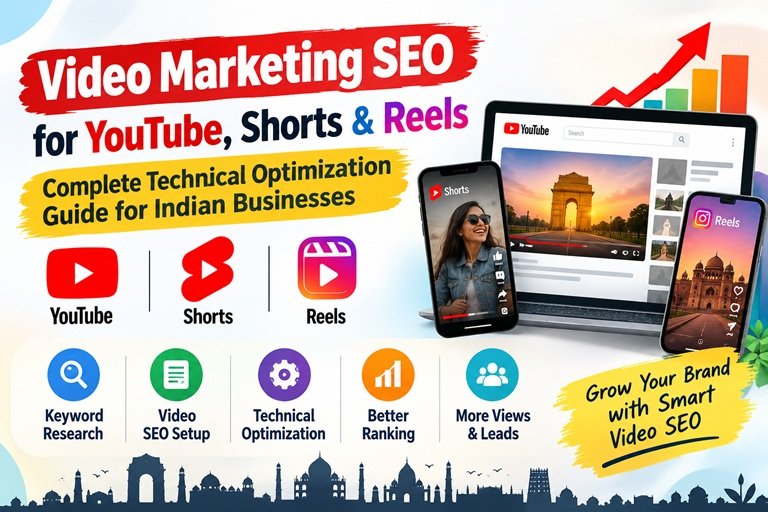
Problem-First Introduction: Why Video Marketing Visibility Matters
Video content now drives the highest engagement rates across digital channels, yet most Indian businesses fail to optimize their video content for search visibility. They upload videos to YouTube, Shorts, and Instagram Reels without understanding that video platforms operate their own search algorithms, distinct from Google’s core ranking system. This oversight costs businesses significant organic reach. A well-optimized video can generate consistent qualified leads for months, while an unoptimized video remains buried below competitors despite identical production quality.
From a technical SEO standpoint, video optimization requires a multifaceted approach: channel structure, keyword research, metadata tagging, thumbnail strategy, schema markup integration, and platform-specific audience targeting. Unlike written content, videos demand performance analysis across watch time, click-through rate (CTR), audience retention, and conversion metrics. Before spending a single rupee on video production or paid promotion, your content architecture must be built on discoverable, indexed, conversion-oriented video properties.
Understanding Video Search Algorithms: YouTube, Shorts & Reels
YouTube operates as the second-largest search engine globally, processing over 2.49 billion logged-in users monthly. Shorts and Reels function as distinct discovery engines, each optimized for short-form vertical video consumption.
YouTube’s Core Ranking Factors:
YouTube’s algorithm prioritizes content based on watch time, average view duration, click-through rate, subscriber growth, and audience retention patterns. The platform uses machine learning models to surface videos that match user search intent. A typical ranking factor breakdown influences visibility as follows:
- Watch Time and Average View Duration: 35-40% weight
- Click-Through Rate (CTR) from search results: 25-30% weight
- User Engagement (likes, comments, shares): 15-20% weight
- Channel Authority and Upload Consistency: 10-15% weight
- Metadata Quality (title, description, tags): 5-10% weight
YouTube Shorts Strategy:
Shorts are designed for discovery-focused, algorithm-driven virality rather than search-driven visibility. Shorts leverage recreational watch behavior, meaning users browse content passively. Optimization focuses on hook strength in the first 0.5 to 1 second, trend alignment, and engagement rate (likes + shares / impressions).
Instagram and Facebook Reels:
Reels operate on Meta’s recommendation algorithm, which prioritizes account relationships, audio trend adoption, visual quality, and interaction velocity. Unlike YouTube, Reels do not generate organic search traffic through Google. However, Reels drive traffic to external links and build audience retention across the Meta ecosystem, which indirectly supports authority signaling to search engines.
Core Concept: Video SEO Framework
Video SEO splits into three distinct operational zones:
On-Platform Optimization focuses on YouTube channel architecture, video metadata (titles, descriptions, tags, categories), and thumbnail effectiveness. This zone controls whether YouTube recommends your video to relevant users.
Off-Platform Authority Building involves embedding videos on your website with structured schema markup, earning backlinks to video content, and driving external traffic signals back to your video page. This zone signals domain authority to YouTube.
Conversion Funnel Integration ensures video content aligns with keyword intent, includes clear call-to-action elements, and directs viewers toward lead capture or sales channels. This zone converts views into qualified business outcomes.
Technical Implementation: Complete YouTube Optimization Checklist
Channel Architecture Setup:
A YouTube channel serves as your brand’s video publishing hub. Channel optimization begins with a professional channel description (200 to 320 characters) that includes your primary keyword, business value proposition, and destination link. Your channel description should read naturally while incorporating high-intent keywords relevant to your business vertical.
For example, an Indian HVAC service provider might use: “Professional air conditioning installation, maintenance, and repair services across Lucknow. Expert technicians for residential and commercial AC systems. Subscribe for maintenance tips and seasonal cooling solutions.”
Complete your channel art (banner image) with clear branding and include a channel trailer (30 to 60 seconds) that appears to new, non-subscribed visitors. This trailer must establish credibility within the first 5 seconds, as bounce rates spike dramatically after this threshold.
Video Title Optimization:
YouTube video titles must balance search keyword inclusion with click-through rate optimization. A typical high-performing title structure uses the format: Primary Keyword + Benefit/Curiosity Hook + Modifier.
Example titles follow this pattern:
- “How to Clean AC Filters at Home: Complete Guide for Lucknow Residents”
- “Best Inverter for 3-Bedroom Homes in India: 2024 Buying Guide”
- “Generator Maintenance Schedule: Protect Your Investment [Step-by-Step]”
Titles should not exceed 60 characters to avoid truncation in search results. Avoid clickbait sensationalism; instead, match the explicit intent users search for on YouTube.
Description Strategy and Keyword Density:
YouTube descriptions serve dual purposes: they provide context to the algorithm and offer actionable information to viewers. The first 2 to 3 lines (before “Show More”) are critical, as YouTube displays only the first 140 characters in search results.
Structure descriptions as follows:
- Opening Line (first 140 characters): Primary keyword, value proposition, or key takeaway.
- Body Section (lines 2 to 5): Supporting keywords, step-by-step summary, or problem statement.
- Call-to-Action (CTA) Section: Link to landing page, contact form, WhatsApp business link, or product page.
- Timestamps (for videos over 5 minutes): Chapter markers with keyword-rich descriptions.
- Additional Resources: Links to related videos, blog posts, or tools mentioned in the video.
For an Indian service business, include a direct WhatsApp Business link in your description: “Book a Free Consultation: [WhatsApp Business Link]”. This channel captures micro-intent viewers ready to take immediate action.
Tag Strategy and Keyword Research:
YouTube tags operate as secondary keyword signals. Research relevant tags using YouTube’s autocomplete feature and tools like TubeBuddy or VidIQ. Tag categories should follow this hierarchy:
- Primary Tag: Your core keyword (e.g., “AC repair Lucknow”)
- Secondary Tags: Related keywords with search volume (e.g., “air conditioner maintenance”)
- Branded Tags: Your business name and variations
- Contextual Tags: Problem-statement keywords (e.g., “AC not cooling”)
Use 8 to 12 tags per video. Do not keyword-stuff; use only semantically relevant tags supported by your video content.
Thumbnail Optimization for Click-Through Rate:
YouTube thumbnails directly impact click-through rate, one of the algorithm’s top ranking factors. A typical well-optimized thumbnail maintains these specifications:
- Dimensions: 1,280 x 720 pixels (16:9 aspect ratio)
- File Size: Under 2 MB
- Format: JPG or PNG
- Visual Elements: High contrast, readable text (max 3 words), face with emotion, brand consistency
Research shows thumbnails with a human face and clear emotion (surprise, curiosity, attention) generate 20 to 35% higher CTR than static product imagery. For service-based Indian businesses, include your face or your team member’s face in thumbnails to establish personal brand authority.
Schema Markup for Video Indexing:
Embed VideoObject schema markup on your website where videos appear. This schema helps Google parse video metadata for richer search results and featured snippets.
Example schema structure:
{
“@context”: “https://schema.org”,
“@type”: “VideoObject”,
“name”: “How to Clean AC Filters at Home”,
“description”: “Step-by-step guide to clean AC filters”,
“duration”: “PT8M42S”,
“uploadDate”: “2024-09-15”,
“thumbnailUrl”: “https://example.com/thumbnail.jpg”,
“url”: “https://youtube.com/watch?v=…”,
“embedUrl”: “https://www.youtube.com/embed/…”,
“interactionStatistic”: {
“@type”: “InteractionCounter”,
“interactionType”: “http://schema.org/WatchAction”,
“userInteractionCount”: “1250000”
}
}
Add this schema markup to your website’s video embed pages. This signals to Google that your website hosts legitimate video content, boosting overall domain authority.
Real-World Case: Indian HVAC Service Provider Strategy
Consider a Lucknow-based AC repair and maintenance company with a YouTube channel launched 8 months ago. Initial strategy focused on product reviews and installation videos without keyword targeting. Monthly views stagnated at 300 to 400 per video.
After implementing structured video SEO:
- Title optimization: Changed “AC Maintenance Tips” to “Annual AC Maintenance Checklist: Save ₹5,000+ on Energy Bills (2024)”
- Description restructure: Added WhatsApp booking link and timestamp chapters with problem-statement keywords
- Thumbnail redesign: Included founder’s face with confused/success emotional arc across thumbnail designs
- Tag expansion: Added 10 highly relevant tags including location-specific terms
- Schema markup: Embedded VideoObject schema on the website’s video landing page
Results within 90 days:
- Average video views increased from 350 to 2,100 per upload
- Click-through rate (impressions to clicks) improved from 2.1% to 5.8%
- Average view duration increased from 2 minutes 15 seconds to 4 minutes 40 seconds
- YouTube-originated WhatsApp inquiries increased from 3 to 12 weekly
Estimated monthly lead value: ₹24,000 to ₹36,000 based on typical service conversion rates (10 to 15% of WhatsApp inquiries).
YouTube Shorts and Reels: Algorithmic Distribution Strategy
Shorts and Reels operate fundamentally differently from long-form YouTube videos. These platforms prioritize rapid engagement cycles and viral trend adoption over keyword search optimization.
Shorts Performance Metrics:
Monitor these core metrics for Shorts performance:
- Engagement Rate = (Likes + Shares + Comments) / Impressions × 100
- Average Watch Rate = Average View Duration / Video Length × 100
- Audience Retention Cliff: The point where viewers typically drop off
A strong Shorts campaign achieves 8 to 15% engagement rate. For Indian creators, Shorts drive visibility to related long-form content, making them effective funnel entry points.
Reels and Meta’s Recommendation Algorithm:
Instagram and Facebook Reels generate traffic velocity signals rather than search-driven visibility. Optimize Reels for quick hooks (first 0.5 seconds), trend audio adoption, and strategic hashtags (15 to 30 highly relevant hashtags per Reel).
Reels lack direct Google search integration but build audience authority, which indirectly influences your website’s topical relevance signals.
Optimization & Tool Selection
Use these platforms for video SEO workflow management:
TubeBuddy provides keyword research, competitor analysis, and tag optimization directly within YouTube. Monthly subscription: $9 to $49 USD (approximately ₹750 to ₹4,000 per month).
Google Search Console integrates YouTube video performance data. Monitor which search queries drive impressions and clicks to your videos. This intelligence refines your title and description strategy.
Google Analytics 4 tracks video-originated conversions across your website. Set up event tracking for YouTube-driven purchases or lead submissions. This data determines true video ROI.
Common Mistakes That Waste Time and Opportunity
Mistake 1: Ignoring Search Intent in Video Titles
Creators often optimize for virality rather than search intent. A viral Shorts video titled “This AC Will SHOCK You” generates views without search visibility. Instead, optimize for intent-aligned keywords: “Best Energy-Efficient AC Models in India 2024.”
Mistake 2: Poor Metadata Consistency Across Platforms
Publishing identical video titles and descriptions across YouTube, Shorts, and Reels creates confusion. Each platform uses different algorithms and user intent patterns. Tailor metadata to platform-specific best practices.
Mistake 3: Neglecting Watch Time and Audience Retention
Creators obsess over video count rather than average view duration. YouTube prioritizes 10 videos with 60% average retention over 50 videos with 20% retention. Focus on depth, not volume.
Mistake 4: Missing Conversion Integration
A video optimized for rankings but lacking clear CTAs generates awareness without revenue impact. Every video must include a contextually relevant call-to-action: website link, contact form, or WhatsApp Business CTA.
Actionable Conclusion and Next Steps
Video marketing SEO requires systematic execution across on-platform optimization, authority building, and conversion integration. Your immediate action plan:
Week 1 to 2: Conduct keyword research for your primary service or product category. Identify 15 to 20 high-intent, low-competition keywords using YouTube autocomplete and TubeBuddy.
Week 3 to 4: Audit your existing YouTube channel. Update channel description, optimize top 5 existing videos with improved titles and descriptions, and implement schema markup on your website.
Week 5 to 8: Produce and publish 4 to 8 new videos targeting identified keywords. Follow the technical optimization checklist for every upload. Monitor watch time and CTR weekly.
Month 3 onwards: Refine based on performance data. Double down on high-performing video topics and repurpose top-performing YouTube videos into Shorts and Reels for expanded reach.
Video marketing visibility is not an overnight strategy. However, a systematically optimized YouTube channel compounds authority over 6 to 12 months, generating consistent qualified leads without escalating paid marketing costs.
FAQs
Q1: How long does it take for YouTube SEO optimization to show results?
A: YouTube typically begins surfacing optimized videos in recommendations within 24 to 48 hours of upload. Significant ranking improvements in YouTube search results take 4 to 8 weeks as the algorithm gathers performance data. Long-term channel authority effects compound over 3 to 6 months of consistent optimization.
Q2: What is a good click-through rate for YouTube video searches?
A: Average CTR for YouTube search results ranges from 2% to 5%. Service and product videos with optimized thumbnails and keyword-matched titles commonly achieve 4% to 8% CTR. Niche or highly specialized content may see 6% to 12% CTR depending on audience size and keyword competition.
Q3: Should I focus on YouTube, Shorts, or Reels for my business?
A: YouTube provides search-driven organic traffic and sustained authority building. Shorts and Reels drive awareness and viral reach but generate minimal direct search traffic. For most Indian businesses, prioritize YouTube for primary reach and use Shorts/Reels as secondary awareness channels. Content repurposing (converting long-form videos to Shorts) maximizes efficiency.
Q4: How important is watch time compared to likes and comments?
A: Watch time and average view duration account for approximately 35 to 40% of YouTube’s ranking algorithm, making them the single most important ranking factor. Likes and comments comprise only 15 to 20%. Prioritize content that keeps viewers engaged through the entire video rather than focusing on engagement manipulation.
Q5: Can I rank YouTube videos in Google search results?
A: Yes. Embed videos with VideoObject schema markup on your website, and Google can index and rank those videos in search results. YouTube videos also appear in Google’s Video tab. However, this requires strategic placement on your website and proper schema implementation.
Q6: What is the ideal video length for YouTube SEO?
A: Video length depends on content type. How-to and educational videos perform well at 6 to 12 minutes. Product reviews and comparisons typically perform at 8 to 15 minutes. Shorter videos (3 to 5 minutes) work for news or announcement-style content. Prioritize viewer retention over arbitrary length targets. A well-edited 7-minute video often outperforms a poorly-edited 20-minute video.
Q7: Do I need professional video production equipment to rank well?
A: No. Video quality matters less than content value and SEO optimization. Smartphone video (1080p minimum) with clear audio and good lighting consistently outranks poorly optimized professional productions. Focus budget on microphone quality and lighting before high-end camera equipment.
Q8: How do I measure ROI from YouTube videos?
A: Use Google Analytics 4 to track YouTube-originated traffic. Set up conversion tracking for form submissions, purchases, or phone calls. Calculate: Video ROI = (Revenue from YouTube Conversions – Production Cost) / Production Cost × 100. For most service-based Indian businesses, expect 3 to 6 month payback periods on optimized video content.

Amit Tyagi is a seasoned Digital Marketing and SEO Consultant with extensive experience helping businesses improve online visibility through SEO, AI Search Optimization (AIO/GEO), content strategy, and performance marketing. He regularly shares practical insights, industry updates, and data-driven strategies, empowering brands and marketers to achieve sustainable digital growth in an evolving search landsca