
The Uncomfortable Truth About Chasing New Customers
You spend ₹50,000 per month on Google Ads to acquire 20 new customers. Your customer acquisition cost lands at ₹2,500 per customer. But 60% of those customers never return, and you never hear from them again. So next month, you spend another ₹50,000 to replace those lost customers, and the cycle repeats indefinitely.
This is the trap of acquisition-only marketing. Your business treadmill never stops because you are constantly hunting for new customers to replace the ones who left. Your marketing budget disappears into the void, and you have nothing to show for it except temporary revenue spikes.
What if instead, you built something with your existing customers. A space where they felt valued, stayed engaged, and invited their friends. A community that turned paying customers into brand advocates who brought you new business without paid advertising costs.
Community building is not a trendy buzzword; it is a fundamental shift in how modern businesses reduce customer acquisition cost, increase lifetime value, and create sustainable, word-of-mouth-driven growth.
Understanding Community Building: More Than Just a Facebook Group
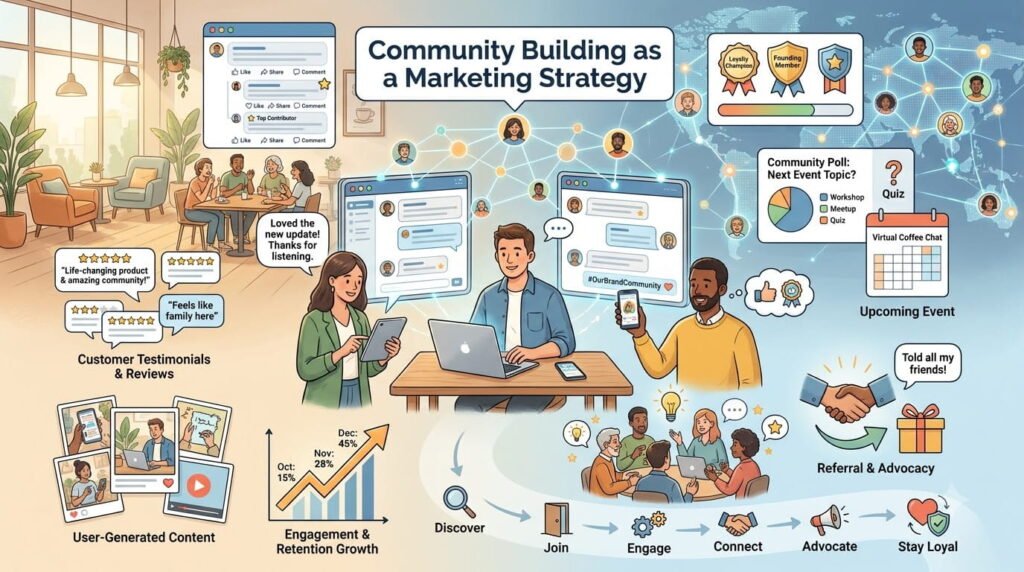
Community building in marketing is the deliberate process of creating a shared space where your customers, prospects, and partners connect, exchange value, and develop emotional loyalty to your brand. A true community is not a broadcast channel where you dump promotional messages. It is a living ecosystem where members benefit from each other as much as they benefit from your business.
From a technical SEO and digital strategy standpoint, communities serve multiple business functions:
1. Customer Retention & Lifetime Value Multiplication
Studies across e-commerce and B2B sectors consistently show that engaged community members have 3 to 5 times higher lifetime value than non-community customers. A customer who participates in your community is more likely to purchase again, spend more per transaction, and stay loyal through competitor pressure.
2. Earned Word-of-Mouth Marketing
Community members become natural brand advocates. They recommend your products in the group, invite friends, and defend your brand against criticism. This earned referral traffic costs you zero in advertising spend.
3. First-Party Data Collection & Product Insights
Communities provide direct, unfiltered feedback about customer pain points, feature requests, and market trends. You can test product ideas, gather testimonials, and refine messaging without paying for market research.
4. Content & Social Proof Generation
Community members create user-generated content, case studies, and testimonials that serve as authentic marketing assets. This content boosts your SEO credibility and conversion rates far more effectively than branded promotional copy.
5. Customer Support Cost Reduction
In mature communities, experienced members answer other members’ questions before your team needs to intervene. This reduces support ticket volume and response time costs.
Technical Implementation: Building Communities on the Right Platform
The platform you choose determines the community’s success. There is no single correct choice; the best platform depends on your audience, industry, and business model.
Platform Comparison: Where to Build Your Community
| Platform | Best For | Setup Complexity | Cost Range | Engagement Rate |
| WhatsApp / Telegram Groups | Local service providers, quick engagement | Very Low | Free to ₹0-5,000/month (automation tools) | 60-80% |
| Facebook Groups | Broad audience, existing Facebook presence, e-commerce | Low | Free | 20-40% |
| Discord | Tech-savvy audiences, gaming, SaaS, educational communities | Moderate | Free to ₹5,000/month (premium features) | 50-75% |
| LinkedIn Communities | B2B, professional services, thought leadership | Moderate | Free | 15-30% |
| Slack Communities | B2B, paid memberships, professional networks | Moderate | ₹6,000-15,000/month | 70-85% |
| Dedicated Community Platform (Circle, Mighty Networks) | Premium communities, online courses, membership models | High | ₹15,000-50,000/month | 65-80% |
Step 1: Define Your Community Purpose & Core Member Profile
Before launching, answer these questions clearly:
- Who are your target community members (existing customers, prospects, or both)?
- What specific problem does your community solve for them?
- What are the top 3 to 5 topics members will discuss regularly?
- What is your revenue model (free engagement, paid membership, conversion to products)?
For a B2B electrical supplies business like SS Enterprises, the community could focus on: “A space where commercial contractors and electrical shop owners share project experiences, troubleshoot technical issues, and discuss business growth strategies.”
Step 2: Choose Your Platform Based on Audience Behavior
For most Indian businesses:
- Local service providers (plumbing, electrical, repairs): Use WhatsApp groups with a moderator. Minimal friction, maximum participation from your audience.
- E-commerce & retail: Use Facebook Groups. Your customers already spend time there daily.
- B2B & professional services: Use LinkedIn Communities or Slack. These platforms attract serious, intent-driven professionals.
- Tech-savvy or educational audiences: Use Discord. The platform supports multimedia content, discussion threads, and roles that scale well.
Step 3: Structure Your Community for Engagement
Create clear sections, channels, or folders covering:
- Introductions (new members introduce themselves and their challenges)
- Ask for help / Troubleshooting (members ask questions, others answer)
- Wins & Case studies (members share their successes)
- Product feedback (direct input on features and improvements)
- Industry news & education (curated content from your team)
- Off-topic (casual conversations that build social bonds)
Assign a community manager to moderate, seed discussions, and respond to new members within 24 hours.
Step 4: Measure Community Health & ROI
Community success is not measured in raw member count. Track these metrics:
Monthly Active Users (MAU): What percentage of members log in and participate each month? Target: 40% to 60% MAU for healthy communities.
Average Posts Per Member: How many messages does an average member post monthly? Target: 3 to 8 posts per member per month.
Referral Attributions: How many new customers were referred by existing community members? Track with unique promo codes or UTM parameters.
Lifetime Value Increase: Compare the average lifetime value of community members versus non-community customers.
Customer Retention Rate: Community members should show 20% to 40% higher retention than non-community cohorts.
Real-World Case Study: Building Authority Through Electrical Supply Community
Consider SS Enterprises, a Lucknow-based electrical and home appliances distributor. Instead of relying solely on paid Google Ads (₹60,000 monthly spend for customer acquisition), they launched a WhatsApp and Telegram community called “Electrical Professionals Hub.”
Community Setup:
- 150 initial members (sourced from existing customers)
- Daily discussion of electrical troubleshooting, product comparisons, and business tips
- Weekly curated content: industry trends, new product launches, regulatory updates
- Community manager responding within 4 hours on weekdays
Results After 6 Months:
| Metric | Before | After | Change |
| Monthly New Customers (Paid Ads) | 20 | 16 | -20% |
| Monthly New Customers (Community Referrals) | 0 | 8 | +8 customers |
| Average Customer Lifetime Value | ₹15,000 | ₹22,500 | +50% |
| Monthly Ad Spend (Google Ads) | ₹60,000 | ₹42,000 | -30% |
| Monthly Support Ticket Volume | 40 | 24 | -40% |
| Monthly CAC (Blended) | ₹3,000 | ₹2,100 | -30% reduction |
The community did not replace paid advertising, but it dramatically reduced customer acquisition costs and increased customer value. Within 12 months, the community had grown to 400+ active members, and referral-sourced customers became the second-largest acquisition channel after paid search.
Optimization & Platform Scaling Strategy
Phase 1 (Months 1 to 3): Launch with a single platform (WhatsApp or Facebook). Focus on onboarding, establishing moderation norms, and seeding early discussions.
Phase 2 (Months 4 to 6): Expand to a second platform if your audience uses it (e.g., add Discord if younger audiences join). Repurpose content across platforms.
Phase 3 (Months 7 to 12): Implement monetization or conversion (premium membership, exclusive products, affiliate recommendations) only after organic engagement is proven.
Tools for Community Management:
- Airtable or Notion: Track member onboarding, feature requests, and engagement metrics.
- Zapier or Make.com: Automate notifications, onboarding sequences, and member milestone announcements.
- Typeform or Google Forms: Quarterly surveys to measure satisfaction and identify member needs.
- Substack or Beehiiv: Newsletter to surface key community discussions to inactive members.
Common Community Building Mistakes That Kill Growth
Mistake 1: Broadcasting instead of facilitating conversation. You post product announcements daily but never ask member questions or respond to their contributions. Communities thrive on member-to-member interaction, not one-way company announcements. Your role is to facilitate, not dominate.
Mistake 2: Launching without a clear moderation policy. Spam, self-promotion, and off-topic trolling take over within weeks. Define and enforce community guidelines from day one.
Mistake 3: Ignoring inactive members. If 80% of your members never post, the community feels dead. Send re-engagement messages, ask questions directly, and identify why members are lurking. Sometimes a simple onboarding question (“What is your biggest challenge right now?”) activates silent members.
Mistake 4: Not assigning a dedicated community manager. Communities require consistent tending. If no single person is responsible, activity drops within 2 to 3 months.
Mistake 5: Expecting community ROI too quickly. Community benefits compound over 6 to 12 months. If you expect immediate customer acquisition, you will abandon the effort prematurely.
Mistake 6: Using community exclusively as a sales channel. Members can sense when they are being sold to rather than served. Communities focused purely on conversion feel inauthentic and fail to retain engagement.
Actionable Roadmap: Launch Your Community in 30 Days
Week 1: Define your community purpose, identify your first 50 members from existing customers, and choose your platform.
Week 2: Create your community (WhatsApp group, Facebook Group, Discord server, or LinkedIn Community) and establish moderation guidelines.
Week 3: Onboard your first 50 members with a personalized welcome message and direct introduction request.
Week 4: Seed 3 to 5 high-engagement discussions (ask members about their biggest challenge, share a case study, pose an industry question). Assign your community manager to respond within 4 hours for the first month.
By Day 30, you should have 40 to 50% monthly active participation and 2 to 3 organic word-of-mouth referrals. This is the proof of concept that justifies further investment.
FAQs: Community Building as a Marketing Strategy
1. What is the minimum viable community size?
You need at least 30 to 50 actively engaged members to establish momentum. Below this, the community feels inactive and discourages new members. Focus on quality over quantity in the early stage.
2. How long does it take for community to drive measurable business results?
Expect 3 to 6 months of consistent moderation before you see tangible referrals and retention improvements. Do not measure success before this baseline period.
3. Should I charge membership fees for my community?
No, not in the early stage. Build engagement and prove value first. After 12 months of strong engagement (50%+ monthly active users), you can introduce premium tiers or membership fees for advanced features.
4. How often should I post content in the community?
As the founder, post 2 to 3 times weekly (curated news, thoughtful questions, or case studies). Let members drive the majority of discussions. If 80% of activity comes from you, the community is not self-sustaining.
5. Which industries benefit most from communities?
B2B services, SaaS, educational content, e-commerce, and local services. Any industry with repeat purchases or strong customer relationships benefits from community. One-time purchase or low-engagement businesses see slower ROI.
6. How do I prevent my community from turning into a complaints forum?
Set clear guidelines at launch: “We discuss solutions and learning, not complaints.” Create a dedicated feedback channel where criticism is channeled productively. Address common complaints publicly with action steps.
7. What is the difference between a Facebook Group and a private Discord server?
Facebook Groups reach broader, non-technical audiences but have lower engagement rates. Discord appeals to younger, more engaged communities but requires technical comfort. Choose based on where your audience already spends time.
8. Can I build community without growing my social media presence?
Absolutely. Community building is separate from social media growth. You can have a small but highly engaged community while your social media remains minimal. Prioritize depth of engagement over breadth.

Amit Tyagi is a seasoned Digital Marketing and SEO Consultant with extensive experience helping businesses improve online visibility through SEO, AI Search Optimization (AIO/GEO), content strategy, and performance marketing. He regularly shares practical insights, industry updates, and data-driven strategies, empowering brands and marketers to achieve sustainable digital growth in an evolving search landsca