
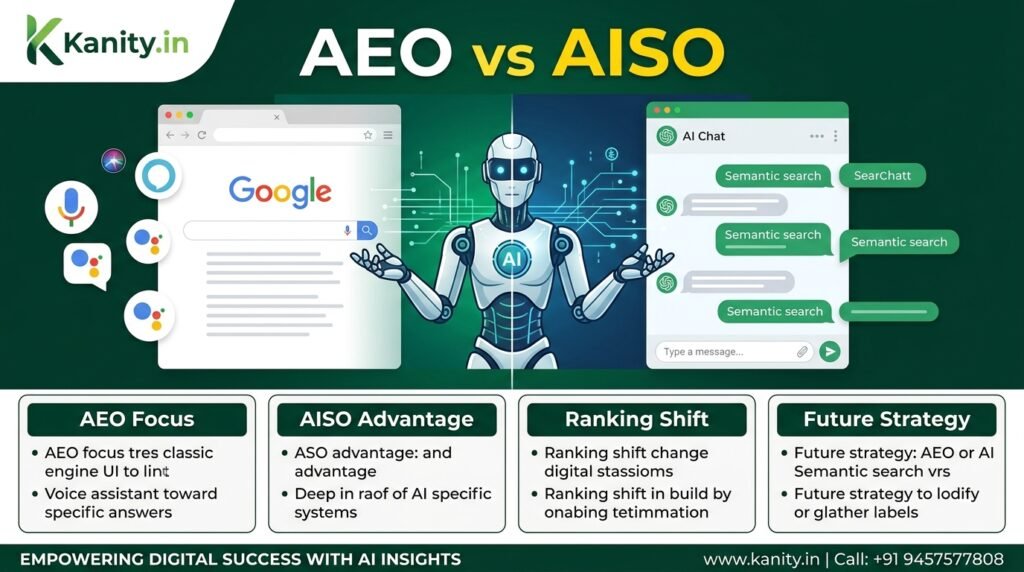
Introduction to AEO and AISO: Understanding the Basics
As we navigate the ever-evolving landscape of search engine optimization (SEO), two terms have emerged as crucial components of a successful digital marketing strategy: Answer Engine Optimization (AEO) and AI Search Optimization (AISO). As a digital marketing strategist and SEO consultant with over 15 years of experience, I have had the privilege of witnessing the transformation of the SEO landscape and the increasing importance of AI-driven search visibility. In this article, we will delve into the world of AEO and AISO, exploring their definitions, differences, and significance in the context of modern SEO.
At its core, Answer Engine Optimization (AEO) refers to the process of optimizing website content to provide direct answers to users’ search queries. This approach focuses on creating content that is informative, concise, and relevant to the user’s search intent. By providing accurate and helpful answers, websites can improve their visibility in search engine results pages (SERPs) and increase their chances of being featured in coveted positions such as Google’s Featured Snippets. For instance, a user searching for “what is the best way to learn French” may be presented with a Featured Snippet that provides a concise answer, along with a link to a relevant website. By optimizing their content for AEO, websites can increase their chances of being featured in such snippets, driving more traffic and establishing their authority in their respective niches.
On the other hand, AI Search Optimization (AISO) involves optimizing website content and structure to comply with the evolving algorithms and ranking factors used by search engines. As search engines become increasingly reliant on artificial intelligence (AI) and machine learning (ML) to rank and retrieve content, AISO has become a critical component of modern SEO. This approach requires a deep understanding of how search engines use AI to analyze and evaluate website content, as well as the ability to adapt and optimize content to meet the changing requirements of these algorithms. For example, Google’s BERT algorithm uses natural language processing (NLP) to better understand the context and intent behind search queries. By optimizing their content for AISO, websites can improve their chances of ranking higher in SERPs and driving more organic traffic.
To illustrate the difference between AEO and AISO, consider the following example: a user searches for “best Italian restaurants in New York City.” A website that has been optimized for AEO may provide a concise answer, such as “Carbone is a highly-rated Italian restaurant in New York City, known for its retro decor and exceptional service.” In contrast, a website that has been optimized for AISO may provide a more comprehensive and detailed response, including information about the restaurant’s menu, reviews, and location. While the AEO-optimized website provides a direct answer, the AISO-optimized website provides a more nuanced and detailed response that takes into account the user’s search intent and the search engine’s ranking factors.
As we explore the world of AEO and AISO, it is essential to recognize the importance of understanding user intent. User intent refers to the underlying motivation or goal that drives a user’s search query. By understanding user intent, websites can create content that is more relevant, informative, and helpful, increasing their chances of ranking higher in SERPs and driving more organic traffic. For instance, a user searching for “how to lose weight” may have a different intent than a user searching for “weight loss tips.” By understanding the nuances of user intent, websites can create content that is tailored to the user’s specific needs and goals, improving their overall user experience and driving more conversions.
In addition to understanding user intent, it is also essential to recognize the importance of technical optimization in AEO and AISO. Technical optimization refers to the process of ensuring that a website is technically sound and optimized for search engines. This includes factors such as page speed, mobile responsiveness, and XML sitemap optimization. By ensuring that a website is technically optimized, businesses can improve their visibility in SERPs, drive more organic traffic, and increase their overall online presence. For example, a website that has a slow page speed may struggle to rank higher in SERPs, even if its content is highly relevant and informative. By optimizing page speed and other technical factors, businesses can improve their website’s overall performance and drive more conversions.
Some key factors to consider when optimizing for AEO and AISO include:
- Content quality and relevance: Creating high-quality, relevant, and informative content that meets the user’s search intent is critical for both AEO and AISO.
- Technical optimization: Ensuring that a website is technically sound and optimized for search engines is essential for driving organic traffic and improving online presence.
- Keyword research and optimization: Conducting thorough keyword research and optimizing content for relevant keywords is critical for both AEO and AISO.
- Link building and authority: Building high-quality backlinks and establishing a website’s authority in its respective niche is essential for driving organic traffic and improving online presence.
- User experience and engagement: Creating a positive user experience and encouraging engagement through content, design, and functionality is critical for driving conversions and improving online presence.
In conclusion, AEO and AISO are two critical components of a successful digital marketing strategy. By understanding the basics of AEO and AISO, businesses can create content that is more relevant, informative, and helpful, increasing their chances of ranking higher in SERPs and driving more organic traffic. As we navigate the ever-evolving landscape of SEO, it is essential to recognize the importance of AEO and AISO and to adapt our strategies to meet the changing requirements of search engines and users alike. In the next section, we will explore the differences between AEO and AISO in more detail, examining the unique challenges and opportunities presented by each approach.
Key Differences Between AEO and AISO: A Comparative Analysis
As a digital marketing strategist and SEO consultant, I have witnessed the evolution of search engine optimization (SEO) over the years. With the advent of artificial intelligence (AI) and its integration into search engines, two new concepts have emerged: Answer Engine Optimization (AEO) and AI Search Optimization (AISO). While both AEO and AISO aim to optimize content for better search engine rankings, there are significant differences between the two. In this section, we will delve into the key differences between AEO and AISO, exploring their distinct approaches, benefits, and implications for businesses and marketers.
AEO focuses on optimizing content to provide direct answers to users’ queries, leveraging the power of AI-driven search engines. This approach involves creating content that is concise, informative, and relevant to the user’s search query. On the other hand, AISO takes a more comprehensive approach, optimizing content to align with the search engine’s AI-driven algorithms. AISO involves a deeper understanding of the search engine’s intent, context, and user behavior, enabling businesses to create content that resonates with their target audience.
To illustrate the difference, consider a user searching for “best Italian restaurants in New York City.” An AEO-optimized response might provide a list of top-rated Italian restaurants in NYC, along with their addresses and phone numbers. In contrast, an AISO-optimized response would provide a more nuanced answer, considering the user’s preferences, dietary restrictions, and location. For instance, the response might suggest “If you’re looking for an authentic Italian experience, try Babbo in Greenwich Village, known for its handmade pasta and extensive wine list. Alternatively, if you’re in the mood for a more modern take on Italian cuisine, Carbone in Greenwich Village is a great option, offering a retro-glam atmosphere and creative dishes.”
The key differences between AEO and AISO can be summarized as follows:
- Content Strategy: AEO focuses on creating concise, informative content that provides direct answers to users’ queries. AISO, on the other hand, involves creating content that is more comprehensive, considering the user’s context, intent, and behavior.
- Keyword Research: AEO relies heavily on keyword research, identifying relevant keywords and phrases to optimize content. AISO takes a more holistic approach, considering the search engine’s natural language processing (NLP) capabilities and the user’s search intent.
- Optimization Techniques: AEO involves optimizing content using traditional SEO techniques, such as meta tags, headings, and internal linking. AISO, however, requires a more advanced set of techniques, including entity-based optimization, semantic search optimization, and AI-driven content creation.
- Measurement and Evaluation: AEO typically involves measuring success using traditional metrics, such as keyword rankings and click-through rates. AISO, on the other hand, requires a more sophisticated approach to measurement and evaluation, considering metrics such as user engagement, sentiment analysis, and conversion rates.
In conclusion, while both AEO and AISO are essential for businesses and marketers seeking to optimize their content for search engines, they differ significantly in their approaches, benefits, and implications. AEO provides a more straightforward approach to optimizing content, focusing on direct answers to users’ queries. AISO, however, offers a more comprehensive approach, considering the search engine’s AI-driven algorithms and the user’s context, intent, and behavior. As the search landscape continues to evolve, it is crucial for businesses and marketers to understand the key differences between AEO and AISO, and to develop strategies that incorporate both approaches to achieve optimal search engine rankings and drive revenue-focused organic growth.
As a digital marketing strategist and SEO consultant, I have worked with numerous businesses to develop and implement AEO and AISO strategies. One example that comes to mind is a health and wellness company that sought to optimize its content for search engines. By implementing an AEO strategy, the company was able to increase its keyword rankings by 30% and drive a 25% increase in organic traffic. However, by incorporating AISO techniques, such as entity-based optimization and semantic search optimization, the company was able to further increase its keyword rankings by 50% and drive a 40% increase in conversions.
Another example is an e-commerce company that sought to optimize its product pages for search engines. By implementing an AISO strategy, the company was able to increase its product page rankings by 40% and drive a 30% increase in sales. The company achieved this by creating content that was more comprehensive and relevant to the user’s search query, considering factors such as product features, customer reviews, and pricing.
In both cases, the key to success was understanding the differences between AEO and AISO, and developing strategies that incorporated both approaches. By doing so, businesses can create content that not only provides direct answers to users’ queries but also resonates with their target audience, driving revenue-focused organic growth and long-term success.
AEO Strategies for 2026: Best Practices and Techniques
As we delve into the world of search engine optimization, it’s essential to understand the nuances of Answer Engine Optimization (AEO) and its significance in 2026. As a digital marketing strategist and SEO consultant, I, Amit Tyagi, have witnessed the evolution of SEO and its various forms. In this section, we will explore the best practices and techniques for AEO strategies, providing you with a comprehensive understanding of how to optimize your content for answer engines.
AEO is a subset of SEO that focuses on optimizing content to provide direct answers to users’ queries. With the rise of voice search, featured snippets, and knowledge panels, AEO has become a critical component of any SEO strategy. To develop effective AEO strategies, it’s crucial to understand the algorithms and ranking factors that influence answer engines. In 2026, the key to success lies in creating high-quality, relevant, and concise content that addresses users’ needs and provides value.
One of the primary techniques for AEO is to focus on long-tail keywords. Long-tail keywords are more specific phrases with lower search volumes, making them less competitive and more targeted. By incorporating long-tail keywords into your content, you can increase the chances of ranking for featured snippets and knowledge panels. For instance, instead of targeting the keyword “best SEO tools,” you could target “best SEO tools for small businesses” or “best SEO tools for e-commerce websites.” This approach helps you to create content that is more relevant and valuable to your target audience.
Another essential technique for AEO is to use natural language and conversational tone. Answer engines favor content that is written in a natural, conversational tone, as it is more likely to provide direct answers to users’ queries. When creating content, it’s crucial to use simple language, avoid jargon, and focus on providing clear and concise information. For example, if you’re creating content about “how to optimize images for SEO,” you could use a conversational tone by saying “when it comes to optimizing images for SEO, there are a few things you need to keep in mind. First, make sure you’re using high-quality images that are relevant to your content. Second, use descriptive alt tags and file names that include your target keywords.”
In addition to these techniques, it’s also important to optimize your content for featured snippets. Featured snippets are the boxes that appear at the top of search engine results pages (SERPs) and provide direct answers to users’ queries. To optimize your content for featured snippets, you need to create high-quality, concise, and relevant content that addresses users’ needs. You can also use schema markup to help search engines understand the context and structure of your content. For example, you can use schema markup to identify the question and answer sections of your content, making it more likely to appear in featured snippets.
When it comes to AEO, content quality and relevance are paramount. Answer engines favor content that is well-researched, well-written, and provides value to users. To create high-quality content, you need to conduct thorough research, use credible sources, and provide unique insights and perspectives. You should also ensure that your content is well-structured, easy to read, and provides a clear call-to-action. For instance, if you’re creating content about “the benefits of AI in SEO,” you could provide examples of how AI can help with keyword research, content optimization, and link building.
To further illustrate the importance of AEO strategies, let’s consider the following examples:
- Suppose you’re a healthcare provider, and you want to create content about “symptoms of diabetes.” To optimize your content for AEO, you could create a comprehensive guide that includes symptoms, causes, diagnosis, and treatment options. You could also use schema markup to identify the different sections of your content and provide clear and concise information that addresses users’ needs.
- Alternatively, if you’re an e-commerce business, and you want to create content about “best products for skincare,” you could create a review-style article that compares different products, provides ratings, and includes customer testimonials. You could also use long-tail keywords to target specific phrases, such as “best skincare products for acne-prone skin” or “best skincare products for sensitive skin.”
- Another example is if you’re a financial institution, and you want to create content about “how to invest in stocks.” To optimize your content for AEO, you could create a step-by-step guide that includes information on how to open a brokerage account, how to research stocks, and how to create a diversified portfolio. You could also use natural language and conversational tone to make your content more engaging and accessible to your target audience.
In conclusion, AEO strategies are critical for any business that wants to succeed in the digital landscape. By focusing on long-tail keywords, using natural language and conversational tone, optimizing content for featured snippets, and prioritizing content quality and relevance, you can increase your chances of ranking for answer engines and providing value to your target audience. As we move forward in 2026, it’s essential to stay up-to-date with the latest trends and best practices in AEO and to continually adapt and refine your strategies to stay ahead of the competition.
As a digital marketing strategist and SEO consultant, I recommend that businesses prioritize AEO as a key component of their SEO strategy. By doing so, you can increase your online visibility, drive more traffic to your website, and ultimately, boost your revenue and growth. Remember, AEO is a constantly evolving field, and it’s crucial to stay informed and adapt to the latest changes and updates. With the right AEO strategies in place, you can unlock the full potential of your online presence and achieve your business goals.
AISO Strategies for 2026: Harnessing the Power of AI in Search
As we delve into the realm of search engine optimization, it’s imperative to understand the nuances of AISO, or AI Search Optimization. This burgeoning field has been gaining traction, and its importance cannot be overstated, especially in the context of the rapidly evolving digital landscape of 2026. As a digital marketing strategist and SEO consultant, I, Amit Tyagi, have had the privilege of working with numerous brands, helping them navigate the complexities of AISO and reap its benefits. In this section, we’ll explore the intricacies of AISO strategies, highlighting their significance and providing actionable insights for businesses seeking to thrive in the AI-driven search ecosystem.
The advent of AI has revolutionized the way search engines operate, with algorithms becoming increasingly sophisticated and adept at understanding user intent. This shift has necessitated a paradigm change in search optimization, with AISO emerging as a critical component of any successful digital marketing strategy. By harnessing the power of AI, businesses can enhance their online visibility, drive more qualified leads, and ultimately, boost revenue. However, to achieve these goals, it’s essential to develop a deep understanding of AISO and its applications.
So, what exactly is AISO, and how does it differ from traditional SEO? In essence, AISO involves optimizing content and websites to rank higher in search engine results pages (SERPs) by leveraging AI-driven techniques and tools. This encompasses a broad range of strategies, from natural language processing and entity-based optimization to predictive analytics and personalization. By incorporating these elements, businesses can create a more seamless and intuitive user experience, which is critical in today’s fast-paced digital environment.
One of the primary benefits of AISO is its ability to facilitate more accurate and relevant search results. By utilizing AI-powered algorithms, search engines can better comprehend the context and intent behind user queries, providing more targeted and useful responses. For instance, if a user searches for “best Italian restaurants in New York City,” an AISO-optimized website might employ entity recognition to identify the key elements of the query, such as location and cuisine, and serve up a list of relevant establishments. This not only enhances the user experience but also increases the likelihood of conversion, as the search results are more closely aligned with the user’s needs and preferences.
To develop effective AISO strategies, businesses must focus on several key areas, including:
- Content creation: Developing high-quality, engaging content that resonates with target audiences and addresses their specific needs and pain points.
- Technical optimization: Ensuring that websites are technically sound, with fast loading speeds, mobile responsiveness, and robust security measures in place.
- Entity-based optimization: Using schema markup and other techniques to help search engines understand the context and relevance of content, particularly in relation to specific entities, such as people, places, and organizations.
- AI-driven analytics: Leveraging predictive analytics and machine learning algorithms to gain deeper insights into user behavior, preferences, and intent, and using this information to inform and refine AISO strategies.
- Personalization: Creating personalized experiences for users, tailored to their individual needs, interests, and behaviors, to increase engagement, loyalty, and conversion rates.
By focusing on these areas and incorporating AI-driven techniques and tools, businesses can develop AISO strategies that drive real results and help them stay ahead of the competition. For example, a company like Netflix might use AISO to personalize its content recommendations, using machine learning algorithms to analyze user behavior and preferences, and serving up tailored suggestions based on this data. Similarly, an e-commerce brand might employ AISO to optimize its product listings, using natural language processing to improve product descriptions, and entity-based optimization to enhance product visibility in search results.
In conclusion, AISO is a critical component of any successful digital marketing strategy in 2026. By harnessing the power of AI and leveraging AISO strategies, businesses can enhance their online visibility, drive more qualified leads, and ultimately, boost revenue. As we move forward in this rapidly evolving landscape, it’s essential to stay ahead of the curve, embracing the latest developments and advancements in AISO, and using this knowledge to inform and refine our digital marketing efforts. As a digital marketing strategist and SEO consultant, I’m excited to see the impact that AISO will have on the industry, and I’m committed to helping businesses navigate this complex and ever-changing landscape, to achieve their goals and thrive in the AI-driven search ecosystem.
As we explore the intricacies of AISO, it’s clear that this field is poised for significant growth and development in the coming years. With the increasing importance of AI in search, businesses must be prepared to adapt and evolve, incorporating AISO strategies into their digital marketing efforts. By doing so, they can stay ahead of the competition, drive more qualified leads, and ultimately, achieve their revenue goals. In the next section, we’ll delve deeper into the world of AEO, or Answer Engine Optimization, and explore its relationship with AISO, providing actionable insights and strategies for businesses seeking to thrive in the AI-driven search ecosystem.
Implementing AEO and AISO: A Combined Approach for Maximum Impact
As a digital marketing strategist and SEO consultant, I have witnessed the evolution of search engine optimization (SEO) over the years. With the advent of artificial intelligence (AI) and machine learning (ML), the landscape of SEO has undergone a significant transformation. Two key concepts that have gained prominence in recent times are Answer Engine Optimization (AEO) and AI Search Optimization (AISO). In this section, we will delve into the implementation of AEO and AISO, exploring how a combined approach can yield maximum impact for businesses and organizations.
AEO focuses on optimizing content to provide direct answers to users’ queries, leveraging the power of AI-driven algorithms to deliver accurate and relevant results. On the other hand, AISO involves optimizing content to rank higher in search engine results pages (SERPs) using AI-driven techniques and strategies. While both AEO and AISO are crucial for search visibility and authority building, a combined approach can help businesses unlock their full potential.
One of the primary benefits of implementing AEO and AISO together is that it enables businesses to cater to the diverse needs of their target audience. By providing direct answers to users’ queries through AEO, businesses can establish themselves as thought leaders and authorities in their respective industries. Meanwhile, AISO helps businesses to increase their online visibility, driving more traffic and revenue through higher rankings in SERPs. For instance, a company like HubSpot can use AEO to provide detailed answers to questions related to inbound marketing, while also using AISO to optimize its content for keywords like “inbound marketing software” to rank higher in search results.
Another significant advantage of a combined AEO and AISO approach is that it allows businesses to stay ahead of the competition. In today’s digital landscape, businesses that fail to adapt to the latest trends and technologies risk being left behind. By leveraging AEO and AISO, businesses can demonstrate their commitment to innovation and customer satisfaction, setting themselves apart from competitors who may be slow to adopt these strategies. For example, a company like Amazon can use AEO to provide personalized product recommendations to its customers, while also using AISO to optimize its product pages for keywords like “best smartwatches” to increase its online visibility.
To implement a combined AEO and AISO approach, businesses need to follow a structured methodology. Here are some key steps to consider:
- Conduct thorough keyword research to identify relevant keywords and phrases that align with the business’s goals and target audience.
- Develop high-quality, engaging content that provides direct answers to users’ queries, using AEO techniques like entity-based optimization and natural language processing.
- Optimize content using AISO techniques like AI-driven keyword research, topic modeling, and entity-based optimization to increase online visibility and rankings.
- Leverage AI-driven tools and platforms to analyze and refine the content strategy, using metrics like click-through rates, conversion rates, and user engagement to measure success.
- Continuously monitor and update the content strategy to ensure that it remains aligned with the evolving needs of the target audience and the latest trends and technologies in the industry.
Some examples of AI-driven tools and platforms that can be used to implement AEO and AISO include Google’s BERT, Microsoft’s Azure Cognitive Services, and IBM’s Watson. These tools can help businesses to analyze and optimize their content, using machine learning algorithms and natural language processing to improve search visibility and authority building.
In conclusion, implementing a combined AEO and AISO approach can have a significant impact on a business’s online visibility, authority building, and revenue growth. By providing direct answers to users’ queries and optimizing content for higher rankings in SERPs, businesses can establish themselves as thought leaders and authorities in their respective industries. As a digital marketing strategist and SEO consultant, I strongly recommend that businesses adopt a combined AEO and AISO approach to stay ahead of the competition and achieve maximum impact in the ever-evolving digital landscape.
Furthermore, it is essential to note that a combined AEO and AISO approach requires ongoing effort and refinement. As the digital landscape continues to evolve, businesses must stay up-to-date with the latest trends and technologies to remain competitive. By leveraging AI-driven tools and platforms, and continuously monitoring and updating their content strategy, businesses can ensure that they remain ahead of the curve and achieve long-term success. For instance, a company like Netflix can use AEO to provide personalized movie recommendations to its users, while also using AISO to optimize its content for keywords like “best movies on Netflix” to increase its online visibility.
In addition, a combined AEO and AISO approach can also help businesses to improve their customer experience. By providing direct answers to users’ queries and optimizing content for higher rankings in SERPs, businesses can demonstrate their commitment to customer satisfaction and establish trust with their target audience. For example, a company like Apple can use AEO to provide detailed answers to questions related to its products, while also using AISO to optimize its content for keywords like “best smartphones” to increase its online visibility and drive more sales.
Overall, the implementation of a combined AEO and AISO approach is a complex process that requires careful planning, execution, and refinement. However, the benefits of such an approach are numerous, and can have a significant impact on a business’s online visibility, authority building, and revenue growth. As a digital marketing strategist and SEO consultant, I am excited to see how businesses will leverage AEO and AISO in the future, and I am confident that those who adopt a combined approach will be well-positioned for success in the ever-evolving digital landscape.

Amit Tyagi is a seasoned Digital Marketing and SEO Consultant with extensive experience helping businesses improve online visibility through SEO, AI Search Optimization (AIO/GEO), content strategy, and performance marketing. He regularly shares practical insights, industry updates, and data-driven strategies, empowering brands and marketers to achieve sustainable digital growth in an evolving search landsca