
Introduction to Autonomous Customer Acquisition
As we step into the year 2026, the landscape of customer acquisition is undergoing a significant transformation. With the rapid advancement of artificial intelligence (AI) and machine learning (ML) technologies, businesses are now poised to leverage the power of autonomous systems to drive their sales efforts. As a digital marketing strategist and SEO consultant, I, Amit Tyagi, have had the privilege of witnessing the evolution of AI-driven sales strategies, and I firmly believe that autonomous customer acquisition is the future of business growth. In this article, we will delve into the concept of autonomous customer acquisition, its benefits, and how AI agents can become an integral part of your sales team.
The traditional sales model, which relies heavily on human interaction, is no longer sufficient to keep pace with the ever-changing customer behaviors and preferences. Customers today expect personalized experiences, instant responses, and seamless interactions across multiple touchpoints. To meet these expectations, businesses need to adopt a more agile and adaptable approach to sales, and that’s where autonomous customer acquisition comes into play. By harnessing the power of AI and ML, companies can create intelligent sales systems that can learn, adapt, and respond to customer needs in real-time, thereby maximizing the potential for conversion and revenue growth.
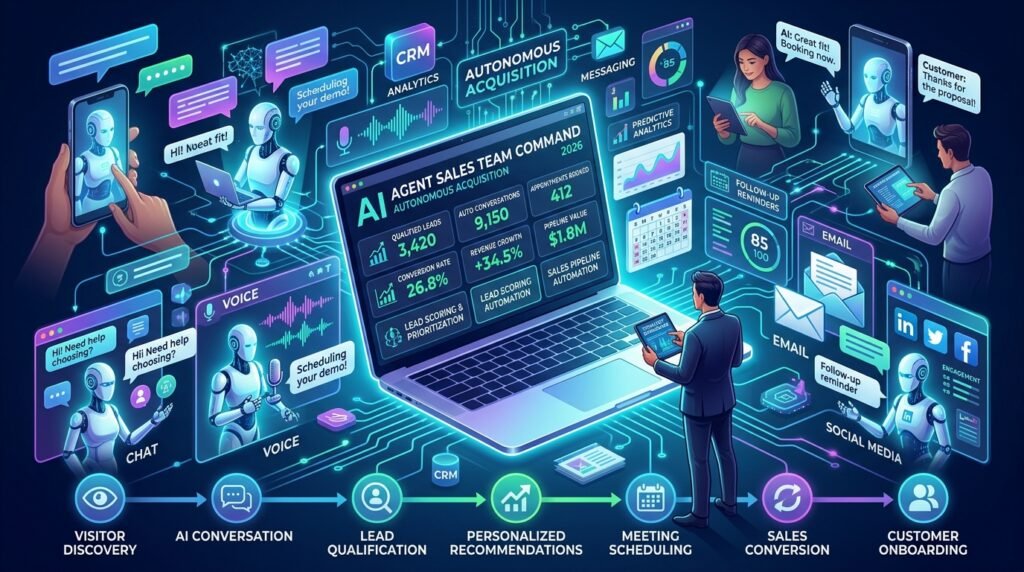
Autonomous customer acquisition involves the use of AI-powered agents that can simulate human-like conversations, analyze customer data, and make informed decisions to drive sales. These agents can be integrated into various channels, such as social media, messaging platforms, and websites, to interact with customers and provide them with personalized experiences. For instance, AI-powered chatbots can be used to engage with customers on social media, answering their queries, and routing complex issues to human representatives. Similarly, AI-driven email marketing campaigns can be designed to send personalized messages to customers based on their purchase history, browsing behavior, and other demographic factors.
The benefits of autonomous customer acquisition are multifaceted. Firstly, it enables businesses to scale their sales efforts without increasing their workforce. AI agents can handle a large volume of customer interactions simultaneously, freeing up human representatives to focus on high-value tasks that require empathy, creativity, and problem-solving skills. Secondly, autonomous customer acquisition helps companies to reduce their sales costs, as AI agents can operate around the clock without requiring breaks, vacations, or training. Thirdly, it provides businesses with valuable insights into customer behavior, preferences, and pain points, enabling them to refine their sales strategies and improve customer satisfaction.
To illustrate the potential of autonomous customer acquisition, let’s consider the example of a leading e-commerce company that implemented an AI-powered chatbot on its website. The chatbot was designed to engage with customers, answer their queries, and provide personalized product recommendations. Within a few months, the company witnessed a significant increase in sales, with the chatbot contributing to over 20% of the total revenue. The chatbot’s ability to provide instant responses, offer personalized suggestions, and route complex issues to human representatives helped to improve customer satisfaction, reduce bounce rates, and increase average order value.
In another example, a financial services company used AI-driven email marketing campaigns to target its customers with personalized offers and promotions. The company’s AI system analyzed customer data, such as purchase history, browsing behavior, and demographic factors, to create targeted email campaigns that resonated with its audience. As a result, the company witnessed a significant increase in open rates, click-through rates, and conversion rates, with the AI-driven email campaigns generating over 30% of the total revenue.
When it comes to implementing autonomous customer acquisition, businesses need to consider several factors, including the type of AI technology to use, the channels to deploy, and the metrics to measure success. Some of the key considerations include:
- Choosing the right AI technology: Businesses need to select an AI technology that aligns with their sales goals, customer behavior, and technical infrastructure. For instance, companies that want to engage with customers on social media may opt for AI-powered chatbots, while those that want to personalize email marketing campaigns may choose AI-driven marketing automation platforms.
- Deploying AI agents across channels: Companies need to decide which channels to deploy their AI agents, such as social media, messaging platforms, websites, or email. The choice of channel depends on customer behavior, preferences, and the type of sales interaction required.
- Measuring success: Businesses need to establish clear metrics to measure the success of their autonomous customer acquisition efforts. These metrics may include conversion rates, revenue growth, customer satisfaction, and return on investment (ROI).
- Integrating AI with human sales teams: Companies need to ensure that their AI agents are integrated with human sales teams to provide seamless customer experiences. This requires defining clear roles, responsibilities, and escalation procedures to ensure that complex issues are routed to human representatives.
- Continuously monitoring and optimizing: Businesses need to continuously monitor their autonomous customer acquisition efforts and optimize their AI systems to improve performance, customer satisfaction, and revenue growth.
In conclusion, autonomous customer acquisition is poised to revolutionize the way businesses approach sales and customer engagement. By leveraging the power of AI and ML, companies can create intelligent sales systems that can learn, adapt, and respond to customer needs in real-time. As we move forward in 2026, it’s essential for businesses to explore the potential of autonomous customer acquisition and develop strategies to harness its benefits. Whether it’s through AI-powered chatbots, email marketing campaigns, or other channels, the key to success lies in understanding customer behavior, preferences, and pain points, and using AI to provide personalized experiences that drive conversion, revenue growth, and customer satisfaction.
Understanding AI Agents in Sales: Capabilities and Limitations
As we step into 2026, the sales landscape is poised to undergo a significant transformation with the integration of Artificial Intelligence (AI) agents. These AI-powered entities are being designed to simulate human-like interactions, aiming to revolutionize the way businesses acquire customers and manage sales processes. As a digital marketing strategist and SEO consultant, I, Amit Tyagi, have had the opportunity to delve into the capabilities and limitations of AI agents in sales, and I must say, the potential is vast and promising.
To truly understand the role AI agents can play in sales, it’s essential to first grasp their capabilities. AI agents are equipped with advanced algorithms that enable them to analyze vast amounts of data, identify patterns, and make informed decisions. This capability allows them to personalize customer interactions, offering tailored solutions and recommendations that cater to individual needs and preferences. For instance, an AI agent can analyze a customer’s browsing history, purchase behavior, and social media activity to predict their buying intentions and provide targeted product suggestions.
Another significant capability of AI agents is their ability to process and respond to natural language inputs. This allows customers to interact with AI agents in a conversational manner, using voice or text-based interfaces. For example, a customer can ask an AI agent about the features and benefits of a particular product, and the agent can respond with detailed information, comparisons, and even provide personalized demos. This level of interactivity can significantly enhance the customer experience, making it more engaging, informative, and convenient.
However, it’s also important to acknowledge the limitations of AI agents in sales. While they can process and analyze vast amounts of data, they often lack the emotional intelligence and empathy that human sales representatives possess. This can lead to a lack of personal touch and understanding, which can be detrimental in building strong customer relationships. Moreover, AI agents may struggle to handle complex sales scenarios that require nuanced decision-making, creativity, and outside-the-box thinking.
Despite these limitations, AI agents can still play a vital role in augmenting human sales teams. By automating routine tasks, such as data entry, lead qualification, and follow-up communications, AI agents can free up human sales representatives to focus on high-value activities, such as building relationships, identifying new opportunities, and closing deals. This hybrid approach can lead to significant improvements in sales efficiency, productivity, and overall performance.
To illustrate the potential of AI agents in sales, let’s consider a few examples.
- Chatbots: Many companies are already using chatbots to provide basic customer support and answer frequently asked questions. These chatbots can be integrated with AI agents to provide more advanced sales capabilities, such as personalized product recommendations and lead qualification.
- Voice Assistants: Voice assistants, such as Amazon Alexa and Google Assistant, are being used to facilitate voice-based sales interactions. AI agents can be integrated with these voice assistants to provide customers with personalized product information, promotions, and offers.
- Virtual Sales Assistants: Virtual sales assistants, such as virtual product demos and guided selling tools, can be powered by AI agents to provide customers with immersive and interactive sales experiences.
These examples demonstrate the potential of AI agents to enhance sales processes, improve customer experiences, and drive revenue growth.
In conclusion, AI agents have the potential to revolutionize the sales landscape by providing personalized, efficient, and convenient customer interactions. While they have limitations, such as a lack of emotional intelligence and empathy, they can still play a vital role in augmenting human sales teams. By understanding the capabilities and limitations of AI agents, businesses can harness their potential to drive sales growth, improve customer satisfaction, and stay ahead of the competition in 2026 and beyond.
As we move forward, it’s essential to consider the future of sales and how AI agents will continue to evolve and improve. With advancements in machine learning, natural language processing, and computer vision, AI agents will become even more sophisticated, enabling them to handle complex sales scenarios, build strong customer relationships, and drive revenue growth. As a digital marketing strategist and SEO consultant, I’m excited to see how AI agents will transform the sales landscape and create new opportunities for businesses to thrive in the digital age.
The integration of AI agents in sales will also require businesses to rethink their sales strategies and processes. They will need to develop new skills, such as AI-powered sales analytics, to optimize their sales performance and stay ahead of the competition. Moreover, they will need to ensure that their AI agents are aligned with their brand values, messaging, and customer experience goals. By doing so, businesses can harness the full potential of AI agents and create a seamless, personalized, and engaging sales experience for their customers.
Finally, as we prepare for the autonomous customer acquisition in 2026, it’s essential to consider the ethical implications of using AI agents in sales. Businesses must ensure that their AI agents are transparent, fair, and unbiased, and that they prioritize customer privacy and data protection. By doing so, businesses can build trust with their customers, maintain a positive reputation, and create a sustainable and responsible sales strategy that drives long-term growth and success.
Preparing Your Business for Autonomous Customer Acquisition
As we step into 2026, the landscape of customer acquisition is undergoing a significant transformation. The integration of Artificial Intelligence (AI) in sales and marketing is no longer a novelty but a necessity for businesses aiming to stay ahead of the curve. AI agents, with their autonomous capabilities, are poised to revolutionize the way companies approach customer acquisition. As a digital marketing strategist and SEO consultant, I, Amit Tyagi, have witnessed firsthand the potential of AI-driven strategies in enhancing search visibility, building authority, and driving revenue-focused organic growth.
The concept of autonomous customer acquisition might seem like a futuristic dream, but it’s rapidly becoming a reality. AI agents, powered by advanced algorithms and machine learning, can interact with potential customers, understand their needs, and tailor pitches to convert them into loyal clients. This not only streamlines the sales process but also enhances the overall customer experience. However, to fully leverage the potential of AI agents, businesses must prepare their infrastructure, strategies, and mindset for this paradigm shift.
One of the primary steps in preparing your business for autonomous customer acquisition is to assess your current sales and marketing infrastructure. This involves evaluating your existing technology, data management systems, and customer interaction channels. The goal is to identify areas where AI integration can enhance efficiency, personalize customer interactions, and provide real-time insights. For instance, implementing a Customer Relationship Management (CRM) system that is compatible with AI agents can help in managing leads, tracking customer journeys, and analyzing sales performance.
Another crucial aspect is data quality and management. AI agents rely heavily on data to make informed decisions and interact effectively with customers. Ensuring that your business has a robust data management system in place, with accurate, up-to-date, and relevant customer information, is essential. This includes customer demographics, preferences, purchase history, and other behavioral data that can help AI agents in personalizing their approach. For example, an e-commerce company can use customer purchase history to train AI agents to recommend products that are likely to interest the customer, thereby increasing the chances of a sale.
In addition to infrastructure and data, training and development of AI agents are critical for autonomous customer acquisition. This involves feeding the AI system with a vast amount of data, including successful sales pitches, customer interactions, and market trends. The AI agents must be capable of learning from this data, adapting to new situations, and evolving their strategies based on feedback and performance metrics. Companies like HubSpot and Marketo are already leveraging AI in their marketing and sales platforms, demonstrating the potential of AI-driven customer acquisition.
Moreover, ethical considerations and transparency are paramount when deploying AI agents for customer acquisition. Businesses must ensure that their AI systems are fair, unbiased, and compliant with regulatory requirements. Transparency about the use of AI in customer interactions is also essential, as customers have the right to know when they are interacting with a human or a machine. This not only builds trust but also helps in avoiding any potential backlash or legal issues.
To further illustrate the potential of AI agents in autonomous customer acquisition, let’s consider a few examples:
- Chatbots and Virtual Assistants: Many companies are already using chatbots and virtual assistants to interact with customers, answer queries, and provide basic support. These AI-powered tools can be further enhanced to handle complex sales conversations, offer personalized recommendations, and even close deals.
- Social Media and Content Marketing: AI agents can analyze social media trends, create content, and engage with potential customers on platforms like Twitter, Facebook, and LinkedIn. This can help businesses expand their reach, build their brand, and drive website traffic.
- Email Marketing and Lead Nurturing: AI-driven email marketing campaigns can personalize messages, optimize send times, and automate follow-ups, leading to higher conversion rates and more efficient lead nurturing.
In conclusion, preparing your business for autonomous customer acquisition through AI agents requires a multifaceted approach. It involves assessing and upgrading your infrastructure, ensuring high-quality data management, training and developing AI agents, and prioritizing ethical considerations and transparency. By embracing these strategies and leveraging the potential of AI, businesses can revolutionize their sales and marketing efforts, enhance customer experiences, and stay competitive in the ever-evolving market landscape of 2026 and beyond.
Implementing AI Agents as Your Sales Team: Strategies and Best Practices
As we delve into the realm of autonomous customer acquisition, it’s essential to understand the role of AI agents in revolutionizing the sales process. As a digital marketing strategist, I’ve had the opportunity to work with numerous brands, helping them scale their operations through advanced SEO frameworks and performance-driven digital strategies. In this section, we’ll explore the strategies and best practices for implementing AI agents as your sales team, and how this can transform your customer acquisition process.
The concept of AI-powered sales teams is no longer a distant dream, but a reality that’s being embraced by forward-thinking businesses. By leveraging AI agents, companies can automate mundane sales tasks, freeing up human resources to focus on high-value activities that require creativity, empathy, and complex problem-solving skills. AI agents can handle tasks such as lead generation, qualification, and nurturing, allowing human sales teams to concentrate on closing deals and building long-term relationships with customers.
So, how can you implement AI agents as your sales team? The first step is to identify areas where AI can add value to your sales process. This could be in the form of chatbots that provide 24/7 customer support, or AI-powered lead scoring models that help you prioritize high-quality leads. Once you’ve identified these areas, you can begin to develop a strategy for integrating AI agents into your sales workflow.
One key strategy is to use AI agents to augment human sales teams, rather than replacing them. This hybrid approach allows you to leverage the strengths of both human and artificial intelligence, creating a more efficient and effective sales process. For example, AI agents can handle initial customer interactions, providing basic information and answering frequently asked questions. Human sales teams can then take over, providing personalized support and guidance to customers who require more complex assistance.
Another important consideration is data quality and integration. AI agents rely on high-quality data to function effectively, so it’s essential to ensure that your sales data is accurate, up-to-date, and integrated with your AI systems. This may involve implementing data management processes, such as data cleansing and normalization, to ensure that your AI agents have access to the information they need to perform their tasks.
In addition to these strategies, there are several best practices to keep in mind when implementing AI agents as your sales team. These include:
- Define clear goals and objectives for your AI agents, such as increasing lead generation or improving customer engagement.
- Develop a comprehensive training program for your AI agents, to ensure they have the knowledge and skills needed to perform their tasks effectively.
- Monitor and evaluate AI agent performance on an ongoing basis, using metrics such as conversion rates and customer satisfaction scores.
- Ensure transparency and accountability in your AI-powered sales process, by providing clear information to customers about how their data is being used and protected.
- Stay up-to-date with the latest developments in AI technology, to ensure your sales team remains competitive and effective in a rapidly evolving market.
By following these strategies and best practices, you can unlock the full potential of AI agents as your sales team, and achieve autonomous customer acquisition in 2026. Whether you’re a seasoned sales professional or just starting out, the key is to be open to new ideas and technologies, and to be willing to adapt and evolve in response to changing market conditions.
For example, companies like HubSpot and Salesforce are already using AI agents to power their sales and marketing efforts. These companies have developed sophisticated AI-powered systems that can analyze customer data, identify potential leads, and even predict customer behavior. By leveraging these capabilities, businesses can gain a competitive edge in the market, and achieve greater efficiency and effectiveness in their sales operations.
Another example is the use of chatbots in customer service. Chatbots are AI-powered systems that can provide 24/7 customer support, answering frequently asked questions and helping customers resolve basic issues. By using chatbots, companies can reduce the workload of human customer support teams, allowing them to focus on more complex and high-value tasks. This can lead to significant cost savings, as well as improved customer satisfaction and loyalty.
In conclusion, implementing AI agents as your sales team requires a strategic and nuanced approach. By understanding the strengths and limitations of AI technology, and by developing a comprehensive plan for integration and deployment, you can unlock the full potential of AI-powered sales and achieve autonomous customer acquisition in 2026. Whether you’re a business leader, a sales professional, or a marketing expert, the key is to be open to new ideas and technologies, and to be willing to adapt and evolve in response to changing market conditions.
As we move forward into the future of sales and marketing, it’s essential to stay ahead of the curve and to be prepared for the opportunities and challenges that AI-powered sales will bring. By following the strategies and best practices outlined in this section, you can position your business for success in a rapidly evolving market, and achieve greater efficiency, effectiveness, and competitiveness in your sales operations. With the right approach and mindset, the possibilities are endless, and the potential for growth and innovation is vast.
Future of Autonomous Customer Acquisition: Trends and Predictions for 2026
As we step into 2026, the landscape of customer acquisition is poised to undergo a significant transformation. The integration of Artificial Intelligence (AI) in sales and marketing is no longer a novelty but a necessity for businesses aiming to stay ahead of the curve. As a digital marketing strategist and SEO consultant, I, Amit Tyagi, have had the privilege of witnessing firsthand the evolution of AI-driven sales strategies. In this section, we will delve into the future of autonomous customer acquisition, exploring the trends and predictions that will shape the industry in 2026.
The concept of autonomous customer acquisition refers to the use of AI-powered agents to manage and execute sales and marketing tasks without human intervention. These agents are designed to learn from data, adapt to changing market conditions, and make decisions in real-time, thereby optimizing the customer acquisition process. The potential of autonomous customer acquisition is vast, and its impact will be felt across various industries, from e-commerce and finance to healthcare and technology.
One of the primary trends that will dominate the autonomous customer acquisition landscape in 2026 is the increased use of Generative AI. This technology has the capability to generate human-like content, such as product descriptions, social media posts, and even entire websites. Generative AI will enable businesses to create personalized customer experiences at scale, thereby enhancing engagement and conversion rates. For instance, an e-commerce company can use Generative AI to create customized product recommendations for each customer, based on their browsing history, search queries, and purchase behavior.
Another significant trend that will shape the future of autonomous customer acquisition is the rise of Conversational AI. Conversational AI refers to the use of chatbots, voice assistants, and other conversational interfaces to interact with customers and provide them with personalized support. In 2026, we can expect to see Conversational AI become more sophisticated, with the ability to understand nuances of human language, empathize with customers, and provide more accurate solutions to their queries. For example, a financial services company can use Conversational AI to offer customers personalized investment advice, based on their financial goals, risk tolerance, and investment horizon.
The use of Predictive Analytics will also play a crucial role in autonomous customer acquisition in 2026. Predictive Analytics involves the use of machine learning algorithms to analyze customer data, identify patterns, and predict future behavior. By leveraging Predictive Analytics, businesses can anticipate customer needs, preferences, and pain points, and develop targeted marketing campaigns to address them. For instance, a healthcare company can use Predictive Analytics to identify patients who are at risk of developing a certain disease, and offer them personalized prevention and treatment plans.
In addition to these trends, there are several predictions that can be made about the future of autonomous customer acquisition in 2026. Some of these predictions include:
- The widespread adoption of AI-powered sales automation tools, which will enable businesses to automate routine sales tasks, such as lead qualification, follow-up emails, and data entry.
- The increasing use of Virtual Reality (VR) and Augmented Reality (AR) to create immersive customer experiences, such as virtual product demos, 360-degree views, and interactive tutorials.
- The growing importance of Customer Data Platforms (CDPs), which will enable businesses to collect, integrate, and analyze customer data from multiple sources, and use it to develop personalized marketing campaigns.
- The emergence of new job roles and skills in the field of autonomous customer acquisition, such as AI sales trainers, conversational AI designers, and predictive analytics specialists.
In conclusion, the future of autonomous customer acquisition in 2026 is exciting and full of possibilities. As AI technology continues to evolve, we can expect to see more sophisticated and effective sales and marketing strategies emerge. Businesses that embrace autonomous customer acquisition will be able to stay ahead of the competition, enhance customer engagement, and drive revenue growth. As a digital marketing strategist and SEO consultant, I am eager to help businesses navigate this new landscape and unlock the full potential of autonomous customer acquisition.
To prepare for the future of autonomous customer acquisition, businesses should start by assessing their current sales and marketing infrastructure, and identifying areas where AI can be leveraged to improve efficiency, effectiveness, and personalization. They should also invest in developing the skills and expertise needed to implement and manage AI-powered sales and marketing tools, such as Generative AI, Conversational AI, and Predictive Analytics. By taking these steps, businesses can position themselves for success in the autonomous customer acquisition landscape of 2026, and beyond.
Furthermore, businesses should also focus on developing a customer-centric approach to autonomous customer acquisition. This involves understanding customer needs, preferences, and pain points, and using AI to deliver personalized experiences that meet their expectations. By putting the customer at the center of their sales and marketing strategy, businesses can build trust, loyalty, and advocacy, and drive long-term growth and profitability. In the next section, we will explore the importance of customer-centricity in autonomous customer acquisition, and provide tips and strategies for businesses to develop a customer-centric approach to sales and marketing.

Amit Tyagi is a seasoned Digital Marketing and SEO Consultant with extensive experience helping businesses improve online visibility through SEO, AI Search Optimization (AIO/GEO), content strategy, and performance marketing. He regularly shares practical insights, industry updates, and data-driven strategies, empowering brands and marketers to achieve sustainable digital growth in an evolving search landsca