
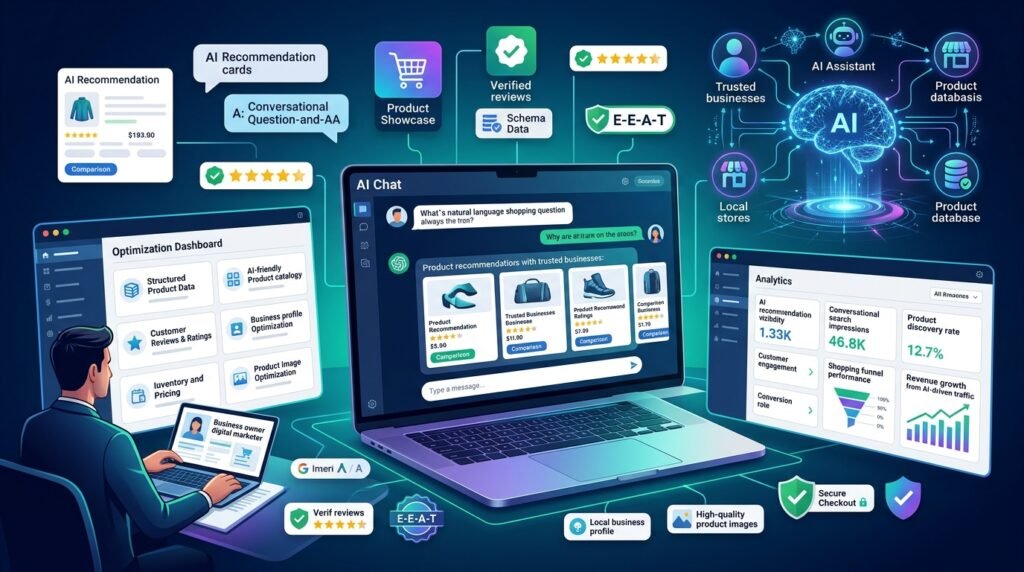
Introduction to ChatGPT Shopping AI Recommendations and Conversational Search
As a digital marketing strategist and SEO consultant, I, Amit Tyagi, have witnessed the evolution of search engines and their impact on businesses. The latest development in this space is the integration of ChatGPT, a conversational AI, into shopping platforms. This innovative technology has given rise to a new era of search, known as conversational search, where users can engage in natural-sounding conversations with AI-powered chatbots to find products and services. In this section, we will delve into the world of ChatGPT shopping AI recommendations and conversational search, exploring how businesses can leverage this technology to enhance their online presence and drive revenue.
ChatGPT shopping AI recommendations are designed to provide users with personalized product suggestions based on their preferences, search history, and behavior. This is achieved through advanced natural language processing (NLP) and machine learning algorithms that analyze user inputs and generate relevant responses. The conversational search aspect of ChatGPT allows users to ask follow-up questions, request more information, or even seek recommendations from the AI chatbot. This interactive approach to search has revolutionized the way users discover and engage with products online.
For businesses, the integration of ChatGPT shopping AI recommendations and conversational search presents a significant opportunity to increase their online visibility, drive conversions, and build brand loyalty. By optimizing their digital presence for conversational search, businesses can improve their chances of appearing in ChatGPT’s search results, thereby reaching a wider audience and gaining a competitive edge in their respective markets. In the following sections, we will explore the strategies and techniques that businesses can employ to rank their business on ChatGPT shopping AI recommendations and conversational search.
To understand the potential of ChatGPT shopping AI recommendations and conversational search, let’s consider a few examples. Suppose a user is searching for a new smartphone on a ChatGPT-powered shopping platform. The user can ask the chatbot questions like “What are the latest smartphone models available?” or “Which smartphone has the best camera?” The chatbot will respond with relevant information, including product recommendations, prices, and reviews. The user can then engage in a conversation with the chatbot, asking follow-up questions or seeking more information about specific products.
This conversational approach to search provides businesses with a unique opportunity to showcase their products and services in a more personalized and engaging way. By providing accurate and helpful responses to user queries, businesses can establish themselves as authorities in their respective markets, building trust and credibility with potential customers. As we will discuss later, this requires a deep understanding of the user’s intent, preferences, and behavior, as well as the ability to create high-quality, relevant content that meets their needs.
The rise of ChatGPT shopping AI recommendations and conversational search also highlights the importance of developing a robust digital marketing strategy that incorporates AI-driven search visibility, authority building, and revenue-focused organic growth. As a digital marketing strategist and SEO consultant, I have worked with numerous businesses to develop and implement such strategies, leveraging advanced SEO frameworks, Generative Engine Optimization (GEO), and performance-driven digital strategies to drive growth and revenue.
In the context of ChatGPT shopping AI recommendations and conversational search, businesses need to focus on creating high-quality, conversational content that resonates with their target audience. This can include product descriptions, reviews, and tutorials, as well as more in-depth content like blog posts, videos, and podcasts. By developing a content strategy that aligns with the user’s intent and preferences, businesses can increase their chances of appearing in ChatGPT’s search results and driving conversions.
To achieve this, businesses can use a variety of techniques, including:
- Conducting thorough keyword research to identify relevant search terms and phrases
- Creating high-quality, conversational content that meets the user’s needs and preferences
- Optimizing product pages and descriptions for conversational search
- Developing a robust review and ratings strategy to build trust and credibility
- Leveraging social media and influencer marketing to amplify their brand message and reach a wider audience
By incorporating these techniques into their digital marketing strategy, businesses can improve their online visibility, drive conversions, and establish themselves as authorities in their respective markets. In the next section, we will explore the importance of developing a robust digital marketing strategy that incorporates AI-driven search visibility, authority building, and revenue-focused organic growth.
In conclusion, ChatGPT shopping AI recommendations and conversational search have revolutionized the way users discover and engage with products online. By understanding the potential of this technology and developing a robust digital marketing strategy, businesses can increase their online visibility, drive conversions, and establish themselves as authorities in their respective markets. As a digital marketing strategist and SEO consultant, I am excited to help businesses navigate this new era of search and drive growth and revenue through AI-driven search visibility, authority building, and revenue-focused organic growth.
As we move forward in this guide, we will delve deeper into the strategies and techniques that businesses can employ to rank their business on ChatGPT shopping AI recommendations and conversational search. We will explore the importance of developing a robust digital marketing strategy, creating high-quality conversational content, and leveraging advanced SEO frameworks and Generative Engine Optimization (GEO) to drive growth and revenue. By the end of this guide, businesses will have a comprehensive understanding of how to optimize their digital presence for ChatGPT shopping AI recommendations and conversational search, and how to drive growth and revenue in this new era of search.
Optimizing Your Business for ChatGPT Shopping AI Recommendations
As a digital marketing strategist and SEO consultant, I have helped numerous businesses scale globally through advanced SEO frameworks, Generative Engine Optimization (GEO), and performance-driven digital strategies. With the rise of ChatGPT shopping AI recommendations and conversational search, it’s essential for businesses to optimize their online presence to maximize visibility and revenue. In this section, we will delve into the world of ChatGPT shopping AI recommendations and explore the strategies to optimize your business for this emerging trend.
ChatGPT shopping AI recommendations are revolutionizing the way people shop online. This technology uses artificial intelligence to understand user preferences, behavior, and search history to provide personalized product recommendations. As a business owner, it’s crucial to understand how ChatGPT shopping AI recommendations work and how you can optimize your business to increase visibility and sales.
To start with, you need to ensure that your business is listed on the ChatGPT platform. This involves creating a business profile, adding high-quality product images, and providing detailed product descriptions. It’s also essential to optimize your product titles, descriptions, and keywords to match the search intent of your target audience. For instance, if you’re an e-commerce company selling outdoor gear, you should use keywords like “hiking boots,” “camping tents,” or “fishing rods” to help ChatGPT’s AI algorithm understand your product offerings.
Another critical aspect of optimizing your business for ChatGPT shopping AI recommendations is to focus on building high-quality backlinks from authoritative sources. Backlinks are a crucial ranking factor for ChatGPT’s AI algorithm, as they indicate the credibility and trustworthiness of your business. You can build backlinks by guest blogging, participating in online communities, or partnering with influencers in your niche. For example, if you’re a fashion brand, you can partner with fashion bloggers or influencers to showcase your products and build backlinks to your website.
In addition to building backlinks, it’s also essential to optimize your website for user experience and conversational search. This involves ensuring that your website is mobile-friendly, has fast loading speeds, and provides a seamless user experience. You should also use conversational language in your product descriptions, FAQs, and customer support sections to help ChatGPT’s AI algorithm understand your business and provide accurate recommendations. For instance, if a user asks ChatGPT “What are the best hiking boots for beginners?”, your website should have a conversational answer that provides a clear and concise recommendation.
Furthermore, you should focus on building a strong brand identity and authority in your niche. This involves creating high-quality content, engaging with your target audience on social media, and providing exceptional customer service. You should also use schema markup on your website to provide additional context to ChatGPT’s AI algorithm about your business and products. For example, you can use schema markup to highlight your business hours, location, and product reviews to help ChatGPT provide more accurate recommendations.
To optimize your business for ChatGPT shopping AI recommendations, you should also keep an eye on the latest trends and updates in the world of conversational search. This involves staying up-to-date with the latest developments in natural language processing (NLP), machine learning, and artificial intelligence. You should also experiment with different optimization strategies and track the results to see what works best for your business. For instance, you can use A/B testing to compare the performance of different product titles, descriptions, and keywords to see which ones drive more conversions and sales.
Some key strategies to optimize your business for ChatGPT shopping AI recommendations include:
- Creating high-quality, conversational content that resonates with your target audience
- Building high-quality backlinks from authoritative sources to increase credibility and trustworthiness
- Optimizing your website for user experience and conversational search
- Using schema markup to provide additional context to ChatGPT’s AI algorithm about your business and products
- Staying up-to-date with the latest trends and updates in the world of conversational search
- Experimenting with different optimization strategies and tracking the results to see what works best for your business
In conclusion, optimizing your business for ChatGPT shopping AI recommendations requires a deep understanding of how this technology works and the strategies to maximize visibility and revenue. By focusing on building high-quality backlinks, optimizing your website for user experience and conversational search, and creating high-quality content, you can increase your chances of ranking higher on ChatGPT’s shopping AI recommendations and driving more sales and revenue for your business. As a digital marketing strategist and SEO consultant, I recommend that businesses stay ahead of the curve and adapt to the latest trends and updates in the world of conversational search to remain competitive and successful in the market.
By following these strategies and staying focused on providing exceptional user experiences, you can optimize your business for ChatGPT shopping AI recommendations and drive long-term growth and success. Whether you’re an e-commerce company, a brick-and-mortar store, or a service-based business, ChatGPT shopping AI recommendations provide a unique opportunity to reach and engage with your target audience in a more personalized and conversational way. As we move forward in 2026 and beyond, it’s essential to prioritize ChatGPT optimization and conversational search to stay ahead of the competition and drive business success.
The future of search is conversational, and businesses that adapt to this trend will be better positioned to succeed in the market. By optimizing your business for ChatGPT shopping AI recommendations and conversational search, you can increase your online visibility, drive more sales and revenue, and build a strong brand identity that resonates with your target audience. As a digital marketing strategist and SEO consultant, I am excited to help businesses navigate this new landscape and achieve long-term growth and success through advanced SEO frameworks, Generative Engine Optimization (GEO), and performance-driven digital strategies.
Building Authority and Trust for ChatGPT Recommendations
As a digital marketing strategist and SEO consultant, I have witnessed the evolution of search engines and the emergence of AI-driven search visibility. With the rise of ChatGPT, businesses are now looking to optimize their online presence for conversational search and AI-powered recommendations. In this section, we will explore the importance of building authority and trust for ChatGPT recommendations and provide actionable tips to help your business rank higher in 2026.
Establishing authority and trust is crucial for any business looking to succeed in the digital landscape. ChatGPT, being an AI-powered conversational search engine, relies heavily on the credibility and reliability of the information it provides to its users. To rank your business on ChatGPT shopping AI recommendations, you need to demonstrate your expertise, showcase your brand’s values, and build trust with your target audience.
So, how do you build authority and trust for ChatGPT recommendations? The process starts with creating high-quality, informative, and engaging content that addresses the needs and concerns of your target audience. This can include blog posts, articles, videos, podcasts, and social media posts that provide valuable insights, tips, and advice related to your industry or niche. By consistently producing high-quality content, you can establish your brand as a thought leader and authority in your industry, making it more likely for ChatGPT to recommend your business to its users.
Another important factor in building authority and trust is to optimize your website and online presence for SEO. This includes ensuring that your website is mobile-friendly, has fast loading speeds, and is secure (HTTPS). You should also focus on building high-quality backlinks from reputable sources, as these can significantly improve your website’s authority and trustworthiness. Additionally, make sure to claim and optimize your Google My Business listing, as this can help improve your local search visibility and increase your chances of being recommended by ChatGPT.
Furthermore, it’s essential to leverage user-generated content (UGC) and customer reviews to build trust and credibility with your target audience. Encourage your customers to leave reviews on your website, social media, or other review platforms, and respond promptly to any feedback or concerns. This will not only improve your online reputation but also increase your visibility in ChatGPT search results. For example, a study by BrightLocal found that 85% of consumers trust online reviews as much as personal recommendations, highlighting the importance of UGC in building trust and credibility.
In addition to these strategies, you should also focus on building a strong brand identity and showcasing your brand’s values and mission. This can include creating a unique and compelling brand story, developing a consistent tone and voice, and highlighting your brand’s social responsibility and community involvement. By building a strong brand identity, you can differentiate yourself from your competitors and establish a deeper connection with your target audience, making it more likely for ChatGPT to recommend your business.
Some examples of businesses that have successfully built authority and trust for ChatGPT recommendations include:
- Patagonia, which has established itself as a leader in sustainable and environmentally-friendly clothing, and has built a strong brand identity around its commitment to social and environmental responsibility.
- Warby Parker, which has created a unique and compelling brand story around its mission to provide affordable and stylish eyewear, and has built a strong reputation for its excellent customer service and social responsibility.
- Dollar Shave Club, which has disrupted the traditional razor industry with its innovative subscription-based model, and has built a strong brand identity around its commitment to convenience, affordability, and sustainability.
These businesses have successfully built authority and trust with their target audience, and have established themselves as leaders in their respective industries. By following their example and implementing the strategies outlined above, you can build authority and trust for ChatGPT recommendations and increase your chances of ranking higher in conversational search results.
In conclusion, building authority and trust is a crucial step in ranking your business on ChatGPT shopping AI recommendations. By creating high-quality content, optimizing your website and online presence for SEO, leveraging user-generated content and customer reviews, and building a strong brand identity, you can establish your business as a thought leader and authority in your industry. Remember to stay focused on providing value to your target audience, and to continuously adapt and evolve your strategies to stay ahead of the competition. With the right approach and mindset, you can increase your visibility in ChatGPT search results and drive more sales and revenue for your business in 2026.
Technical SEO for ChatGPT and Conversational Search
As a digital marketing strategist and SEO consultant, I have witnessed the rapid evolution of search engines and the rise of Artificial Intelligence (AI) in revolutionizing the way we interact with online platforms. With the emergence of ChatGPT and conversational search, businesses must adapt their technical SEO strategies to stay ahead of the curve. In this section, we will delve into the world of technical SEO for ChatGPT and conversational search, exploring the key elements that can help your business thrive in this new landscape.
Technical SEO is the foundation of any successful search engine optimization strategy, and it plays a crucial role in ensuring that your website is crawlable, indexable, and visible to search engines like ChatGPT. To optimize your website for ChatGPT and conversational search, you need to focus on several key areas, including page speed, mobile-friendliness, SSL encryption, and schema markup. By optimizing these elements, you can improve your website’s visibility, drive more traffic, and increase your chances of ranking higher in ChatGPT’s search results.
Let’s take a closer look at each of these areas and explore how you can optimize them for ChatGPT and conversational search. Page speed is a critical factor in technical SEO, as it directly affects the user experience and search engine rankings. A slow-loading website can lead to higher bounce rates, lower engagement, and reduced conversions. To optimize your website’s page speed, you can use tools like Google PageSpeed Insights or GTmetrix to identify areas for improvement. Some strategies for improving page speed include compressing images, minifying CSS and JavaScript files, and leveraging browser caching.
Another important aspect of technical SEO is mobile-friendliness. With the majority of online searches now taking place on mobile devices, it’s essential to ensure that your website is optimized for mobile users. A mobile-friendly website should have a responsive design that adapts to different screen sizes and devices, easy-to-use navigation, and fast loading speeds. You can test your website’s mobile-friendliness using tools like Google’s Mobile-Friendly Test or by simply accessing your website on a mobile device.
In addition to page speed and mobile-friendliness, SSL encryption is also a critical factor in technical SEO. SSL (Secure Sockets Layer) encryption is a security protocol that helps protect user data and secure online transactions. In 2020, Google announced that it would start prioritizing HTTPS websites in search results, making SSL encryption a must-have for any business website. To enable SSL encryption on your website, you can purchase an SSL certificate from a trusted provider and install it on your server. This will not only improve your website’s security but also increase trust with your users and search engines.
Finally, schema markup is another essential element in technical SEO for ChatGPT and conversational search. Schema markup is a type of microdata that helps search engines understand the context and meaning of your website’s content. By adding schema markup to your website, you can provide search engines with additional information about your business, such as hours of operation, prices, and reviews. This can help improve your website’s visibility in search results and drive more targeted traffic to your site. Some common types of schema markup include LocalBusiness, Product, and Review.
To illustrate the importance of technical SEO for ChatGPT and conversational search, let’s consider an example. Suppose you own an e-commerce website that sells outdoor gear and apparel. To optimize your website for ChatGPT and conversational search, you would want to focus on technical SEO elements like page speed, mobile-friendliness, SSL encryption, and schema markup. By optimizing these elements, you can improve your website’s visibility, drive more traffic, and increase your chances of ranking higher in ChatGPT’s search results. For instance, you could add schema markup to your product pages to provide search engines with additional information about your products, such as prices, reviews, and availability.
Here are some additional tips for optimizing your website for ChatGPT and conversational search:
- Use natural language processing (NLP) to optimize your website’s content and improve its relevance to conversational search queries.
- Implement voice search optimization techniques, such as using long-tail keywords and phrases, to improve your website’s visibility in voice search results.
- Use entity-based optimization to help search engines understand the context and meaning of your website’s content and improve its relevance to conversational search queries.
- Leverage user-generated content, such as reviews and testimonials, to improve your website’s credibility and trust with search engines and users.
- Stay up-to-date with the latest algorithm updates and best practices in technical SEO to ensure that your website remains optimized for ChatGPT and conversational search.
In conclusion, technical SEO is a critical component of any successful search engine optimization strategy, and it plays a vital role in helping businesses rank higher in ChatGPT and conversational search results. By focusing on key elements like page speed, mobile-friendliness, SSL encryption, and schema markup, you can improve your website’s visibility, drive more traffic, and increase your chances of success in the world of conversational search. As a digital marketing strategist and SEO consultant, I recommend that businesses prioritize technical SEO and stay up-to-date with the latest best practices and algorithm updates to remain competitive in this rapidly evolving landscape.
Measuring Success and Scaling Your Business with ChatGPT
As a business owner, understanding how to measure the success of your ChatGPT shopping AI recommendations and conversational search efforts is crucial to scaling your business in 2026. With the rise of AI-driven search visibility, it’s essential to have a robust framework in place to track your progress, identify areas for improvement, and make data-driven decisions to drive revenue-focused organic growth. In this section, we’ll delve into the key performance indicators (KPIs) you should be tracking, and provide actionable tips on how to optimize your ChatGPT strategy for maximum ROI.
When it comes to measuring success on ChatGPT, it’s not just about tracking vanity metrics such as likes, shares, and comments. Instead, you need to focus on metrics that have a direct impact on your bottom line. Some of the key KPIs you should be tracking include:
- Conversion rates: This includes tracking the number of users who complete a desired action, such as making a purchase, filling out a form, or subscribing to a newsletter, after interacting with your ChatGPT recommendations.
- Click-through rates (CTRs): This measures the number of users who click on your ChatGPT recommendations, and can help you understand the effectiveness of your messaging and targeting.
- Average order value (AOV): This tracks the average amount spent by users who make a purchase after interacting with your ChatGPT recommendations, and can help you understand the revenue potential of your strategy.
- Return on ad spend (ROAS): This measures the revenue generated by your ChatGPT recommendations compared to the cost of running the ads, and can help you understand the profitability of your strategy.
- Customer lifetime value (CLV): This tracks the total value of a customer over their lifetime, and can help you understand the long-term potential of your ChatGPT strategy.
By tracking these KPIs, you can gain a deeper understanding of how your ChatGPT strategy is performing, and make data-driven decisions to optimize your approach. For example, if you notice that your CTR is high, but your conversion rate is low, you may need to adjust your messaging or targeting to better align with your target audience. On the other hand, if you notice that your AOV is high, but your ROAS is low, you may need to adjust your bidding strategy or ad creative to improve the profitability of your campaign.
In addition to tracking KPIs, it’s also essential to have a robust framework in place for scaling your business with ChatGPT. This includes:
- Developing a clear value proposition that resonates with your target audience, and differentiates your business from the competition.
- Creating high-quality, engaging content that addresses the needs and pain points of your target audience, and provides value to users.
- Building a strong brand identity that is consistent across all touchpoints, and reflects the values and mission of your business.
- Establishing key partnerships and collaborations that can help you reach new audiences, and drive revenue growth.
- Investing in ongoing training and education to stay up-to-date with the latest trends and best practices in ChatGPT and AI-driven search visibility.
By following these tips, and tracking the right KPIs, you can set your business up for success with ChatGPT, and drive revenue-focused organic growth in 2026. Remember, scaling your business with ChatGPT requires a long-term approach, and a willingness to continuously optimize and improve your strategy. With the right framework in place, and a deep understanding of your target audience, you can unlock the full potential of ChatGPT, and take your business to the next level.
For example, let’s say you’re an e-commerce business that sells outdoor gear and apparel. You could use ChatGPT to create personalized product recommendations for users based on their search history and preferences. By tracking KPIs such as conversion rates, CTRs, and AOV, you can understand how effective your recommendations are, and make data-driven decisions to optimize your approach. You could also use ChatGPT to create engaging content, such as product reviews and tutorials, that provides value to users and helps to establish your brand as a thought leader in the industry.
Another example could be a travel company that uses ChatGPT to provide personalized travel recommendations to users. By tracking KPIs such as ROAS and CLV, you can understand the revenue potential of your strategy, and make data-driven decisions to optimize your approach. You could also use ChatGPT to create engaging content, such as travel guides and destination reviews, that provides value to users and helps to establish your brand as a thought leader in the industry.
In conclusion, measuring success and scaling your business with ChatGPT requires a deep understanding of your target audience, a robust framework for tracking KPIs, and a willingness to continuously optimize and improve your strategy. By following the tips outlined in this section, and tracking the right KPIs, you can unlock the full potential of ChatGPT, and drive revenue-focused organic growth in 2026. Whether you’re an e-commerce business, a travel company, or any other type of business, ChatGPT provides a powerful tool for reaching and engaging with your target audience, and driving long-term revenue growth.

Amit Tyagi is a seasoned Digital Marketing and SEO Consultant with extensive experience helping businesses improve online visibility through SEO, AI Search Optimization (AIO/GEO), content strategy, and performance marketing. He regularly shares practical insights, industry updates, and data-driven strategies, empowering brands and marketers to achieve sustainable digital growth in an evolving search landsca