
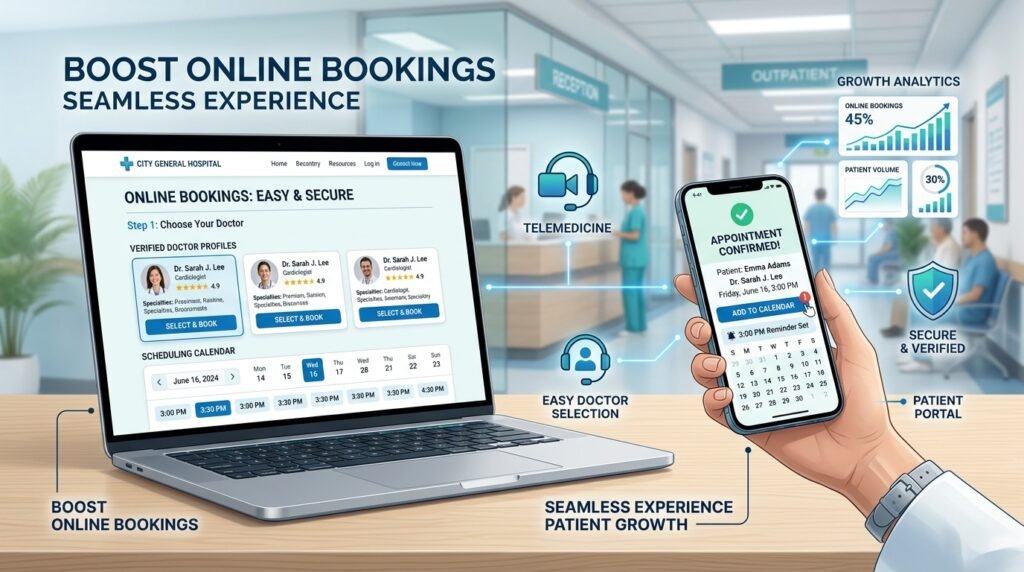
Introduction to Online Appointment Bookings for Hospitals
In today’s digital age, hospitals and healthcare institutions are constantly seeking innovative ways to improve patient engagement, streamline their services, and increase revenue. One crucial aspect of achieving these goals is by optimizing online appointment bookings. As a digital marketing strategist and SEO consultant, I, Amit Tyagi, have helped numerous healthcare providers enhance their online presence and boost appointment bookings through AI-driven search visibility, authority building, and revenue-focused organic growth strategies.
The importance of online appointment bookings cannot be overstated. It not only provides patients with a convenient and hassle-free way to schedule appointments but also enables hospitals to manage their resources more efficiently. By leveraging the power of digital marketing and search engine optimization (SEO), hospitals can increase their online visibility, attract more patients, and ultimately drive revenue growth. In this section, we will delve into the world of online appointment bookings for hospitals, exploring the benefits, challenges, and strategies for success.
According to recent studies, a significant percentage of patients prefer to book appointments online, with many using search engines like Google to find healthcare providers and schedule appointments. This shift towards online booking has created new opportunities for hospitals to connect with patients, improve their overall experience, and build a strong reputation. By providing a seamless online booking experience, hospitals can differentiate themselves from competitors, increase patient satisfaction, and drive loyalty.
However, many hospitals still struggle to optimize their online appointment booking systems, often due to limited resources, outdated technology, or a lack of expertise in digital marketing. Common challenges include poor website design, inadequate search engine optimization, and insufficient online presence. To overcome these challenges, hospitals must adopt a strategic approach to online appointment bookings, focusing on user experience, search visibility, and performance-driven digital marketing.
Some of the key benefits of online appointment bookings for hospitals include:
- Increased patient engagement and satisfaction
- Improved resource allocation and reduced no-show rates
- Enhanced online reputation and visibility
- Increased revenue and growth opportunities
- Better data collection and analytics for informed decision-making
For instance, a hospital that implements an online appointment booking system can expect to see a significant reduction in no-show rates, as patients are more likely to receive reminders and notifications about their scheduled appointments. Additionally, hospitals can use data and analytics to identify trends and patterns in patient behavior, informing decisions on resource allocation, marketing strategies, and service improvement.
To illustrate the potential of online appointment bookings, consider the example of a large hospital chain that implemented a user-friendly online booking system. By optimizing their website for search engines and providing a seamless booking experience, the hospital chain was able to increase online appointment bookings by over 25% within a few months. This not only drove revenue growth but also improved patient satisfaction and reduced no-show rates.
In the next section, we will explore the strategies and best practices for hospitals to increase online appointment bookings, including the importance of user experience, search engine optimization, and performance-driven digital marketing. By adopting a comprehensive approach to online appointment bookings, hospitals can unlock new opportunities for growth, improve patient outcomes, and establish themselves as leaders in the healthcare industry.
As a digital marketing strategist and SEO consultant, I have worked with numerous healthcare providers to develop and implement effective online appointment booking strategies. My expertise in AI-driven search visibility, authority building, and revenue-focused organic growth has enabled hospitals to increase their online presence, attract more patients, and drive revenue growth. In the following sections, I will share my insights and expertise to help hospitals optimize their online appointment booking systems and achieve their goals.
By focusing on the patient experience, search visibility, and performance-driven digital marketing, hospitals can create a robust online appointment booking system that drives growth, improves patient outcomes, and establishes their brand as a leader in the healthcare industry. With the right strategies and expertise, hospitals can unlock the full potential of online appointment bookings and achieve long-term success in an increasingly competitive market.
Optimizing Hospital Websites for Online Bookings
As a digital marketing strategist and SEO consultant, I have worked with numerous hospitals and healthcare providers to improve their online presence and increase appointment bookings. In today’s digital age, having a website that is optimized for online bookings is crucial for hospitals to stay competitive and attract new patients. In this section, we will discuss the importance of optimizing hospital websites for online bookings and provide tips and strategies for hospitals to improve their online booking process.
A well-designed and user-friendly website is essential for hospitals to provide a seamless online experience for patients. A website that is easy to navigate, provides clear and concise information, and offers a simple online booking process can significantly improve the patient experience and increase appointment bookings. On the other hand, a website that is difficult to navigate, lacks essential information, and has a complicated online booking process can lead to frustration and disappointment for patients, resulting in a loss of potential bookings.
So, what makes a hospital website optimized for online bookings? Firstly, the website should have a clear and prominent call-to-action (CTA) that encourages patients to book an appointment online. The CTA should be visible on every page of the website and should be accompanied by a simple and secure online booking form. The online booking form should require only the necessary information from patients, such as their name, contact details, and appointment preferences. Additionally, the website should provide patients with the option to book an appointment at a time that suits them, including evenings and weekends.
Another important aspect of optimizing hospital websites for online bookings is search engine optimization (SEO). A website that is optimized for search engines can improve its visibility and ranking on search engine results pages (SERPs), making it more likely to attract new patients. Hospitals can improve their website’s SEO by using relevant keywords, creating high-quality and informative content, and building high-quality backlinks from other reputable websites. For example, a hospital that specializes in cardiology can use keywords such as “cardiology services” or “heart care” to attract patients searching for these services online.
Furthermore, hospitals can also use online directories and review sites to improve their online presence and attract new patients. Online directories such as Healthgrades and RateMDs allow patients to search for hospitals and doctors based on their location, specialty, and ratings. Hospitals can claim their listings on these directories and optimize them with accurate and up-to-date information, including their address, phone number, and services offered. Additionally, hospitals can encourage their patients to leave reviews on these directories, which can help improve their reputation and attract new patients.
In addition to online directories and review sites, hospitals can also use social media to promote their services and attract new patients. Social media platforms such as Facebook and Twitter allow hospitals to connect with patients, share information about their services, and promote their brand. Hospitals can create social media accounts and post regular updates about their services, including new treatments and technologies, patient success stories, and community events. They can also use social media advertising to target specific audiences and promote their services to patients who are likely to be interested in them.
For example, a hospital that specializes in orthopedic services can create a social media campaign that targets patients who are interested in sports medicine and fitness. The campaign can include ads and posts that promote the hospital’s orthopedic services, including its team of experienced orthopedic surgeons and its state-of-the-art facilities. The campaign can also include patient testimonials and success stories, which can help build trust and credibility with potential patients.
To further optimize their website for online bookings, hospitals can also use data and analytics to track patient behavior and preferences. By analyzing data on website traffic, patient engagement, and online bookings, hospitals can identify areas for improvement and make data-driven decisions to optimize their website and online booking process. For example, hospitals can use Google Analytics to track website traffic and patient engagement, including the number of page views, bounce rate, and conversion rate. They can also use patient feedback and surveys to identify areas for improvement and make changes to their website and online booking process accordingly.
Some of the key metrics that hospitals can track to optimize their website and online booking process include:
- Website traffic: The number of patients who visit the hospital’s website, including the source of traffic, such as search engines, social media, or referrals.
- Patient engagement: The level of engagement patients have with the hospital’s website, including the number of page views, bounce rate, and time spent on the website.
- Conversion rate: The percentage of patients who complete an online booking or take another desired action on the website.
- Patient feedback: Feedback and surveys from patients, including their satisfaction with the online booking process and suggestions for improvement.
By tracking these metrics and using data and analytics to optimize their website and online booking process, hospitals can improve the patient experience, increase appointment bookings, and drive revenue growth. Additionally, hospitals can also use artificial intelligence (AI) and machine learning (ML) algorithms to analyze patient data and behavior, and make predictions about patient preferences and needs. This can help hospitals to personalize the patient experience, improve patient outcomes, and reduce costs.
In conclusion, optimizing hospital websites for online bookings is crucial for hospitals to stay competitive and attract new patients. By providing a seamless online experience, optimizing for search engines, using online directories and review sites, leveraging social media, and using data and analytics to track patient behavior and preferences, hospitals can improve the patient experience, increase appointment bookings, and drive revenue growth. As a digital marketing strategist and SEO consultant, I have seen firsthand the impact that a well-designed and user-friendly website can have on a hospital’s online presence and appointment bookings. By following the tips and strategies outlined in this section, hospitals can optimize their website for online bookings and improve their overall online presence.
Search Engine Optimization (SEO) for Hospital Websites
As a digital marketing strategist and SEO consultant, I have worked with numerous hospitals and healthcare organizations to improve their online presence and increase appointment bookings. In today’s digital age, having a strong online presence is crucial for hospitals to attract new patients and retain existing ones. One of the most effective ways to achieve this is by optimizing hospital websites for search engines through Search Engine Optimization (SEO). In this section, we will explore the importance of SEO for hospital websites and provide tips on how to optimize your website to increase appointment bookings online.
SEO is the process of improving the visibility and ranking of a website in search engine results pages (SERPs) through various techniques such as keyword research, on-page optimization, link building, and content creation. For hospitals, SEO is critical because it helps patients find their website when searching for medical services or treatments online. According to a study, 77% of patients use search engines to find healthcare providers, and 76% of patients use online reviews to choose a healthcare provider. Therefore, having a well-optimized website is essential for hospitals to attract new patients and increase appointment bookings.
So, how can hospitals optimize their website for SEO? Here are some tips:
- Keyword research: Conduct thorough keyword research to identify relevant keywords and phrases that patients use to search for medical services or treatments online. Use tools such as Google Keyword Planner, Ahrefs, or SEMrush to find the best keywords for your hospital’s website.
- On-page optimization: Optimize your website’s on-page elements such as title tags, meta descriptions, headings, and content to include relevant keywords. Make sure your website’s content is high-quality, engaging, and informative to patients.
- Content creation: Create high-quality, engaging, and informative content such as blog posts, articles, and videos to attract and retain patients. Use content marketing to establish your hospital as a thought leader in the healthcare industry and attract links from other reputable websites.
- Link building: Build high-quality backlinks from other reputable websites to increase your website’s authority and ranking in search engines. Use techniques such as guest blogging, broken link building, and resource pages to build links to your website.
- Local SEO: Optimize your website for local SEO by including your hospital’s name, address, and phone number (NAP) consistently across the web. Use Google My Business to claim and optimize your hospital’s listing and attract more patients from local search results.
For example, let’s say a hospital in New York City wants to attract more patients searching for “best cardiologists in NYC”. The hospital can optimize its website by including relevant keywords such as “cardiologists”, “NYC”, and “heart care” in its title tags, meta descriptions, and content. The hospital can also create high-quality content such as blog posts and videos to attract and retain patients and establish itself as a thought leader in the healthcare industry. By optimizing its website for SEO, the hospital can increase its visibility and ranking in search engines and attract more patients searching for cardiologists in NYC.
Another example is a hospital in Los Angeles that wants to attract more patients searching for “pediatric care in LA”. The hospital can optimize its website by including relevant keywords such as “pediatric care”, “LA”, and “children’s health” in its title tags, meta descriptions, and content. The hospital can also create high-quality content such as blog posts and videos to attract and retain patients and establish itself as a thought leader in the pediatric care industry. By optimizing its website for SEO, the hospital can increase its visibility and ranking in search engines and attract more patients searching for pediatric care in LA.
In addition to these tips, hospitals can also use technical SEO to improve their website’s performance and user experience. Technical SEO involves optimizing a website’s technical aspects such as page speed, mobile responsiveness, and SSL encryption to improve its ranking in search engines. Hospitals can use tools such as Google PageSpeed Insights and GTmetrix to analyze their website’s performance and identify areas for improvement.
Furthermore, hospitals can also use analytics and tracking to measure their website’s performance and track the effectiveness of their SEO efforts. Hospitals can use tools such as Google Analytics to track their website’s traffic, engagement, and conversion rates and adjust their SEO strategy accordingly. By tracking their website’s performance, hospitals can identify areas for improvement and make data-driven decisions to optimize their website and increase appointment bookings.
In conclusion, SEO is a critical component of a hospital’s digital marketing strategy. By optimizing their website for SEO, hospitals can increase their visibility and ranking in search engines, attract more patients, and increase appointment bookings. By following the tips outlined in this section, hospitals can improve their website’s performance, establish themselves as thought leaders in the healthcare industry, and attract more patients searching for medical services or treatments online.
Leveraging Digital Marketing Channels for Appointment Bookings
As a digital marketing strategist and SEO consultant, I have worked with numerous hospitals and healthcare institutions to improve their online presence and increase appointment bookings. In today’s digital age, it is essential for hospitals to leverage digital marketing channels to reach their target audience and stay ahead of the competition. In this section, we will discuss how hospitals can utilize digital marketing channels to increase appointment bookings online.
Digital marketing channels offer a wide range of benefits for hospitals, including increased visibility, improved patient engagement, and enhanced reputation management. By leveraging these channels, hospitals can effectively promote their services, build trust with their target audience, and drive more appointments. Some of the most effective digital marketing channels for hospitals include search engine optimization (SEO), pay-per-click (PPC) advertising, social media marketing, email marketing, and content marketing.
Let’s take a closer look at each of these channels and how they can be used to increase appointment bookings online. Search engine optimization (SEO) is the process of optimizing a hospital’s website to rank higher in search engine results pages (SERPs) for relevant keywords and phrases. By optimizing their website for SEO, hospitals can increase their visibility, drive more organic traffic, and attract more patients. For example, a hospital that specializes in cardiology can optimize its website for keywords like “cardiology hospital” or “heart disease treatment” to attract patients who are searching for these services online.
Pay-per-click (PPC) advertising is another effective digital marketing channel that hospitals can use to increase appointment bookings online. PPC advertising involves creating ads that are displayed on search engines and other websites, and hospitals only pay for each ad click. This channel offers a high return on investment (ROI) and can be used to target specific keywords, demographics, and locations. For instance, a hospital can create a PPC ad campaign that targets patients who are searching for “orthopedic surgery” or “knee replacement” in a specific geographic location.
Social media marketing is also an essential digital marketing channel for hospitals to increase appointment bookings online. Social media platforms like Facebook, Twitter, and Instagram offer hospitals a unique opportunity to engage with their target audience, build trust, and promote their services. Hospitals can use social media to share patient testimonials, provide health tips, and offer exclusive promotions to attract more patients. For example, a hospital can create a social media campaign that encourages patients to share their experiences and testimonials on Facebook, which can help to build trust and credibility with potential patients.
In addition to these channels, email marketing is another effective way for hospitals to increase appointment bookings online. Email marketing involves sending targeted and personalized emails to patients and potential patients to promote hospital services and encourage appointments. Hospitals can use email marketing to send newsletters, promotional offers, and reminders to patients, which can help to build trust and loyalty. For instance, a hospital can send a newsletter to its subscribers that highlights its latest services, technologies, and treatments, which can help to establish the hospital as a thought leader in the healthcare industry.
Content marketing is also a crucial digital marketing channel for hospitals to increase appointment bookings online. Content marketing involves creating and distributing valuable, relevant, and consistent content to attract and retain a clearly defined audience. Hospitals can use content marketing to create blog posts, videos, infographics, and other types of content that provide value to patients and establish the hospital as a trusted authority in the healthcare industry. For example, a hospital can create a blog post that provides tips on how to prevent heart disease, which can help to attract patients who are interested in learning more about heart health.
To get the most out of these digital marketing channels, hospitals need to have a clear strategy in place. This involves setting specific goals and objectives, identifying the target audience, and selecting the most effective channels to reach that audience. Hospitals also need to track and measure the performance of their digital marketing campaigns to see what is working and what is not. This involves using analytics tools to monitor website traffic, engagement, and conversion rates, and making adjustments to the campaign as needed.
Some best practices for hospitals to increase appointment bookings online include:
- Optimizing their website for SEO to increase visibility and drive more organic traffic
- Creating targeted and personalized PPC ad campaigns to attract more patients
- Using social media to engage with patients, build trust, and promote hospital services
- Sending targeted and personalized emails to patients and potential patients to encourage appointments
- Creating valuable, relevant, and consistent content to attract and retain a clearly defined audience
- Tracking and measuring the performance of digital marketing campaigns to see what is working and what is not
- Using analytics tools to monitor website traffic, engagement, and conversion rates
- Making adjustments to digital marketing campaigns as needed to optimize performance
By following these best practices and leveraging digital marketing channels, hospitals can increase appointment bookings online and establish themselves as trusted authorities in the healthcare industry. As a digital marketing strategist and SEO consultant, I have seen firsthand the impact that effective digital marketing can have on a hospital’s online presence and appointment bookings. By investing in digital marketing and staying up-to-date with the latest trends and technologies, hospitals can stay ahead of the competition and provide better care to their patients.
In conclusion, leveraging digital marketing channels is essential for hospitals to increase appointment bookings online. By utilizing channels like SEO, PPC advertising, social media marketing, email marketing, and content marketing, hospitals can reach their target audience, build trust, and drive more appointments. By having a clear strategy in place, tracking and measuring performance, and following best practices, hospitals can get the most out of their digital marketing efforts and establish themselves as leaders in the healthcare industry.
Measuring and Improving Online Appointment Booking Success
As a digital marketing strategist and SEO consultant, I have worked with numerous hospitals and healthcare institutions to improve their online presence and increase appointment bookings. In today’s digital age, having a robust online appointment booking system is crucial for hospitals to stay competitive and provide patients with a seamless experience. In this section, we will delve into the importance of measuring and improving online appointment booking success, and explore strategies that hospitals can implement to achieve this goal.
Measuring online appointment booking success is a critical step in understanding the effectiveness of a hospital’s online presence. By tracking key performance indicators (KPIs) such as website traffic, conversion rates, and patient engagement, hospitals can identify areas for improvement and make data-driven decisions to optimize their online appointment booking system. For instance, a hospital can track the number of visitors to their website, the number of online appointments booked, and the conversion rate of website visitors to booked appointments. By analyzing these metrics, hospitals can identify trends and patterns, and make adjustments to their online strategy to increase appointment bookings.
One of the primary challenges that hospitals face in measuring online appointment booking success is the lack of visibility into the patient’s journey. Patients often interact with hospitals through multiple touchpoints, including websites, social media, and online review sites. To gain a comprehensive understanding of the patient’s journey, hospitals can use tools such as Google Analytics to track website traffic and behavior, and social media listening tools to monitor patient conversations and sentiment. By analyzing data from these tools, hospitals can identify pain points and areas for improvement, and develop targeted strategies to enhance the patient experience and increase online appointment bookings.
Improving online appointment booking success requires a multifaceted approach that involves optimizing the hospital’s website, search engine optimization (SEO), and online reputation management. Hospitals can start by ensuring that their website is user-friendly, mobile-friendly, and easy to navigate. A well-designed website should have a clear and prominent call-to-action (CTA) for online appointment bookings, and should provide patients with a seamless and secure booking experience. For example, a hospital can use a website builder such as WordPress or Wix to create a responsive and user-friendly website that is optimized for online appointment bookings.
In addition to website optimization, hospitals should also focus on SEO to improve their online visibility and drive more traffic to their website. By optimizing their website for relevant keywords and phrases, hospitals can increase their search engine rankings and attract more patients who are searching for healthcare services online. For instance, a hospital can optimize their website for keywords such as “online doctor appointments” or “hospital near me” to attract patients who are searching for convenient and accessible healthcare services. Hospitals can also use local SEO strategies such as Google My Business to increase their online visibility and attract more local patients.
Another critical aspect of improving online appointment booking success is online reputation management. Hospitals should monitor their online reviews and ratings on platforms such as Google My Business, Yelp, and Healthgrades, and respond promptly to patient feedback and concerns. By maintaining a strong online reputation, hospitals can build trust and credibility with patients, and increase the likelihood of online appointment bookings. For example, a hospital can use a reputation management tool such as Reputation.com to monitor their online reviews and respond to patient feedback in a timely and effective manner.
To further improve online appointment booking success, hospitals can implement the following strategies:
- Use patient engagement platforms to communicate with patients and provide them with personalized care and support. For instance, a hospital can use a patient engagement platform such as PatientPing to send patients reminders and notifications about upcoming appointments, and to provide them with educational resources and support.
- Offer online payment options to make it easy for patients to pay their bills and copays online. For example, a hospital can use an online payment platform such as PayPal or Stripe to provide patients with a secure and convenient payment experience.
- Provide clear and concise information about hospital services, physicians, and locations to help patients make informed decisions about their care. For instance, a hospital can use a content management system such as Drupal or Joomla to create a robust and user-friendly website that provides patients with detailed information about hospital services and physicians.
- Use social media to engage with patients, provide them with educational resources, and promote hospital services and events. For example, a hospital can use social media platforms such as Facebook or Twitter to share patient testimonials, promote hospital events, and provide patients with educational resources and support.
- Implement artificial intelligence (AI) and machine learning (ML) algorithms to analyze patient data and provide personalized recommendations for care. For instance, a hospital can use an AI-powered chatbot to provide patients with personalized support and guidance, and to help them navigate the hospital’s website and services.
By implementing these strategies, hospitals can improve their online appointment booking success, increase patient engagement and satisfaction, and drive revenue growth. It’s essential for hospitals to continuously monitor and evaluate their online appointment booking system, identify areas for improvement, and make data-driven decisions to optimize their online strategy. By doing so, hospitals can stay competitive in the digital age and provide patients with a seamless and convenient experience.
In conclusion, measuring and improving online appointment booking success is a critical aspect of a hospital’s digital marketing strategy. By tracking key performance indicators, optimizing their website and online presence, and implementing patient-centric strategies, hospitals can increase online appointment bookings, enhance the patient experience, and drive revenue growth. As a digital marketing strategist and SEO consultant, I have seen firsthand the impact that a well-designed online appointment booking system can have on a hospital’s bottom line. By prioritizing online appointment booking success, hospitals can stay ahead of the curve and provide patients with the convenient and accessible care that they deserve.

Amit Tyagi is a seasoned Digital Marketing and SEO Consultant with extensive experience helping businesses improve online visibility through SEO, AI Search Optimization (AIO/GEO), content strategy, and performance marketing. He regularly shares practical insights, industry updates, and data-driven strategies, empowering brands and marketers to achieve sustainable digital growth in an evolving search landsca