
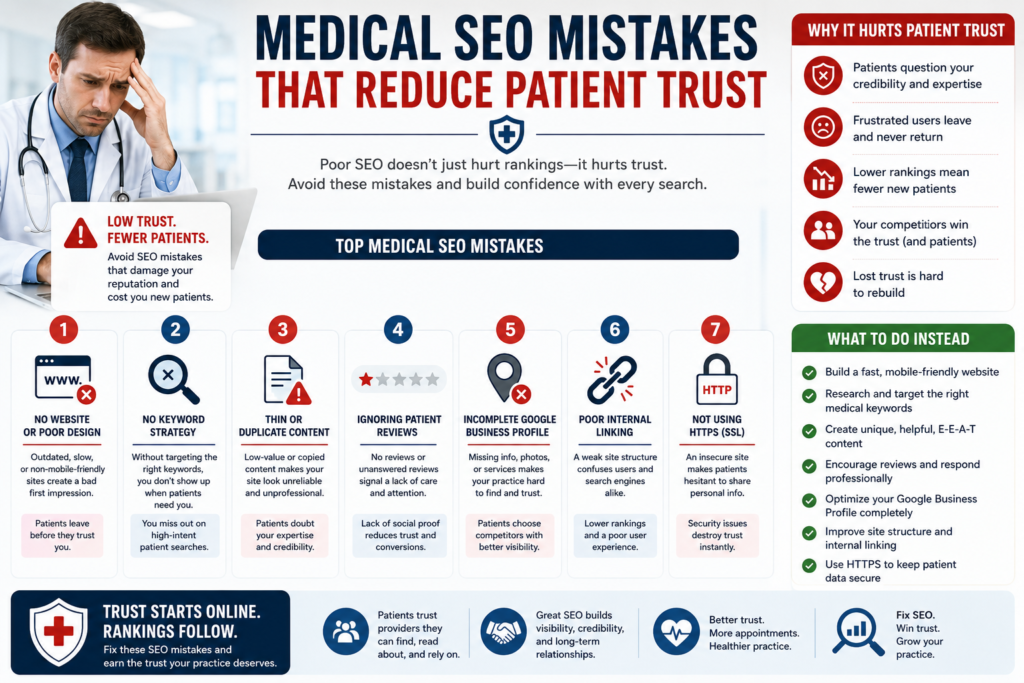
Introduction to Medical SEO and Patient Trust
As a digital marketing strategist and SEO consultant, I have worked with numerous healthcare providers and medical institutions to improve their online presence and attract more patients. In today’s digital age, having a strong online presence is crucial for medical professionals to establish trust with potential patients. Medical SEO plays a vital role in this process, as it helps medical websites rank higher in search engine results pages (SERPs) and increase their visibility. However, there are several medical SEO mistakes that can reduce patient trust and ultimately harm a medical practice’s reputation and revenue.
Patient trust is the foundation of any successful medical practice. Patients want to feel confident that their healthcare provider is knowledgeable, experienced, and trustworthy. A strong online presence can help establish this trust, but it requires a deep understanding of medical SEO and how to avoid common mistakes that can erode patient trust. In this section, we will explore the importance of medical SEO and patient trust, and discuss some common medical SEO mistakes that can reduce patient trust.
Medical SEO is a specialized form of search engine optimization that is designed specifically for medical websites. It involves optimizing a website’s content, structure, and coding to make it more search engine friendly, while also ensuring that the website provides valuable and accurate information to patients. Medical SEO is a complex and constantly evolving field, and it requires a deep understanding of search engine algorithms, keyword research, and content creation. By optimizing a medical website for search engines, healthcare providers can increase their online visibility, attract more patients, and establish themselves as authorities in their field.
Patient trust is critical to the success of any medical practice. Patients want to feel confident that their healthcare provider is knowledgeable, experienced, and trustworthy. A strong online presence can help establish this trust, but it requires a deep understanding of medical SEO and how to avoid common mistakes that can erode patient trust. For example, a medical website that is poorly designed, difficult to navigate, or contains outdated or inaccurate information can quickly erode patient trust. On the other hand, a well-designed medical website that provides valuable and accurate information, is easy to navigate, and has a strong online presence can help establish trust with patients and attract more patients to the practice.
There are several factors that contribute to patient trust, including the quality of care provided, the qualifications and experience of the healthcare provider, and the overall patient experience. A strong online presence can also play a critical role in establishing patient trust, as it provides patients with a first impression of the medical practice and helps to establish the practice’s credibility and authority. By avoiding common medical SEO mistakes and creating a strong online presence, healthcare providers can establish trust with patients, attract more patients to their practice, and ultimately improve their bottom line.
Some common examples of medical SEO mistakes that can reduce patient trust include poor website design, inaccurate or outdated information, lack of transparency, and poor online reviews. These mistakes can quickly erode patient trust and harm a medical practice’s reputation and revenue. For example, a medical website that is poorly designed or difficult to navigate can make it difficult for patients to find the information they need, while inaccurate or outdated information can make patients question the credibility and authority of the healthcare provider.
In addition to these examples, there are several other medical SEO mistakes that can reduce patient trust, including:
- Keyword stuffing, which involves using keywords excessively in website content to try to manipulate search engine rankings
- Thin or low-quality content, which provides little value to patients and can make the healthcare provider appear unprofessional or untrustworthy
- Lack of mobile-friendliness, which can make it difficult for patients to access the website on their mobile devices
- Slow page loading times, which can make it difficult for patients to access the website and can increase bounce rates
- Poor social media presence, which can make the healthcare provider appear unprofessional or unengaged with their patients
These are just a few examples of medical SEO mistakes that can reduce patient trust. By avoiding these mistakes and creating a strong online presence, healthcare providers can establish trust with patients, attract more patients to their practice, and ultimately improve their bottom line. In the next section, we will explore some strategies for creating a strong online presence and avoiding common medical SEO mistakes.
Establishing patient trust is a critical component of any successful medical practice. By understanding the importance of medical SEO and avoiding common mistakes, healthcare providers can create a strong online presence that attracts patients and establishes their credibility and authority. With the right strategies and techniques, healthcare providers can improve their online visibility, attract more patients, and ultimately drive revenue and growth for their practice. By prioritizing patient trust and creating a strong online presence, healthcare providers can build a loyal patient base and establish themselves as leaders in their field.
In conclusion, medical SEO and patient trust are closely intertwined. By avoiding common medical SEO mistakes and creating a strong online presence, healthcare providers can establish trust with patients, attract more patients to their practice, and ultimately improve their bottom line. As a digital marketing strategist and SEO consultant, I have seen firsthand the impact that a strong online presence can have on a medical practice’s success. By prioritizing patient trust and creating a strong online presence, healthcare providers can build a loyal patient base, drive revenue and growth, and establish themselves as leaders in their field.
Keyword Research and Optimization Mistakes
As a digital marketing strategist and SEO consultant, I have come across numerous medical websites that struggle to establish trust with their patients due to poor keyword research and optimization. In the medical industry, it is crucial to use relevant and accurate keywords to attract potential patients and establish authority. However, many medical websites make critical mistakes in their keyword research and optimization strategies, ultimately reducing patient trust. In this section, we will explore some of the most common keyword research and optimization mistakes that medical websites make and provide guidance on how to avoid them.
One of the primary mistakes medical websites make is using irrelevant keywords. This can be due to a lack of understanding of their target audience or a failure to conduct thorough keyword research. For instance, a medical website that specializes in cosmetic surgery may use keywords like “health tips” or “wellness advice,” which are not relevant to their services. This can lead to attracting the wrong audience and reducing patient trust. To avoid this mistake, medical websites should conduct thorough keyword research using tools like Google Keyword Planner, Ahrefs, or SEMrush to identify relevant keywords that accurately reflect their services.
Another mistake medical websites make is over-optimizing their content with keywords. While it is essential to use relevant keywords in your content, over-optimization can lead to a spammy and untrustworthy appearance. For example, a medical website that uses the keyword “cosmetic surgery” in every sentence of their content may appear spammy to search engines and users. To avoid this mistake, medical websites should aim for a keyword density of 1-2% and use variations of their target keywords throughout their content.
Medical websites also make the mistake of not using long-tail keywords. Long-tail keywords are phrases that have lower search volumes but are more specific and less competitive. For instance, a medical website that uses the keyword “cosmetic surgery” may face high competition, but using long-tail keywords like “cosmetic surgery in New York” or “facial cosmetic surgery” can help them attract more targeted traffic. To avoid this mistake, medical websites should use tools like Google Keyword Planner or Ahrefs to identify long-tail keywords that are relevant to their services and use them in their content.
In addition to these mistakes, medical websites also fail to optimize their meta tags with relevant keywords. Meta tags like title tags, description tags, and header tags are essential for search engine optimization and should be optimized with relevant keywords to attract more targeted traffic. For example, a medical website that uses the keyword “cosmetic surgery” in their title tag and description tag can help search engines understand the content of their page and attract more targeted traffic. To avoid this mistake, medical websites should use tools like SEMrush or Ahrefs to optimize their meta tags with relevant keywords.
Medical websites also make the mistake of not using keyword clustering. Keyword clustering involves grouping related keywords together to create a content cluster that attracts more targeted traffic. For instance, a medical website that creates a content cluster around the topic of “cosmetic surgery” can attract more targeted traffic and establish authority in their industry. To avoid this mistake, medical websites should use tools like Ahrefs or SEMrush to identify related keywords and create a content cluster that attracts more targeted traffic.
To avoid these keyword research and optimization mistakes, medical websites should follow these best practices:
- Conduct thorough keyword research using tools like Google Keyword Planner, Ahrefs, or SEMrush to identify relevant keywords that accurately reflect their services.
- Use relevant and accurate keywords in their content to attract more targeted traffic and establish authority.
- Avoid over-optimization by aiming for a keyword density of 1-2% and using variations of their target keywords throughout their content.
- Use long-tail keywords to attract more targeted traffic and reduce competition.
- Optimize their meta tags with relevant keywords to attract more targeted traffic and establish authority.
- Use keyword clustering to create a content cluster that attracts more targeted traffic and establishes authority in their industry.
By following these best practices and avoiding common keyword research and optimization mistakes, medical websites can attract more targeted traffic, establish authority in their industry, and build trust with their patients. As a digital marketing strategist and SEO consultant, I have helped numerous medical websites improve their keyword research and optimization strategies, resulting in increased traffic, engagement, and revenue. By investing in a well-planned keyword research and optimization strategy, medical websites can achieve their online goals and establish a strong online presence.
Furthermore, medical websites should also consider the user experience and content quality when optimizing their content with keywords. This means creating high-quality, engaging, and informative content that provides value to users and helps them make informed decisions about their health. By prioritizing user experience and content quality, medical websites can establish trust with their patients and attract more targeted traffic to their website.
In conclusion, keyword research and optimization mistakes can have a significant impact on patient trust and the online success of medical websites. By avoiding common mistakes like using irrelevant keywords, over-optimizing content, and not using long-tail keywords, medical websites can attract more targeted traffic, establish authority in their industry, and build trust with their patients. As a digital marketing strategist and SEO consultant, I recommend that medical websites invest in a well-planned keyword research and optimization strategy that prioritizes user experience, content quality, and relevance to attract more targeted traffic and achieve their online goals.
Content Creation and Marketing Blunders
As a digital marketing strategist and SEO consultant, I have worked with numerous medical professionals and healthcare organizations, helping them establish a strong online presence and attract more patients to their practices. However, I have also seen many medical professionals make critical mistakes in their content creation and marketing efforts that ultimately reduce patient trust. In this section, we will explore some of the most common content creation and marketing blunders that medical professionals make, and provide guidance on how to avoid them.
One of the most significant mistakes that medical professionals make is creating low-quality or irrelevant content. This can include blog posts that are too short or lack depth, social media posts that are not engaging or informative, or website content that is outdated or inaccurate. When patients encounter low-quality or irrelevant content, they are likely to lose trust in the medical professional or organization, and may even question their expertise or credibility. For example, a medical practice that creates a blog post titled “10 Ways to Stay Healthy” that only includes generic tips and does not provide any unique insights or perspectives is unlikely to attract or engage patients.
Another mistake that medical professionals make is failing to optimize their content for search engines. This can include not using relevant keywords, not optimizing images or videos, or not using internal or external linking to improve the user experience. When medical professionals fail to optimize their content, they make it difficult for patients to find them online, which can reduce patient trust and ultimately harm their practice. For instance, a medical practice that creates a website with no meta tags, headings, or descriptions is unlikely to appear in search engine results pages (SERPs) for relevant keywords, making it difficult for patients to find them.
In addition to creating low-quality or irrelevant content and failing to optimize for search engines, medical professionals also make mistakes in their content marketing strategy. This can include not having a clear target audience, not using the right channels or platforms to reach patients, or not measuring or tracking the effectiveness of their content marketing efforts. When medical professionals make these mistakes, they are likely to waste time and resources on content marketing efforts that do not produce any meaningful results. For example, a medical practice that creates a Facebook page but does not post regularly or engage with patients is unlikely to see any significant returns on their investment.
Some other common content creation and marketing blunders that medical professionals make include:
- Not using patient testimonials or reviews to build trust and credibility with potential patients. Patient testimonials and reviews are a powerful way to demonstrate the quality of care and services that a medical practice provides, and can help to establish trust with patients who are researching their options online.
- Not using visual content such as images, videos, or infographics to communicate complex medical information in a clear and concise way. Visual content can help to engage patients and make medical information more accessible and understandable.
- Not creating content that addresses the specific needs and concerns of their target audience. Medical professionals should create content that speaks directly to the needs and concerns of their target audience, whether it is patients who are researching a specific condition or treatment option, or healthcare professionals who are looking for continuing education or professional development opportunities.
- Not measuring or tracking the effectiveness of their content marketing efforts. Medical professionals should use analytics tools to measure and track the effectiveness of their content marketing efforts, including website traffic, engagement, and conversion rates. This will help them to identify what is working and what is not, and make data-driven decisions to improve their content marketing strategy.
In conclusion, medical professionals make a variety of content creation and marketing blunders that can reduce patient trust and harm their practice. By creating high-quality and relevant content, optimizing for search engines, and using a targeted and effective content marketing strategy, medical professionals can establish trust with patients and attract more patients to their practice. It is essential for medical professionals to avoid common mistakes such as creating low-quality or irrelevant content, failing to optimize for search engines, and not using patient testimonials or reviews, and instead focus on creating content that addresses the specific needs and concerns of their target audience, and measuring and tracking the effectiveness of their content marketing efforts.
As a digital marketing strategist and SEO consultant, I have helped numerous medical professionals and healthcare organizations create effective content marketing strategies that attract and engage patients, and establish trust and credibility online. By working with a experienced digital marketing professional, medical professionals can avoid common content creation and marketing blunders, and instead create a strong online presence that drives real results for their practice. Whether it is creating high-quality and relevant content, optimizing for search engines, or using social media to engage with patients, medical professionals can use a variety of tactics and strategies to establish trust with patients and attract more patients to their practice.
Ultimately, the key to creating effective content marketing strategies that attract and engage patients is to focus on the needs and concerns of the target audience. Medical professionals should create content that speaks directly to the needs and concerns of their target audience, whether it is patients who are researching a specific condition or treatment option, or healthcare professionals who are looking for continuing education or professional development opportunities. By focusing on the needs and concerns of their target audience, medical professionals can create content that is relevant, informative, and engaging, and that establishes trust and credibility with patients.
Additionally, medical professionals should use a variety of channels and platforms to reach patients and promote their content. This can include social media, email marketing, and paid advertising, as well as traditional marketing channels such as print or television advertising. By using a variety of channels and platforms, medical professionals can reach a wider audience and increase the visibility of their content, which can help to attract more patients to their practice.
In order to measure and track the effectiveness of their content marketing efforts, medical professionals should use analytics tools such as Google Analytics or social media insights. These tools can provide valuable data and insights on website traffic, engagement, and conversion rates, which can help medical professionals to identify what is working and what is not, and make data-driven decisions to improve their content marketing strategy. By using analytics tools, medical professionals can optimize their content marketing efforts and achieve better results for their practice.
Technical SEO Errors and Patient Experience
As a digital marketing strategist and SEO consultant, I have seen numerous medical websites that fail to establish trust with their patients due to technical SEO errors. These mistakes not only hinder the website’s search engine ranking but also compromise the patient experience, ultimately affecting the medical practice’s reputation and revenue. In this section, we will delve into the common technical SEO errors that reduce patient trust and explore ways to rectify them.
A well-designed and SEO-optimized website is crucial for medical practices to attract and retain patients. A website that is slow, unresponsive, or difficult to navigate can lead to a high bounce rate, negatively impacting the patient experience. On the other hand, a website that is technically sound, user-friendly, and provides valuable information can foster trust and credibility with patients. Technical SEO errors can be broadly categorized into two types: on-page and off-page errors. On-page errors refer to issues that occur on the website itself, such as slow page loading speed, duplicate content, and poor mobile responsiveness. Off-page errors, on the other hand, refer to issues that occur outside of the website, such as low-quality backlinks and inconsistent citations.
One of the most common technical SEO errors that affect patient experience is slow page loading speed. A website that takes too long to load can be frustrating for patients, leading to a high bounce rate and negatively impacting the website’s search engine ranking. According to a study by Google, a website that takes more than three seconds to load can experience a bounce rate of up to 53%. To rectify this issue, medical practices can optimize their website’s images, minify CSS and JavaScript files, and leverage browser caching. For example, a medical practice can compress its images using tools like TinyPNG or ImageOptim to reduce the file size and improve page loading speed.
Another technical SEO error that can compromise patient experience is poor mobile responsiveness. With the majority of patients using their mobile devices to search for medical information, a website that is not optimized for mobile devices can lead to a poor user experience. A website that is not mobile-friendly can have a negative impact on the website’s search engine ranking, as Google favors websites that are mobile-friendly. To rectify this issue, medical practices can use responsive design, ensure that their website’s content is easily accessible on mobile devices, and test their website’s mobile responsiveness using tools like Google’s Mobile-Friendly Test. For instance, a medical practice can use a responsive design template to ensure that its website adapts to different screen sizes and devices.
In addition to slow page loading speed and poor mobile responsiveness, duplicate content is another technical SEO error that can reduce patient trust. Duplicate content refers to identical or similar content that appears on multiple pages of a website. This can lead to confusion among patients and search engines, ultimately affecting the website’s search engine ranking. To rectify this issue, medical practices can use canonical URLs, 301 redirects, and meta robots tags to indicate the preferred version of a page. For example, a medical practice can use a canonical URL to specify the preferred version of a page, such as https://www.example.com/services, to avoid duplicate content issues.
Technical SEO errors can also occur due to inconsistent citations. Inconsistent citations refer to variations in a medical practice’s name, address, and phone number (NAP) across different directories and citations. This can lead to confusion among patients and search engines, ultimately affecting the website’s search engine ranking. To rectify this issue, medical practices can use citation management tools, such as Moz Local or Ahrefs, to ensure consistency in their NAP across different directories and citations. For instance, a medical practice can use Moz Local to claim and optimize its listings on different directories, such as Google My Business, Yelp, and Healthgrades.
Furthermore, technical SEO errors can also occur due to low-quality backlinks. Low-quality backlinks refer to links from spammy or irrelevant websites that can negatively impact a website’s search engine ranking. To rectify this issue, medical practices can use backlink analysis tools, such as Ahrefs or SEMrush, to identify and remove low-quality backlinks. For example, a medical practice can use Ahrefs to analyze its backlink profile and identify low-quality backlinks, such as links from spammy websites or websites with low authority.
To avoid technical SEO errors and improve patient experience, medical practices can follow these best practices:
- Conduct regular website audits to identify and rectify technical SEO errors, such as slow page loading speed, duplicate content, and inconsistent citations.
- Optimize website content for user experience, including clear and concise language, easy navigation, and prominent calls-to-action.
- Use responsive design to ensure that the website is mobile-friendly and adapts to different screen sizes and devices.
- Use canonical URLs and 301 redirects to indicate the preferred version of a page and avoid duplicate content issues.
- Use citation management tools to ensure consistency in NAP across different directories and citations.
- Monitor backlink profile to identify and remove low-quality backlinks that can negatively impact the website’s search engine ranking.
In conclusion, technical SEO errors can have a significant impact on patient experience and trust. By avoiding common technical SEO errors, such as slow page loading speed, poor mobile responsiveness, duplicate content, inconsistent citations, and low-quality backlinks, medical practices can improve their website’s search engine ranking and establish trust with their patients. By following best practices, such as conducting regular website audits, optimizing website content, using responsive design, and monitoring backlink profile, medical practices can ensure a positive patient experience and improve their online reputation.
Measuring Success and Avoiding Common Analytics Mistakes
As a digital marketing strategist and SEO consultant, I have seen numerous medical practices and healthcare organizations struggle to measure the success of their online presence. In today’s digital age, having a strong online presence is crucial for attracting new patients and building trust with existing ones. However, many medical practices make critical mistakes when it comes to measuring the success of their online marketing efforts, which can ultimately reduce patient trust. In this section, we will explore the common analytics mistakes that medical practices make and provide guidance on how to avoid them.
Measuring the success of a medical practice’s online presence is not just about tracking website traffic or social media engagement. It requires a deeper understanding of how patients interact with the practice’s online presence and how that interaction affects their decision to seek care. Google Analytics is a powerful tool that can provide valuable insights into patient behavior, but it must be used correctly to avoid common mistakes.
One of the most common mistakes medical practices make is tracking the wrong metrics. For example, tracking website traffic alone does not provide a complete picture of a practice’s online success. Conversion rates, such as the number of patients who schedule appointments or request consultations, are a more important metric to track. By tracking conversion rates, medical practices can gain a better understanding of how their online presence is driving real-world results.
Another mistake medical practices make is not setting up goals and events in Google Analytics. Goals and events allow practices to track specific actions on their website, such as form submissions or phone calls. By setting up goals and events, practices can gain a better understanding of how patients are interacting with their website and identify areas for improvement. For example, a medical practice may set up a goal to track the number of patients who submit a contact form on their website. By tracking this goal, the practice can see how effective their website is at driving patient inquiries.
In addition to tracking the right metrics and setting up goals and events, medical practices must also avoid making mistakes when it comes to data analysis. One common mistake is not accounting for seasonal fluctuations in patient behavior. For example, a medical practice may see a surge in website traffic during the winter months due to an increase in flu cases. By accounting for seasonal fluctuations, practices can get a more accurate picture of their online success and make informed decisions about their marketing efforts.
Medical practices must also avoid making mistakes when it comes to data visualization. Data visualization is the process of turning data into visual representations, such as charts and graphs, to make it easier to understand. By using data visualization tools, medical practices can gain a better understanding of their online success and identify trends and patterns in patient behavior. For example, a medical practice may use a heatmap to visualize where patients are clicking on their website. By using a heatmap, the practice can see which areas of their website are most engaging to patients and make informed decisions about their website design.
To avoid common analytics mistakes, medical practices can follow these best practices:
- Track the right metrics: Instead of just tracking website traffic, track conversion rates, such as the number of patients who schedule appointments or request consultations.
- Set up goals and events: Use Google Analytics to track specific actions on your website, such as form submissions or phone calls.
- Account for seasonal fluctuations: Account for seasonal fluctuations in patient behavior to get a more accurate picture of your online success.
- Use data visualization tools: Use data visualization tools, such as heatmaps, to gain a better understanding of patient behavior and identify trends and patterns.
- Regularly review and analyze data: Regularly review and analyze your data to identify areas for improvement and make informed decisions about your marketing efforts.
By following these best practices and avoiding common analytics mistakes, medical practices can gain a better understanding of their online success and make informed decisions about their marketing efforts. This can ultimately lead to increased patient trust and a stronger online presence. As a digital marketing strategist and SEO consultant, I have seen firsthand the impact that accurate analytics can have on a medical practice’s online success. By tracking the right metrics, setting up goals and events, accounting for seasonal fluctuations, using data visualization tools, and regularly reviewing and analyzing data, medical practices can drive real-world results and build a strong online presence that attracts new patients and builds trust with existing ones.
In addition to avoiding common analytics mistakes, medical practices must also ensure that their website is user-friendly and provides a positive user experience. This includes having a clear and concise navigation, easy-to-use contact forms, and prominent display of practice information, such as hours of operation and contact information. By providing a positive user experience, medical practices can increase patient trust and drive real-world results.
Furthermore, medical practices must also ensure that their website is mobile-friendly and secure. With the majority of patients using their smartphones to search for medical information online, having a mobile-friendly website is crucial for providing a positive user experience. Additionally, having a secure website is essential for protecting patient data and building trust with patients. By having a mobile-friendly and secure website, medical practices can increase patient trust and drive real-world results.
In conclusion, measuring the success of a medical practice’s online presence requires a deep understanding of patient behavior and the ability to track the right metrics. By avoiding common analytics mistakes, such as tracking the wrong metrics and not setting up goals and events, medical practices can gain a better understanding of their online success and make informed decisions about their marketing efforts. By following best practices, such as tracking conversion rates, setting up goals and events, accounting for seasonal fluctuations, using data visualization tools, and regularly reviewing and analyzing data, medical practices can drive real-world results and build a strong online presence that attracts new patients and builds trust with existing ones.

Amit Tyagi is a seasoned Digital Marketing and SEO Consultant with extensive experience helping businesses improve online visibility through SEO, AI Search Optimization (AIO/GEO), content strategy, and performance marketing. He regularly shares practical insights, industry updates, and data-driven strategies, empowering brands and marketers to achieve sustainable digital growth in an evolving search landsca