
Introduction to Automated Lead Nurturing Systems
As a digital marketing strategist, I have worked with numerous businesses to help them scale their operations and increase their revenue through advanced marketing strategies. One of the most effective ways to achieve this is by implementing an automated lead nurturing system. In this section, we will explore the concept of automated lead nurturing systems, their benefits, and how they can be used to drive business growth.
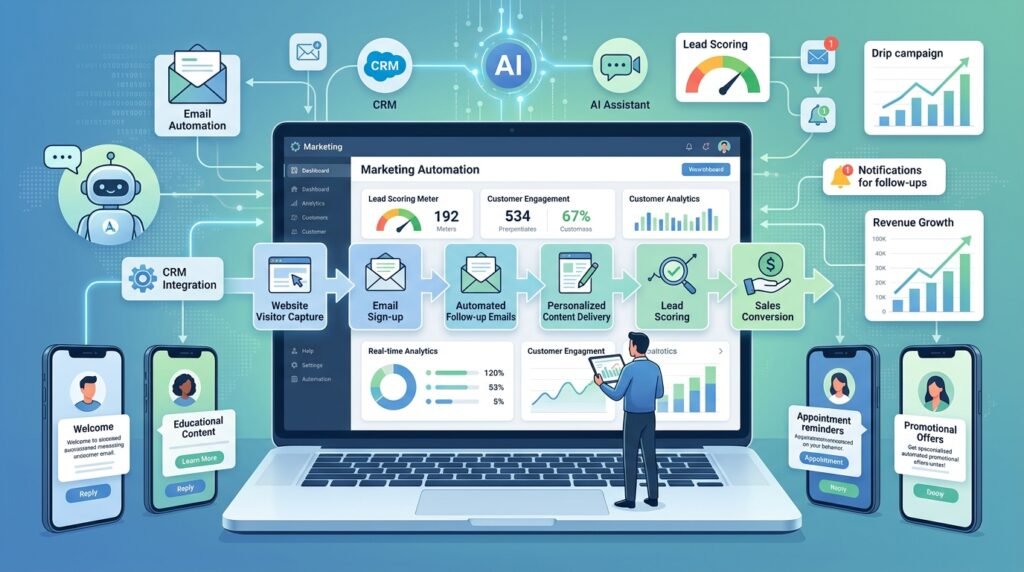
An automated lead nurturing system is a powerful tool that allows businesses to engage with their leads at every stage of the buyer’s journey, from initial awareness to conversion. It is a systematic approach to building relationships with potential customers, educating them about a product or service, and ultimately converting them into paying customers. By automating the lead nurturing process, businesses can save time, increase efficiency, and improve the overall effectiveness of their marketing efforts.
The key to a successful automated lead nurturing system is to understand the needs and preferences of the target audience. This can be achieved through data analysis, market research, and customer feedback. By analyzing customer data, businesses can identify patterns and trends that can help them create personalized messages, offers, and content that resonate with their audience. For example, a business that sells outdoor gear may use data analysis to identify customers who have shown interest in hiking equipment and create targeted campaigns that promote relevant products and offers.
Automated lead nurturing systems can be used in a variety of ways, including email marketing, social media marketing, and content marketing. Email marketing, for instance, is a highly effective way to nurture leads, as it allows businesses to send personalized messages and offers to their target audience. By using email marketing automation tools, businesses can create complex workflows that trigger specific emails based on customer behavior, such as abandoning a shopping cart or downloading a whitepaper. Social media marketing is another effective way to nurture leads, as it allows businesses to engage with their audience in real-time and provide them with valuable content and offers.
One of the main benefits of automated lead nurturing systems is that they allow businesses to scale their marketing efforts without increasing their workload. By automating repetitive tasks, such as sending follow-up emails and monitoring customer behavior, businesses can free up more time to focus on high-value activities, such as strategy development and creative content creation. Additionally, automated lead nurturing systems can help businesses to improve their customer engagement, increase their conversion rates, and reduce their customer acquisition costs.
For example, let’s say a business that sells software solutions wants to nurture its leads through a series of educational emails. The business can create a workflow that sends a welcome email to new subscribers, followed by a series of emails that provide valuable information about the software, such as its features, benefits, and case studies. The workflow can also include triggers that send specific emails based on customer behavior, such as clicking on a link or downloading a trial version of the software. By using automated lead nurturing, the business can educate its leads, build trust, and ultimately convert them into paying customers.
Another example of automated lead nurturing is the use of chatbots to engage with customers on a website. Chatbots can be programmed to ask customers questions, provide them with information, and offer them personalized recommendations. By using chatbots, businesses can provide their customers with a more personalized and interactive experience, which can help to increase customer satisfaction and loyalty. For instance, a business that sells fashion products can use a chatbot to ask customers about their style preferences and provide them with personalized product recommendations.
In addition to these examples, automated lead nurturing systems can also be used to nurture leads through the sales funnel. The sales funnel is a model that describes the different stages that a customer goes through before making a purchase. The stages of the sales funnel include awareness, consideration, and decision. By using automated lead nurturing, businesses can create targeted campaigns that speak to each stage of the sales funnel, providing customers with the information and support they need to move through the funnel and make a purchase.
To create an effective automated lead nurturing system, businesses need to have a deep understanding of their target audience, including their needs, preferences, and behaviors. This can be achieved through data analysis, market research, and customer feedback. Businesses also need to have a clear understanding of their marketing goals and objectives, as well as a well-defined strategy for achieving them. By using automated lead nurturing, businesses can create a more personalized and engaging experience for their customers, which can help to drive business growth and increase revenue.
Some of the key components of an automated lead nurturing system include:
- Data analysis and market research: This involves analyzing customer data and market trends to understand the needs and preferences of the target audience.
- Content creation: This involves creating high-quality, relevant, and valuable content that speaks to the needs and interests of the target audience.
- Workflow automation: This involves using automation tools to create complex workflows that trigger specific emails, offers, and content based on customer behavior.
- Personalization: This involves using data and analytics to create personalized messages, offers, and content that resonate with the target audience.
- Lead scoring: This involves assigning scores to leads based on their behavior and demographics, which can help businesses to identify high-quality leads and prioritize their marketing efforts.
By using these components, businesses can create an automated lead nurturing system that drives real results and helps them to achieve their marketing goals. In the next section, we will explore the benefits of automated lead nurturing systems in more detail, including how they can help businesses to increase their conversion rates, improve their customer engagement, and reduce their customer acquisition costs.
Understanding Your Audience and Creating Relevant Content
As a digital marketing strategist, I have worked with numerous businesses to develop and implement effective lead nurturing systems. One of the most critical components of a successful lead nurturing system is understanding your audience and creating relevant content that resonates with them. In this section, we will delve into the importance of understanding your audience and creating content that speaks to their needs, interests, and pain points.
To begin with, it is essential to recognize that your audience is not a homogenous group. They have different demographics, behaviors, and preferences, which must be taken into account when creating content. For instance, if you are a B2B company that offers software solutions to businesses, your audience may consist of IT professionals, business owners, and decision-makers. Each of these groups has unique needs and interests that must be addressed through targeted content.
To understand your audience, you must conduct thorough research and analysis. This involves gathering data on their demographics, behaviors, and preferences. You can use various tools and techniques, such as buyer personas, customer surveys, and social media listening, to gather this data. Once you have this information, you can create detailed buyer personas that outline their needs, interests, and pain points.
For example, let’s say you are a company that offers marketing automation software to businesses. Your research may reveal that your target audience consists of marketing professionals who are interested in streamlining their marketing processes and improving their ROI. They may be experiencing pain points such as limited resources, lack of expertise, and inadequate technology. With this information, you can create targeted content that addresses these needs and interests, such as blog posts, whitepapers, and webinars on marketing automation best practices, industry trends, and success stories.
Creating relevant content is critical to capturing the attention of your audience and nurturing them through the sales funnel. This content must be informative, engaging, and relevant to their needs and interests. It can take various forms, such as blog posts, social media posts, email newsletters, and video content. The key is to provide value to your audience and establish your brand as a thought leader in your industry.
Some effective ways to create relevant content include:
- Conducting keyword research to identify topics and themes that are relevant to your audience
- Creating buyer personas to guide your content creation efforts
- Developing a content calendar to ensure consistency and organization
- Using storytelling techniques to make your content more engaging and relatable
- Utilizing various content formats, such as video, podcasting, and infographics, to cater to different learning styles and preferences
Another important aspect of creating relevant content is to ensure that it is optimized for search engines. This involves using keywords and phrases that your audience uses to search for information online. By optimizing your content for search engines, you can increase your visibility, drive more traffic to your website, and generate more leads.
For instance, if you are a company that offers SEO services to businesses, you may create content around keywords such as “SEO best practices,” “keyword research,” and “link building strategies.” By optimizing your content for these keywords, you can attract more visitors to your website and establish your brand as a thought leader in the SEO industry.
In addition to creating relevant content, it is also essential to ensure that it is delivered to your audience at the right time and through the right channels. This involves using marketing automation tools to personalize and optimize your content delivery. For example, you can use email marketing automation to send targeted email campaigns to your subscribers based on their interests, behaviors, and preferences.
Furthermore, you can use social media automation tools to schedule and publish content on your social media channels at optimal times. This can help you increase your reach, engagement, and conversions. By delivering your content to your audience at the right time and through the right channels, you can maximize its impact and effectiveness.
In conclusion, understanding your audience and creating relevant content is critical to building an automated lead nurturing system. By conducting thorough research and analysis, creating detailed buyer personas, and developing targeted content, you can capture the attention of your audience and nurture them through the sales funnel. Remember to optimize your content for search engines, deliver it to your audience at the right time and through the right channels, and use marketing automation tools to personalize and optimize your content delivery.
As a digital marketing strategist, I have seen numerous businesses achieve significant results by implementing these strategies. For example, one of my clients, a B2B company that offers software solutions to businesses, was able to increase its lead generation by 50% by creating targeted content and delivering it to its audience through personalized email campaigns. Another client, an e-commerce company, was able to boost its sales by 20% by optimizing its content for search engines and using social media automation tools to increase its reach and engagement.
By following these strategies and best practices, you can build an automated lead nurturing system that drives real results for your business. Remember to stay focused on your audience, create content that resonates with them, and use marketing automation tools to personalize and optimize your content delivery. With the right approach and mindset, you can achieve significant returns on your investment and drive long-term growth and success for your business.
As Amit Tyagi, a digital marketing strategist and SEO consultant, I have extensive experience in developing and implementing effective lead nurturing systems for businesses. I have worked with numerous companies to create targeted content, optimize their websites for search engines, and use marketing automation tools to drive real results. If you are interested in learning more about how to build an automated lead nurturing system for your business, I encourage you to reach out to me for a consultation.
Setting Up the Technical Infrastructure for Automation
As a digital marketing strategist, I have worked with numerous businesses to develop and implement automated lead nurturing systems that drive significant revenue growth. However, before we can dive into the specifics of creating a lead nurturing system, it’s essential to set up the technical infrastructure that will support automation. In this section, we will explore the critical components of the technical infrastructure and provide guidance on how to set them up.
The technical infrastructure for automation serves as the foundation for your lead nurturing system. It consists of various tools and platforms that work together to collect, process, and analyze data, as well as execute automated tasks. The key components of the technical infrastructure include marketing automation software, customer relationship management (CRM) systems, email service providers, and data analytics tools.
When selecting marketing automation software, it’s crucial to consider the specific needs of your business. Some popular options include Marketo, Pardot, and HubSpot. Each of these platforms offers a range of features, such as lead scoring, email marketing, and social media integration. For example, Marketo is known for its advanced lead scoring and nurturing capabilities, while Pardot excels in its integration with Salesforce CRM.
In addition to marketing automation software, a CRM system is essential for managing and tracking interactions with your leads and customers. Popular CRM options include Salesforce, Zoho CRM, and Microsoft Dynamics. These platforms provide a centralized database for storing customer information, tracking sales interactions, and analyzing customer behavior. For instance, Salesforce offers a robust set of features, including sales forecasting, marketing automation, and customer service management.
Email service providers (ESPs) are another critical component of the technical infrastructure. ESPs enable you to send targeted and personalized emails to your leads and customers. Some popular ESPs include Mailchimp, Constant Contact, and Klaviyo. These platforms offer a range of features, such as email templates, automation workflows, and analytics reporting. For example, Mailchimp is known for its user-friendly interface and affordable pricing plans, while Constant Contact offers advanced features, such as survey and poll tools.
Data analytics tools are also essential for measuring the performance of your lead nurturing system. These tools help you track key metrics, such as email open rates, click-through rates, and conversion rates. Popular data analytics tools include Google Analytics, Mixpanel, and Adobe Analytics. For instance, Google Analytics provides a comprehensive set of features, including website tracking, campaign measurement, and audience analysis.
To set up the technical infrastructure, follow these steps:
- Research and select the marketing automation software that best fits your business needs.
- Choose a CRM system that integrates with your marketing automation software and provides the necessary features for managing customer interactions.
- Select an ESP that offers the required features, such as email templates and automation workflows.
- Set up data analytics tools to track key metrics and measure the performance of your lead nurturing system.
- Integrate all the components of the technical infrastructure to ensure seamless data flow and automation.
For example, let’s say you’re a B2B software company that wants to automate your lead nurturing process. You select Marketo as your marketing automation software, Salesforce as your CRM system, and Mailchimp as your ESP. You also set up Google Analytics to track key metrics, such as email open rates and conversion rates. Once you’ve integrated all these components, you can create automated workflows that nurture your leads and drive revenue growth.
Another example is a B2C e-commerce company that wants to automate its lead nurturing process. You select HubSpot as your marketing automation software, Zoho CRM as your CRM system, and Klaviyo as your ESP. You also set up Mixpanel to track key metrics, such as customer retention and lifetime value. By integrating all these components, you can create personalized and targeted marketing campaigns that drive sales and revenue growth.
In conclusion, setting up the technical infrastructure for automation is a critical step in building an automated lead nurturing system. By selecting the right marketing automation software, CRM system, ESP, and data analytics tools, you can create a robust and scalable infrastructure that drives revenue growth and customer engagement. In the next section, we will explore how to create personalized and targeted lead nurturing campaigns that drive significant revenue growth.
As a digital marketing strategist, I have seen numerous businesses struggle to set up the technical infrastructure for automation. However, with the right guidance and support, you can create a robust and scalable infrastructure that drives significant revenue growth. Remember to research and select the marketing automation software, CRM system, ESP, and data analytics tools that best fit your business needs. By following the steps outlined in this section, you can set up the technical infrastructure for automation and create a foundation for building an automated lead nurturing system.
Some of the benefits of setting up the technical infrastructure for automation include:
- Improved efficiency and productivity, as automated workflows reduce manual tasks and minimize errors.
- Enhanced customer experience, as personalized and targeted marketing campaigns drive engagement and conversion.
- Increased revenue growth, as automated lead nurturing systems drive significant conversion rates and customer lifetime value.
- Better data analysis and insights, as data analytics tools provide real-time tracking and measurement of key metrics.
- Scalability and flexibility, as the technical infrastructure can be easily integrated with other systems and platforms.
However, setting up the technical infrastructure for automation also poses some challenges, such as:
- High upfront costs, as marketing automation software, CRM systems, and data analytics tools can be expensive.
- Complexity and technical requirements, as integrating multiple systems and platforms can be challenging.
- Data quality and integrity, as inaccurate or incomplete data can compromise the effectiveness of automated lead nurturing systems.
- Change management, as businesses must adapt to new processes and workflows.
- Security and compliance, as automated systems must ensure the security and integrity of customer data.
By understanding these challenges and benefits, you can better navigate the process of setting up the technical infrastructure for automation and create a robust and scalable foundation for building an automated lead nurturing system. In the next section, we will explore how to create personalized and targeted lead nurturing campaigns that drive significant revenue growth.
Building and Implementing the Automated Lead Nurturing Workflow
As a digital marketing strategist, I have seen numerous businesses struggle with converting leads into paying customers. This is often due to a lack of effective lead nurturing, which is a crucial step in the sales process. In this section, we will explore the process of building and implementing an automated lead nurturing workflow that can help businesses streamline their sales process and increase conversions. To start with, it is essential to understand that lead nurturing is all about building a relationship with your potential customers and providing them with relevant information that addresses their needs and concerns.
Automated lead nurturing takes this concept to the next level by using technology to personalize and optimize the lead nurturing process. By leveraging marketing automation tools, businesses can create complex workflows that cater to the unique needs of each lead, without requiring manual intervention. The key to building an effective automated lead nurturing workflow is to understand your target audience, their pain points, and their buying behavior. This information can be used to create buyer personas, which are semi-fictional representations of your ideal customers.
For example, let’s say you are a company that offers software solutions for small businesses. Your buyer persona may be a small business owner who is looking for ways to streamline their operations and increase efficiency. This persona may have specific pain points, such as limited budget, lack of technical expertise, and limited time to devote to learning new software. By understanding these pain points, you can create an automated lead nurturing workflow that addresses these concerns and provides the lead with relevant information that addresses their needs.
The first step in building an automated lead nurturing workflow is to map out the customer journey. This involves identifying the different stages that a lead goes through, from initial awareness to conversion. The customer journey may include stages such as awareness, consideration, and decision. Each stage requires a different approach and type of content to nurture the lead and move them further down the sales funnel. For instance, at the awareness stage, you may want to provide the lead with educational content that introduces them to your brand and products.
As the lead progresses to the consideration stage, you can provide them with more detailed information about your products and services, such as case studies, whitepapers, and webinars. Finally, at the decision stage, you can provide the lead with offers and promotions that encourage them to make a purchase. The key is to create a workflow that is tailored to the specific needs of each lead, based on their behavior, demographics, and firmographic data.
To illustrate this, let’s consider an example of an e-commerce company that sells outdoor gear. The company may create an automated lead nurturing workflow that includes the following stages:
- Awareness: The lead downloads a guide to hiking trails in their area, which introduces them to the company’s brand and products.
- Consideration: The lead is sent a series of emails that provide more detailed information about the company’s hiking gear, including product reviews and customer testimonials.
- Decision: The lead is sent a promotional offer for a discounted hiking backpack, which encourages them to make a purchase.
This is just a simple example, but the key is to create a workflow that is tailored to the specific needs of each lead, based on their behavior and demographics. The workflow should also be flexible, so that it can be adjusted based on the lead’s response to each stage. For instance, if a lead is not engaging with the content at the awareness stage, the workflow may need to be adjusted to provide more relevant and engaging content.
Another important aspect of building an automated lead nurturing workflow is to use personalization to create a more humanized experience for the lead. This can be done by using the lead’s name, company name, and other personal details to create a more personalized experience. For example, an email that addresses the lead by their name and references their company name is more likely to grab their attention than a generic email that does not include any personal details.
In addition to personalization, it’s also important to use segmentation to create targeted content that resonates with each lead. Segmentation involves dividing the leads into different groups based on their demographics, firmographics, and behavior. This allows businesses to create targeted content that addresses the specific needs and concerns of each group. For instance, a company that sells software solutions for small businesses may create separate segments for businesses in different industries, such as healthcare, finance, and retail.
Each segment can then be targeted with specific content that addresses their unique needs and concerns. This can include industry-specific case studies, webinars, and whitepapers. By using segmentation and personalization, businesses can create a more tailored and humanized experience for each lead, which can help to build trust and increase conversions. In the next section, we will explore the different tools and technologies that can be used to build and implement an automated lead nurturing workflow.
Some of the most popular marketing automation tools include Marketo, Pardot, and HubSpot. These tools provide a range of features and functionalities that can be used to create complex workflows, including email marketing, lead scoring, and social media management. They also provide analytics and reporting capabilities, which can be used to track the performance of the workflow and make adjustments as needed.
For example, a business may use Marketo to create a workflow that sends a series of emails to leads who have downloaded a whitepaper. The workflow may include triggers and filters that determine which leads receive which emails, based on their behavior and demographics. The business can then use Marketo’s analytics capabilities to track the performance of the workflow and make adjustments as needed.
In conclusion, building and implementing an automated lead nurturing workflow requires a deep understanding of the customer journey and the ability to create targeted content that resonates with each lead. By using personalization, segmentation, and marketing automation tools, businesses can create complex workflows that cater to the unique needs of each lead, without requiring manual intervention. The key is to create a workflow that is tailored to the specific needs of each lead, based on their behavior, demographics, and firmographic data.
Monitoring, Optimizing, and Scaling Your Automated Lead Nurturing System
As a digital marketing strategist and SEO consultant, I have seen numerous businesses struggle to effectively monitor, optimize, and scale their automated lead nurturing systems. In this section, we will delve into the importance of monitoring and optimizing your system, and provide actionable tips on how to scale it for maximum impact.
Once you have set up your automated lead nurturing system, it is crucial to continuously monitor its performance to ensure that it is achieving its intended goals. This involves tracking key metrics such as email open rates, click-through rates, conversion rates, and lead scoring. By analyzing these metrics, you can identify areas of improvement and make data-driven decisions to optimize your system.
For instance, let’s say you notice that your email open rates are low, but your click-through rates are high. This could indicate that your subject lines are not effective, but your email content is engaging. Based on this insight, you could optimize your subject lines to improve open rates, while maintaining the quality of your email content. Similarly, if you notice that your conversion rates are low, you may need to revisit your lead scoring criteria or adjust your nurturing workflows to better align with your buyers’ journeys.
To monitor and optimize your automated lead nurturing system, you can use a variety of tools such as marketing automation software, analytics platforms, and CRM systems. These tools provide valuable insights into your system’s performance and enable you to make data-driven decisions to improve its effectiveness.
Some key metrics to track when monitoring your automated lead nurturing system include:
- Email open rates: The percentage of recipients who open your emails.
- Click-through rates: The percentage of recipients who click on links in your emails.
- Conversion rates: The percentage of leads who complete a desired action, such as filling out a form or making a purchase.
- Lead scoring: A numerical value assigned to each lead based on their behavior, demographics, and firmographic data.
- Lead velocity: The rate at which leads move through your sales funnel.
By tracking these metrics, you can identify trends, patterns, and areas for improvement, and make adjustments to your system to optimize its performance.
In addition to monitoring and optimizing your system, it is also essential to scale it to maximize its impact. Scaling your automated lead nurturing system involves expanding its reach, increasing its complexity, and integrating it with other marketing channels and systems.
For example, you could scale your system by adding more lead sources, such as social media, content marketing, or paid advertising. You could also increase the complexity of your system by adding more nurturing workflows, lead scoring criteria, or personalization rules.
Integrating your automated lead nurturing system with other marketing channels and systems, such as CRM, sales automation, or customer service platforms, can also help you scale its impact. This enables you to create a seamless customer experience, from initial awareness to post-purchase support, and provides a unified view of your customers across all touchpoints.
Some best practices for scaling your automated lead nurturing system include:
- Continuously monitor and optimize your system to ensure it remains effective and efficient.
- Expand your lead sources to increase the reach and diversity of your system.
- Increase the complexity of your system by adding more nurturing workflows, lead scoring criteria, or personalization rules.
- Integrate your system with other marketing channels and systems to create a seamless customer experience.
- Use data and analytics to inform your scaling decisions and measure the effectiveness of your system.
By following these best practices and continuously monitoring, optimizing, and scaling your automated lead nurturing system, you can maximize its impact and drive revenue growth for your business.
As a digital marketing strategist and SEO consultant, I have seen firsthand the impact that a well-designed and well-executed automated lead nurturing system can have on a business. By providing a personalized and relevant experience for your leads, you can build trust, establish your authority, and drive conversions.
In conclusion, monitoring, optimizing, and scaling your automated lead nurturing system is crucial to its success. By tracking key metrics, making data-driven decisions, and expanding your system’s reach and complexity, you can maximize its impact and drive revenue growth for your business. Remember to continuously monitor and optimize your system, expand your lead sources, increase complexity, integrate with other systems, and use data to inform your decisions.
By following these principles and best practices, you can create an automated lead nurturing system that drives real results for your business and helps you achieve your marketing and sales goals. Whether you are a seasoned marketer or just starting out, I encourage you to explore the potential of automated lead nurturing and discover the benefits it can bring to your business.
As you continue to develop and refine your automated lead nurturing system, keep in mind that it is a ongoing process that requires continuous monitoring, optimization, and scaling. By staying focused on your goals, being open to new ideas and strategies, and leveraging the latest tools and technologies, you can create a system that drives real results and helps you achieve long-term success.

Amit Tyagi is a seasoned Digital Marketing and SEO Consultant with extensive experience helping businesses improve online visibility through SEO, AI Search Optimization (AIO/GEO), content strategy, and performance marketing. He regularly shares practical insights, industry updates, and data-driven strategies, empowering brands and marketers to achieve sustainable digital growth in an evolving search landsca