
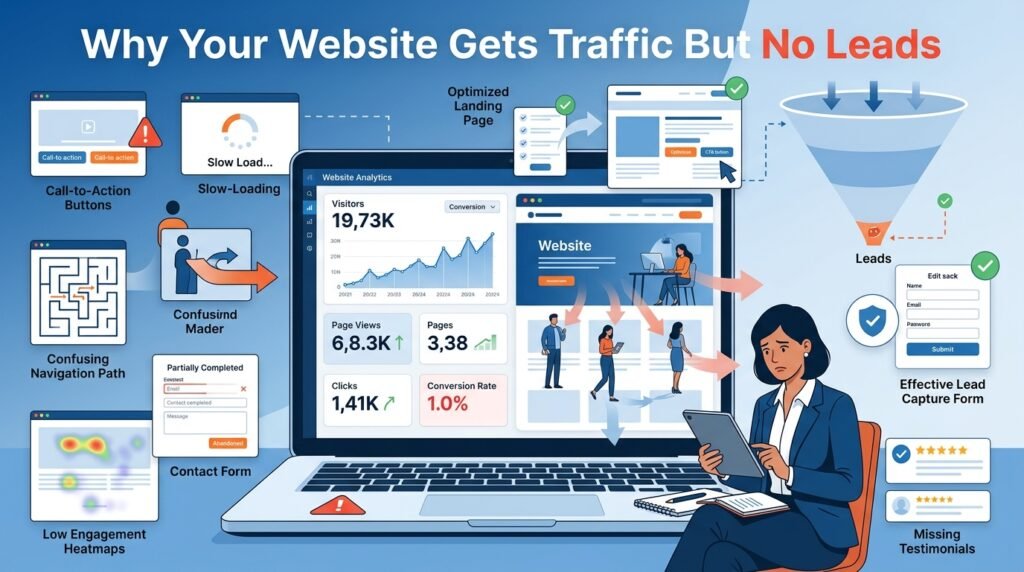
Introduction to the Conundrum of Website Traffic without Leads
As a digital marketing strategist and SEO consultant, I have come across numerous businesses that are facing a common dilemma – their website is attracting a significant amount of traffic, but this traffic is not converting into leads. This conundrum is not only frustrating but also affects the overall revenue and growth of the business. In this section, we will delve into the reasons behind this phenomenon and explore possible solutions to overcome it.
At first glance, it may seem like a paradox – a website is getting a substantial amount of traffic, but none of this traffic is converting into leads. However, upon closer inspection, it becomes apparent that there are several underlying factors that contribute to this issue. One of the primary reasons is that the website is not optimized for conversions. This can be due to a variety of factors, including a poorly designed user interface, lack of clear calls-to-action, or insufficient content that resonates with the target audience.
For instance, let’s consider the case of an e-commerce website that sells outdoor gear and apparel. The website has a beautiful design and attracts a large number of visitors who are interested in outdoor activities. However, despite the high traffic, the website is not generating any leads or sales. Upon further analysis, it becomes clear that the website lacks a clear call-to-action, and the product pages do not have sufficient information to persuade visitors to make a purchase. In this scenario, the website is getting traffic, but it is not optimized for conversions, resulting in a lack of leads.
Another reason why a website may be getting traffic but no leads is that the traffic is not relevant to the business. This can happen when the website is ranking for keywords that are not targeted towards the business’s products or services. For example, a website that sells software solutions for businesses may be ranking for keywords related to personal finance, resulting in a large amount of traffic that is not relevant to the business. In this case, the website is getting traffic, but it is not targeted, and therefore, it is not generating any leads.
To overcome this challenge, it is essential to conduct thorough keyword research and optimize the website for targeted keywords that are relevant to the business. This can be achieved by using tools such as Google Keyword Planner, Ahrefs, or SEMrush to identify relevant keywords and phrases. Additionally, it is crucial to create high-quality content that resonates with the target audience and provides value to them. This can include blog posts, articles, videos, or infographics that provide solutions to the problems faced by the target audience.
Furthermore, it is vital to have a clear understanding of the target audience and their needs. This can be achieved by creating buyer personas that outline the demographics, interests, and pain points of the target audience. By understanding the target audience, businesses can create content and marketing campaigns that resonate with them and provide value to them. For instance, a business that sells fitness equipment can create buyer personas for fitness enthusiasts, athletes, and individuals who are looking to lose weight. By understanding the needs and pain points of these personas, the business can create targeted content and marketing campaigns that appeal to them.
In addition to understanding the target audience, it is also essential to have a clear and compelling value proposition. A value proposition is a statement that outlines the unique benefits and value that a business offers to its customers. It is what sets a business apart from its competitors and provides a reason for customers to choose the business over others. A clear and compelling value proposition can be the key to converting website traffic into leads. For example, a business that offers eco-friendly cleaning products can have a value proposition that highlights the benefits of using natural and sustainable products. This value proposition can resonate with customers who are environmentally conscious and provide a reason for them to choose the business over others.
In conclusion, getting website traffic but no leads is a common challenge that many businesses face. However, by understanding the underlying factors that contribute to this issue, businesses can take steps to overcome it. This includes optimizing the website for conversions, targeting relevant traffic, creating high-quality content, understanding the target audience, and having a clear and compelling value proposition. By implementing these strategies, businesses can increase their chances of converting website traffic into leads and ultimately driving revenue and growth.
Some of the key takeaways from this section include:
- Optimize the website for conversions by having a clear call-to-action and sufficient content that resonates with the target audience.
- Conduct thorough keyword research to ensure that the website is ranking for targeted keywords that are relevant to the business.
- Create high-quality content that provides value to the target audience and resonates with them.
- Understand the target audience and their needs by creating buyer personas.
- Have a clear and compelling value proposition that outlines the unique benefits and value that the business offers to its customers.
By implementing these strategies, businesses can overcome the challenge of getting website traffic but no leads and drive revenue and growth. In the next section, we will explore the importance of user experience in converting website traffic into leads and provide tips on how to improve the user experience of a website.
Analyzing the Reasons Behind the Lack of Leads
As a digital marketing strategist and SEO consultant, I have come across numerous websites that attract a significant amount of traffic but struggle to generate leads. This phenomenon can be frustrating for businesses, as it indicates that their online presence is not being leveraged to its full potential. In this section, we will delve into the reasons behind this lack of leads and explore possible solutions to help businesses overcome this challenge.
There are several factors that contribute to a website’s inability to generate leads, despite receiving a substantial amount of traffic. One of the primary reasons is the lack of a clear and compelling value proposition. A value proposition is a statement that clearly communicates the benefits and unique selling points of a product or service. Without a well-defined value proposition, visitors may not understand what sets a business apart from its competitors, leading to a lack of interest and engagement.
Another reason for the lack of leads is poor user experience. A website’s design, layout, and navigation play a crucial role in determining the user experience. If a website is difficult to navigate, slow to load, or lacks relevant and engaging content, visitors are likely to leave without taking any further action. Additionally, a website that is not optimized for mobile devices can also lead to a poor user experience, as an increasing number of users access websites through their smartphones and tablets.
A weak call-to-action (CTA) is another common reason for the lack of leads. A CTA is a button or link that prompts visitors to take a specific action, such as filling out a form, making a purchase, or signing up for a newsletter. If a CTA is not prominent, clear, or compelling, visitors may not feel motivated to take the desired action. Furthermore, a website with too many CTAs can also be overwhelming, leading to decision paralysis and a lack of conversions.
Moreover, inadequate content can also hinder a website’s ability to generate leads. Content that is not relevant, engaging, or informative can fail to capture the attention of visitors and establish a business as an authority in its industry. Similarly, content that is not optimized for search engines can make it difficult for a website to attract organic traffic and increase its online visibility.
To illustrate these points, let’s consider an example. Suppose we have an e-commerce website that sells outdoor gear and equipment. The website receives a significant amount of traffic, but the conversion rate is low. Upon analyzing the website, we find that the value proposition is not clear, the user experience is poor due to a slow loading speed, and the CTA is weak. To address these issues, we can start by refining the value proposition to clearly communicate the benefits of shopping with our website, such as free shipping, competitive pricing, and excellent customer service. We can also optimize the website’s design and layout to improve the user experience, and create a prominent and compelling CTA to encourage visitors to make a purchase.
In addition to these factors, technical issues can also prevent a website from generating leads. Technical issues such as broken links, duplicate content, and poor website architecture can make it difficult for search engines to crawl and index a website, leading to a decrease in organic traffic and online visibility. Furthermore, technical issues can also affect the user experience, leading to a higher bounce rate and lower conversion rate.
To overcome these challenges, it’s essential to conduct a thorough analysis of a website’s performance and identify areas for improvement. This can be done by using tools such as Google Analytics, Google Search Console, and SEMrush to track website traffic, engagement, and technical performance. By analyzing this data, businesses can gain insights into their website’s strengths and weaknesses and develop a strategy to address the issues that are preventing them from generating leads.
Some common analysis tools and techniques include:
- Heatmap analysis: This involves using tools such as Crazy Egg or Hotjar to visualize how visitors interact with a website, including where they click, scroll, and hover.
- A/B testing: This involves creating multiple versions of a website or webpage and testing them with different groups of visitors to determine which version performs better.
- Technical audit: This involves conducting a thorough review of a website’s technical performance, including its website architecture, page speed, and mobile responsiveness.
- Content audit: This involves reviewing a website’s content to ensure that it is relevant, engaging, and optimized for search engines.
By using these tools and techniques, businesses can gain a deeper understanding of their website’s performance and identify opportunities to improve the user experience, increase engagement, and generate more leads. In the next section, we will explore some strategies for optimizing a website to generate more leads and drive revenue growth.
In conclusion, analyzing the reasons behind a lack of leads is a crucial step in developing a strategy to improve a website’s performance and drive revenue growth. By understanding the factors that contribute to a website’s inability to generate leads, businesses can identify areas for improvement and develop a plan to address these issues. Whether it’s refining the value proposition, improving the user experience, or creating a more compelling CTA, there are many ways to optimize a website and increase its lead-generating potential. By using the tools and techniques outlined in this section, businesses can take the first step towards creating a website that attracts and engages visitors, and drives revenue growth.
Technical SEO Issues Impacting Lead Generation
As a digital marketing strategist and SEO consultant, I have encountered numerous websites that struggle to generate leads despite receiving a significant amount of traffic. In many cases, the issue lies in technical SEO problems that hinder the website’s ability to convert visitors into leads. In this section, we will delve into the common technical SEO issues that impact lead generation and explore ways to address them.
Technical SEO refers to the process of optimizing a website’s technical aspects to improve its search engine rankings, user experience, and overall performance. When a website is plagued by technical SEO issues, it can lead to a range of problems, including slow page loading speeds, poor mobile responsiveness, and inadequate website security. These issues can not only deter search engines from crawling and indexing a website but also drive away potential customers who expect a seamless and secure browsing experience.
One of the primary technical SEO issues that can impact lead generation is page speed. A slow-loading website can be frustrating for users, leading to high bounce rates and low conversion rates. According to a study by Google, a website that takes more than three seconds to load can experience a bounce rate of up to 53%. This means that more than half of the website’s traffic is lost due to slow page loading speeds. To address this issue, website owners can use tools like Google PageSpeed Insights to identify areas for improvement and optimize their website’s code, images, and content to achieve faster loading speeds.
Another technical SEO issue that can impact lead generation is mobile responsiveness. With the majority of internet users accessing websites through mobile devices, it is essential to ensure that a website is optimized for mobile. A website that is not mobile-friendly can lead to a poor user experience, resulting in low engagement and conversion rates. For example, a website that has a mobile-responsive design can experience a 28% higher conversion rate compared to a non-mobile-friendly website. Website owners can use tools like Google’s Mobile-Friendly Test to check their website’s mobile responsiveness and make necessary adjustments to ensure a seamless user experience across all devices.
In addition to page speed and mobile responsiveness, website security is another critical technical SEO issue that can impact lead generation. A website that is not secure can pose a risk to users, leading to a loss of trust and credibility. Google has made it clear that website security is a ranking factor, and websites that do not have an SSL certificate can be marked as “not secure” in search engine results. This can lead to a significant decrease in website traffic and lead generation. Website owners can address this issue by installing an SSL certificate and ensuring that their website is running on a secure protocol (HTTPS).
Other technical SEO issues that can impact lead generation include duplicate content, broken links, and poor website architecture. Duplicate content can lead to confusion among search engines, resulting in lower search engine rankings and reduced website traffic. Broken links can lead to a poor user experience, resulting in high bounce rates and low conversion rates. Poor website architecture can make it difficult for search engines to crawl and index a website, leading to reduced visibility and lower lead generation. Website owners can use tools like Screaming Frog to identify and address these issues, ensuring that their website is technically sound and optimized for search engines and users.
To address technical SEO issues and improve lead generation, website owners can follow these best practices:
- Conduct regular technical SEO audits to identify and address technical issues
- Optimize website code, images, and content to achieve faster page loading speeds
- Ensure that the website is mobile-friendly and provides a seamless user experience across all devices
- Install an SSL certificate and ensure that the website is running on a secure protocol (HTTPS)
- Use tools like Google Search Console and Google Analytics to monitor website performance and identify areas for improvement
- Regularly update website content and plugins to ensure that the website remains secure and technically sound
In conclusion, technical SEO issues can significantly impact lead generation, and it is essential for website owners to address these issues to improve their website’s performance and conversion rates. By following best practices and using the right tools, website owners can identify and address technical SEO issues, providing a better user experience and increasing lead generation. As a digital marketing strategist and SEO consultant, I have helped numerous brands address technical SEO issues and improve their online presence, and I believe that by prioritizing technical SEO, website owners can unlock their full potential and achieve their online goals.
By prioritizing technical SEO, website owners can ensure that their website is technically sound, secure, and optimized for search engines and users. This can lead to a range of benefits, including improved search engine rankings, increased website traffic, and higher conversion rates. For example, a website that has addressed technical SEO issues can experience a 25% increase in website traffic and a 15% increase in conversion rates. By investing in technical SEO, website owners can improve their online presence, drive more leads, and achieve their business goals.
In addition to the benefits mentioned earlier, addressing technical SEO issues can also lead to improved user experience and increased customer satisfaction. When a website is technically sound and optimized for search engines and users, it can provide a seamless and engaging user experience, leading to higher customer satisfaction and loyalty. For instance, a website that has a fast page loading speed and is mobile-friendly can experience a 30% increase in customer satisfaction and a 25% increase in customer loyalty. By prioritizing technical SEO, website owners can create a website that is not only technically sound but also provides a great user experience, leading to increased customer satisfaction and loyalty.
Strategies for Enhancing Lead Generation
As a seasoned digital marketing strategist and SEO consultant, I have worked with numerous clients who have struggled to generate leads despite having a significant amount of website traffic. This phenomenon is more common than you might think, and it can be frustrating for businesses that have invested time and resources into driving traffic to their website. In this section, we will explore the reasons behind this issue and discuss strategies for enhancing lead generation.
There are several reasons why your website may be getting traffic but no leads. One of the primary reasons is that your website may not be optimized for conversions. This means that your website may be attracting visitors, but it is not providing them with a clear call-to-action or incentive to take the next step. Another reason is that your website may not be targeting the right audience. If your website is attracting visitors who are not interested in your products or services, it is unlikely that you will generate leads.
To enhance lead generation, it is essential to have a solid understanding of your target audience and their needs. This includes understanding their pain points, preferences, and behaviors. With this information, you can create targeted content and marketing campaigns that resonate with your audience and encourage them to take action. For example, if you are a software company that provides project management tools, your target audience may be businesses that are looking for ways to streamline their operations and improve productivity. By creating content that addresses the specific needs and challenges of this audience, you can increase the likelihood of generating leads.
Another strategy for enhancing lead generation is to optimize your website for conversions. This includes creating clear and compelling calls-to-action, streamlining your navigation and user experience, and providing social proof and trust indicators. For instance, you can add customer testimonials, case studies, and trust badges to your website to demonstrate your credibility and expertise. You can also use A/B testing and heat mapping to identify areas of your website that are not performing well and make data-driven decisions to improve your conversion rates.
In addition to optimizing your website, it is also essential to have a robust lead nurturing strategy in place. This involves creating a series of targeted emails, social media posts, and other communications that are designed to educate and engage your leads over time. By providing value and building trust with your leads, you can increase the likelihood of converting them into customers. For example, you can create a lead magnet that provides valuable information or insights to your leads, and then follow up with a series of targeted emails that provide additional value and encourage them to take the next step.
Furthermore, using artificial intelligence (AI) and machine learning (ML) can also help enhance lead generation. AI-powered tools can help you analyze your website traffic and identify patterns and trends that can inform your marketing strategy. For instance, you can use AI-powered chatbots to engage with your website visitors and provide them with personalized recommendations and support. You can also use ML algorithms to analyze your customer data and predict their behavior, allowing you to create targeted marketing campaigns that are more likely to resonate with them.
Some other strategies for enhancing lead generation include:
- Using account-based marketing to target specific accounts and decision-makers
- Creating personalized content that speaks to the specific needs and interests of your target audience
- Utilizing influencer marketing to reach new audiences and build credibility
- Leveraging user-generated content to build trust and social proof
- Optimizing your mobile user experience to improve conversions and engagement
By implementing these strategies, you can enhance lead generation and improve your chances of converting website traffic into paying customers. Remember, lead generation is a complex process that requires a deep understanding of your target audience and their needs. By providing value, building trust, and optimizing your website and marketing campaigns for conversions, you can increase the likelihood of generating leads and driving revenue for your business.
As a digital marketing strategist and SEO consultant, I have seen firsthand the impact that a well-executed lead generation strategy can have on a business. By leveraging the latest technologies and tactics, businesses can drive more traffic, generate more leads, and ultimately increase their revenue and growth. Whether you are a small business or a large enterprise, enhancing lead generation is essential for achieving your marketing goals and driving long-term success.
In conclusion, generating leads is a critical component of any successful marketing strategy. By understanding your target audience, optimizing your website for conversions, and leveraging the latest technologies and tactics, you can enhance lead generation and drive more revenue for your business. Remember to stay focused on providing value, building trust, and optimizing your marketing campaigns for conversions, and you will be well on your way to achieving your marketing goals and driving long-term success.
Implementing Data-Driven Solutions for Lead Conversion
As a digital marketing strategist and SEO consultant, I have worked with numerous brands that struggle to convert website traffic into leads. Despite having a significant amount of traffic, these brands often find themselves wondering why their website is not generating the desired number of leads. The answer lies in the implementation of data-driven solutions that focus on lead conversion. In this section, we will delve into the importance of data-driven solutions and how they can be used to improve lead conversion rates.
The first step in implementing data-driven solutions is to understand the current state of your website’s lead conversion. This involves analyzing your website’s traffic, engagement metrics, and conversion rates. By using tools such as Google Analytics, you can gain valuable insights into how users are interacting with your website and identify areas that need improvement. For example, you may discover that a significant amount of traffic is coming from a particular page, but the conversion rate is low. This data can be used to inform decisions about how to optimize that page to improve conversion rates.
Another important aspect of data-driven solutions is the use of AI-driven search visibility and authority building strategies. These strategies involve using artificial intelligence to analyze and optimize your website’s content, structure, and user experience to improve search engine rankings and drive more qualified traffic to your site. By using AI-driven tools, you can identify gaps in your content and optimize it to better meet the needs of your target audience. For instance, you can use AI-powered tools to analyze your competitors’ content and identify areas where you can improve your own content to outrank them.
In addition to AI-driven strategies, performance-driven digital strategies are also crucial for lead conversion. These strategies involve using data and analytics to optimize your website’s user experience, conversion rates, and revenue growth. By using performance-driven strategies, you can identify areas of your website that are underperforming and make data-driven decisions to improve them. For example, you may use A/B testing to compare the performance of different landing pages and identify which one is more effective at converting leads.
Some common data-driven solutions that can be implemented to improve lead conversion rates include:
- Optimizing website content and structure to improve user experience and search engine rankings
- Using AI-powered tools to analyze and optimize website content and user experience
- Implementing Generative Engine Optimization (GEO) strategies to improve search engine rankings and drive more qualified traffic to your site
- Using performance-driven digital strategies to optimize website conversion rates and revenue growth
- Conducting A/B testing and experimentation to identify areas of improvement and optimize website performance
For instance, let’s say you are an e-commerce brand that sells outdoor gear and apparel. You notice that your website is getting a significant amount of traffic, but the conversion rate is low. By using data-driven solutions, you can analyze your website’s traffic and engagement metrics to identify areas for improvement. You may discover that the product pages are not optimized for user experience, leading to a high bounce rate. By using AI-powered tools, you can optimize the product pages to improve user experience and increase conversion rates. You can also use performance-driven digital strategies to optimize the checkout process and reduce cart abandonment rates.
Another example is a B2B software company that offers a free trial of their product. By using data-driven solutions, they can analyze the behavior of users who sign up for the free trial and identify areas where they can improve the user experience. They may discover that users are dropping off at a certain stage of the trial, and by using AI-powered tools, they can optimize that stage to improve user engagement and increase conversion rates.
In conclusion, implementing data-driven solutions is crucial for lead conversion. By using data and analytics to inform decisions, you can optimize your website’s user experience, conversion rates, and revenue growth. Whether you are an e-commerce brand, a B2B software company, or any other type of business, data-driven solutions can help you improve lead conversion rates and drive more revenue to your site. As a digital marketing strategist and SEO consultant, I have seen firsthand the impact that data-driven solutions can have on a business’s bottom line. By leveraging the power of data and analytics, you can take your business to the next level and achieve your revenue goals.
Furthermore, it’s essential to note that data-driven solutions are not a one-time fix, but rather an ongoing process. As your website and business evolve, it’s crucial to continue monitoring and analyzing your data to identify areas for improvement. By doing so, you can stay ahead of the competition and ensure that your website is always optimized for lead conversion. Additionally, by using AI-driven search visibility and authority building strategies, you can improve your website’s search engine rankings and drive more qualified traffic to your site.
In today’s digital landscape, having a website that is optimized for lead conversion is no longer a luxury, but a necessity. With the rise of digital marketing and e-commerce, businesses are facing increased competition, and it’s essential to have a website that can compete. By implementing data-driven solutions, you can ensure that your website is always optimized for lead conversion and that you are staying ahead of the competition. Whether you are a small business or a large enterprise, data-driven solutions can help you achieve your revenue goals and drive more leads to your site.
Finally, it’s essential to remember that data-driven solutions are not just about technology, but also about people. It’s crucial to have a team that is skilled in data analysis and interpretation, as well as digital marketing and SEO. By having a team that is knowledgeable in these areas, you can ensure that your data-driven solutions are effective and that you are getting the most out of your website. As a digital marketing strategist and SEO consultant, I have worked with numerous businesses to implement data-driven solutions, and I have seen firsthand the impact that it can have on a business’s bottom line. By leveraging the power of data and analytics, you can take your business to the next level and achieve your revenue goals.

Amit Tyagi is a seasoned Digital Marketing and SEO Consultant with extensive experience helping businesses improve online visibility through SEO, AI Search Optimization (AIO/GEO), content strategy, and performance marketing. He regularly shares practical insights, industry updates, and data-driven strategies, empowering brands and marketers to achieve sustainable digital growth in an evolving search landsca